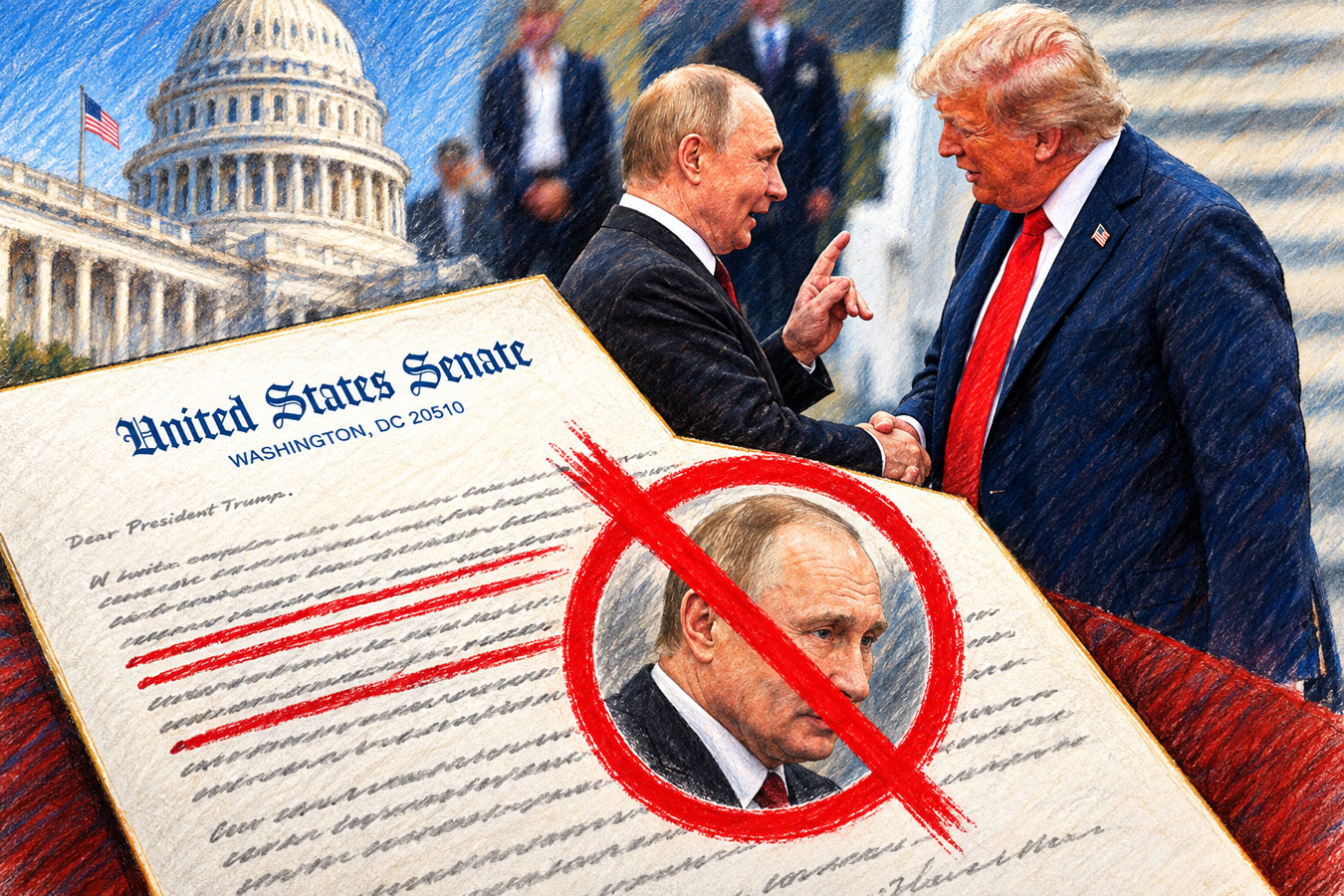
In Washington, Republicans and Democrats issued a joint appeal to the President of the United States. They demand not to allow Putin to attend the December G20 summit in Miami and directly link this issue to the Russian war against Ukraine and military support for Iran. For Israel, there is a separate aspect in this story: Moscow’s alleged assistance to Tehran is now featured in the official appeal of American lawmakers as an argument against diplomatic rapprochement with the Kremlin.
Author: Anton Pshedynsky
Seven Republicans and seven Democrats. Why they appealed to Trump
On September 25, 2026, the U.S. Senate Committee on Foreign Relations published an appeal from fourteen senators to President Donald Trump. The authors of the letter demanded a review of the invitation to Vladimir Putin to the G20 summit, which is to be held on December 14-15 in Miami, Florida.
The initiators of the appeal were two representatives from different parties: Jeanne Shaheen, a senator from the Democratic Party elected from New Hampshire and representing the Democratic minority in the Senate Foreign Relations Committee, and Roger Wicker, a Republican from Mississippi, chairman of the Senate Armed Services Committee.
They were joined by twelve more senators.
From the Republican Party, the letter was signed by Mitch McConnell (Kentucky), John Cornyn (Texas), Jerry Moran (Kansas), Thom Tillis (North Carolina), John Curtis (Utah), and Alan Armstrong (Oklahoma).
From the Democratic Party — Sheldon Whitehouse (Rhode Island), Michael Bennet (Colorado), Chris Coons (Delaware), Richard Blumenthal (Connecticut), Tim Kaine (Virginia), and Ruben Gallego (Arizona).
There is one peculiarity: unlike the other signatories, Alan Armstrong was not elected by the voters of his state. On March 24, 2026, Oklahoma Governor Kevin Stitt appointed him as a temporary senator in place of Markwayne Mullin, who moved to the position of U.S. Secretary of Homeland Security. Armstrong represents the Republican Party and holds the position until the end of the current term in January 2027.
Thus, the appeal bears the signatures of seven Democrats and seven Republicans representing fourteen different American states. Among the Republican signatories is former party leader in the Senate Mitch McConnell and current chairman of the Armed Services Committee Roger Wicker.
For understanding the American political system: senators are elected by the population of their entire state, not a separate electoral district, like members of the House of Representatives. One state is represented in the Senate by two legislators.
There are exactly equal representatives of both parties. This is significant for understanding the political context: the document cannot be considered solely an initiative of the Democratic opposition to Trump. Among its authors are influential Republicans, including the head of the committee directly dealing with American defense issues.
The letter states that allowing the Russian president to participate in the summit on U.S. territory raises serious questions against the backdrop of ongoing Russian strikes on Ukrainian civilian targets.
However, the war in Ukraine is not the only argument. The senators specifically point to reports that Russia is helping Iranian military forces identify targets for strikes on American troops in the Middle East.
Original appeal — U.S. Senate Committee on Foreign Relations.
Why Iran unexpectedly appeared in the letter about Putin
For the Israeli audience, this part of the American document is of particular interest.
The senators did not limit themselves to describing Russian actions in Ukraine. They linked them to events in the Middle East and reminded of public reports regarding Moscow’s assistance to Iranian armed forces.
The story began long before the current appeal.
On March 6, The Washington Post published an investigation based on information from three American officials familiar with intelligence data. According to the publication, Russia provided Iran with information about the location of American military facilities, ships, and aircraft in the region.
It was not about supplying conventional weapons, but about information that could potentially be used in selecting targets and preparing strikes.
The Russian side did not confirm the information about the transfer of intelligence data at that time. Kremlin spokesman Dmitry Peskov refused to comment on the American intelligence information.
Later, other reports emerged about Russian-Iranian cooperation, including the alleged transfer of satellite images, drone technologies, and technical support.
It is important to distinguish the degree of confirmation. The senators’ letter itself does not contain new declassified intelligence documents. The lawmakers refer to previously published reports, and Moscow’s specific involvement in certain Iranian strikes remains the subject of investigations.
But now this information is used not only in journalistic investigations. It is included in the official argumentation of American parliamentarians addressed directly to the President of the United States.
NANews previously detailed this story in the article “How Russian Frontline Experience Now Works Against Israel”.
From Ukrainian Shaheds to American facilities in the Middle East
To understand the Israeli component of the current appeal, it is worth returning to 2022.
After the full-scale Russian invasion of Ukraine, Iran became one of the suppliers of drone technologies for the Russian army. Iranian Shaheds, designated as “Geran” in Russia, gradually became one of the main tools for massive attacks on Ukrainian cities and energy infrastructure.
Initially, it was about transferring ready-made devices. Later, Russia established its own production and began modifying the drones’ design based on accumulated combat experience.
On January 17, 2025, Moscow and Tehran signed a comprehensive strategic partnership agreement. The document provides for the interaction of intelligence services, information exchange, military training, and the development of military-technical cooperation.
This is not an agreement on automatic mutual military protection. But it created an official basis for further interaction between the two states.
In the spring and summer of 2026, reports emerged that military cooperation was developing in the opposite direction as well. According to Western journalists and intelligence sources, Moscow began helping Tehran with technologies and information of direct value in confronting the U.S. and Israel.
NANews — Israel News | Nikk.Agency thoroughly explored this interconnection in the article “Iran and Russia: How the War in Ukraine Became a Testing Ground for Future War Against Israel and the U.S.”.
There is also a material aspect to the interaction. In August, NBC News reported on Russian military supplies to Iran via the Caspian Sea. Among the mentioned cargoes were drone components, ammunition, and TNT — trinitrotoluene, an explosive used in the manufacture of ammunition.
More details — in our investigation “Russia Supplies Weapons to Iran via the Caspian: TNT, Ammunition, and Drone Parts”.
It is this connection of two directions that now appeared in the Senate letter. Lawmakers consider Russian strikes on Ukraine and reports of assistance to Iranian military forces in the context of the overall security interests of the U.S.
In Miami, they have already started inviting Russian officials. Senators are also dissatisfied with this
The current appeal has its own backstory, and it is quite specific.
American lawmakers remind Trump of several G20 events where official representatives of Moscow were already present.
In Asheville, North Carolina, the Russian delegation at the financial meeting was headed by Finance Minister Anton Siluanov. Russian representatives also participated in the innovation meeting in Chapel Hill and the energy event in Houston.
All three cities are in the U.S. Therefore, for the authors of the letter, the question is not only about Russia’s presence at international negotiations but also about allowing Russian officials under American sanctions directly onto the country’s territory.
Senators remind that Putin and Siluanov fall under restrictions imposed in accordance with Executive Order No. 14024. This sanction mechanism is applied by Washington in connection with actions of the Russian leadership affecting American interests and security.
As early as April 3, American lawmakers raised the issue of allowing sanctioned deputies of the Russian State Duma into the U.S.
Now the dispute has moved to the level of inviting the Russian president himself.
However, sanctions should not be automatically interpreted as an unconditional ban on any diplomatic meeting. There are special legal procedures and exceptions for official international events. Senators primarily challenge the political decision of the administration to provide such an opportunity to Russian representatives.
In the concluding part of the letter, they demand to withdraw the invitation to Putin and limit the participation of other sanctioned Russian officials in upcoming G20 meetings.
What the Trump administration responds and why the invitation appeared at all
On September 23, 2026, two days before the publication of the Senate appeal, U.S. Secretary of State Marco Rubio confirmed that Washington invited Putin to the December summit.
The statement was made in New York after Rubio’s meeting with Russian Foreign Minister Sergey Lavrov on the sidelines of the UN General Assembly.
Rubio explained the administration’s position by the need to maintain contacts even with those state leaders with whom the U.S. has serious disagreements. According to him, participation in the G20 would provide Putin with the opportunity to communicate not only with Trump but also with other world leaders.
This is fundamentally different logic than that outlined in the Senate letter. The White House views the invitation as a possible diplomatic tool, while the lawmakers who signed the appeal point to the risk of political normalization of relations with the Russian leadership before the end of the war.
As of September 26, there is no public confirmation of Putin’s agreement to come to Miami.
Here arises the Ukrainian question.
On September 12, Volodymyr Zelensky announced his readiness to personally meet with the Russian president at the American summit. However, Ukraine itself is not part of the G20, and the participation of its leader requires a separate invitation from the host country.
NANews has already analyzed this situation in the publication “Zelensky Invites Putin to Miami: G20 Could Be the First Personal Meeting Since 2019”.
Now, to the uncertainty regarding the possible meeting of the presidents of Ukraine and Russia, there is added open disagreement from part of the American Senate with the very invitation of the Russian leader.
What has changed for Ukraine and Israel
For Kyiv, the appeal means that within the American political establishment, there remains a bipartisan group of lawmakers advocating for continued pressure on Russia. However, their position is not identical to the decision of the entire Senate and does not obligate the president to automatically cancel the invitation.
For Israel, the significance of the document is somewhat different.
Russian-Iranian military interaction now appears in the American political debate not as an additional regional problem but as one of the arguments related to Washington-Moscow relations.
Such consideration creates a new diplomatic framework: Russia’s actions are evaluated by American senators simultaneously through the war against Ukraine and through reports of support for Iranian military operations against American forces in the Middle East.
These processes also have a practical dimension. Israeli and American air defense systems face the development of drone technologies, and Ukraine has accumulated years of experience countering their mass use. The exchange of weapons, production technologies, and intelligence information between Moscow and Tehran affects the security interests of both countries.
But the current letter itself does not mean the introduction of new sanctions, a revision of American policy towards Israel, or the cancellation of Russia’s participation in the G20.
The December summit now depends not only on the Kremlin
As of today, three open questions remain: will the Trump administration keep the invitation, will the Russian president agree to come to the U.S., and will the idea of a personal meeting between Zelensky and Putin develop.
The authors of the Senate appeal propose linking the participation of the Russian leadership in international events with achieving peace in Ukraine. The Trump administration, on the contrary, publicly explains the invitation as an opportunity for direct negotiations.
The summit in Miami is scheduled for December 14-15. There are still almost three months to go, and new diplomatic decisions may emerge during this period.
However, the letter published on September 25 has already recorded an important detail: when discussing Russia’s place at the international negotiating table, American lawmakers separately raise the issue of its alleged military assistance to Iran.
In this story, Ukraine and the Middle East are not two independent topics of American foreign policy but parts of one document addressed to the President of the United States.