
On Tuesday, September 29, 2026, a memorial event will be held at Yad Vashem in Jerusalem to mark the 85th anniversary of the mass killings at Babi Yar. According to Yad Vashem’s own wording, it is dedicated to the memory of the Jewish community of Ukraine who perished during the Holocaust. On the official event page, the time is set at 12:00, gathering and light refreshments will begin at 12:15, and the main program will start at 13:00 in the Edmund J. Safra Lecture Hall.
Author: R.Verter
The event will be held in Hebrew. However, the organizers have specifically noted a detail significant for many immigrants from Ukraine and the former USSR in Israel: headphones with simultaneous translation will be provided to those who wish. This is not just a technical note at the end of the program — the audience for such memory in Israel has long been multilingual.
The program names the chairman of Yad Vashem Danny Dayan, Natan Sharansky — chairman of the Babi Yar Center Supervisory Board, Ukraine’s ambassador to Israel Yevgen Korniychuk, and acting chairwoman of the Association of Immigrants from Ukraine in Israel Larisa Levkovskaya.
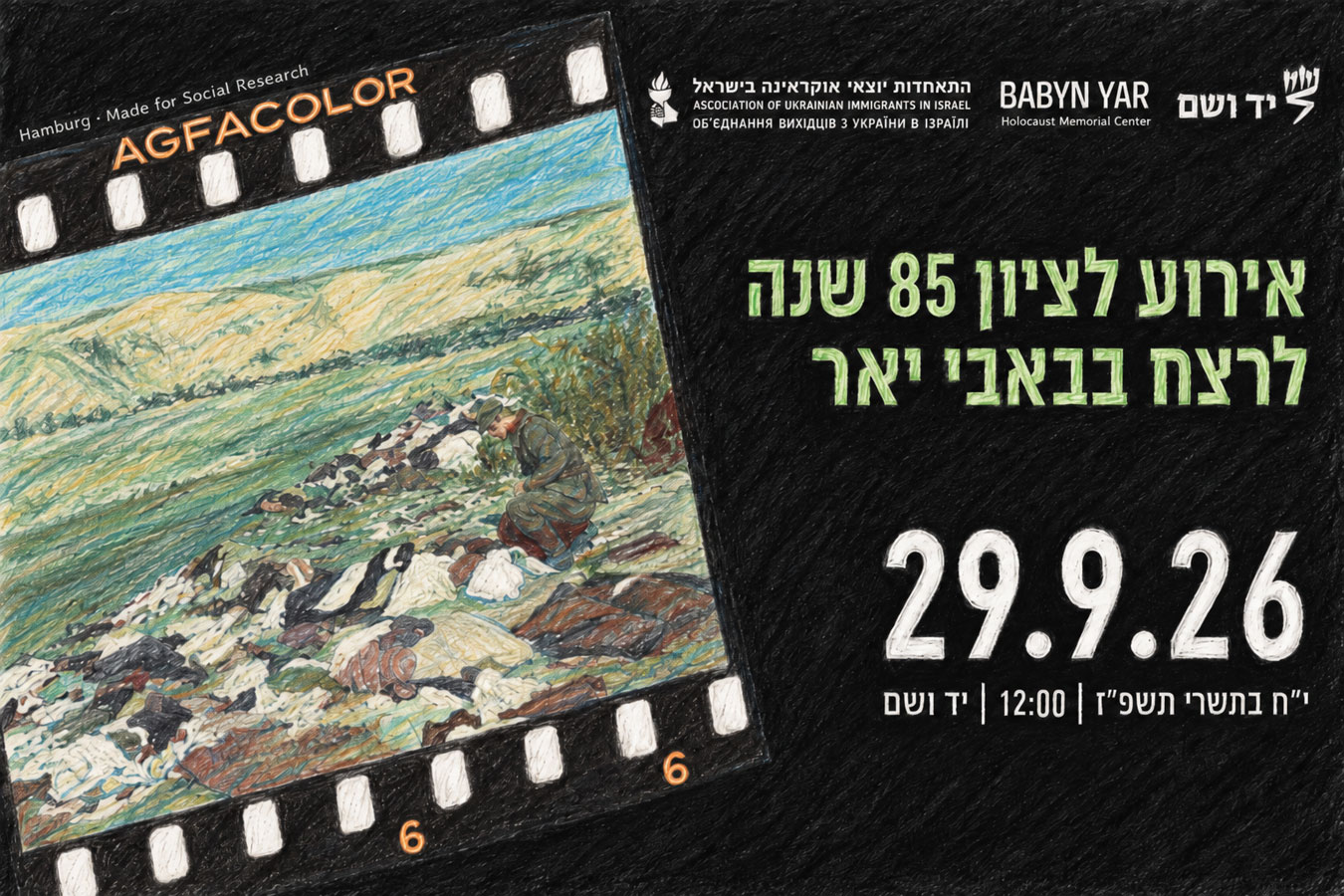
There will also be a separate research part. Masha Pollak Rosenberg from the Yad Vashem International Institute for Holocaust Research will give a lecture on the reaction of the surrounding people to the extermination of Kyiv’s Jews in the fall of 1941. In the foyer of the Safra Hall, an installation “Traces of Absence” — עקבות של היעדר will be set up. The program is led by Orly Nir from Yad Vashem, and the musical part will be performed by violinist Sanya Kreuter.
Why exactly September 29
This is one of those cases where the date explains almost everything.
German troops occupied Kyiv on September 19, 1941. Before the war, about 160,000 Jews lived in the city — about one-fifth of the population. About 100,000 managed to leave Kyiv before the occupation, the rest stayed: primarily women, children, the elderly, the sick, those who could not leave or did not imagine what would happen next until the last moment. These figures are provided by the United States Holocaust Memorial Museum in its chronology of the occupation of Kyiv.
On September 28, announcements were posted around Kyiv. Jews were ordered to appear at a specific place the next morning with documents, money, valuables, and warm clothing. Those who did not comply with the order were threatened with execution. The set of items more closely resembled preparation for relocation or deportation — this also helped gather people. This order and the course of events are described in detail in Yad Vashem’s materials on the Jewish community of Kyiv and Babi Yar.
On September 29, columns were led to the Babi Yar ravine, which was then outside the city development. People were forced to undress, then taken in small groups to the execution site. The killings were carried out by German SS and police units, Einsatzgruppe C, and auxiliary forces. USHMM in a separate material on Kyiv and Babi Yar describes the mechanism of this operation in detail.
On September 29 and 30, 33,771 Jews were killed. This is not a modern approximate estimate and not a figure that appeared decades later: the number is recorded in the reports of the Einsatzgruppen themselves. Yad Vashem also draws attention to the Jewish calendar connection — the mass murder took place on the eve of Yom Kippur. For the Israeli reader, this detail does not require a long explanation: the people of Kyiv were killed precisely on the days when Jewish tradition enters the most severe and personal part of the year.
Babi Yar is not just two September days
After September 30, the shootings did not stop. Babi Yar continued to be used as a place of killings almost until Kyiv returned to Soviet control. Other Jews found later, Soviet prisoners of war, Roma, Ukrainian citizens, and people from other persecuted categories were killed there. According to the United States Holocaust Memorial Museum, about 100,000 people could have been killed in Babi Yar in total.
But there is a fundamental boundary here that is sometimes blurred by retelling. The victims of Babi Yar were different, but the action of September 29–30, 1941, was a targeted mass extermination of Kyiv’s Jews. Mixing these 33,771 people into the overall number of all the dead means losing the meaning of what happened on those two days again.
NANews — News of Israel | Nikk.Agency
For an Israeli, Babi Yar sometimes remains a name from school Holocaust history: Kyiv, ravine, shootings. But before September 1941, behind this future site of mass murder, there was a completely different Kyiv — with one of the largest Jewish communities in the region, families, schools, doctors, musicians, craftsmen, engineers. In two days, they destroyed not an abstract group of the population. A huge part of a specific urban world disappeared.
Hence the wording of the current invitation from Yad Vashem. The organizers speak not only about the anniversary of Babi Yar but also about the memory of the Jews of Ukraine who perished in the Holocaust. Babi Yar here becomes an entry point into a much broader history.
After the murder, another struggle began — over how to talk about it
The Soviet authorities did not hide that the Nazis committed mass murders at Babi Yar. And yet, the Jewish identity of the main victims of the September action was dissolved for decades in a more general formula about the “Soviet citizens” who perished.
Therefore, the history of Babi Yar after the war is also not quite a history of monuments. It is the history of who was allowed to call the dead Jews and who could get into trouble for such a reminder.
In September 1966, on the 25th anniversary of the shootings, the first civil memory actions took place in Kyiv. At first, dozens of people came, then hundreds. Among the participants were Viktor Nekrasov, Ivan Dziuba, and Babi Yar survivor Dina Pronicheva. The Soviet authorities watched what was happening, and the combination of Jewish and Ukrainian independent memory was perceived by the authorities with obvious suspicion.
NANews has thoroughly reconstructed this history — with two September gatherings, surviving film footage, KGB reaction, and people who came there when official memory still preferred to speak in other words — in the article “The Shameful Gathering of Jewish and Ukrainian Nationalists”: How the First Rally at Babi Yar Took Place in 1966.
For the Israeli audience, there is another understandable nerve here. After the Holocaust, the question “who exactly was killed?” is not at all a bureaucratic quibble over the wording of a memorial plaque. When a Jew is killed because he is a Jew, and then in the official version, the word “Jew” itself disappears, memory changes a second time — already after the person’s death.
Kuznetsov wrote about the same Kyiv from the inside
There is another line that connects the current ceremony with what is happening in Ukraine today.
In September 2026, a new Ukrainian edition of Anatoly Kuznetsov’s documentary novel “Babi Yar” appeared in Kyiv. Kuznetsov was a child during the occupation and lived nearby. Later, he collected testimonies, recorded what he heard and saw, but the first Soviet publication of his book in 1966 came out after serious censorship interference. The full text was later taken out of the USSR by the author.
NANews has already explained why the history of the book itself became a continuation of the debate about memory: first, a person saw what was happening with his own eyes, then tried to record it, then the state decided which parts of what was seen to show to the reader and which to better remove. More details are in our article on the new Ukrainian edition of “Babi Yar” by Anatoly Kuznetsov.
It turns out to be a strange, not at all museum-like chronology. 1941 — murders. 1966 — Kuznetsov and the first public gatherings at Babi Yar. 1991 — already in independent Ukraine, a menorah appears in memory of the murdered Jews. In 2026, the book is published again in Ukrainian, and in Jerusalem, Yad Vashem gathers people for the 85th anniversary.
Israel and Ukraine meet here not at the level of diplomatic protocol
The presence of the Ukrainian ambassador at the ceremony is understandable. The participation of representatives of immigrants from Ukraine in Israel is also understandable. But if you leave the material only at the level of “representatives of two countries honored the memory,” it will turn into a standard protocol news item, and the reason why this topic resonates here will disappear.
In Israel, there is a large and Ukrainian-speaking community that came from Kyiv, Odessa, Kharkiv, Dnipro, Chernivtsi, and dozens of smaller cities. For some of these families, the Holocaust on the territory of Ukraine is not a foreign story and not even just a national history of Israel. These are the places where parents, grandparents came from; sometimes the place where the family branch simply breaks off.
Separately, this is why Yad Vashem’s decision to provide simultaneous Russian translation is read. The ceremony is conducted in Hebrew — the natural language of the Israeli state space. But the ability to listen in another language allows even those elderly Israelis for whom that language remained the language of the family story about the war and the Holocaust to attend.
The Ukrainian side here is also not limited to the presence of the ambassador. After the collapse of the USSR, Ukraine received, along with the territory, a complex legacy of memory: Jewish sites of mass murder, Soviet forms of their memorialization, untold stories of collaboration with the occupiers, and at the same time stories of saving Jews. You have to work with all of this at once, not just choose the convenient half.
Against this background, a political substitution of the past with today’s dispute appears especially easily. NANews has already analyzed the story of the alleged “cleansing” of the Yad Vashem exhibition related to Ukrainians: the basis for loud publications was, in particular, a frame from a 2003 feature film, passed off as a museum photograph. Details are in our analysis of the fake around the Yad Vashem exhibition.
This is a good example of why Babi Yar requires not loud generalizations, but sometimes boring accuracy — dates, documents, surnames, the origin of the photograph. Otherwise, the event of 1941 is very quickly turned into an argument for a conversation that is actually about 2026.
What Masha Pollak Rosenberg will talk about
The title of the lecture in the Yad Vashem program brings out another level: the reaction of the surrounding people to the extermination of Kyiv’s Jews.
For the Holocaust, this is one of the most difficult questions because between the killer and the victim, there was almost always an environment. Neighbors saw disappearing families, someone understood where the column was going, someone took the remaining property, someone informed, someone hid a person with them. There were also those who risked their own lives and the lives of their families to save Jews.
The desire to get one answer immediately about the whole city or the whole people works poorly here. People’s behavior was different, and research is needed precisely to not replace a document with a slogan — neither accusatory nor exculpatory.
Perhaps that is why the title of the installation “Traces of Absence” hits the topic more accurately than long speeches. After a mass murder, not only a grave remains. There remains an empty apartment, a place at a school desk, a surname that no one can continue, a neighbor who is suddenly gone. After 85 years, this absence can still be seen if you know where to look.
If you want to come
The event will take place on Tuesday, September 29, 2026, in the Edmund J. Safra Lecture Hall at Yad Vashem, Jerusalem. The event card indicates 12:00, according to the detailed program at 12:15 gathering and light refreshments begin, and at 13:00 — the main part.
The working language is Hebrew. Simultaneous translation through headphones is provided for those who wish. Yad Vashem publishes the current program and participation details on the official page of the event for the 85th anniversary of Babi Yar.
On September 29, in the Yad Vashem hall, they will talk about an event for which an almost frighteningly accurate figure has been preserved: 33,771 Jews killed in two days. But the meaning of the current meeting is precisely that the figure does not remain just a figure.
Between Kyiv in September 1941 and Jerusalem in September 2026, 85 years have passed. The debate about memory during this time has changed languages, countries, and political systems. And the simple question remains the same: can we name the murdered as who they were, preserve the documents, and not let another convenient version of history replace the people.