
“Culture is what allows Ukrainians to feel stability and resilience, it is our point of support in this difficult time,” says Yevhen Kotlyar. He is almost the only researcher in Ukraine studying synagogue murals. When a rocket damaged the stained glass windows of the Kyiv synagogue, it was he who had to restore them.
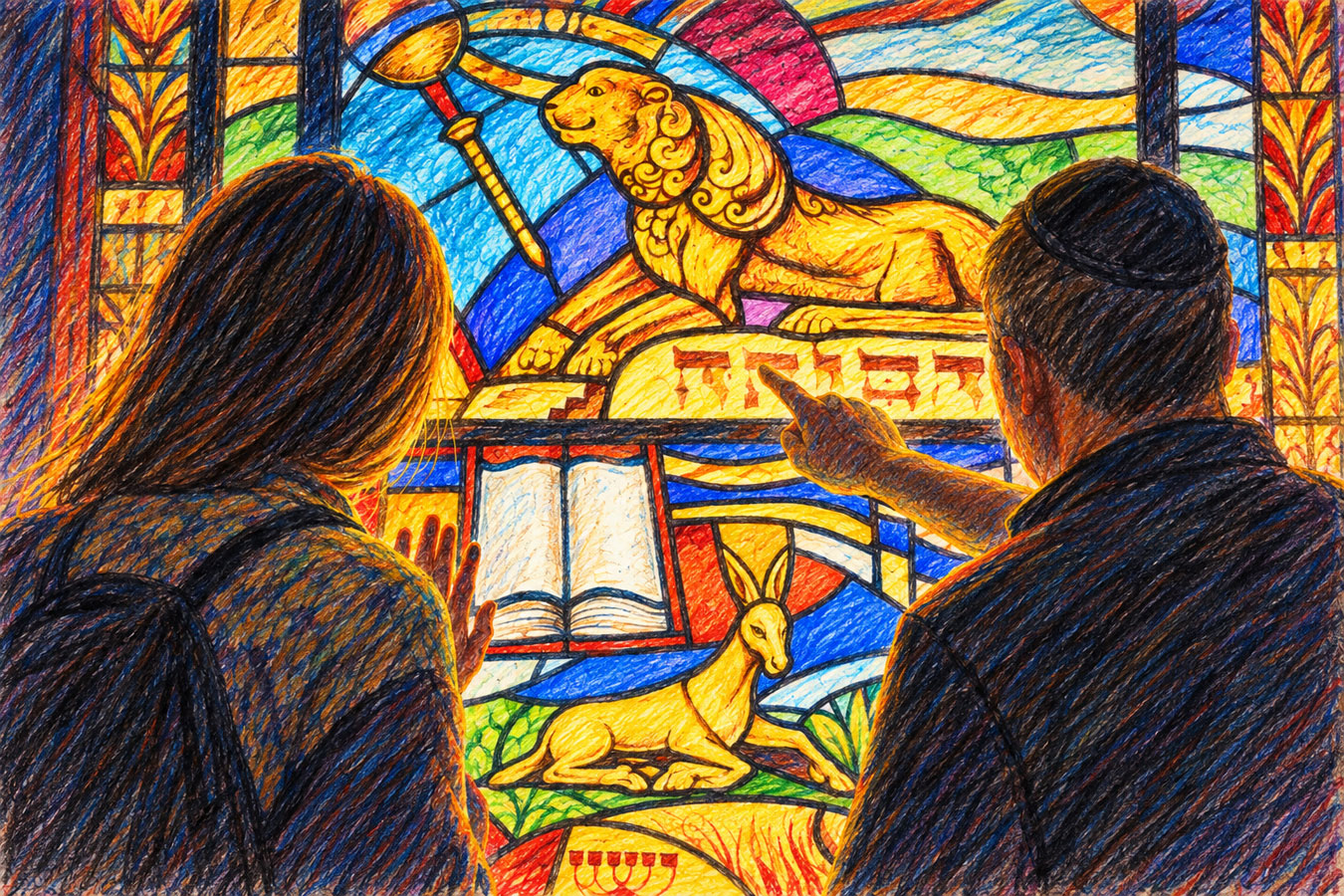
In the Great Choral Synagogue in Podil, Kyiv, stained glass windows damaged during a Russian attack are being restored. The work was undertaken by Yevhen Kotlyar, a Kharkiv artist, art historian, and researcher of Jewish heritage, who created these windows more than twenty years ago. They depict the blessing of the Kohanim, Babyn Yar, and the return of Jewish life. Now this story has gained another part, not planned by the author.
Author: R.Verter
On September 14, 2026, Ukraїner published a large article about artist Yevhen Kotlyar and the stained glass windows of the Great Choral Synagogue in Kyiv, and on September 16, they highlighted this story separately on their social networks. The project was prepared in collaboration with UNESCO Ukraine with financial support from the European Union. The Ukraїner material is titled “Light in Motion. Stained Glass of the Synagogue in Kyiv.”
The story there seems to be about an artist and three windows. But if you don’t stop at the windows, it becomes a story of a different scale: Soviet assimilation, a person’s return to their Jewish roots, the destroyed Jewish Kyiv, the revival of the community after the USSR, and a new war during which what has been returned must be saved.
And another coincidence, although the word “coincidence” doesn’t quite fit here. Kotlyar has already restored his apartment three times after Russian attacks. Now he is repairing the synagogue’s stained glass windows.
He first came to the synagogue as an adult
Yevhen Kotlyar was born in Kharkiv in the 1970s. The family was Jewish, but quite typical for the late USSR—assimilated, Soviet in lifestyle, without regular religious practice, although they knew about their origins at home and treated it with respect.
Kotlyar first visited a synagogue in the early 1990s, when religious buildings began to be returned to communities after decades of Soviet bans and seizures. According to his recollections, the feeling was almost physical: as if he had landed on another planet. At that time, he knew little about Jewish religious architecture, but he understood that the walls around him were a place of prayer for people whose connection Soviet life had almost severed.
Later, this became one of the main themes of his work.
Kotlyar became a stained glass artist, art historian, teacher, curator, restorer. He researches synagogue murals, engages in Jewish art in Ukraine. Ukraїner calls him almost the only Ukrainian researcher who systematically works specifically with synagogue murals. Among his projects are “Painted Prayers” and “Ukrainian Shtetl. Return to Places of Power.”
By the way, “shtetl” here is not a beautiful designation for an old town. This word in Yiddish referred to towns and villages in Eastern Europe with a significant Jewish population. Many names that Israelis now encounter in their grandparents’ documents, family books, or Yad Vashem archives were once such vibrant Jewish centers.
And what remains of these places is now actively being tried to at least document. In August, researchers from the Center for Jewish Art at the Hebrew University of Jerusalem traveled through Ukrainian Podolia and surveyed more than 30 historical synagogues. NAnovosti detailed this expedition from Jerusalem. Podolia should not be confused with Kyiv’s Podil: Podolia is a large historical region in southwestern Ukraine, while Podil is an old district of Kyiv itself.
And it is precisely in Podil that the Kyiv part of Kotlyar’s story begins.
The synagogue in Podil became a place for the family
After the start of the full-scale Russian invasion, Kotlyar moved with his family from Kharkiv to Kyiv.
In the capital, the family began attending the Great Choral Synagogue in Podil. For them, it turned into not just a research object or a historical building, but their own community space.
Podil is one of the oldest districts of Kyiv, the lower historical part of the city by the Dnipro. For the history of Kyiv’s Jews, this is also an important place: before the revolution, there was a dense Jewish urban environment with prayer houses, trade, crafts, schools, and charity.
The Great Choral Synagogue itself appeared here at the end of the 19th century. And it arose in a rather unusual way.
The Russian Empire severely restricted the rights of Jews, including the ability to create new prayer buildings. Therefore, the history of the Kyiv synagogue is associated with the community’s attempts to legally circumvent the existing bans—the building was initially designed in such a way as to be able to actually use it for prayer.
This is an important detail. When you look at the old synagogue today as just an architectural monument, it’s easy to lose sight of the question: why did it have to be built this way at all?
The answer is quite simple. Because Jews were not always allowed to build a synagogue normally.
Then the Soviet government came. In 1929, the synagogue was closed. Later it reopened and for decades remained one of the few places of public Jewish religious life in Kyiv.
So today’s functioning synagogue is not a reconstruction of a vanished world. It is a building through which that world somehow continued.
Three stained glass windows. And in them almost the entire history of the community
Kotlyar has three main stained glass plots in the synagogue.
One depicts the hands of the Kohanim during the blessing.
Kohanim are descendants of the ancient Jewish priestly lineage associated with temple service. The gesture with fingers spread in a certain way usually doesn’t need explanation for an Israeli who occasionally visits a synagogue. But for a secular Russian-speaking reader in Ukraine, this image may just look like two raised hands. In Jewish tradition, it has a very specific meaning—a priestly blessing.
A completely different window is dedicated to Babyn Yar.
Babyn Yar is located in Kyiv itself. On September 29 and 30, 1941, German occupation forces and their units shot almost 34,000 Jews there. The killings continued later; the ravine also saw the execution of Roma, Soviet prisoners of war, partisans, and other people.
For Israel, the name “Babyn Yar” has long become one of the symbols of the Holocaust on the territory of the USSR. But for Kyiv, it is also the story of the physical destruction of a huge part of the city’s own residents.
After the war, the Soviet government avoided separate discussions specifically about the Jewish victims of Babyn Yar for decades. In September 1966, people began gathering there independently for the first time. NAnovosti detailed how the first such rally took place and why Soviet documents called it a “shameful gathering of Jewish and Ukrainian nationalists”.
Memory had to be literally returned from below.
Even Anatoly Kuznetsov’s book “Babyn Yar” went through Soviet censorship. In September 2026, a new Ukrainian edition of this documentary book was published in Kyiv; we separately detailed what exactly happened with Kuznetsov’s text and why the full version of the book ended up outside the USSR.
And now the image of Babyn Yar is not in a museum, but in the window of a functioning Kyiv synagogue.
The third stained glass window is about something else: the revival of the Jewish community.
To put it simply, the three works tell one long story: Jewish tradition, destruction, and life after destruction.
Kotlyar created it with glass.
Then a Russian rocket exploded nearby.
“Lord, that’s right across from my stained glass windows”
In October 2025, during a Russian attack on Kyiv, the synagogue was damaged.
The stained glass windows were also affected.
Kotlyar told Ukraїner that when he saw the news about the strike, he immediately thought of his windows. He arrived at the synagogue in the morning. It became clear that things could have ended much worse: the main blast wave passed below, so the stained glass windows were not completely destroyed.
But there was damage.
Two windows had to be dismantled and restored.
This is not an isolated case in the history of Ukrainian Jewish objects after February 2022. The United Jewish Community of Ukraine collected data on about 40 Jewish religious, memorial, educational, and social infrastructure objects damaged during Russian aggression. The list includes synagogues, schools, cemeteries, community buildings, and memorial sites.
NAnovosti published a detailed analysis of this list separately. It’s important to look not only at the number of objects. Behind one item there may be a cemetery, behind another—a school or a functioning community, meaning places of completely different roles and scales.
Here, another thing is important.
For part of the Israeli readership, “the war in Ukraine” is primarily the front, Kyiv, Kharkiv, rockets, politics. But under attack is also the territory where a significant part of Ashkenazi Jewish culture was formed over centuries. Sometimes a rocket hits not just another old building on a Ukrainian street. It could be a place whose name, two generations later, already lives in Haifa, Ashdod, or Be’er Sheva.
Stained glass is not a typical tradition of the old shtetl
This story has another interesting layer.
Kotlyar explains: stained glass itself was not a traditional part of old Eastern European synagogues.
Stained glass culture is much more strongly associated with Christian architecture in Europe. It began to spread more noticeably in synagogues around the 19th century, especially in modernized communities. In a small Ukrainian or Polish shtetl, colored glass in a prayer house was not at all a mandatory thing.
Jewish art never existed in a vacuum. It lived alongside other cultures, adopting some things, adapting others.
This is well seen in the old synagogue murals of Ukraine.
Recently, an exhibition “Painted Prayers” was shown in Kyiv, dedicated to the synagogue murals of Ukrainian Bukovina, which are under threat of disappearance. NAnovosti detailed this exhibition and why Ukrainian students today document Jewish art in small towns of Bukovina.
Here the circle almost closes: Kotlyar deals with the same world that until recently existed separately for most Ukrainians—as “Jewish history.”
But it is not separate.
From Kyiv to Stryi—the buildings are very different, the problem is one
On September 19, 2026, another example appeared.
In Stryi, Lviv region, city authorities and the organization “Spadshchyna UA” signed a memorandum on preparing the restoration of the Great Synagogue of 1817. NAnovosti detailed the history of this building—from the large Jewish community of Stryi to the Holocaust, Soviet warehouse, and the attempt to turn the synagogue into a pool.
Stryi is a city south of Lviv. In old documents, you can find Stryj, Stryi, Стрый, Стрий, or the Hebrew סטרי—these are not different places, but different linguistic forms of one name. For Israeli families, this has practical meaning: a person searches for the city of ancestors in the archive and sometimes thinks they have encountered several different settlements.
With the Kyiv synagogue, the situation is almost the opposite.
In Kyiv, the building is alive, the community is active, and the restorer saves individual damaged elements.
In Stryi, mostly walls remain of the Great Synagogue.
But both stories show one problem: the Jewish heritage of Ukraine today needs to be simultaneously studied, restored, and sometimes simply preserved until the next destruction.
And here a direct Israeli connection appears, not specially invented for the article. The Center for Jewish Art at the Hebrew University of Jerusalem in August 2026 studied more than 30 synagogues in Ukrainian Podolia. Specialists photographed facades, documented layouts, architectural details, and remnants of murals. They study not “exotic ruins of Eastern Europe,” but the material world of communities from which part of modern Jewish Israel emerged.