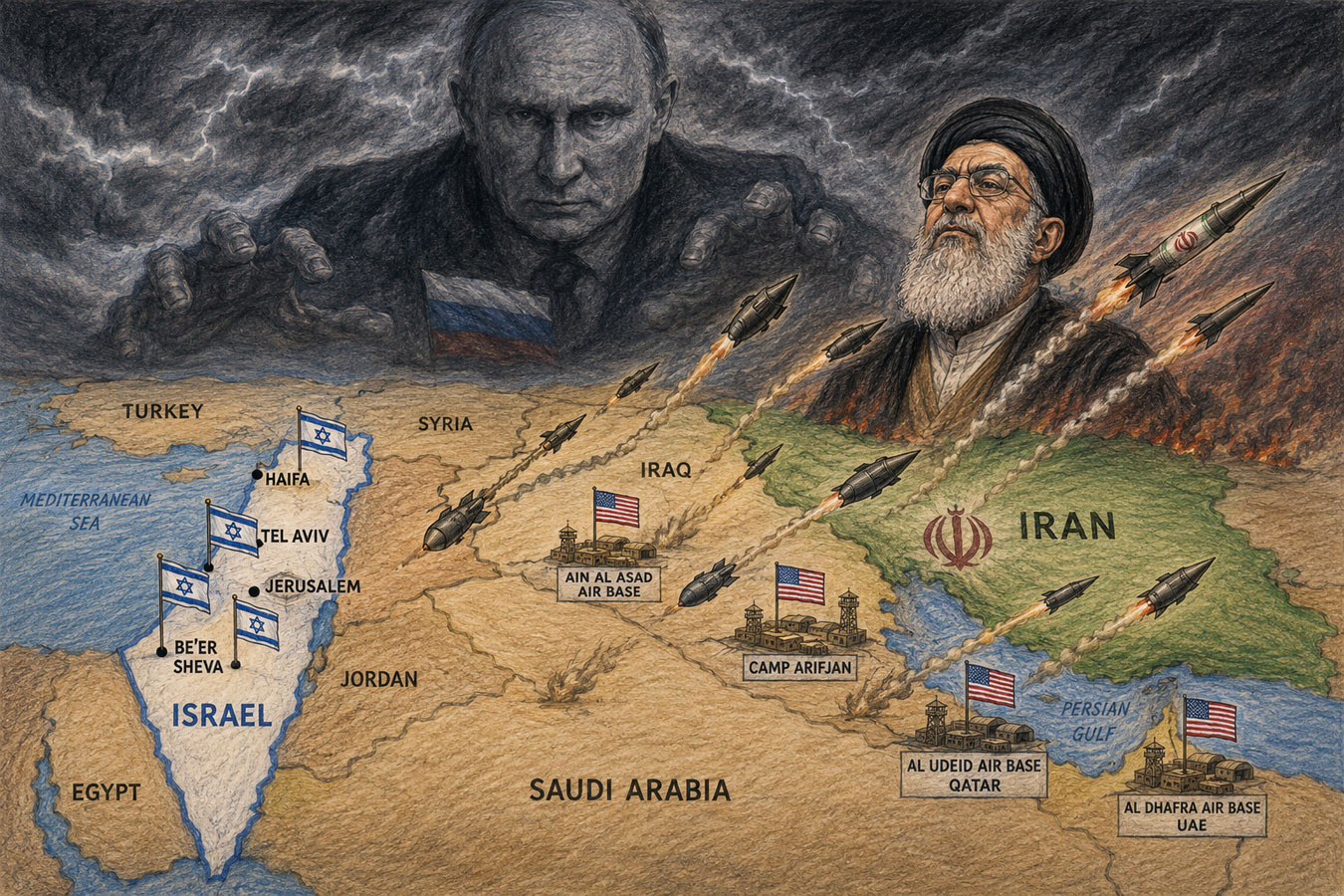
August 11, 2026 The New York Times published an article by Eric Schmitt and Helene Cooper about a troubling change in Iranian tactics. For five days in July, Iran attacked three American bases in Jordan with missiles and drones, forcing air defenses to expend more and more expensive interceptors. On the fifth day, one missile broke through: on July 17, three American servicemen were killed at the Muwaffaq Salti Air Base, and over a hundred were injured.
But for NANovosti, another question is more interesting here. Where did Iran get this ability to quickly change tactics — and why does Ukraine appear again in the American investigation?
Author Victoria Katsman is originally from Ukraine and writes for an Israeli audience about events that connect Ukrainian and Israeli realities. She is not a military expert and does not attempt to replace air defense specialists: for this material, Victoria compared the NYT publication with US Treasury documents, the text of the Russian-Iranian agreement, Reuters reports, and previous NANovosti publications. This boundary is important because part of what is happening is confirmed by open documents, and part by intelligence data that cannot be fully verified from open sources.
And the picture that emerges after such a comparison is significantly more unpleasant than the formula ‘Iran learns from Russia.’
Initially, Iran helped Russia learn to fight
In the fall of 2022, Ukrainian cities first faced mass attacks by Iranian Shahed drones. Later, this ceased to be a story about batches of ready-made weapons: Russia began localizing the production of the Iranian design and turning it into an industrial tool for a protracted war.
In April 2024, the US Treasury described this system quite specifically. According to its data, the Iranian Ministry of Defense cooperated with the Russian SEZ ‘Alabuga’ in financing and producing Iranian-designed strike drones under a contract worth $1.75 billion. The Russian side planned to produce thousands of units per year at this site, and the drones produced there were used against Ukrainian critical infrastructure and civilian targets.
This is why the story of Shahed is more important than the question of the country of origin of a particular part. Iran provided Russia with the model of a cheap mass long-range strike, and Russia had the opportunity to test it in real large-scale war conditions for several years.
NANovosti previously detailed a statement by Volodymyr Zelensky, according to which at the initial stage Iranian operators themselves participated in launching Shaheds against Ukraine. This is another detail that shows how close the cooperation was at an early stage.
Then came the missiles. In September 2024, the US Treasury announced that at the end of 2023, Russia and Iran signed a contract for the supply of hundreds of Iranian missiles, in the summer of 2024, Russian military personnel were trained in Iran to work with Project 360, and in early September, Russia received the first batch of these missiles. The European Union subsequently officially called the transfer of Iranian ballistic missiles a significant escalation of support for Russian aggression against Ukraine.
So the movement was clear: ready-made drones, training, production, components, then missiles, and increasingly close military-technical cooperation.
And then the direction of exchange began to change.
Ukraine gave Russia what cannot be bought by contract
Over four and a half years of full-scale aggression, Ukraine has become a territory of a vast, continuous, and human life-paid military experiment.
Russian military had the opportunity to test how Western air defense systems respond to different routes and altitudes, how to combine drones with cruise and ballistic missiles, how to stretch an attack over time, and how to force defenders to expend expensive missiles on significantly cheaper targets.
Each Russian mass strike provided new data. What was intercepted. What got through. Where overload occurred. How quickly the enemy moved air defenses. Which combinations work worse, and which force simultaneous responses to several fundamentally different threats.
The New York Times now writes that Iran is using exactly this experience. According to Seth Jones from the Center for Strategic and International Studies, Tehran effectively used Russian tactics: a combination of different types of missiles and drones that forces air defenses to protect multiple objects at once and distribute limited ammunition between different threats.
This is no longer the export of a specific Shahed from one country to another. This is the export of the results of years of combat testing.
In May, Reza Pahlavi, speaking in Odessa, formulated a similar problem much more succinctly: ‘Shahed does not see the difference between Kharkiv and Tehran’. At that time, this phrase could be perceived as a political metaphor. The events of the following months increasingly turn it into a description of a real military system.
One day — about 50 Patriots
Figures from the new NYT investigation show another side of this war — the economy of air defense depletion.
According to the publication, citing people familiar with the state of American stocks, since the start of the war against Iran, the Pentagon has expended more than 1,500 Patriot interceptors, with less than 1,700 remaining in stock. Throughout 2025, the US produced about 600 such missiles. On one of the days of the July attacks, American forces in the Middle East fired about 50 Patriots, each costing approximately $4 million.
If these estimates are correct, just one day of defense meant an expenditure of approximately $200 million — and money is not even the main problem here. Money can be allocated by a Congressional decision. New interceptors cannot be instantly pulled from the budget: they still need to be produced.
Here lies the first serious inconsistency within the American story itself. Pentagon spokesman Sean Parnell publicly claims that reports of a shortage of American munitions are false. At the same time, the NYT provides data on more than 1,500 used Patriots and less than 1,700 remaining, and the Pentagon is demanding that manufacturers speed up the production of weapons.
Both positions cannot simply be glued into one convenient phrase. The exact sizes of American military stocks are classified, so independent verification of the figure of 1,700 is impossible. But the problem of the rate of expenditure of expensive interceptors already exists independently of the dispute over the specific number of missiles in stock.
For Israel, this is all too familiar mathematics. Tehran saw during the 12-day war in June 2025 how many resources Israel and the US have to spend to repel large missile-drone salvos. The NYT writes that the Iranian side clearly drew conclusions from this.
Two of the deceased were studying precisely the lessons of Ukraine
This story has a detail that cannot be reduced to a graph of ammunition expenditures.
After the start of the war, part of the American forces was relocated from Kuwait, Bahrain, Qatar, and the UAE to Jordan. The Muwaffaq Salti base was considered more remote from Iran and, accordingly, safer from missile and drone attacks.
On July 17, this assumption stopped working.
Among the three killed were 19-year-old Isabella Gonzalez and 28-year-old Angel Rampersad. Both served in units associated with the 10th Army Air and Missile Defense Command in Germany. The NYT reports that American specialists from these units had been studying Russian attacks against Ukraine for months and passing on the acquired experience to US Central Command.
There is almost unbearable military irony in this. American military personnel were studying how to defend against tactics that Russia was practicing in Ukraine — and died from an Iranian strike, which at the same time was learning from the Russian experience of that very war.
The third deceased, 25-year-old air defense officer Tyler Fihan, served in a unit in North Carolina. It is important here not to repeat the widespread inaccuracy: not all three of the deceased served in Germany.
Such details are more important for NANovosti — Israel News than the faceless formula ‘Air defense failed.’ Air defense intercepted almost everything. But modern warfare is arranged so that sometimes the enemy only needs one missile that gets through the system after dozens of successful interceptions.
F-15E for $60 million and drones as eyes
Another episode described by the NYT shows that Iranian adaptation now concerns not only massive bombardments.
In April, an American F-15E Strike Eagle was shot down over southern Iran. Both crew members ejected; the pilot was evacuated quickly, while the weapons systems officer hid from Iranian forces for almost two days before being found by American special operations units.
According to a senior American military official, Iran deployed a group of drones in the area of American aviation penetration. They helped obtain data on the position, speed, and direction of the aircraft, after which the F-15E, costing about $60 million, was hit by a portable anti-aircraft complex. The NYT also provides the crew’s account of the extremely short warning time before the hit — this technical detail should be perceived precisely as a report from American military personnel, not an independently established fact.
The most important part here is not even the loss of an expensive aircraft.
A cheap drone no longer has to carry a warhead itself and destroy an expensive target. It can become a flying sensor, observer, element of a reconnaissance network — and the strike will be delivered by completely different weapons.
Ukraine has been living within this new logic of war for several years.
In January 2025, the exchange of experience was recorded in an agreement
On January 17, 2025, Russia and Iran signed a Comprehensive Strategic Partnership Agreement. It does not include an automatic obligation to go to war for each other, so calling the document a Russian-Iranian equivalent of NATO’s Article 5 would be incorrect.
But the content of the agreement is hard to call symbolic.
Article 4 explicitly provides for the exchange of information and experience between the intelligence and security services of the two states. Article 5 provides for military cooperation, training of military personnel, exchange of military and expert delegations, and joint exercises. Article 6 enshrines the development of military-technical cooperation.
So by 2025, what started with Shahed was already embedded in an official state structure.
And a year later, this point of the agreement acquired a completely different meaning.
Russia helps Iran see American targets?
In March 2026, the first reports appeared that the direction of assistance had turned: now Moscow is helping Tehran directly in the Middle East.
On March 17, Reuters reported The Wall Street Journal’s message about providing Iran with Russian satellite images and advanced drone technologies. The next day, the Kremlin called this information ‘fake,’ and Reuters separately noted that it initially could not independently confirm the report.
The story did not end there.
On April 7, Reuters reviewed a Ukrainian intelligence assessment, according to which Russian satellites conducted at least 24 detailed surveys of 46 objects in 11 Middle Eastern countries from March 21 to 31. Among them were American military bases, airports, oil facilities, and air defense deployment areas.
The Ukrainian intelligence assessment itself is not yet independent proof. However, Reuters received confirmation of increased Russian satellite activity from a Western military source and a separate regional security source; both also reported that the images were transmitted to Iran. The space company Kayhan Space confirmed unusual Russian satellite activity over the region, although it rightly noted: the mere passage of a satellite over an object does not yet prove the fact of shooting or transmission of a specific image.
Here lies the second important inconsistency.
Moscow denies helping Iran in targeting strikes. But the agreement signed by Russia itself provides for the exchange of intelligence information and experience, and several Reuters sources speak of the actual transfer of satellite materials. This does not yet allow us to assert that every specific Iranian strike was targeted by Russian intelligence, but it can no longer be reduced to an unconfirmed single statement by Kyiv.
NANovosti previously detailed how the Caspian corridor Iran — Russia became part of the military infrastructure of the two regimes, and in July reported on Ukrainian strikes on Russian-Iranian military logistics. If systematic intelligence support has indeed been added to arms supplies, production, and maritime logistics, we are already talking about a much more mature military ecosystem.
A closed loop has formed
If we remove diplomatic formulations, the chain looks like this.
Iran gave Russia Shahed, technology, and a production model. Russia deployed mass production, used and modified this system in Ukraine for years, and simultaneously improved methods of combined missile-drone attacks. Now Iran is using methods in the Middle East that American specialists directly associate with Russian experience, and Moscow, according to Reuters and Ukrainian intelligence, is also helping Tehran with information about potential targets.
Iran → Russia → Ukraine → accumulated combat experience → back to Iran.
This is one of those cases where the arrows on the diagram are more important than diplomatic declarations.
This is why the wars of Russia against Ukraine and Iran against Israel and the USA are increasingly difficult to view as separate crises. Weapons, production technologies, intelligence data, specialists, logistics routes, and, most dangerously, real results of trial and error circulate between them.
Why Israel cannot consider Ukraine a foreign front
For Israel, the conclusion here is significantly more unpleasant than the usual phrase about ‘Russian-Iranian rapprochement.’
It’s not just about Moscow selling something to Tehran or diplomatically covering for it. Iran gains access to knowledge accumulated during years of Russian war against a state armed with Patriot, NASAMS, IRIS-T, and other Western systems.
Russia in Ukraine tests the limits of Western air defense in real-time. Iran does not have to start learning from scratch.
This is especially important for a small country with limited territory and critical infrastructure that cannot be endlessly ‘spread out’ over a vast space. For Israel, the cost of a mistake can be measured not only by the number of interceptors but by one power plant, one airfield, one communication node, or one missile that got through after dozens of successful interceptions.
Therefore, Reza Pahlavi’s words in Odessa about a unified Russian-Iranian threat today no longer look like a political slogan. Russian-Iranian cooperation has acquired a full cycle: production, logistics, combat experience, intelligence, and the reverse transfer of acquired knowledge.
And now Ukraine is teaching others to defend themselves
There is another twist to this story.
The country that was used for years as a territory for testing mass drone and missile warfare has itself accumulated unique experience in countering it. Ukraine knows Shahed not from exhibitions and manufacturer presentations — it disassembles their wreckage, changes the detection system, creates cheap interceptors, builds mobile fire groups, and constantly adapts to new Russian modifications.
In March, Volodymyr Zelensky spoke about helping Middle Eastern states counter Iranian drones. Kyiv hopes to turn this experience into long-term defense cooperation with regional states now facing the weapons and approaches that Ukrainians have been studying since 2022.
It turns out to be a cruel exchange of roles. First, Iran helped Russia attack Ukraine. Then Russia had the opportunity to perfect this war for years. Now Iran is using part of the accumulated experience against the US and its allies — and they have to turn to the knowledge of the country where this experience was gained.
Ukraine was not a ‘distant war.’ It was a warning
One can argue about the exact number of remaining Patriots. One can wait for new evidence of which specific satellite images Moscow transmitted to Tehran. One can separately discuss how much each Iranian technique is a direct copy of the Russian one, and how much both regimes simply come to the same solutions under the pressure of modern warfare.
But the main chain does not disappear because of this.
Iranian weapons ended up in Russia. Their production was localized and expanded. The Russian army tested new methods of mass strikes in Ukraine for several years. Iranian military studied this war. The Russian-Iranian agreement enshrined the exchange of intelligence experience and military-technical cooperation. Now American military personnel are recording Russian techniques already in Iran’s actions in the Middle East.
This is where the convenient illusion ends that Russia’s war against Ukraine is happening somewhere separate from Israel’s security.
Ukraine became a testing ground where authoritarian regimes had the opportunity to test weapons, tactics, the economy of air defense depletion, and the ability of democratic states to quickly adapt for years. These were cannibalistic experiments: their results were measured by Ukrainian destroyed homes, power plants, and human lives, not by neat test center reports.
The most dangerous mistake of democracies was not that they knew nothing. They saw this process almost live — launch after launch, winter after winter.
It’s just that dictatorships learned faster.
Now part of the accumulated knowledge has returned to the Middle East. Americans are already counting interceptors and burying servicemen. For Israel, the question has long been not whether the war in Ukraine is related to it.
The question is how much more will have to be paid for the lessons that Ukraine began paying for with its blood four years ago.
Editorial verification sources: The New York Times, August 11, 2026; U.S. Department of the Treasury, materials from April 25 and September 10, 2024; official text of the Comprehensive Strategic Partnership Agreement between Russia and Iran from January 17, 2025; Reuters, materials from March–April 2026; Council of the European Union; previous NANovosti publications.