
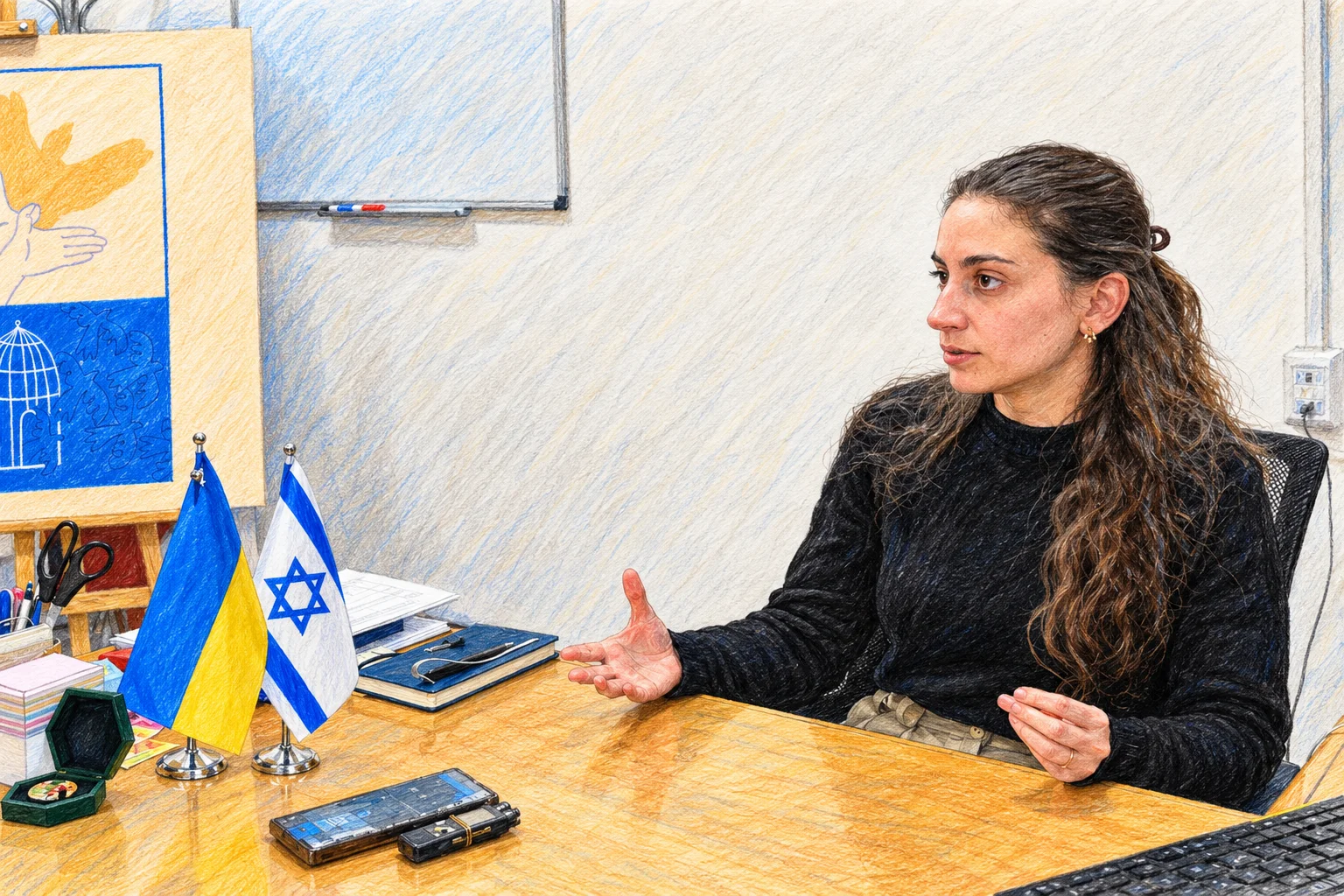
Israel is ready to become a mediator in possible negotiations between Ukraine and the Russian Federation, but neither side is asking for it. This was stated in an interview with RBC-Ukraine by Mila Tzur, Deputy Ambassador of Israel to Ukraine.
On October 30, 2026, Mila Tzur, Deputy Ambassador of Israel to Ukraine, explained why Jerusalem is not in a hurry to become a mediator between Kyiv and Moscow. In an interview with journalist Milan Lelich for RBC-Ukraine, she simultaneously spoke about the Knesset elections, the threat of new escalation with Iran, possible visits of leaders of the two countries, and assistance to Ukrainian cities. Behind the diplomatic formulations lies a specific project: Israel is preparing to purchase mobile shelters for the Sumy region.
Author: Anton Pshedynsky
I compared Tzur’s words with Israeli procurement documentation, voting results, and statements from Ukrainian authorities. The picture differs from the brief news that Israel will not become a mediator. According to the diplomat, there is currently no negotiation request, but practical ties with Ukraine are developing. This is not a refusal of contacts with Russia and not a promise of military assistance to Kyiv.
In the elections on October 27, the Benjamin Netanyahu bloc received, according to preliminary data, 53 seats out of 120, the change bloc led by Gadi Eisenkot — 48, and two Arab parties — 19. A government requires 61 mandates. As already reported by NANews in a detailed analysis of the voting results, on October 29, the Central Election Commission completed the counting of special “double envelopes,” and the final results are expected on November 4. No camp has yet secured a parliamentary majority.
Who is Mila Tzur: a brief biography
Mila Tzur (Mila Tzur, מילה צור) is an Israeli diplomat, Deputy Head of the Israeli diplomatic mission in Ukraine. She studied at Tel Aviv University, participated in the international young diplomats training program of the Diplomatic Academy of Montenegro in 2024. Since autumn 2025, she has publicly represented Israel in Ukraine, and in August 2026, she temporarily served as the head of the Israeli diplomatic mission in Kyiv. Her work includes political contacts, humanitarian aid, restoration of Ukrainian infrastructure, cooperation with Jewish communities, and preserving the memory of the Holocaust.
In 2025–2026, Tzur participated in the opening of a rehabilitation center for war victims, the transfer of more than 100 backup power systems to the Kyiv region, medical aid projects, and events in Babyn Yar. She accompanied diplomatic contacts involving Minister Zeev Elkin, spoke at cultural and educational events in Kyiv and Lviv. In July 2026, at a bar and bat mitzvah ceremony in Kyiv, she shared her grandfather’s family story, who preserved Jewish traditions in the USSR.
Elections without a majority and the question of why Ukraine does not vote
Tzur does not consider prolonged coalition negotiations a threat to the country’s governance: until the new cabinet is sworn in, the current government, headed by the acting prime minister, continues to work. She reminded that repeat elections are costly for the economy, as election day is a holiday, and political uncertainty drags on. Israel is already familiar with several consecutive electoral cycles. However, the subsequently formed government was able to work a full term, despite the shock of October 7, 2023.
It is important for the Israeli reader to distinguish between a party’s victory and the formation of a government. The president consults with factions and assigns the creation of a coalition to a deputy capable of securing majority support. Netanyahu lacks eight mandates, the change bloc — thirteen. At the same time, 19 deputies of the two Arab parties cannot automatically be considered a single part of the opposition bloc: their political positions differ.
The interview raised an uncomfortable question for Kyiv: why can Israel vote during the war, but Ukraine cannot?
The diplomat pointed to different conditions, not a difference in commitment to democracy. In Israel, sharp escalations are followed by relatively calm periods, most evacuated residents have returned home, and the remaining relocated border communities were provided with the opportunity to vote. Ukraine faces continuous large-scale battles, a large number of displaced citizens, and the inability to open polling stations at the front and in occupied territories. This is Tzur’s practical comparison, not a legal conclusion about Ukrainian elections.
A separate problem arose around suspicions of foreign interference. The chairman of the Israeli Central Election Commission, Judge Noam Solberg, instructed the Shin Bet — the internal security service — to check possible financing of voter bribery in Arab communities. The media named Qatar and Turkey; both countries denied involvement, and on October 30, reports emerged about the involvement of the Mossad. Tzur mentioned the arrests of alleged money distributors and does not expect changes in the distribution of mandates. The investigation is limited in scope, mass falsification has not been proven, and suspicions cannot be extended to all Arab voters.
Iran, Russian Shahed, and diplomacy that already works
After the elections, Netanyahu spoke of a unique opportunity to counter the Iranian threat. But Tzur refused to derive a future military operation from the electoral calendar: decisions, she said, depend primarily on national security, and a significant portion of the information is classified. She urged caution regarding claims that any military actions are dictated by domestic political calculations. Neither the dates of a new campaign nor a decision on its start were disclosed by the diplomat.
The journalist reminded of the downside of possible escalation for Ukraine: American attention may shift to the Middle East, there will be fewer Patriot interceptors, and rising oil prices will increase Russian revenues. These are risks outlined in the question, not Tzur’s forecast. Her response concerned common interests: limiting Iran’s ability to transfer weapons and technology to Russia benefits Kyiv, and stopping support for Hezbollah in Lebanon and the Houthis in Yemen benefits Israel and the region. She mentioned American economic pressure on Tehran and the funds Iranian authorities direct to armed partners instead of meeting the needs of their own population.
The connection between the two wars has a verifiable history. Russia uses Iranian Shahed technologies against Ukrainian cities; Israel counters missiles and drones from Iran and its allies. NANews — News of Israel | Nikk.Agency previously analyzed the Russian-Iranian exchange of military technologies and the shortage of Patriot interceptors, which could worsen with a new confrontation. The common threat does not mean a created military alliance between Ukraine and Israel, but explains why governments increasingly discuss security.
On December 4, 2025, in Jerusalem, Taras Kachka and Zeev Elkin held the first meeting of the intergovernmental commission on trade and economic cooperation since the start of the full-scale Russian invasion. The parties signed a protocol on cooperation priorities, including trade, energy, medicine, and technology. And on October 6, 2026, Elkin met with Zelensky in Kyiv during events marking the 85th anniversary of the Babyn Yar tragedy. They discussed Iranian and Russian Shahed and the situation in the Middle East. This is concrete confirmation of Tzur’s words about improving relations.
The most substantive part of the interview concerns Sumy. On the Israeli government procurement portal on October 22, a notice from the Ministry of Foreign Affairs No. 4000623163 was published: the MASHAV agency is preparing to purchase five mobile reinforced concrete shelters from the Ukrainian GARANT BUD ODESSA PLUS, each for 50 people — a total of 250 people. Manufacturing, delivery, and installation in public places in the Sumy region are provided, including protective doors, explosion-proof valves, lighting, benches, first aid kits, and fire extinguishers.
The cost of the offer is 14.585 million hryvnias without VAT, 17.5 million with VAT; the Israeli register lists 327 thousand dollars. Objections are accepted until November 11, the proposed contract period is from November 12 to December 12. This is still an intention to conclude a contract, not a confirmed delivery. Warranty and service after installation are not provided by the offer.
MASHAV is an Israeli state agency for international cooperation under the Ministry of Foreign Affairs, not a military structure. For Israelis, these mobile structures are closer to public “miguniot” than to apartment “mamads” — protected rooms inside housing. Tzur also hopes for assistance to other Ukrainian regions, continuation of energy support provided last winter, and work with people who have experienced military trauma. No new budgets have been announced for these areas yet. Israeli civil protection experience has already become a topic of NANews, including in a material about shelters and protection of residential buildings.
Possible visit of Zelensky and negotiations under US leadership
The embassy would like to organize visits of Volodymyr Zelensky to Israel and the Israeli Prime Minister to Ukraine after the formation of a new government. Tzur did not name agreed dates, travel programs, or officially confirmed agreements. This is a diplomatic wish, not an announcement of an upcoming visit.
Tzur says that Israel is still ready to assist in peace negotiations within its capabilities, but, in her opinion, neither of the warring parties is asking for such participation. She believes that an excess of mediators can confuse the process and suggests giving a chance to the US-led initiative. This is not an official refusal from Kyiv or Moscow and not a new Israeli peace initiative.
Even the American negotiation platform does not yet have an approved date.
For Israel, the practical outcome of the interview is not in choosing between Moscow and Kyiv. Restraint in the matter of mediation coexists with ministerial contacts, joint discussion of the Iranian threat, and a specific procedure for purchasing shelters.
If it is important for you to see how world events affect Israel and Ukraine, add NANews to Google and follow our publications.