
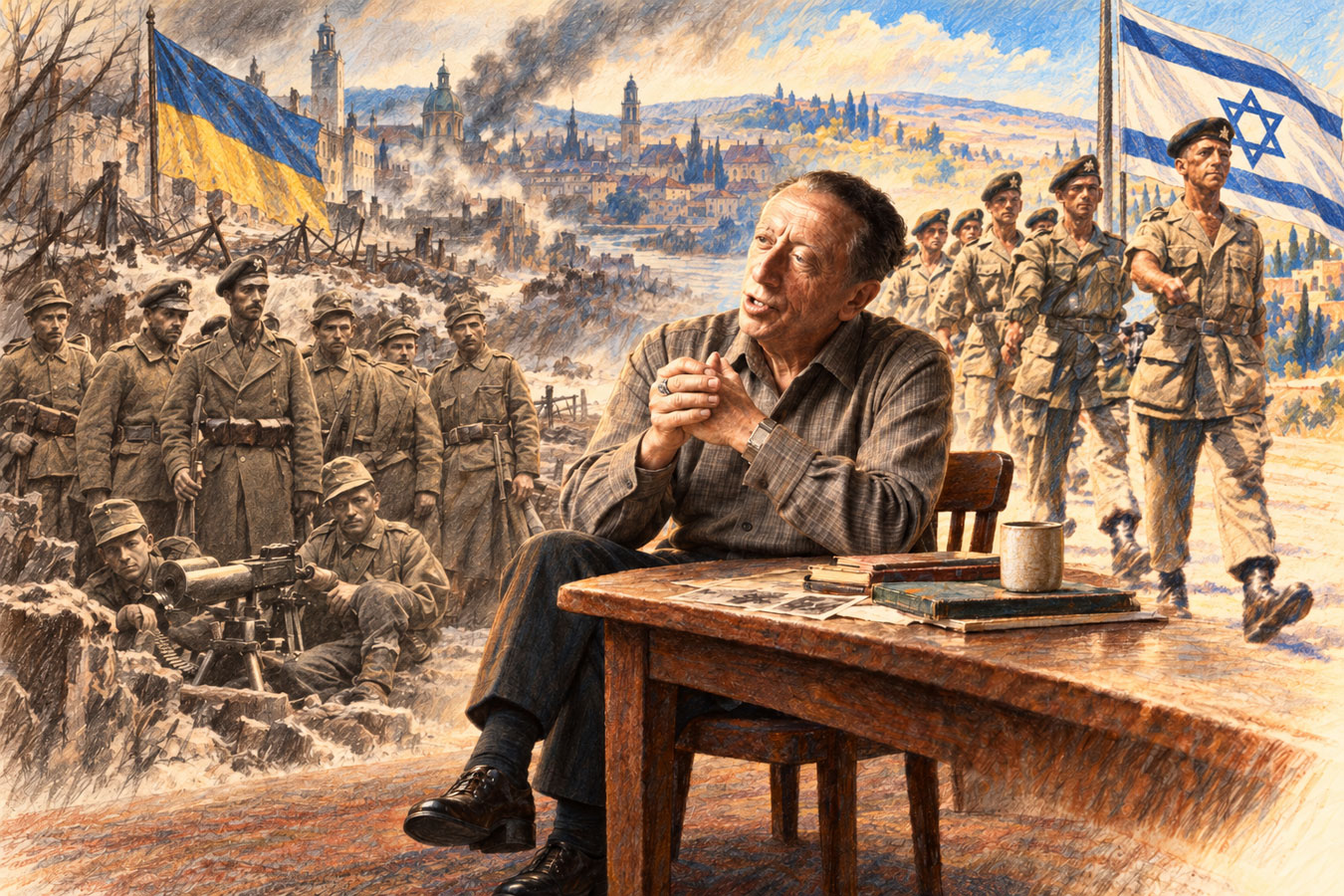
In November 1918, eighteen-year-old Jewish Chaim Kahane joined a Ukrainian armed formation fighting Polish troops for Lviv. Thirty years later, he participated in the creation of the first parachute units of the Israel Defense Forces. Between these events were the First World War, the organization of Jewish self-defense in Austria, service in the British commandos, and sabotage raids against Nazi troops from Libya to the Greek islands.
Author: Alexander Khmelnitsky | NANews, section “Jews from Ukraine”
In the Austro-Hungarian army, Chaim was called Karl. Under this name, he was later known in Israel. The most detailed biography was published by the project Jewish Heroes; another version of his military path was reconstructed by reserve colonel, military historian Dr. Beni Michelson for the Israeli Museum of the Jewish Warrior of World War II. The dates and individual episodes in these stories do not always match. Therefore, where there is no independent document, it is important to speak specifically about biographical testimony, not a proven event.
1900–1913 years. Smolyanka, Mikulintsy, Ternopil — the early years of life
Chaim Kahane was born on August 6, 1900, in Eastern Galicia, which was then part of Austria-Hungary. Michelson names Smolyanka near Mikulintsy, in the territory of modern Ternopil region of Ukraine, as the place of birth. A separate Israeli museum card names Mikulintsy. A metric record that would eliminate the discrepancy has not yet been established.
Father, Joseph Kahane, came from Skomorokhy, mother, Pesia Margulis, from Teofilovka in the territory of modern Vinnytsia region. The family had a daughter Brane and six sons: David-Pinkas, Abraham, Yekel, Jacob-Isaac, Boruch, and Chaim. The family was religious and, judging by biographical descriptions, quite well-off.
The father adhered to strict educational rules, explaining the children’s misdeeds as yetzer hara — an evil inclination in Jewish religious tradition.
Chaim attended a cheder — a traditional Jewish elementary school. The road to the neighboring village passed over a bridge where local teenagers, according to a recollective story, ambushed Jewish students, beat them, and took their food. At the age of seven, Chaim got into a fight with their leader named Stepan: he received blows with a stick, then stones were thrown at him. At home, his father punished Chaim himself for the confrontation with non-Jews.
Later, the boy ran away from home to Ternopil, survived on odd jobs, and returned with clothes and gifts bought with his own money. Jewish Heroes speaks of several months of absence, Michelson about approximately a year. The biography also preserved an incident with a circus that came to Mikulintsy: not having 20 kreutzers for a ticket, Chaim tried to get in for free, pulled out a penknife during a quarrel with security, and was punished by local residents, including the city head named Kurtz.
All these details allow us to see a lively, stubborn Galician teenager, but the origin of the stories is not fully traced: police, school, or family documents separately confirming the bridge, circus, and escape are not presented. They should be published with this caveat.
The family’s move to Vienna dates approximately to 1912–1913. Michelson indicates 1912; Jewish Heroes reports that first the older sister Brane went to an aunt, and Chaim arrived after his bar mitzvah — Jewish religious coming of age at 13, which fell around 1913.
In Vienna, he met Zionist youth, began attending their meetings, and saw the blue and white Jewish national flag for the first time. The idea of a future Jewish state entered his life even before his first military service.
1914–1918 years. Austro-Hungarian army and regiment, predominantly Ukrainians
After the start of World War I, Joseph Kahane was mobilized, and the eldest son David-Pinkas was sent to the Serbian front. Chaim also volunteered but was too young. The biography states that the father was sent to the Italian front at the beginning of the war; there is an inaccuracy here since Italy entered the war against Austria-Hungary only in May 1915. This assignment may have occurred later.
In 1917, Chaim was drafted into the imperial army and sent for training in Moravia, an area of present-day Czechia. Among the circumstances he remembered were harsh drills, extortion, and a corporal-Ruthenian who extorted money from recruits. “Ruthenians” in Austro-Hungarian documents usually referred to the East Slavic, primarily Ukrainian, population of Galicia. In the German-speaking army environment, Chaim became Karl.
He served in the 15th Galician Infantry Regiment named after Baron von Georgi. According to the historical reference of the regiment, the pre-war composition included 62% Ruthenians, 29% Poles, and 9% representatives of other nationalities. The recruitment district was located in Ternopil; the second battalion was stationed in Lviv in peacetime. This does not mean that Kahane’s specific company had exactly the same composition in the fall of 1918 — its list has not been found.
In June 1918, according to the biography, Kahane was sent to the Italian front at the Piave River. During the offensive from June 15 to 23, the Austro-Hungarian army suffered heavy losses, and his unit had to be replenished after returning to Moravian Ostrava. Further sources describe the return to Ternopil, a through bullet wound in the groin area, a hospital, and new service. Soldiers participated in requisitions of grain, cattle, and horses, paying peasants with rapidly depreciating banknotes.
But there is a chronological problem.
Jewish Heroes places the battles with the Russians near Ternopil after the Italian campaign of 1918, although the Brest-Litovsk peace with Soviet Russia was concluded on March 3. Probably, episodes from different months are mixed here; the date and circumstances of the wound cannot be considered established. By November 1918, however, Kahane is already described as a corporal who had undergone army training and had combat experience.
November 1918: the collapse of Austria-Hungary and Kahane’s transition to the Ukrainian side
In October–November 1918, the Austro-Hungarian Empire collapsed after defeat in World War I. Independent states began to emerge on its territory, and the former imperial army was divided along national lines.
On October 18, 1918, the Ukrainian National Council was established in Lviv, headed by Yevhen Petrushevych. Already on October 19, it declared the creation of a Ukrainian state on the Ukrainian lands of Austria-Hungary. On October 31, Ukrainian military leaders decided to take control of Lviv without waiting for the transfer of power by the Austrian administration.
On the night of October 31 to November 1, 1918, Ukrainian servicemen occupied the most important administrative institutions of Lviv. These events went down in history as the Listopadovyi Chyn — November Uprising. On November 1, Ukrainian power was established in the city, but Polish armed formations opposed it. The battles for Lviv began.
On November 9, 1918, the government of the new Ukrainian state — the State Secretariat — was formed. On November 13, the Ukrainian National Council adopted the Provisional Basic Law, legally securing the existence of the Western Ukrainian People’s Republic — ZUNR, a state that emerged on the territory of former Austrian Galicia. On the same day, a law was adopted on the organization of its armed forces.
It was in this environment, in November 1918, that eighteen-year-old Chaim Kahane faced a choice of further military service. Servicemen who had recently sworn allegiance to one emperor divided into national camps.
According to the biographical project Jewish Heroes, Kahane’s Polish company commander gathered the soldiers, informed them of the monarchy’s collapse, and declared them free from their previous oath. The Polish servicemen left in an organized manner. The Ukrainians remained in the Lviv garrison and offered Chaim to join them.
On the same day, on one of the streets of Lviv, Kahane met a familiar Jewish lieutenant Goldberg, who was involved in the local Zionist committee. Chaim explained that he wanted to serve among the Ukrainians so that the Jewish community of Lviv would have its own person in their armed forces. Goldberg supported his decision: he removed the old Austro-Hungarian insignia and attached a blue and white ribbon of the Jewish national movement to his headgear.
The exact calendar date of Kahane’s transition to the Ukrainian unit is not specified in the published biography. It is known that this happened during the November events of 1918, before the Ukrainian troops left Lviv on the night of November 21 to 22.
Kahane did not cease to be a Zionist when joining the Ukrainian unit. According to his published biography, he primarily intended to help Jews caught between Ukrainian and Polish armed formations. His decision should be considered with this motive in mind, without attributing political views to him that he did not document.
Ukrainian non-commissioned officer in Lviv: battles, bread, firewood, and help for the dead
After joining the Ukrainian formation, corporal Chaim Kahane was promoted to non-commissioned officer — a junior commander, similar in position to a modern IDF sergeant. He led a small group of servicemen, participated in street battles, and attacked a fortified Polish position. According to the biography Jewish Heroes, for his initiative in battle, he was praised by a Ukrainian colonel who resembled a university professor. The officer’s name, unit number, and composition of Kahane’s unit have not yet been established.
In breaks between battles, Kahane helped the Jewish residents of the city. At night, he visited families, warned them of danger, advised them to leave Lviv and head west. To those who stayed, he delivered bread, coal, and firewood. He also helped with the burial of the dead: he transported their bodies on a handcart to the burial site. In a city divided by armed opponents, such work was dangerous in itself.
Once, when Kahane was transporting the bodies of the dead, a boy ran up to him and warned about armed people near the Jewish quarter. Kahane temporarily left the bodies in an empty cinema and went to his unit. He demanded that his subordinates defend the residents, but the soldiers refused. Then, according to Jewish Heroes, Kahane took a rifle, two grenades, and went to the Jewish market alone.
On the way, he repeated “Kiddush ha-Shem” (קידוש השם) — “sanctification of the Name of the Almighty.” In Jewish tradition, this concept is associated with loyalty to God and the willingness to defend one’s faith even in the face of mortal danger. Near the trading stalls, Kahane saw a group of armed people and threw a grenade in their direction. The biographical story reports that the attackers fell, but does not specify their number or further fate.
All these events relate to November 1918, before the withdrawal of Ukrainian troops from Lviv on the night of November 21 to 22. The exact dates of Kahane’s promotion, combat clashes, and the incident at the Jewish market are unknown. Independent combat reports or other documents confirming the described grenade attack have not yet been found. This episode should be considered as biographical testimony, not mixed with subsequent events in Lviv.
Jewish militia of Lviv and Ukrainian troops are not the same
Kahane’s story unfolded against the backdrop of broader and ambiguous Ukrainian-Jewish military cooperation. Ukrainian researcher Oleh Stetsishyn in the scientific work “Military Cooperation of the Jewish Population of Galicia with ZUNR (1918–1923)”, published in 2024, used archival documents on armed formations of Jewish communities.
According to the information he provided, on November 7, 1918, 195 Jewish militiamen and 24 officers participated in patrolling Lviv; on November 13 — 237 militiamen and 37 officers. The creation of a joint Ukrainian-Polish-Jewish militia with equal representation of the three communities was discussed, but the Polish side did not accept such a model. By mid-month, new Jewish militia companies were being recruited, promising volunteers 10 Austrian crowns a day, food, and accommodation.
In other cities of Galicia — Kolomyia, Brody, Ternopil, Pidvolochysk — Jewish detachments maintained order, interacted with Ukrainian authorities, and sometimes received weapons and uniforms from them. An archival document mentions ten former Jewish militiamen from Brody who left with Ukrainian troops. Stetsishyn also provides information about other Jews in the units of the Galician army.
At the same time, the Jewish militia of Lviv officially adhered to neutrality and was not part of the Ukrainian Galician army. Individual Jews who joined Ukrainian formations made personal decisions. Such a difference cannot be erased, otherwise, an incorrect picture of the relations of entire communities will emerge.
Later, already in June 1919, the Jewish Shock Battalion of Solomon Leinberg was created as part of the Galician army. It was not a unit where Kahane’s service in November 1918 is documented. The history of this formation, its composition, subordination, and combat path was previously analyzed by NANews in the materials “History of the ‘Judean Battalion’ in the Ukrainian Galician Army of 1919” and “Under the Star of David and the Ukrainian Flag: Jewish Military Units of Ukraine, Their Forgotten Commanders, and the Road to Future Israel”.
November 21–24, 1918. Retreat, Polish captivity, and pogrom
On the night of November 21 to 22, Ukrainian troops left Lviv. According to the biographical story, Kahane broke into a military warehouse, took cartridges and cigarettes, and set the building on fire, not wanting to leave property to the enemy. He tried to escape on horseback but ran into a Polish vanguard and took refuge in an empty cinema. There were two more Ukrainian soldiers there. All three were captured.
The captives were brought to a gymnasium hall. The senior officer ordered them to be shot. Kahane, according to the story, pretended that the officer called him, walked past the guard, turned his coat inside out, and threw away his military headgear. Then he hid for several days with a Jewish potter, whose house he found by the sign.
In Lviv during these days, there was an anti-Jewish pogrom from November 22 to 24, 1918. Killings, robberies, and destruction are confirmed by sources independent of Kahane’s biography: documents of the American diplomatic mission and research by Polish historian Zbigniew Zaporowski. Estimates of the number of Jewish victims vary: the Jewish relief committee named 72 dead, the Henry Morgenthau commission — 64. These figures relate to different counting methodologies and should not be mechanically summed.
According to the biography, Kahane saw devastated Jewish homes and dead residents. Then he registered as a former Austro-Hungarian serviceman, using the name Karl and knowledge of Vienna’s streets and districts. He received exit documents, reached a train with returning Austrian prisoners from Russia, and traveled part of the way in the locomotive cab. He returned to Vienna for Hanukkah when his relatives already considered him shot along with two Ukrainian prisoners.
Important discrepancy: Jewish Heroes associates Kahane’s return with the end of 1918, while Beni Michelson writes about Ukrainian service for about a year and arrival in Vienna at the beginning of 1920. Ukrainian historian Yuriy Yuzich in the publication “Jewish Nationalist Who Volunteered in the UGA” on January 8, 2024, also tells about the November battles and captivity, mentioning a wound after captivity. But Yuzich largely cites details from Jewish Heroes. Without Kahane’s personal file or an independent document, we cannot unequivocally determine when his service in the Ukrainian formation ended and to which episode the mentioned wound relates.
Vienna and Klagenfurt. Self-defense against anti-Semitic violence
After the war, Kahane participated in organizing Jewish self-defense in Austria. Together with other veterans, he practiced shooting in Vienna’s Prater, guarded Jewish institutions and synagogue congregants from attacks by nationalist groups. One biographical episode tells of defending a synagogue before Rosh Hashanah — the Jewish New Year.
There are also stories about a Steyr pistol falling out in a tram, police detention, a previous conflict over an anti-Semitic scene in a theater, and a warning from an officer who refused to consider Kahane an arms dealer. These plots have not yet been confirmed by independent police materials.
Kahane moved to Klagenfurt in southern Austria, worked in the city administration, participated in a Zionist club, and organized youth sports camps. In March 1938, Germany annexed Austria. Jewish Heroes tells of Kahane’s unfulfilled plan to attack Hitler during a supposed visit to Klagenfurt on April 4: from an apartment on the second floor, an acquaintance was supposed to get a gun, but the plan failed. Independent confirmation of the assassination preparation has not been found; it cannot be asserted that it was indeed being prepared.
Trying to leave, Kahane was first stopped at the Italian border. Then he reached the Danube through Czechoslovakia, further to the Romanian port of Constanta, and set off on the Greek ship “Artemisia.” According to the biography, near the coast close to Netanya, the ship ran aground. In December 1938, Kahane reached Eretz-Israel — the Land of Israel, then under British mandate administration.
1939–1942 years. British commandos, Eritrea, Gondar, and German rear
In December 1939, Kahane voluntarily joined the British army. Initially, he served in the 401st Company of the Royal Pioneer Corps, a military engineering and construction unit. He underwent training at the Tzrifin camp, was sent through Egypt to France for work on the railway near the English Channel. After the German offensive in 1940, he was evacuated to Britain, where he also participated in rescue operations after the London bombings.
In the fall of 1940, he returned to the Middle East. In Suez, Kahane, along with about 240 servicemen, joined the new 51st British Commandos unit, created with the participation of Major Henry Kator. It participated in actions near Bardia, then in Sudan, Eritrea, and Ethiopia. In 1941, Kahane, according to his biography and Michelson’s research, fought against Italian forces in the Keren area and during the siege of Gondar.
After the disbandment of Commandos No. 51, he joined the Special Interrogation Group (SIG) — a British intelligence and sabotage group, which included German-speaking servicemen, including Jewish refugees from Europe. Using German uniforms, weapons, and vehicles, the group penetrated enemy lines, set up false roadblocks, and gathered intelligence.
Kahane acted jointly with fighters of the Special Air Service (SAS) — a British special operations unit — under the command of David Stirling; Paddy Mayne is also mentioned in the stories. Once their car encountered a German checkpoint. Kahane, posing as a German officer, claimed he was escorting important British prisoners and secured the vehicle’s passage. This episode is known from the biographical narrative, although the overall participation of SIG in British special forces operations is well reflected in military-historical literature.
On June 3, 1942, his group participated in ensuring the penetration of SAS saboteurs to German airfields in the Derna and Tobruk area, from where aviation threatened Malta’s supply. In July, there was a raid on the Sidi Haneish airfield. In September, Kahane participated in Operation Agreement against the port of Tobruk, where, according to the biography, he was supposed to pose as a German officer and take control of the passage through the guard post.
The operation resulted in heavy losses for the British, including ships and landing craft; SIG commander Captain Herbert Buck was wounded and captured. After this, the group was disbanded. NANews — News of Israel | Nikk.Agency tells about these details not to create a legend of an invincible fighter: it is especially important that Kahane repeatedly found himself a participant in risky operations, the outcome of which depended far from one person.
1943–1945 years. Aegean Sea, Albania, and assistance to Jewish refugees
Kahane’s next unit was the Special Boat Service (SBS) — a British special operations service using small boats, sea landings, and raids. Michelson’s research names the unit commander Lord George Jellicoe and Danish officer Anders Lassen, later awarded the Victoria Cross. For operations, they used small Greek fishing boats, canoes, and inflatable boats.
In 1943, Kahane participated in actions in the Aegean Sea, including on the Greek islands of Kalymnos, Symi, Santorini, and Paros. During the 1944 landing on the Adriatic coast, in the area of the Albania-Yugoslavia border, he was wounded; a British comrade carried him out from under fire.
After treatment, Kahane again went on a mission: he was parachuted into Albania to establish contact with British servicemen who had lost contact with headquarters. He found the group, helped establish interaction with local partisans, and operated in the Korca area, east of Tirana.
By the end of the war, he was again in Austria, in the familiar Klagenfurt. Michelson’s research reports his participation in actions against Nazi underground groups “Werewolf” and assistance to Jews trying to reach Palestine through Italy. In the Jewish Heroes biography, the timing of his return to Eretz-Israel is not entirely consistent, so the exact date of return after these operations should be checked separately.
Plots about special units disguised in German uniforms were later used in war cinema, particularly in the American film “Tobruk” of 1967. But a feature film cannot be taken as a direct screen adaptation of Kahane’s personal service.
1948 year. Czechoslovakia, 42 volunteers, and the beginning of Israeli paratroopers
After the declaration of Israel’s independence on May 14, 1948, the newly formed army needed paratroopers, instructors, and its own training base. Czechoslovakia provided significant assistance in training specialists at that time.
On July 15, 1948, a course for 42 Jewish volunteers began in a military camp near the town of Straz pod Ralskem: 14 arrived from Israel, the remaining 28 from various countries, including Hungary, Czechoslovakia, and the USA. The course was organized by an officer, later known as a poet, Haim Gouri. The oldest participant was Karl Kahane. Sources call him 48 years old, although on July 15 he was still 47: his birthday was on August 6. The course ended in early September.
The returning trainees began creating Israel’s first parachute company at the camp Ahuzat on Mount Carmel, in the Haifa area. The first commander was Yoel Palgi, a veteran of British special operations. He was tasked with creating a paratrooper unit by the IDF Chief of General Staff Yaakov Dori — a native of Odessa. Thus, the biographies of two more people connected by origin with Ukraine converged in the organization of the first Israeli paratroopers.
Palgi appointed Kahane as chief of staff of the new unit. Kahane was responsible for preparing the site, purchasing and maintaining parachutes, equipment, supply, organizing training, and coordinating flights from the Ramat David airfield. In practice, the first unit had to create almost the entire infrastructure from scratch.
1949 year. Parachute school Tel-Nof
At the beginning of 1949, the head of IDF military training Haim Laskov appointed Yehuda Harari as the commander of the paratrooper unit. After checking the base’s condition, he recommended restructuring the training system and moving it to the Tel-Nof airbase, closer to military transport aviation. Israeli research also mentions the agreement of Chief of General Staff Yigal Yadin on this reorganization.
The organizational group included Karl Kahane, the future head of the parachute school Yuval Gershon, and other instructors. Within three months, they managed to equip training facilities, establish supply, and open the first parachute instructor course in August 1949. In October, Prime Minister David Ben-Gurion and Haim Laskov were invited to the graduation ceremony.
The history of organizational changes is confirmed by materials of the military-historical archive of the first Israeli paratroopers. There, Kahane is named one of the creators of the parachute school, an instructor, and the head of the equipment and safety unit. His name is on the scheme of the Tel-Nof training base for 1950; a photograph of Kahane next to the first company commander Yitzhak Volker has been preserved. There is also a group photo of commanders from 1953.
Subsequently, Kahane served with the rank of rav-seren — IDF major. Here again, biographical data diverge: Jewish Heroes and Yuriy Yuzich’s publication name 1958 as the end of service, while Michelson and historical materials of the parachute school — 1953. Jewish Heroes also mentions an episode of Kahane’s last parachute jump upon retirement; independent confirmation of the date of this jump has not yet been found. After the army, according to Michelson, he worked in the Tel Aviv building “Migdal Shalom.”
1974 year and memory of Kahane in Ukraine and Israel
On June 8, 1974, Chaim Kahane died in a car accident in Tel Aviv. He was buried in the Kiryat Shaul cemetery.
On June 11, 1974, the newspaper “Maariv” reported on the farewell to him as one of the veterans of the Israeli paratrooper forces.
In Israel, the memory of Kahane is primarily preserved in military-historical materials. Even during his lifetime, journalist Mordechai Barkai prepared a series for the newspaper “Davar” titled “The Personal War of Karl Kahane”: articles were published on May 18 and 25, June 1 and 8, 1962. They are listed in Michelson’s bibliography; the first publication is stored in the digital newspaper collection of the National Library of Israel. There was also a personal memorial page in the historical archive of paratroopers, but the previous address is now unavailable.
In the Israeli Museum of the Jewish Warrior of World War II, there is a biographical card of Kahane and Michelson’s research; army historians preserved his positions, photographs, and documents on the creation of the parachute school. In May 2026, historian Uri Milstein again told about Kahane in News1 in a study of the parachutist course in Czechoslovakia. The bibliography of this study mentions an interview with Kahane, but its dating and original recording have yet to be established. The presence of museum and archival materials, however, does not in itself prove the existence of a separate physical museum exhibition.
In Ukraine, Kahane’s name appears in scientific-historical publications. Back in 2019, Marko Simkin mentioned him in the Lviv publication “Photographs of Old Lviv” among Jews who joined the Ukrainian armed forces. Then came the Ukrainian-language biography of Jewish Heroes, Yuriy Yuzich’s article in 2024, and Oleh Stetsishyn’s scientific work linking Kahane’s private fate with archival evidence of Ukrainian-Jewish military cooperation.
But as of October 2026, it has not been possible to document the existence in Ukraine or Israel of a street, monument, memorial plaque, unit named in his honor, posthumous honorary award, or separate permanent museum exhibition. The absence of found confirmation is not equivalent to proof that such objects do not exist anywhere. The place of burial, museum biographical materials, and archival presence of his name are reliably established.
Lviv of 1918 and Israel of 1948: one biography, different armies
The story of Chaim Kahane does not fit into one national scheme. A Jewish boy from a Galician village, a teenager from a Viennese Zionist club, an Austro-Hungarian corporal, a Ukrainian non-commissioned officer, a defender of Lviv Jews, a British commando, and an Israeli major — this is one person who lived through several wars and state upheavals.
His participation in Ukrainian formations does not negate the official neutrality of the Jewish militia of Lviv or the tragedy of the pogrom after the Ukrainian troops left. And activity in the IDF does not make every report of early biographers an indisputable fact. Today, Kahane’s story is of interest to both Ukraine and Israel — and it becomes truly understandable when we preserve not only vivid episodes but also accurate names, documents, dates, and open questions.
For the section “Jews from Ukraine,” this is a continuation of the conversation that NANews conducts in the material “Yevhen Konovalets Returns to Ukraine: Jews Next to the Founder of the OUN…”: the common history of Ukrainians and Jews does not consist of one convenient version of the past. It included cooperation, rescue, service side by side, national contradictions, and violence. The life of Karl Kahane allows us to see all this through the fate of a specific person.
Sources and materials for further verification
- Jewish Heroes. “Chaim Kahane” (September 25, 2021) — an expanded biography, including personal episodes that require independent confirmation.
- Beni Michelson. “Karl Kahane” — Museum of the Jewish Warrior of World War II, Israel.
- Yuriy Yuzich. “Jewish Nationalist Who Volunteered in the UGA” — “Historical Truth,” January 8, 2024.
- Oleh Stetsishyn. “Military Cooperation of the Jewish Population of Galicia with ZUNR (1918–1923)” — “Humanitarian Studies: History and Pedagogy,” No. 2, 2024, pp. 51–76.
- K.u.k. Infanterieregiment Nr. 15 — historical reference on the 15th Infantry Regiment of Austria-Hungary.
- Documents of the American diplomatic mission on the situation of Jews in Poland — archive of the US Department of State, 1919.
- Zbigniew Zaporowski. Study of the victims of the Lviv events of November 22–24, 1918 — Institute of National Remembrance of Poland.
- History of the Israeli parachute school — military-historical collection of the first IDF paratroopers.
- Training base Tel-Nof and 890th battalion in 1950 — structure of the base, photographs, and positions.
- Marko Simkin. “Jewish Shock Battalion of the Ukrainian Galician Army” — “Photographs of Old Lviv,” June 7, 2019.
- Mordechai Barkai. “The Personal War of Karl Kahane” — series of the newspaper “Davar,” May 18 and 25, June 1 and 8, 1962 (the full series is listed in Michelson’s research).
- “Maariv,” June 11, 1974 — report on the funeral of Karl Chaim Kahane.
- Jewish Warrior of World War II Museum: Personal Card of Karl Kahane.
- Uri Milstein. “Paratrooper Course in Czechoslovakia” — News1, May 29, 2026.