
In our “Jews from Ukraine” series, we tell the stories of people whose lives are connected to Jewish history, Ukrainian land, and the events that changed the twentieth century. Among them are world-renowned writers, artists, scientists, entrepreneurs, and public figures. But there are also many whose names are almost unknown to the wider public, even though their biographies can be just as remarkable as those of famous people.
Today’s subject is Mandyk Khasman, a Jew from Drohobych who was born on October 11, 1929. Jewish by birth, he survived Nazi persecution, served in the Ukrainian Insurgent Army, and later became active in the OUN–UPA veterans’ movement.
Author: Stas Shifer. For the NAnews “Jews from Ukraine” series.
In the UPA, he was known by the nom de guerre “Malyi,” meaning “Little One.” Decades later, Khasman recalled that among the insurgents he had found people whom he regarded as his comrades, and that his Jewish origins had not stood in the way of those relationships.
At the age of twelve, he witnessed the Nazis murder his parents and brothers, escaped from a mass execution site with two other children, hid with Ukrainian families under the name Volodymyr Dmytrenko, and joined the Ukrainian Insurgent Army while still a teenager. Later, he was wounded, captured by NKVD officers, interrogated, and beaten for nine months. He survived all of this, served in the Soviet Army, worked at a coal mine for thirty-five years, and managed to reestablish contact with relatives whom the war had scattered across different countries.
We do not claim to be conducting an academic historical study, nor are we attempting to replace professional historians, archivists, or Holocaust researchers. Our purpose is somewhat different: to tell complex, sometimes controversial stories in accessible language without losing facts, names, dates, or historical context. These are popular-history publications for people interested in history, and especially for those encountering, for the first time, individuals whose lives do not fit conventional perceptions of the past.
For Israeli readers, this story is of particular interest.
Relations between Ukrainians and Jews during World War II are a complex and painful subject, encompassing the Holocaust, antisemitism, collaboration, the rescue of persecuted people, national movements, Soviet repression, and individual human destinies. One person’s biography cannot explain or justify the actions of an entire organization, but it can reveal a side of historical events that often remains outside standard textbooks and political discussions.
Mandyk Khasman’s story does not erase crimes or prove that antisemitism was absent from the Ukrainian nationalist movement. Nevertheless, it is a real biography preserved through interviews conducted during his lifetime, family recollections, and the work of researchers. It deserves to be read in full, from his birth to the final years of his life.
Let’s begin …
Drohobych: A Jewish Family, Childhood, and the Holocaust
Seven Children in the Family of a Former Austro-Hungarian Officer
On October 11, 1929, a boy named Mandyk Khasman was born in Drohobych.
Some publications give another version of his name: Mundek. Today, Drohobych is located in Ukraine’s Lviv region, but at the time of Mandyk’s birth, the city belonged to the Polish Republic, and before that it had been part of Austria-Hungary. Over a relatively short period, its inhabitants experienced several changes of state and political regime, which directly affected the fate of the Khasman family.
The boy’s father, Zhysik Khasman, whose name is also rendered in different sources as Dzhysik or Dzhysko, served in World War I and rose to the rank of captain in the Austro-Hungarian Army. After the war, he did not pursue a military career but became a carriage driver. He owned horses and a carriage in which he transported passengers around Drohobych. The family was not among the city’s wealthiest residents, but neither did it live in extreme poverty.
His mother, Krentsia, also known as Karolina Khasman, looked after the household and raised the children. There were seven children in the family: four sons—Itsyk, Idol, Mandyk, and Savyk—and three daughters: Hinda, Khana, and Frida. Mandyk was the second-youngest child. Naming every member of the family is important to understanding this story because the war affected their lives in different ways: the parents and two sons were murdered, while the other children were separated by occupation, evacuation, concentration camps, and emigration.
Ukrainian and Polish were spoken in the Khasman household. The family’s Jewish origins did not prevent friendly relations with Ukrainian neighbors. As researchers later discovered, young Mandyk even attended services at a nearby Ukrainian church. This detail was preserved by historian Lesia Bondaruk, who personally met Khasman in May 2011 together with Volodymyr Viatrovych and veterans’ brotherhood representative Vasyl Kushnir.
His visits to the church date back to his prewar childhood and are therefore particularly interesting: they took place long before the boy had to undergo baptism and adopt a Ukrainian name to escape the Nazis. Published recollections do not explain in detail what the family’s religious beliefs were, how strictly they observed Jewish traditions, or what role Yiddish played in their domestic life. What is reliably known is that the family lived in a multinational city where Ukrainian, Polish, and Jewish cultures constantly intersected.
By the beginning of World War II, Mandyk had completed only two years of schooling. Almost no photographs survived from the family’s prewar life. According to researchers, the only surviving photograph in the family album was a portrait of Zhysik Khasman wearing an Austro-Hungarian officer’s uniform. The photograph was later published alongside his son’s biography.
Jewish Drohobych Before the Catastrophe
Drohobych had a centuries-long history of Jewish life.
During the interwar period, the city had synagogues, Jewish schools, charitable societies, professional associations, sports clubs, and political organizations. Branches of Zionist movements, the Bund, Agudat Israel, and other organizations operated there, reflecting the diversity of political and religious views among the Jewish population.
In the early 1930s, Drohobych’s Jewish population numbered approximately thirteen thousand. Jews worked in commerce, industry, crafts, government institutions, and the liberal professions. It was a fully developed urban community with its own schools, public debates, culture, religious traditions, and connections to Jewish communities beyond Poland.
One of the city’s well-known residents was the writer and artist Bruno Schulz. His works are now considered part of twentieth-century European literary heritage, but the writer’s own life ended during the Holocaust: in November 1942, he was shot on a street in Drohobych. When Mandyk Khasman was a child, Schulz was still living in the same city, teaching, writing, and producing his drawings.
The history of the Khasman family is therefore more than the personal tragedy of several individuals. It is part of the destruction of an entire Jewish world that had existed in Galicia for generations. After the German occupation, only individual survivors, photographs, documents, memories, and a small number of surviving buildings would remain of the community’s prewar life.
September 1939: Drohobych Comes Under Soviet Rule
In September 1939, Nazi Germany and the Soviet Union divided Polish territory in accordance with agreements concluded between them.
Drohobych was initially occupied by German troops, but the city subsequently passed under Soviet control. For local residents, this meant a new administrative system, the nationalization of enterprises, restrictions on public organizations, and major changes to everyday life.
Mandyk had not yet turned ten. In his later recollections, he paid little attention to the political events of 1939, instead describing family circumstances that would eventually help some of his relatives survive the war.
One of his older sisters became a nurse, while another married a Soviet officer named Mikhail Gundarev. When Germany invaded the USSR in June 1941, these circumstances enabled the two young women to be far from Drohobych. It later became clear that Hinda and Khana had survived the Holocaust. Their third sister, Frida, remained in territory occupied by the Germans, and her subsequent fate was much more difficult.
The German Occupation and the Destruction of Drohobych’s Jews
On June 30, 1941, German troops occupied Drohobych again.
A pogrom began in the city the following day, involving attacks on Jews, beatings, and killings. According to Yad Vashem materials, German military personnel and some local Ukrainian and Polish residents participated in the violence. Different sources provide different estimates of the death toll, so these figures cannot be reduced to a single number without identifying the specific operation and date.
The Nazi occupation authorities quickly imposed restrictions on Jews. People were subjected to forced labor, restrictions on movement, eviction from their homes, confiscation of property, and arrest. Beginning on September 20, 1941, Jewish residents were required to wear white armbands bearing a blue Star of David. The Judenrat, a Jewish council established by order of the occupation authorities, was forced to carry out German directives, including those related to organizing forced labor.
Further killings and deportations began in the autumn of 1941. In November, the Germans shot a group of sick people and people with disabilities in the Bronytsia Forest near Drohobych. By the end of the year, hundreds of Jews had already been murdered or had died of starvation and disease.
In 1942, the destruction of the community intensified. On March 25, approximately one thousand Jews were deported to the Belzec extermination camp. Another major operation followed in August, when several thousand people were sent to Belzec and others were killed in the city itself. Another wave of deportations took place in October.
The Drohobych ghetto was destroyed gradually, with the final liquidation operations taking place in May and June 1943. Some forced-labor camps continued operating afterward. This chronology is important because brief retellings of Khasman’s biography sometimes refer to the “liquidation of the Drohobych ghetto in the summer of 1942,” although the destruction of the city’s Jewish population continued for much longer.
It was during the events of 1942 that Mandyk lost his parents and two brothers. According to his recollections, they were murdered by the Nazis in the Bronytsia Forest, which became one of the main sites of mass executions of Drohobych’s Jews.
Bronytsia Forest: A Twelve-Year-Old Boy Among Those Condemned to Die
Mandyk was among the people taken away for execution.
His father Zhysik, mother Krentsia, and brothers Itsyk and Idol were there. He later recalled witnessing the deaths of his relatives with his own eyes. The dead were buried near the execution site, while the others waited for their turn.
According to Khasman’s recollections, those carrying out the executions periodically stopped shooting, rested, and drank alcohol. During one such break, the twelve-year-old boy decided to act. His nine-year-old younger brother Savyk and their cousin Kaili were nearby. Mandyk took the children with him and ran into the forest.
It was the escape of three minors who had no parents, documents, money, or safe place to turn to. They did not know whether they would manage to get out of the forest or find people willing to help Jews under Nazi occupation.
Many years later, historians asked Mandyk whether he had been afraid. He replied in Ukrainian: “Ні, просто жити дуже хотілося.” In English: “No, I simply wanted to live very much.”
This short statement was preserved in an interview conducted during his lifetime and conveys what Khasman himself regarded as the main explanation for his actions. However, the exact date of the family’s execution has not been established through documents in the published biographical materials. Historians associate his recollections with the mass murders of 1942, but this is an eyewitness account rather than a discovered German list identifying those executed by name.
Four Days of Wandering and the Journey Through Sokal
After their escape, Mandyk, Savyk, and Kaili wandered through the forests for four days. They were hungry, tried to find their way, and avoided people who might hand them over to the occupation authorities. Eventually, the children managed to reach railway tracks.
In his later recollections, Mandyk said they had to travel around Poland in search of a piece of bread. The children traveled by train without tickets, gradually making their way to places where nobody knew them. They reached Volhynia via Sokal.
The geography of this journey matters for readers unfamiliar with western Ukraine. Drohobych lies south of Lviv, while Volhynia is a historical region in what is now northwestern Ukraine. During the war, the route between these territories passed through areas where the German administration, police, various armed formations, and underground groups operated.
Traveling without documents was dangerous even for an adult. For three children concealing their Jewish origins, every encounter with strangers could have proved fatal.
The published recollections do not make it possible to reconstruct fully how the children parted after arriving in Volhynia or what happened to each of them over the following months. Kaili’s fate remains unknown. Important information about Savyk, however, would emerge decades later: he survived the war and settled in New York.
Vasyl Kyts, Serhii Kropyvets, and the New Name Volodymyr Dmytrenko
In Volhynia, Mandyk found himself in the village of Bilichi. Ukrainian families took him in, and he remembered their names until old age. The boy first lived with Vasyl Kyts and later with Serhii Kropyvets.
For a Jewish child, such assistance meant a chance to survive, but it could also endanger the people sheltering him. In occupied territories, the Nazi authorities brutally persecuted Jews as well as those who helped them hide. The specific circumstances in which the Kyts and Kropyvets families took in the boy are known primarily from his accounts rather than separate documents belonging to those families.
To conceal his Jewish origins, Mandyk became Volodymyr Dmytrenko. His new Ukrainian name allowed him to appear to those around him as an ordinary local teenager. He would live under this identity not only for the remainder of the war but also for several years afterward, including during the NKVD investigation and the beginning of his Soviet military service.
It is important not to attribute religious beliefs to Khasman that he did not describe himself. His baptism, change of name, and obvious need to conceal his origins under Nazi persecution are known facts. The principal biographical publications do not explain in detail whether he maintained any Jewish religious traditions or how he regarded Judaism and Christianity in adulthood.
Life in the village nevertheless remained dangerous, even under his new name. According to Khasman’s recollections, one local woman paid to avoid being sent to Germany for forced labor, after which the household head decided to send Mandyk in her place.
Nazi Germany forcibly transported large numbers of people from occupied territories to work in industry and agriculture. Such workers from Eastern Europe were often called Ostarbeiter. Being sent to Germany was particularly dangerous for a Jewish teenager: an investigation into his origins could lead to his exposure and death.
When Mandyk learned that he was to be sent away for labor, he fled again. This time, he went to young men he knew who were staying in the forest and were connected with the Ukrainian armed underground.
Biographical accounts differ in their dating of this episode. Some references to the spring of 1942 do not fit well with the sequence of events following the escape from the Bronytsia Forest. It is therefore more reliable to preserve the sequence of events without assigning an unconfirmed month to his decision to flee.
The Ukrainian Insurgent Army, War, and Soviet Repression
Why a Jewish Teenager Joined the UPA
The young men to whom Mandyk turned had previously served in the Ukrainian auxiliary police, received some military training, and then left for the forest with their weapons. They joined formations of the Ukrainian Insurgent Army, commonly known by its Ukrainian abbreviation, UPA.
For Israeli readers, it is necessary to explain that the UPA and the Organization of Ukrainian Nationalists, or OUN, were not the same thing. The OUN was a political nationalist organization established during the interwar period, while the UPA was an armed insurgent movement formed during World War II, primarily in Volhynia and Polesia. The two structures were closely connected, particularly through the Bandera faction of the OUN, but their names are not exact synonyms.
The Ukrainian nationalists sought to establish an independent Ukrainian state. At different times, UPA units clashed with German troops, Soviet forces, Polish armed formations, and other opponents. At the same time, the movement’s history includes documented cases of mass violence against civilians, particularly Poles, as well as antisemitism and crimes committed by individual members of the Ukrainian nationalist underground.
These circumstances are important for understanding how unusual Khasman’s biography was. A Jewish teenager whose family had been murdered by the Nazis found himself among fighters in a movement whose history and ideology remain subjects of intense controversy.
Mandyk was approximately fourteen when he asked to join the forest unit. When asked what he could contribute, he replied that he knew how to handle horses. He had acquired this skill in Drohobych while watching his father work as a carriage driver.
The insurgents accepted him. In the unit, Mandyk received the nom de guerre “Malyi,” or “Малий” in Ukrainian, meaning “Little One.” This is the name under which he appears in the main biographical materials by Volodymyr Viatrovych and Lesia Bondaruk based on interviews conducted during his lifetime. Some later retellings use the name “Chaim,” but the principal available testimonies identify him as “Malyi.”
Stable Hand, Commanders’ Driver, and Participant in Insurgent Operations
Initially, Mandyk cared for horses and drove horse-drawn carts. His responsibilities gradually expanded: he was trusted to transport commanders, deliver messages, and carry out various assignments. He first served under company commander “Dovbush,” then under “Khoma,” and later under battalion commander “Holobenko.”
Within the UPA structure, a sotnia was a unit roughly equivalent to a company, although its actual strength could vary. A kurin consisted of several sotnias. Lesia Bondaruk additionally noted that Dovbush’s sotnia operated in the Bilichi area and that the commander was also known as Livochka.
These responsibilities revealed an unexpected connection between the prewar profession of Mandyk’s murdered father and the son’s wartime life. Zhysik Khasman had earned his living driving carriages through Drohobych, while Mandyk used the skills acquired in childhood to survive and carry out assignments for an insurgent unit. In forest conditions, horses remained the principal means of transporting people, food, weapons, and the wounded.
Khasman himself later spoke not only about caring for horses but also about taking part in armed actions. He mentioned attacks on German garrisons, operations against military transport routes, the seizure of vehicles, the delivery of ammunition, and raids by insurgent units. However, most individual episodes are known from his own recollections and require careful presentation: personal testimony is a historical source, but it does not always allow every detail to be independently verified.
How a Teenager Stole a German Cart Loaded with Weapons
Khasman associated one of the most striking episodes with Ivanychi. According to his account, German servicemen were in a restaurant with women while harnessed horses and a cart stood outside. The insurgents instructed Mandyk to take the horses, and the teenager managed to approach them unnoticed, untie them, and ride away.
He later said that the horses belonged to the German commandant. Along with the cart, Mandyk obtained four submachine guns. The captured horses were subsequently used to transport commander Holobenko.
According to Khasman, this incident earned him the respect of his comrades. For a fourteen-year-old who had recently escaped from the Nazis, the assignment required independence and courage. However, the published materials contain no German operational document confirming the circumstances of the theft. The story therefore remains the participant’s own recollection rather than a fully documented military operation.
A Polish Pistol, Ammunition Shortages, and Hungarian Soldiers
Insurgent units constantly suffered from shortages of weapons and ammunition. Khasman recalled possessing a Polish pistol that he called a “six.” The designation survives in his account, although the exact model cannot be established without additional information.
Ammunition had to be obtained in various ways: captured from the enemy, acquired through acquaintances, or exchanged for food. In his recollections, Mandyk described contacts with Hungarian soldiers to whom the insurgents supplied food, particularly pork fat, in exchange for ammunition.
He associated one such episode with journeys to the Manevychi area. According to him, Hungarian servicemen gave the insurgents boxes of ammunition. These contacts amounted to practical arrangements at the local level, despite Hungary’s formal status as an ally of Nazi Germany.
Such details demonstrate how complicated relations between different armed forces could be in occupied territories. The realities of individual garrisons and units did not always correspond to the official political positions of the states they served.
A German Convoy, a Destroyed Bridge, and Twelve Vehicles
In an interview with Lesia Bondaruk, Khasman described an operation near the village of Oziutychi in the Lokachi area. According to him, a German convoy was traveling toward Volodymyr when the insurgents blew up a bridge near Pavlivka, blocked the road, and surrounded the servicemen.
Mandyk claimed that the Germans were disarmed without shots being fired and that the insurgents captured twelve vehicles carrying ammunition. An unexpected problem arose afterward: most of the village boys knew how to handle horses and carts but not motor vehicles. As a result, according to Khasman’s account, the vehicles had to be pulled into the forest using horses.
This is one of the most distinctive details in his wartime recollections. It illustrates the practical difficulties faced by forest-based units, for which capturing vehicles did not necessarily mean being able to use them immediately. Nevertheless, the number of vehicles and the details of the operation should be attributed specifically to Khasman’s account: no independent German or Soviet document confirming them appears in the biographical publications used here.
Fighting Near Ivanychi and Horokhiv and Railway Sabotage
Khasman described insurgent actions against German units near Ivanychi and Horokhiv, shortages of ammunition, losses among his comrades, and attempts to disrupt railway transport. Some episodes involved blowing up railway tracks to obstruct the deportation of residents of occupied territories to forced labor in Germany.
He remembered commanders’ names, the circumstances of particular clashes, and members of the movement who had been killed. In his recollections, wartime life consisted of much more than battles: considerable time was spent traveling, organizing supplies, sleeping in the forest, transporting people, and finding safe routes.
UPA units operated amid constant shortages of weapons, food, medical assistance, and transportation. For a teenager who began his service caring for horses, logistical and transport duties largely defined everyday life, although he later also participated in operations involving weapons.
Spring 1944: A Raid into the Chełm Region
One of the more complicated episodes in his biography was Khoma’s sotnia’s raid into the Chełm region in the spring of 1944. The Chełm region, known in Ukrainian as Kholmshchyna, is a historical area surrounding the city of Chełm, now in Poland. During World War II, both Ukrainians and Poles lived there, and relations between the population and armed formations were marked by severe conflict.
In Khasman’s recollections, the raid was described as an operation to protect Ukrainian villages from attacks by the Polish Home Army, or Armia Krajowa. He said the insurgents were stationed in small groups of twenty to thirty men in Ukrainian settlements and tried to prevent further attacks.
According to Mandyk, members of his sotnia did not burn Polish villages or kill their inhabitants. This testimony must be attributed precisely—as the words of someone who served in a particular unit, not as proof that the UPA as a whole committed no crimes against Polish civilians.
The history of Ukrainian-Polish violence in Volhynia and the Chełm region includes documented mass killings of civilians, retaliatory attacks, armed operations by various organizations, and devastating consequences for both communities. Khasman’s personal account should therefore be considered within the broader historical context rather than used as a substitute for research into the conflict as a whole.
Between Retreating Germans and the Advancing Red Army
In 1944, as the front moved westward, Ukrainian insurgent units found themselves between retreating German forces and advancing Soviet troops. The military situation was constantly changing, and the detachments had to choose their routes, avoid large enemy formations, and find safe places for their wounded.
Khasman recalled that during one clash, his commander Khoma was wounded. According to his account, a bullet knocked out two of the commander’s teeth, and Mandyk himself was nearby. He continued to remember episodes like this for decades, along with the names of the people with whom he had endured the war.
After Soviet rule was restored, the insurgents’ situation changed substantially. The German front moved westward, while NKVD units, Soviet internal troops, and other security structures operated against the Ukrainian armed underground. The UPA gradually shifted toward operations by smaller groups while continuing armed resistance in western Ukraine.
Did the Insurgents Know Mandyk Was Jewish?
This is one of the central questions in Khasman’s biography, particularly for an Israeli audience. Journalists and historians repeatedly asked him whether his UPA comrades knew about his Jewish origins and how they treated him.
Mandyk replied that his background was no secret to the people with whom he served. According to him, the fighters knew he was Jewish and treated him as a comrade. He did not recall being persecuted because of his ethnicity within his unit and instead emphasized their friendly relations.
When discussing violence committed by insurgents, Khasman claimed that punishment was directed primarily at informers and traitors, regardless of nationality. He used the word “seksot,” an abbreviation of the Russian expression for “secret collaborator,” referring to clandestine informants working for Soviet state security agencies.
This position reflected his own experience and assessments. It does not mean that every OUN or UPA unit treated Jews or other civilians in the same way. Nevertheless, it is significant that Khasman maintained this view decades after the war, when he no longer depended on his commanders and could speak publicly about his experiences.
In February 2013, shortly before his death, he again spoke to journalists about the friendly treatment he had received. By then, the children of former comrades-in-arms continued to visit him, and he had worked for many years at the same mine as some former insurgents. In these cases, wartime acquaintance had developed into a lasting human connection that survived changes of political regime.
Jews, the OUN, and the UPA: A Complex History Without Simple Answers
Understanding Khasman’s fate requires addressing the question of antisemitism within the Ukrainian nationalist movement.
The OUN developed in the political climate of interwar European nationalism, and antisemitic positions appeared in some documents and publications associated with the movement. During the German occupation, certain Ukrainian nationalists and members of the auxiliary police were involved in the persecution and murder of Jews.
At the same time, there are documented accounts of Ukrainians rescuing Jews from the Nazis, as well as Jews who participated in different forms of the Ukrainian underground. Among the known examples, researchers mention Leiba-Itsyk Dobrovsky and Jewish doctors associated with insurgent units. Their biographies, the circumstances of their involvement in the underground, and their subsequent fates require separate examination.
These facts do not cancel one another out. The history of an organization or national movement cannot be reduced exclusively to positive or negative examples involving individual people. The rescue of one Jew does not erase crimes committed against others, just as documented crimes do not justify dismissing as fictional the biography of someone whose experience was different.
In 2011, historian Volodymyr Viatrovych published an extensive interview with Khasman under the title “Повстанський Гаврош Мандик Хасман” (“The Insurgent Gavroche: Mandyk Khasman”). In it, he drew attention to the need to study individual lives rather than force them into predetermined historical narratives.
For NAnews, this is alNAnews life, drawing on available testimony and research while preserving the historical context without which such stories can be misunderstood.
Winter 1945: An NKVD Ambush Between Zavydiv and Samovolia
After Soviet rule returned to Volhynia, Mandyk continued to remain among the insurgents. In 1945, larger UPA formations gradually shifted toward operations by small underground groups, while state security agencies conducted operations against armed resistance.
According to Khasman’s recollections, he was caught in an NKVD ambush between the villages of Zavydiv and Samovolia in winter. A burst of automatic gunfire severely wounded both his legs. One later journalistic account also mentions a spinal injury, although the published biographical studies contain no detailed medical documentation of the incident.
The wounded teenager was captured. He was taken to Ivanychi for interrogation, where Soviet security officers attempted to establish the circumstances of his involvement with the insurgents and obtain information about commanders and comrades.
Sources disagree about the date of this episode. Volodymyr Viatrovych and Lesia Bondaruk place his capture in 1945, while a 2013 ZAXID.NET article mentions 1946. The principal biographical chronology is usually based on the testimony recorded by historians, but the precise date of his arrest should ultimately be checked against his Soviet investigative file.
Nine Months of Interrogation and the Cover Story of Volodymyr Dmytrenko
During the investigation, Mandyk continued to identify himself as Volodymyr Dmytrenko. He claimed that he had gone into the forest to hide from the Germans, knew none of the insurgent commanders, and had only cared for horses.
According to his account, investigators beat him, including striking him on the head with a frying pan. At the same time, he already had serious gunshot wounds and needed medical treatment.
Lesia Bondaruk recorded an additional detail. Initially, Mandyk received no adequate treatment. A physician named Shcherbak, who changed his dressings, demanded that the teenager be sent to a hospital. According to Khasman’s recollections, this doctor had previously helped other UPA members.
While Mandyk was in the hospital, insurgents secretly visited him because they wanted to see their wounded comrade. However, someone on the medical staff reported the visitors to the authorities. According to Khasman, police chief Halchenko and Major Savchuk subsequently arrived, and the teenager was returned to a pretrial detention cell.
The interrogations continued. Investigators tried to obtain information about the insurgents, but Mandyk maintained his original story: he had not fought, did not know the commanders, and had worked exclusively with horses. He remained under investigation for nine months.
Because the Soviet authorities were unable to present sufficient evidence of his participation in specific combat operations, and because the detainee was a minor, he was released. Mandyk was approximately sixteen years old. However, neither the reference number of his NKVD investigative file nor its complete contents are provided in the biographical publications used here. Consequently, details of the interrogations and his release are known primarily from Khasman’s later recollections.
He Continued Helping the Insurgents After His Release
Release from investigation did not mean an immediate break with the people among whom Mandyk had spent the war years. According to Lesia Bondaruk’s materials, he maintained contact with former comrades for approximately another year, transported people along forest roads, and sometimes helped rescue the wounded.
This is an important part of the biography that many brief publications omit. The teenager had already survived the mass execution of his family, flight, armed life in the forest, his own wounds, captivity, and interrogation, yet he continued helping insurgents he knew.
He repeatedly returned to these memories later, explaining that his relationships with his comrades went beyond their shared participation in the war. Some of those people would remain close to him after he returned to civilian life.
Hrybovytsia: The First Attempt to Start Over
After his release, Mandyk settled in the village of Hrybovytsia in Volhynia. A local resident named Ilarion Smal helped him, and the young man initially performed household work for him. Khasman subsequently obtained a position managing the household and maintenance operations at the local school.
He married in 1949. His wife’s name is not provided in the principal published biographical materials, although it is known that she later became aware of her husband’s past and supported him. Their marriage marked the beginning of the peaceful family life that Khasman had tried to build after several years of constant danger.
However, that same year, 1949, he was drafted into the Soviet Army. Thus, a former participant in the Ukrainian underground who had previously been investigated by the NKVD became a serviceman of the very state whose security agencies his movement had opposed.
Soviet Soldier Volodymyr Dmytrenko Reclaims the Name Mandyk Khasman
Khasman performed his military service in Transbaikalia, in the Chita region. Lesia Bondaruk identified the Omelianivskyi district and the 74th railway siding. Initially, Mandyk continued using documents issued in the name of Volodymyr Dmytrenko, under which he had lived during the final years of the war and the postwar period.
However, military counterintelligence began investigating his biography. Volodymyr Viatrovych described how a records check failed to confirm that anyone named Volodymyr Dmytrenko had been born in the stated location. Questions arose regarding the serviceman’s origins and the authenticity of his documents.
In recollections recorded by Bondaruk, the recovery of his real name is also linked to the outbreak of the Korean War in 1950. Khasman feared that he might be sent to the Korean Peninsula and decided to reveal that he came from western Ukraine. He hoped that this background might affect the command’s decision about assigning him to service outside the USSR.
Previously, his documents had stated that he came from the Korosten area, but he now had to disclose his true biographical details. Thus, Volodymyr Dmytrenko became Mandyk Khasman again.
These versions do not necessarily contradict each other, since the document checks and the serviceman’s own admission may have been connected. However, the published materials do not allow their exact sequence to be reconstructed. What is reliably known is that Khasman’s real name and Jewish origins became known during his service in the Soviet Army.
Nighttime Interrogations in Transbaikalia
Recovering his name did not free Khasman from suspicion. Once his past became known, military counterintelligence took an interest in his possible connections with the Ukrainian underground. According to recollections recorded by Lesia Bondaruk, Senior Lieutenant Lazurkov summoned Mandyk for questioning at night while the other servicemen were asleep.
He was asked about commanders and former UPA comrades. Mandyk maintained that he had not given investigators information that could harm those people. The main publications provide no details about the results of the checks, disciplinary decisions, or individual counterintelligence documents.
His military service ended in 1953. Khasman was discharged and returned to Volhynia. He had not yet turned twenty-four, but he had already experienced Nazi persecution, the murder of his family, participation in an insurgent movement, severe wounds, nine months under NKVD investigation, and scrutiny by military counterintelligence.
A Miner, Father, Brother, and Witness to an Era
Thirty-Five Years Working at Mine No. 6
After returning from the army, Mandyk settled with his family in Hrybovytsia and found employment at Mine No. 6. He spent thirty-five years working there. The published biographical materials do not specify his exact occupation or list the positions he held, so it would be incorrect to claim that he spent all those years working directly underground.
What matters most about this part of his life is something else: after an extraordinary and tragic youth came decades of ordinary work, family responsibilities, and life among the people of Volhynia. This period is often reduced to a single sentence in short publications, even though it lasted considerably longer than his participation in the insurgent movement.
Mandyk had two daughters, Valentyna and Kateryna. Later, the family welcomed a granddaughter, Natalia, Kateryna’s daughter. His wife and daughters knew about his Jewish origins, wartime past, and the persecution he had endured.
Some former UPA members worked alongside Khasman at the mine. Thus, relationships established during the war continued into the Soviet period despite political circumstances. Eventually, these connections endured into the next generation: the children of some former comrades visited Mandyk in his old age.
Much less is known about his everyday family life during this period than about his wartime experiences. The principal available publications contain no detailed account of his coworkers, family celebrations, the upbringing of his daughters, his attitude toward Jewish religious traditions, or the circumstances of his retirement. Nevertheless, the names of his relatives, the length of his employment, and the most important fact are known: the life of the Khasman family did not end in the Bronytsia Forest.
The Surviving Sisters and Frida’s Fate
In the 1950s, Mandyk learned that some of his relatives had survived World War II.
Two sisters, Hinda and Khana, escaped death because circumstances had taken them away from occupied Drohobych. One had connections to medical service, while the other had married Soviet officer Mikhail Gundarev.
Frida endured the most difficult fate. During the Nazi occupation, she hid for some time but was eventually captured and sent to Auschwitz. The Auschwitz-Birkenau complex became one of the principal symbols of the Holocaust: more than a million people were murdered there, the overwhelming majority of them Jews.
Frida managed to survive imprisonment. After the war, she made her way to the United States, where she began a new life. The circumstances of her liberation, emigration, and subsequent family history have not been established in detail in the biographical materials used here. What is known, however, is that the connection between brother and sister did not disappear forever.
1989: A Reunion with His Sister in America
In 1989, Mandyk Khasman traveled to the United States to visit Frida. Nearly half a century had passed since the German occupation destroyed their prewar family in Drohobych. Frida had survived Auschwitz, while her brother had survived the execution of family members, a days-long escape, life under an assumed name, involvement in the UPA, Soviet imprisonment, and many years of work in Volhynia.
The journey took place before the collapse of the Soviet Union, during perestroika, when restrictions on foreign travel were gradually being relaxed. For a former member of the Ukrainian underground and a Soviet miner, visiting America was a major event.
The principal biographical sources provide no detailed description of the reunion itself. It is not known exactly how long Mandyk stayed with his sister, what family memories they discussed, or whether they were able to reconstruct all the circumstances surrounding the deaths of their loved ones. The fact of his journey in 1989, however, is recorded in Lesia Bondaruk’s account.
This is one of the most important parts of his biography because Khasman’s story is not limited to involvement in an armed movement. It also concerns the restoration of family ties after the Holocaust, when surviving relatives could spend decades in different countries without knowing the details of one another’s lives.
Savyk in Brooklyn: The Boy from Bronytsia Forest Survived
Mandyk’s younger brother Savyk occupies a special place in this story. In 1942, he was nine years old. Mandyk had taken him along during the escape from the mass execution site, together with their cousin Kaili. After wandering for four days, the children reached Volhynia, but Savyk’s subsequent history largely disappears from his older brother’s detailed recollections for a long time.
Decades later, it emerged that Savyk had survived the war and settled in New York, in Brooklyn. Thus, of the two brothers who managed to escape from the Bronytsia Forest, one remained in Volhynia while the other eventually made his home in America.
In 1991, Mandyk’s daughter Kateryna and her daughter Natalia traveled to visit Savyk. They stayed with him for three months. This journey continued the family connection between the Ukrainian and American branches of the Khasman family, which the war and the following decades had not managed to destroy completely.
At the same time, the materials used here do not confirm that Mandyk himself met Savyk in the United States. He visited Frida in 1989, while his daughter and granddaughter visited Savyk in 1991. Combining these two journeys into a single event would be historically incorrect.
What gives this story particular force is the fact that Savyk survived. A twelve-year-old Mandyk had once led his nine-year-old brother out of the forest where their parents had been murdered. Almost half a century later, the older brother’s daughter and granddaughter arrived in New York to spend several months with the younger brother, who had also survived the Holocaust.
What Happened to Their Cousin Kaili?
Unlike Savyk, the subsequent fate of their cousin Kaili remains unknown. She appears in the account of the escape from the Bronytsia Forest, but her biography cannot be traced through the principal published materials after the children’s arrival in Volhynia.
It is not known where she went after they separated, whether she survived the war, changed her name or surname, started a family, or emigrated from Europe. Some information may have survived in family correspondence, postwar displaced-persons lists, records held by Jewish organizations, or the Yad Vashem archives.
Until such documents are found, she cannot be declared either dead or a survivor. For now, her fate remains one of the unresolved questions in the history of the Khasman family and deserves separate investigation.
Ukrainian Independence and the Return to His Insurgent Past
On August 24, 1991, Ukraine declared independence. For Mandyk Khasman, who had belonged to the Ukrainian insurgent movement in his youth, this event had personal significance. Throughout the Soviet decades, participation in the UPA remained a dangerous fact in his biography that could lead to persecution. After Ukrainian independence was restored, it became possible to speak publicly about the past.
Khasman became involved in the activities of the OUN–UPA veterans’ brotherhood in the Volhynia region. He attended meetings, spoke with former comrades and young people, and received veterans’ certificates and decorations. Lesia Bondaruk’s materials list awards including “Wounded in Battles for Ukraine’s Freedom,” “Defender of the Fatherland,” and commemorative decorations marking the UPA’s 60th anniversary and the 100th anniversary of Roman Shukhevych’s birth.
At the same time, Volodymyr Viatrovych noted in 2011 that, despite his veterans’ decorations, Khasman had not received a state award specifically for his participation in the UPA. This distinction matters: honors granted by veterans’ organizations should not automatically be described as Ukrainian state awards.
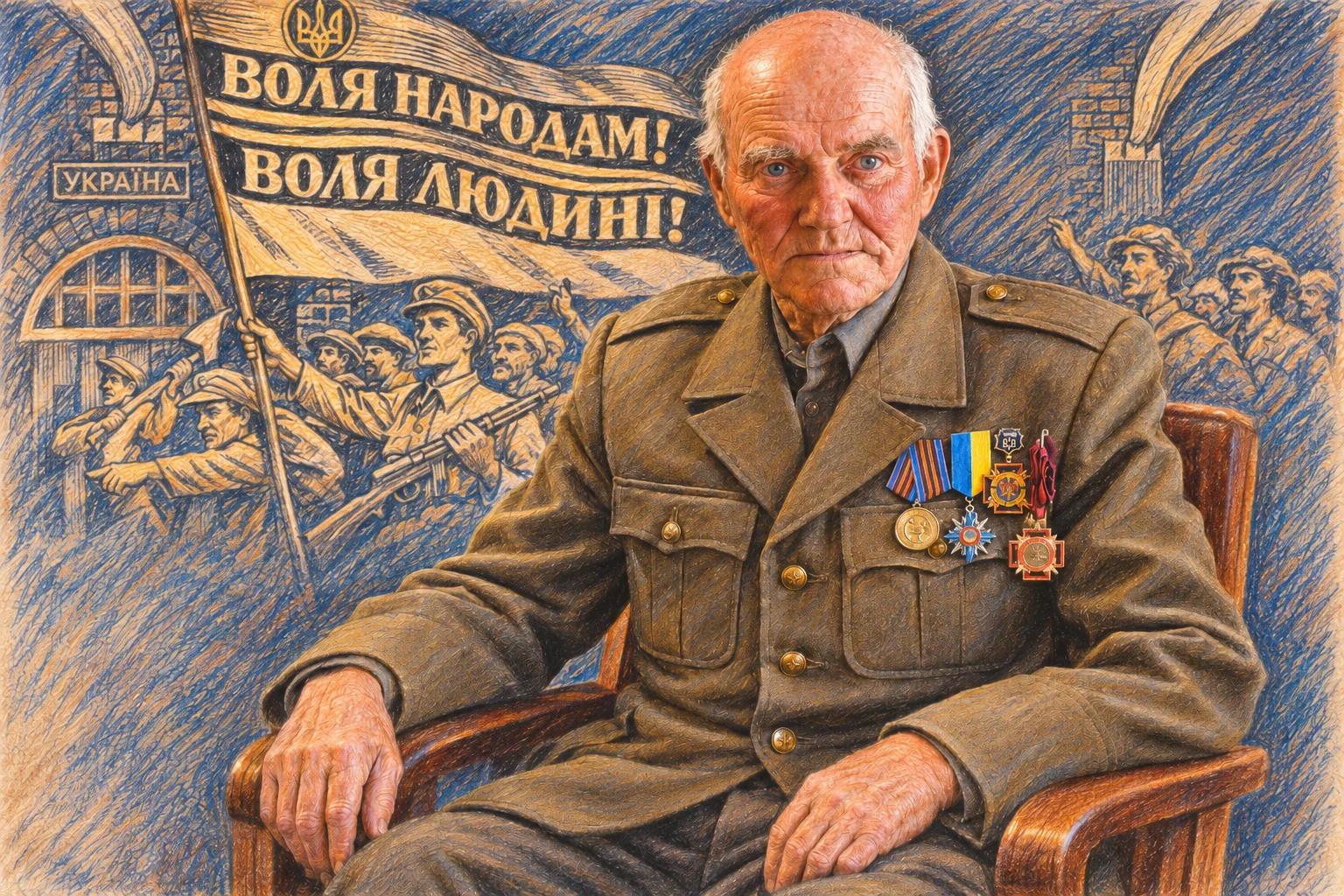
The brotherhood gave Mandyk a military uniform, which he wore to meetings and in photographs. Surviving images from the final years of his life show how much importance the elderly man attached to this gift. The uniform connected him to his youth and to the people he regarded as his comrades-in-arms.
Why Khasman Called Himself a Banderite
In interviews conducted during his lifetime, Mandyk did not conceal his positive assessment of his participation in the UPA.
He called himself a Banderite and regarded the designation as an honorable one. For him, it was associated primarily with the particular people among whom he had found himself as a teenager, their assistance, their shared lives, and their armed struggle.
For readers in Israel, the origin of the term needs explanation. “Banderites” came to refer to supporters of Stepan Bandera, one of the leaders of the Organization of Ukrainian Nationalists. In Soviet journalism and propaganda, the word was widely used as a blanket term for the Ukrainian nationalist and anti-Soviet underground, sometimes regardless of an individual’s actual organizational affiliation.
In contemporary Ukrainian and international historical memory, attitudes toward Bandera and the movement associated with him remain controversial. The reasons involve both the struggle for Ukrainian statehood and the OUN’s ideology, its attitudes toward other ethnic groups, and the actions of nationalist movement members during the war.
Khasman’s words must therefore be understood as an expression of his personal identity, not as a definitive historical assessment of the entire organization. His experience was specific, connected to particular commanders and comrades, while the history of the OUN and UPA is far broader and includes events that Mandyk himself never witnessed.
The Ukrainian Nationalist Decalogue and Insurgent Songs
Even in old age, Khasman could recite the “Decalogue of the Ukrainian Nationalist” from memory.
This text, written by Stepan Lenkavskyi in 1929, became one of the OUN’s well-known ideological documents. It consists of ten principles devoted to loyalty to the nationalist cause, discipline, struggle, and willingness to make sacrifices.
Some of its formulations reflect the radical character of interwar political ideology. For Khasman, however, the Decalogue was associated with everyday life in an insurgent unit. He recalled that the fighters recited it morning and evening, and he continued to repeat lines he remembered decades later.
Mandyk also sang Ukrainian insurgent songs and enjoyed telling stories about the commanders under whom he had served. In 2011, historians recorded some of these memories, while photographs and video materials became important evidence of his final years. By February 2013, singing had become difficult because of problems with his vocal cords, but he could still remember the main principles of the Decalogue.
This detail illustrates the strength of his memory. A man who had long since left military life, served in the Soviet Army, raised children, and spent decades working at a mine still retained texts he had heard as a teenager in the forest.
Wounds, Amputation, and a Wheelchair
The severe injuries Mandyk suffered during the NKVD ambush continued to affect his health. In old age, his left leg was amputated, and he was forced to use a wheelchair. Biographical publications associate his health problems with the consequences of his old wounds, although no complete medical history is available in public sources.
In June 2011, Volodymyr Viatrovych wrote that Khasman was sitting in a borrowed wheelchair. Lesia Bondaruk later explained that a Jewish organization had provided him with an older wheelchair, but using it was difficult. Operating its manual mechanism required considerable effort, and the elderly man’s arms were painful.
Despite his many years of work, participation in the veterans’ movement, and recognition among some historians, the question of obtaining a suitable wheelchair remained unresolved for a long time. In February 2012, young members of the Ukrainian Youth Association collected donations and purchased a new wheelchair for Khasman, which they delivered to Hrybovytsia.
This episode is unrelated to military operations or historical controversies, but it is essential to a complete account of his final years. A man who had survived the Holocaust, war, imprisonment, and decades of labor needed ordinary practical assistance in old age. Ultimately, that assistance came from people for whom his biography had significance.
May 2011: Historians Visit Hrybovytsia
One of the most important events in preserving Mandyk’s story was a meeting with researchers in May 2011. Historian Volodymyr Viatrovych, researcher Lesia Bondaruk, and Vasyl Kushnir, representing the Volhynian UPA veterans’ brotherhood, traveled to Hrybovytsia.
Bondaruk later recalled that they were greeted in the courtyard by a smiling elderly man in a wheelchair. The conversation took place in Khasman’s home and covered almost his entire life: his parents, childhood in Drohobych, Nazi occupation, escape from the Bronytsia Forest, the Ukrainian families who sheltered him, service in an insurgent unit, his wounds, NKVD interrogations, and the postwar years.
The researchers recorded the names of people whom Mandyk still remembered decades later. It is largely thanks to these conversations that many details absent from official biographical summaries and brief newspaper articles are known today.
On June 8, 2011, Istorychna Pravda published Volodymyr Viatrovych’s extensive article, “Повстанський Гаврош Мандик Хасман” (“The Insurgent Gavroche: Mandyk Khasman”). It included recollections, photographs, and additional testimony. Lesia Bondaruk subsequently prepared her own detailed article, published on August 14, 2020, on the Drohobych-based website Maidan.
Bondaruk’s work is particularly valuable for its family information. It revealed the names of Khasman’s daughters and granddaughter, details of his long employment at the mine, his journey to visit Frida in America, and Kateryna and Natalia’s visit to Savyk in Brooklyn. Without these details, Khasman’s story would have remained primarily a military biography, even though his life continued for many decades after the war ended.
February 2013: His Final Interviews Published During His Lifetime
On February 12, 2013, ZAXID.NET published an article titled “На Волині живе єврей-воїн УПА” (“A Jewish UPA Veteran Lives in Volhynia”). It described the elderly Khasman, his disability, participation in the insurgent movement, injuries, and attitude toward the events of his youth.
The journalists presented his recollections of nine months under investigation, his efforts to conceal his combat past, and his friendly relationships with insurgents. Particular attention was paid to the fact that former comrades and their children continued to maintain contact with the veteran many decades later.
This publication is valuable as a source produced during his lifetime, although it, too, contains some inaccuracies. For example, Khasman’s age in February 2013 was given as 84, although, with a birth date of October 11, 1929, he was still only 83. Even interviews published while their subject was alive must therefore be compared with one another and checked against the established chronology.
By then, Mandyk’s health had deteriorated significantly. He used a wheelchair, suffered from the consequences of severe injuries, and could not always sing as he once had. Nevertheless, he continued speaking with journalists interested in his past and telling stories about the people with whom his life had become connected when he was still a teenager.
August 24, 2013: Death on Ukraine’s Independence Day
Mandyk Khasman died on August 24, 2013, in the village of Hrybovytsia in Volhynia. He was 83 years old, less than two months away from his 84th birthday.
His death coincided with Ukraine’s Independence Day, a coincidence that Lesia Bondaruk later specifically noted, given the importance of Ukrainian independence to Khasman himself.
The exact medical cause of death is not stated in the principal published biographical materials. Nor was it possible to establish his precise burial place from those sources. These details remain subjects for possible further archival and local-history research.
After Mandyk’s death, his recollections, photographs from different periods of his life, archival documents, interview recordings, and information about his relatives survived. In 2022, materials about him were included in a collection prepared by the Ukrainian Institute of National Memory to mark the 80th anniversary of the UPA. This brought his testimony into a broader body of recollections by participants in the Ukrainian armed underground.
Why This Story Matters to Israel and Ukraine
Mandyk Khasman’s life cannot be described by a single label. He was a Jew from Drohobych, the son of a former Austro-Hungarian officer, and a child who lost his parents and brothers during the Holocaust. As a teenager, he hid under a Ukrainian name, lived with families who helped him survive, and joined the Ukrainian Insurgent Army, where, in his own words, he found comrades who knew about his Jewish origins.
Later, he survived severe wounds, an NKVD investigation, interrogations by Soviet military counterintelligence, and long decades when speaking openly about service in the UPA could be dangerous. He served in the Soviet Army, worked as a miner, started a family, raised two daughters, and lived to see a granddaughter. Eventually, Mandyk managed to restore contact with relatives whom the Holocaust had scattered across different countries.
For Israel, this biography is of interest primarily as part of the broader history of Eastern Europe’s Jewish population. The Catastrophe destroyed thousands of families whose fates are still being reconstructed through scattered documents, eyewitness testimony, photographs, and postwar correspondence. We often know the dates of deportations and the names of death camps, but we know far less about how people lived before the war, who helped them survive, and what happened to them after liberation.
The story of the Khasman family reveals these events across several generations. The father, a former Austro-Hungarian Army officer, was murdered by the Nazis. His children were separated by war: one son became a participant in the Ukrainian insurgent movement, one daughter survived Auschwitz and moved to America, the youngest son settled in Brooklyn, and other relatives escaped destruction through evacuation. Decades later, Mandyk’s daughter and granddaughter visited his surviving brother in New York.
All of this concerns one Jewish family from the Ukrainian city of Drohobych. Their story does not make Ukrainian-Jewish relations during the war simple, nor does it erase antisemitism, pogroms, Nazi collaboration, or documented crimes against Jews. But it also makes it impossible to forget the particular Ukrainians who sheltered persecuted children and the people of Jewish origin whose lives became connected with the Ukrainian underground.
Mandyk Khasman did not leave behind multi-volume memoirs. Nevertheless, thanks to his meetings with historians, the names of his parents, brothers, sisters, rescuers, commanders, investigators, daughters, and granddaughter have been preserved. We know where he was born, how he survived the Holocaust, why he changed his name, which units he belonged to, where he worked, and how he restored family connections.
Questions remain for which no confirmed answers are yet available: the subsequent fate of his cousin Kaili, his wife’s name and detailed biography, his complete NKVD investigative file, the precise circumstances of certain combat operations, the history of his American relatives, and Mandyk’s own burial place. Not all these gaps may be filled, but they do not invalidate the biography that is already known.
In our “Jews from Ukraine” series, we seek to tell precisely such stories—not to create convenient historical symbols but to preserve the memory of real individuals. Mandyk Khasman lived a life that contained far more than one unusual episode involving a Jew serving in the UPA. He survived the destruction of his family, war, and persecution, then worked for decades, raised children, and eventually reconnected with relatives he had believed lost.
His story deserves to be known not only to historians but also to readers in Israel, Ukraine, and other countries where descendants of Eastern European Jewish families now live.
Sources and Materials
This biographical article is based primarily on Mandyk Khasman’s recollections recorded during his lifetime by Volodymyr Viatrovych and Lesia Bondaruk, as well as journalistic materials published between 2011 and 2013.
- Volodymyr Viatrovych. “The Insurgent Gavroche: Mandyk Khasman.” Istorychna Pravda, June 8, 2011.
- Lesia Bondaruk. “Khasman Zhysi Mandyk, a Native of Drohobych Living in Volhynia.” Maidan, August 14, 2020.
- “A Jewish UPA Veteran Lives in Volhynia.” ZAXID.NET, February 12, 2013.
- Ukrainian Institute of National Memory. Materials Marking the UPA’s 80th Anniversary, 2022.
The historical context of the destruction of Drohobych’s Jewish population is presented on the basis of Holocaust research, including Yad Vashem materials. Sources differ in their accounts of certain events in Khasman’s wartime biography, the circumstances of his captivity, and the recovery of his real name. Where independent documentary confirmation is insufficient, the information is presented as the participant’s own recollections.
If it matters to you to understand how world events affect Israel and Ukraine, add NAnews to your Google preferred sources and follow our publications.