
The Israeli Telegram channel Israel | Trukha on June 5, 2026, spread a message about a leak of Russian defense documents, according to which Russia might have been preparing to supply Iran with aviation missiles and components for Su-35 fighters. The publication mentions air-to-air and air-to-ground missiles, and the foreign customer in the documents is designated with the code “K10”.
Behind the short message lies a larger story: the Russian-Iranian military connection, which after Russia’s full-scale invasion of Ukraine became one of the main security factors for two regions at once — Eastern Europe and the Middle East. Iran helps Moscow with drones and technologies for strikes on Ukraine, and Russia, judging by the published documents, may be paying with aviation equipment, weapons, and components.
It is important to clarify immediately: the Telegram channel is not the primary source of this story. Previously, the English-language publication UNITED24 Media published material about a package of Russian defense documents, which talks about arms supplies to Iran until 2027. Separately, Reuters reported that an Iranian military representative had already confirmed the purchase of Russian Su-35 fighters, although he did not disclose the number of aircraft and delivery times.
For the Israeli reader, this is a fundamental detail. We are not dealing with an official statement from Iran or Russia about the transfer of each missile, but with a document leak that needs to be read carefully: as a signal of a possible production and contract chain related to aviation weapons for Iran.
One of the published documents is dated May 13, 2022. The sender is indicated as JSC “Machine-Building Design Bureau “Iskra” named after I.I. Kartukov”, associated with the Russian corporation “Tactical Missile Armament”. The recipient is FKP “Perm Gunpowder Plant”.
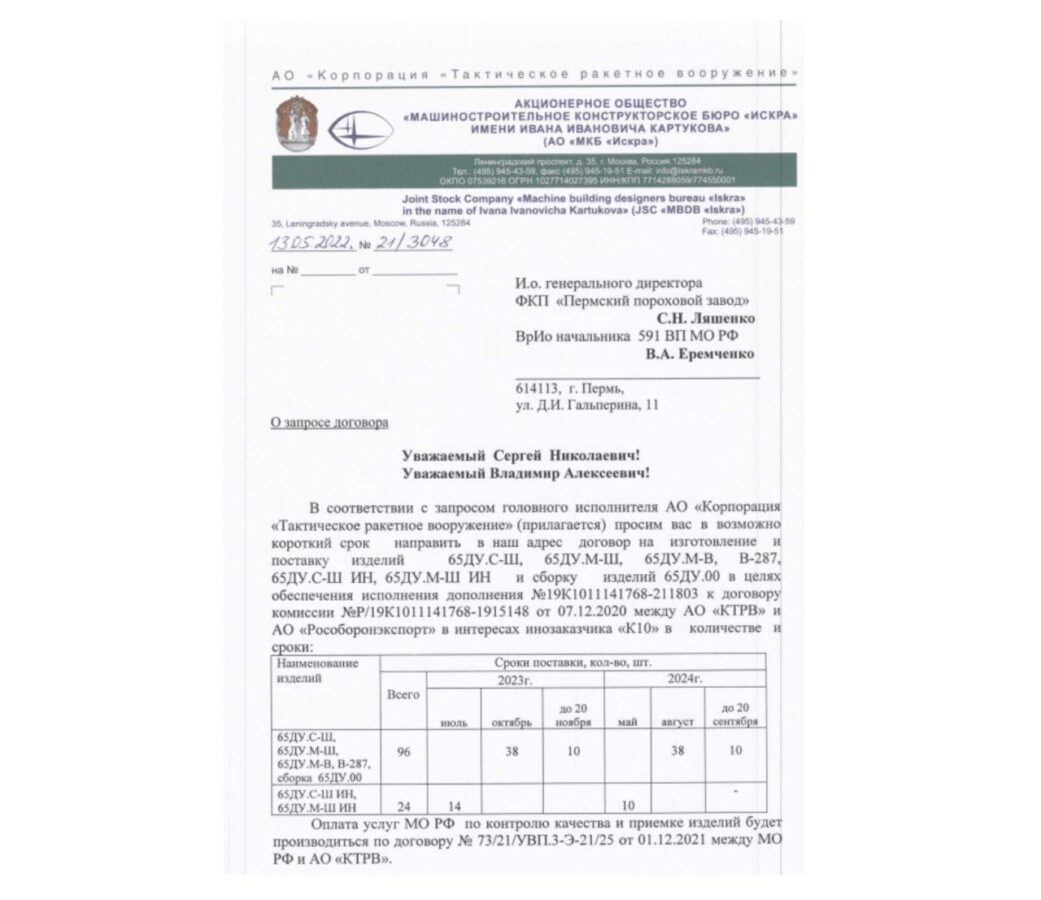
The letter talks about a request for a contract for the manufacture and supply of products with internal designations 65DU.S-SH, 65DU.M-SH, 65DU.M-V, V-287, 65DU.S-SH IN, 65DU.M-SH IN, as well as assembly of product 65DU.00. The document explicitly states that the work is being carried out in the interests of the foreign customer “K10”.
On the visible sheet, there is no open phrase “Iran” and no full name of the missile. This is an important detail for correct presentation.
However, in the overall leak package, sources associate the code “K10” specifically with Iran. UNITED24 Media indicates that the documents relate to Russian supplies of aviation weapons for Iranian Su-35s, and the 65DU products are associated with components for the Kh-38 missile.
The second document, distributed along with the first, is dated December 4, 2024. Its sender is FKP “Perm Gunpowder Plant”. The recipients are JSC “Research Institute of Polymer Materials” and the head of the 591st military representation of the Ministry of Defense of Russia.
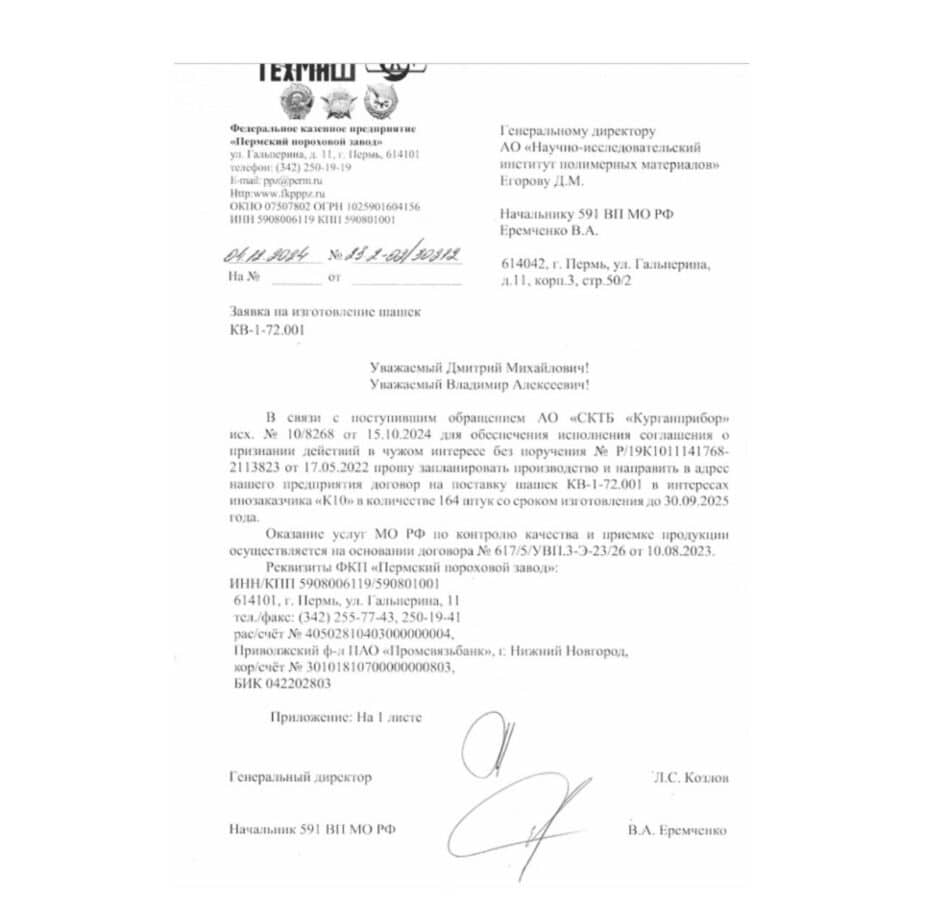
The subject of the letter is “Application for the manufacture of KV-1-72.001 checkers”.
The text states that the Perm Gunpowder Plant requests a contract for the supply of KV-1-72.001 checkers in the interests of the foreign customer “K10”. Quantity — 164 pieces. Manufacturing deadline — by September 30, 2025.
This document is especially important in terms of timing. It shows that it is not only about papers from 2022, but about a chain that, if the leak is genuine, continued after the start of Russia’s major war against Ukraine and could extend into 2025.
According to the published materials, it may be about several types of aviation weapons for Su-35 fighters.
Kh-38 is an air-to-ground missile, including versions with laser guidance. The Telegram publication mentions 120 units.
R-73, also designated as K-73, is a short-range air-to-air missile. The published list indicates 123 units.
R-77, or K-77, is a medium-range air-to-air missile. The publication mentions 42 units.
Kh-31 is a missile that can be used as an anti-radar and anti-ship missile. The list also indicates 42 units.
Individually, these names may sound like technical nomenclature. But together they paint a different picture: Iran could be receiving not just aircraft, but a set of weapons for different scenarios — air combat, strikes on ground targets, attacks on radars, and potential threats to maritime objects.
In this story, it is important to separate primary documents, journalistic publication, international confirmation of the overall deal, and Telegram repost. For the Israeli audience, this is especially important: the topic concerns Iran, Russia, Su-35, and the possible change in the balance of threats around Israel.
The weakest level of the source is the Telegram publication. The Israel | Trukha channel made the topic noticeable for the Israeli audience, but the Telegram channel itself is not the primary source of the documents and does not conduct full international verification. Its role here is more informational: it brought the topic into the Israeli field.
A more serious level is the publication by UNITED24 Media. It is there that the leak of Russian defense documents is described in detail, the Kh-38, K-73/R-73, K-77/R-77, and Kh-31 missiles are named, as well as the connection with Su-35 fighters and the customer “K10”.
But even here a caveat is needed. UNITED24 Media is a Ukrainian English-language platform operating in the context of Russia’s war against Ukraine. This does not make the data false, but requires caution: it is important for the reader to understand that the source is on Ukraine’s side and publishes materials about Russian-Iranian military cooperation as a direct threat.
The strongest external anchor in this story is Reuters.
The agency separately reported that a senior IRGC representative confirmed Iran’s purchase of Russian Su-35s. Reuters did not confirm the entire list of missiles from the leak and did not disclose the timing or number of aircraft, but confirmed the main basis of the plot: Iran’s deal for Russian Su-35s indeed exists at the official level.
Another important source is “Ukrainian Pravda”, which, citing UNITED24 Media and documents analyzed by “Economic Pravda”, wrote that the contract chain for Yak-130 and Su-35 for Iran remains in force, and the foreign customer is referred to in the documents as “K10”.
Therefore, for the Israeli reader, the correct conclusion should sound like this: the overall deal of Iran with Russia for Su-35 is confirmed quite reliably; the connection of the code “K10” with Iran is confirmed by publications based on the leak; the specific list of missiles and components should be presented as data from published documents, not as an officially recognized supply of each unit of weaponry.
In other words, the material deserves attention not because Telegram wrote a loud post, but because the Telegram publication coincided with a broader chain: the English-language publication by UNITED24 Media, documents from the Russian military-industrial complex, Ukrainian investigative materials, and separate confirmation of the Su-35 deal from Reuters.
For Israel, this is enough to consider the story as a serious risk signal. But not enough to unequivocally state: “all the listed missiles have already been delivered to Iran.” A more accurate formula: the published documents indicate possible preparation of a Russian production and contract chain for aviation weapons for Iran, and the fact of Iran’s purchase of Su-35s has already received external confirmation.
For Israel, Iran is not a distant regional player, but a central source of threat. Tehran has been building a system of pressure through its armed forces, missile programs, and proxy structures, including Hezbollah, the Houthis, and other associated groups for decades.
Iran’s weak point for a long time was aviation.
Its fleet largely relies on old aircraft, some of which date back to the period before the Islamic Revolution of 1979. The appearance of the Su-35 itself does not make Iran equal to Israel in the air, but it changes the level of threat.
If Russian missiles, components, technical maintenance, training, and logistics are added to the aircraft, it is no longer a symbolic purchase. It may be an attempt to create a full-fledged aviation contour of a new level for Iran.
For Israel, this is sensitive in several directions at once.
- Firstly, modern air-to-air missiles can complicate the planning of long-range operations. Even if Israeli aviation maintains a technological advantage, the appearance of more modern means of air combat in Iran affects risk calculations.
- Secondly, anti-radar missiles like the Kh-31 are associated with a threat to radars and air defense systems. For a country that lives in a mode of constant military planning, such details cannot be considered secondary.
- Thirdly, the Iranian military system rarely remains only Iranian. Technologies, tactics, instructors, and individual solutions can spread to Tehran’s allied structures, even if the aircraft themselves physically remain in Iran.
For the Israeli audience, this story is as important as it is for Ukraine: NAnovosti News of Israel Nikk.Agency considers such leaks as part of one big process, where Russian-Iranian military cooperation gradually turns into a threat to several regions at once — from Ukrainian cities to the Israeli sky.
After 2022, Iran became one of Russia’s key military partners. It was the Iranian Shahed that became a symbol of night attacks on Ukrainian cities, energy, residential areas, and civilian infrastructure.
Moscow received from Tehran a tool of cheap mass terror.
Now the published documents show the reverse side of this deal. Russia can transfer to Iran what Tehran especially needs: modern aircraft, aviation missiles, components, and production support.
This makes the connection more dangerous.
Ukraine pays for it with destroyed cities and lost lives. Israel may face its consequences in another plane — through the strengthening of an enemy that has long considered the Jewish state a target.
For Ukraine, the documents are important not only as evidence of another Russian-Iranian contract. They help to understand the price Moscow might have paid Tehran for support in the war.
Iran is not a neutral observer.
It is an enemy of Ukraine and Israel, a participant in a single anti-Western military architecture, where drones, missiles, aircraft, technologies, and political support are linked into a single system.
Russia uses Iranian drones against Ukraine. Iran, in turn, receives from Russia access to what can strengthen its own army and its positions in the Middle East.
For Israel, this means that the war in Ukraine is not “somewhere far away.” It directly affects the balance of power around Iran. The longer Russia’s aggression continues, the deeper the military-technical dependence of Moscow and Tehran on each other becomes.
For the US and Western allies, this is also a worrying signal. Su-35s with modern missiles in Iran’s hands are not only a problem for Israel. It is a factor for the Persian Gulf, for American bases in the region, for sea routes, for Washington’s allies, and for the entire system of containing Iran.
It is important to present this story accurately.
There is no public official confirmation yet that each of the listed missiles has already been delivered to Iran. The documents are published as a leak, which means some data requires independent verification. On individual sheets circulating on the network, the code “K10” is not directly deciphered as Iran.
But several important elements are already lining up in one line.
Reuters reported that an IRGC representative confirmed Iran’s purchase of Russian Su-35s. UNITED24 Media published materials stating that Russian weapons for Iran are planned until 2027. Ukrainian sources previously wrote that the Russian-Iranian contract chain for Su-35 and Yak-130 remains in force, and Iran is referred to in the documents as the foreign customer “K10”.
Therefore, a careful formula sounds like this: the published documents indicate the preparation of a production and contract chain in the interests of the customer “K10”, which leak sources associate with Iran. This chain, according to publications, could include components and weapons for Russian Su-35s.
This is not a weak formulation. On the contrary, it makes the material more reliable.
The story with Russian missiles for Iran is important not only as another leak from the Russian military-industrial complex. It shows that Russia’s war against Ukraine and the Iranian threat to Israel are increasingly becoming parts of one system.
Tehran helps Moscow strike Ukraine. Moscow, according to published documents, helps Tehran strengthen aviation and military infrastructure. As a result, Russian aggression against Ukraine returns to the Middle East already in the form of new risks for Israel.
This is the main meaning of the leak.
If the documents are confirmed, it is not about a one-time purchase and not about a random contract. It is about a military bridge between two regimes that work against the interests of Ukraine, Israel, the US, and Western allies.
For Israel, such a signal cannot be ignored. The Russian-Iranian axis is no longer just a topic of the Ukrainian war. It is becoming a factor of Middle Eastern security — with aircraft, missiles, factories, coded customers, and delivery deadlines until 2027.
That is why NAnovosti News of Israel Nikk.Agency considers this story not as a technical leak, but as a warning: when Russia and Iran strengthen each other, the consequences may come not only to the Ukrainian front but also to Israel’s borders.