
In a city about 30 kilometers from the front line, hundreds of schoolchildren simultaneously performed a choreographic performance to a live set by DakhaBrakha. Everything took place underground — in schools, parking lots, and shelters. For Israel, this story has another connection: earlier, Israeli partners helped equip underground schools in the Zaporizhzhia region.
Author: Elena Gunko
On October 5, 2026, the Ukrainian edition NV reported on one of the most unusual events of the GOGOLFEST Pokrova festival, held in Zaporizhzhia from October 1 to 4, 2026. The culmination was the performance “Hymn of Life” (Ukr. «Гімн життя») directed by Vladyslav Troitsky: DakhaBrakha played live in an underground parking lot, and schoolchildren in different parts of the city simultaneously moved to this music, connected into one performance by a telebridge.
On the surface, at this time, remained a frontline city that regularly lives under the threat of Russian drones, missiles, and guided bombs. Therefore, the underground format here was not a scenographic trick. Almost the entire GOGOLFEST program — about 95% of events — was initially moved to bunkers, bomb shelters, parking lots, and other protected spaces. Zaporizhzhia is located approximately 30 kilometers from the front line.
Fifteen minutes simultaneously underground
At the center of the “Hymn of Life” were children. While DakhaBrakha played a live set, schoolchildren synchronously performed approximately 15-minute choreographic sketches. Through movements and decorations, they told about their own fears, the war, and how they see the future. Images from different sites were combined into a media bridge, and the broadcast was displayed on large screens.
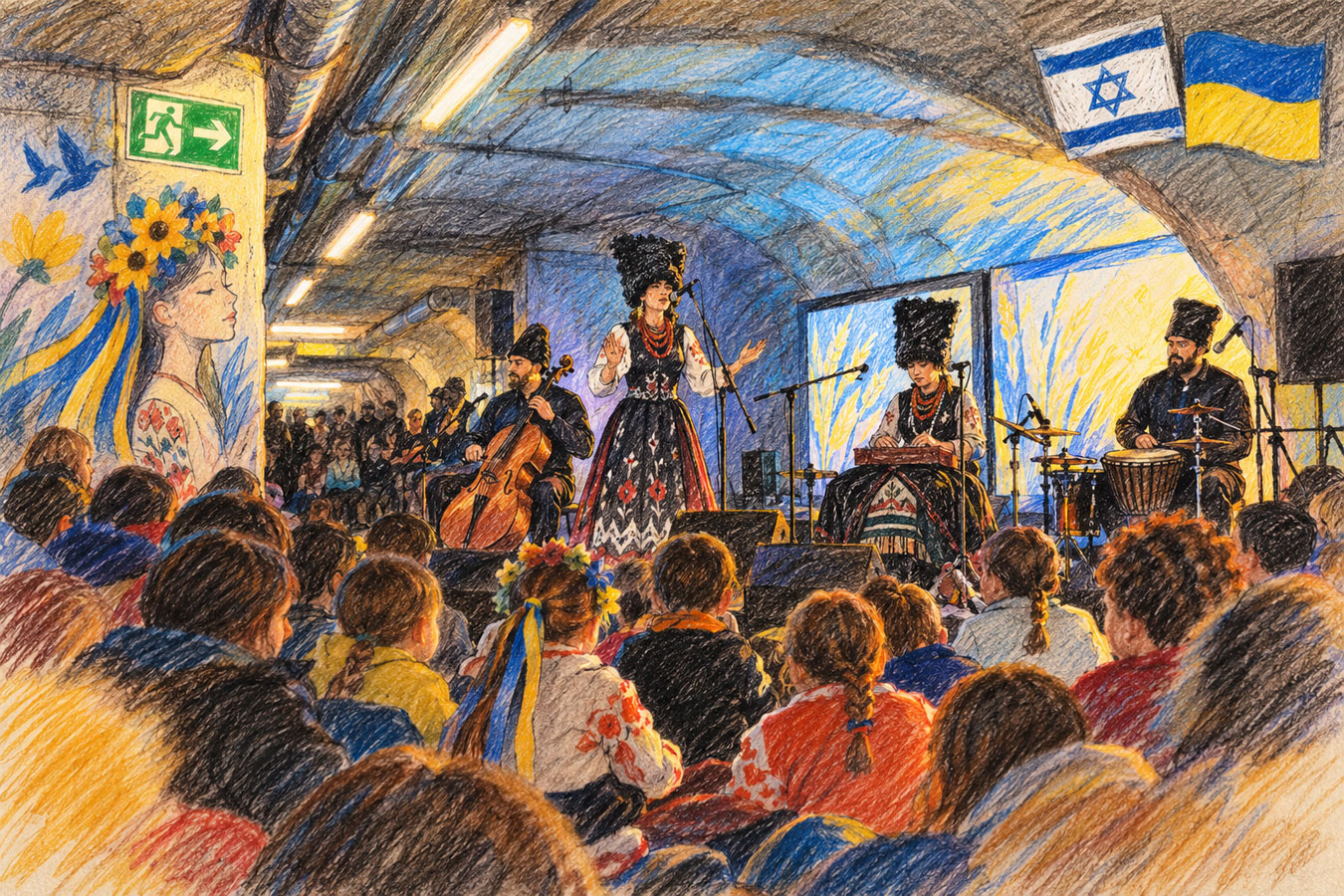
DakhaBrakha is one of the most recognizable Ukrainian musical groups in the world. The quartet emerged in Kyiv in 2004 around the “Dakh” theater of director Vladyslav Troitsky and combines Ukrainian folk polyphony with rhythms and instruments from various musical traditions. Over two decades, the group has performed at major festivals and stages in Europe, the USA, and other countries and has become one of the most notable cultural symbols of modern Ukraine beyond its borders. The Israeli audience is already familiar with the group: DakhaBrakha performed in Tel Aviv in 2018 and returned with a concert at the Barby club in December 2021, gathering a full house.
It turned out to be a performance without a single stage. The musicians were in one underground space, the children in others, and the audience could be in several other points of the city, but everything that happened existed at the same moment and to the same music.
It was this synchronicity that became the basis of the national record.
Here, however, there is a discrepancy in the numbers. NV, citing the GOGOLFEST press service, reports 16 underground schools. The Zaporizhzhia City Council and the regional military administration, recording the record itself, mention 15 schools. The official wording of the achievement is the largest number of underground schools that simultaneously participated in a flash mob to a live concert by the Ukrainian group DakhaBrakha in Zaporizhzhia.
Therefore, it is more accurate to separate the two numbers: festival organizers speak of 16 involved schools, while the National Register of Records of Ukraine recorded the simultaneous participation of 15.
Certificates of the record were received by the main director of GOGOLFEST Pokrova Vladyslav Troitsky, Deputy Head of the Zaporizhzhia Regional Military Administration Oksana Matviishina, and Secretary of the Zaporizhzhia City Council Regina Kharchenko.
In Israel, such words sound familiar. But there is a difference
For the Israeli reader, the very construction “children study during the war” does not require a long explanation. School protected premises, sirens, moving the class to a safe zone — all this is familiar to Israeli families.
But the Ukrainian underground school in a frontline region is somewhat different from the familiar Israeli miklat, where they descend during an alarm. We are talking about full-fledged educational spaces underground: with classrooms, furniture, equipment, and the ability to conduct regular lessons there during the school day.
This has become a separate infrastructure of war. On October 1, the Ministry of Education and Science of Ukraine announced the completion of the construction and equipment of four more underground schools in Zaporizhzhia and the region — two in the city itself and two in the communities of the region. Together they are designed for 1700 places.
Back in May, NAnews — Israel News | Nikk.Agency reported that Ukraine is building dozens of such facilities in frontline regions. At that time, 113 underground schools were at various stages of construction, and more than a hundred were already operational. We wrote more about this system here.
What began as a forced response to the impossibility of normal face-to-face learning gradually turned into a separate school reality. And now it has also become a space for art.
There is already an Israeli trace in this story
The connection with Israel exists here not only at the level of the experience of living under shelling that is understandable to us.
On March 18, 2026, the Ministry of Foreign Affairs of Ukraine publicly thanked Israeli partners for helping children in frontline regions. According to the Ukrainian side, Israeli support made it possible to equip underground schools in the Kharkiv and Zaporizhzhia regions with modern interactive panels necessary for a normal educational process. NAnews wrote about this immediately after the statement of the Ministry of Foreign Affairs of Ukraine.
A few days later, another important detail emerged. On March 24, the Ukrainian embassy in Israel thanked Israeli sponsors and separately the Leonid Nevzlin Foundation for supporting schools in Kharkiv and Zaporizhzhia. The diplomatic mission reported on strengthening the material and technical base of underground schools and equipping them with modern equipment, including interactive panels. NAnews dedicated a separate article to this story.
At the same time, it is important not to connect the facts more strongly than the sources allow. There is no list in open publications that would allow us to assert that each of the 15 or 16 schools that participated in the “Hymn of Life” now received Israeli equipment. The fact of Israeli assistance to underground schools in the Zaporizhzhia region is confirmed.
But this connection does not become less noticeable. Israeli benefactors helped equip the very system of protected education, which a few months later became the venue for a national-scale event.
GOGOLFEST went underground with the city
GOGOLFEST is not just a music or theater festival. It appeared in Kyiv in 2007 at the initiative of director Vladyslav Troitsky and his “Dakh” theater as a space where theater, music, cinema, visual art, and performance exist not separately but collide and mix with each other. The first festival took place in the “Mystetsky Arsenal,” and then GOGOLFEST began to explore former factories, pavilions, film studios, and other spaces that themselves became part of what was happening.
In its first decade, GOGOLFEST became one of the most notable projects of Ukrainian contemporary culture. After Kyiv, the festival began to travel around the country: it was hosted by Mariupol, Vinnytsia, Dnipro, Kherson, and other cities. In 2019, GOGOLFEST was included in the top five European festivals according to the EFFE Awards, and after the start of the full-scale war, the festival’s projects were shown in Oslo, Berlin, Hamburg, Düsseldorf, Prague, and Paris. In 2024, GOGOLFEST also came to Zaporizhzhia.
Therefore, its return here in the fall of 2026 is no longer just another point in the festival program. Zaporizhzhia is located about 30 kilometers from the front line, and the usual GOGOLFEST idea of changing urban space here took on a completely different meaning. Previously, the festival turned a factory or an abandoned building into a stage. Now the stages have become bunkers and shelters: organizers reported that about 95% of GOGOLFEST Pokrova: TimeCode events were to take place underground.
The TimeCode itself was built around three dimensions of Ukrainian time — past, present, and future. The program combined theater, music, performances, contemporary art, discussions, and international projects. But in frontline Zaporizhzhia, this concept almost ceased to be an artistic abstraction: to talk about the future, people first needed to find a safe place in the present.
This became especially evident in the story with the children and DakhaBrakha. Hundreds of schoolchildren participated in a simultaneous artistic action not from ordinary assembly halls and not from school stages. They were in underground schools — spaces that appeared because the school above in the city near the front can no longer be considered a sufficiently safe place.
But the number they performed was not dedicated to war or shelter.
It was called “Hymn of Life”.
And perhaps that is why the national record here turns out to be far from the most important number. Much more significant is another: a few dozen kilometers from the front, hundreds of children simultaneously took to the stage — even if this stage was underground — and spoke not only about the fear that the war brought.
They spoke about life that continues above. And about the future that they still intend to keep for themselves.