
Raphael Lemkin gave the world the word “genocide”. A Polish-Jewish lawyer who studied in Lviv, he lost 49 relatives, including his parents, during the Holocaust. Later, his work became one of the intellectual foundations of the 1948 UN Convention on the Prevention of the Crime of Genocide. But for Ukrainian history, Lemkin’s name has another significance: in 1953, in New York, he spoke about Soviet policy in Ukraine as the systematic destruction of the Ukrainian nation.
Author: Alexander Khmelnitsky
Today, his name is borne by a Ukrainian non-governmental organization — the Raphael Lemkin Society, which unites lawyers, researchers, cultural figures, and human rights activists. One of the issues it works on during the current war may seem museum-like at first glance: what is happening to Ukrainian collections and cultural institutions in territories occupied by Russia?
But very quickly, this question ceases to be only about museums.
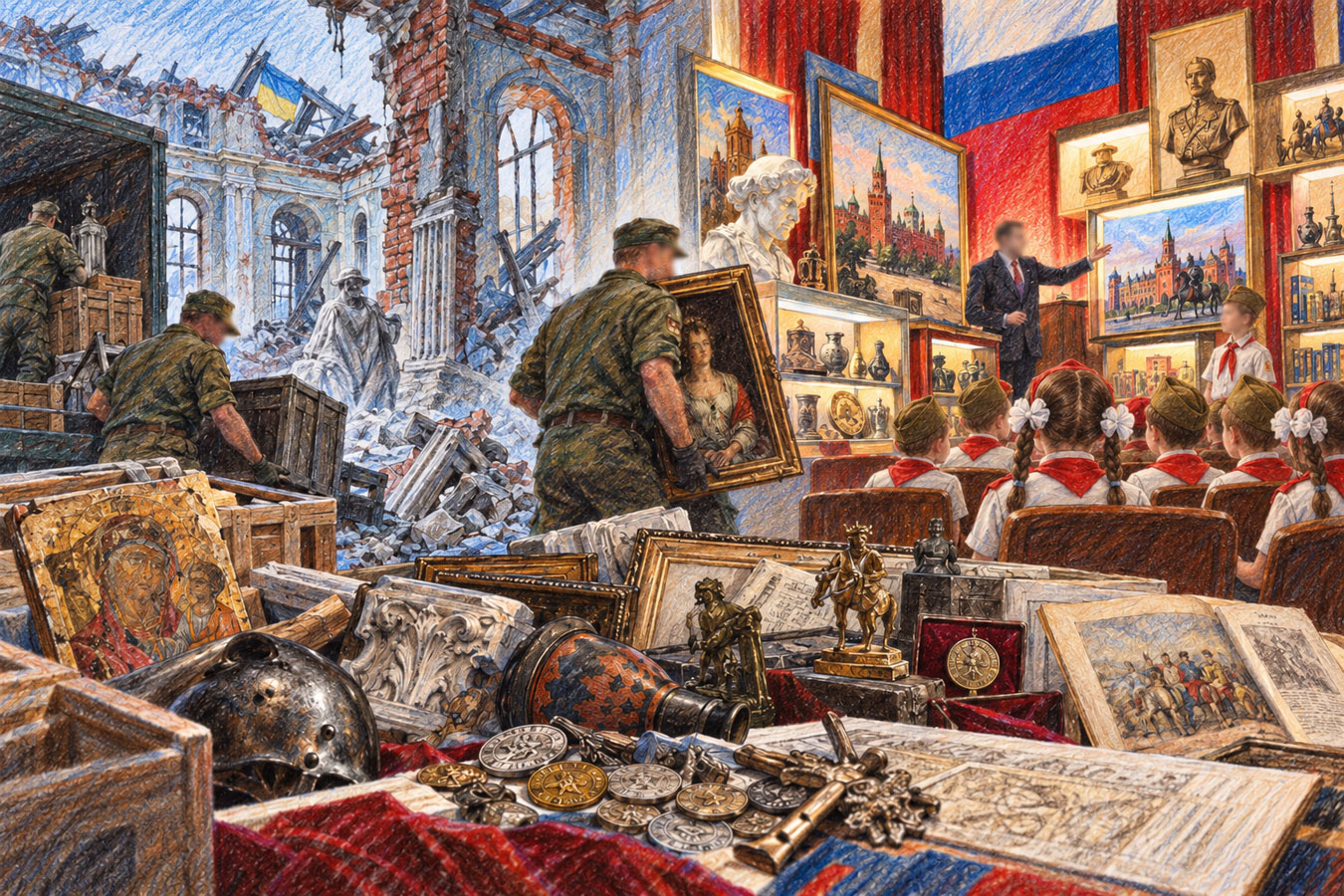
Because a museum can be destroyed. Paintings, documents, and archaeological finds can be taken out of it. Or the museum can be left open — and the history it tells people can be changed.
This is exactly the picture Ukrainian researchers are trying to document today.
In materials published with the participation of NeMo: Ukrainian Heritage Monitoring Lab and the Raphael Lemkin Society, it is not only about the physical losses of Ukrainian museums. Researchers record changes in exhibitions, the content of lectures and excursions, the emergence of Russian historical narratives, and the use of cultural institutions to influence the perceptions of residents of occupied territories about their own history and identity.
On the air of “Suspline Culture” on October 6, 2026, legal expert and analyst of the Raphael Lemkin Society Darina Pidgornaya and curator of the documentation direction NeMo Elizaveta Yevseeva spoke about this. Pidgornaya is conducting a detailed study on the same topic concerning museums in the Donetsk, Luhansk, Zaporizhzhia, Kherson regions of Ukraine, and occupied Crimea.
Why the society in Ukraine bears the name of a Jewish lawyer
For the Israeli reader, the biography of Lemkin himself is important here.
He was born in 1900 to a family of Polish Jews, studied law in Lviv, and in 1944 introduced the term genocide. Lemkin tried to describe a crime aimed not just against many individuals, but against the existence of a particular national, ethnic, racial, or religious group as such.
The Nazis destroyed almost his entire family. According to the US Holocaust Memorial Museum, Lemkin learned about the death of 49 relatives, including his parents.
But an important detail for the current discussion is how broadly Lemkin himself initially understood the destruction of a group. He studied not only mass killings but also the destruction of culture, language, religious life, social institutions, traditions — through which a group continues to be aware of itself. The Raphael Lemkin Society directly calls this part of his legacy one of the intellectual foundations of its work.
In 1953, Lemkin delivered a lecture in New York titled “Soviet Genocide in Ukraine.” He spoke about the destruction of the Ukrainian intelligentsia, church, and peasantry during the artificial famine and the change in Ukraine’s demographic structure as interconnected elements of a blow to the nation.
Therefore, the name of today’s Ukrainian Lemkin Society is not a decorative historical reference.
The organization returns to the question Lemkin himself dealt with: what happens when attempts are made to destroy not only people but also the mechanisms through which a people preserves and transmits its identity?
For Israel, this question is also not abstract. The history of the Holocaust is the history of the murder of people, but at the same time, the history of destroyed communities, schools, synagogues, archives, books, cemeteries, language, and an entire Jewish world of Europe. Therefore, the debate about who owns the memory and who gets the right to tell the story of the dead and survivors is understood here without a long theoretical introduction.
NANews has already written in detail about how the struggle for memory formulations manifested around Babyn Yar: after the mass murder of Kyiv’s Jews, Soviet official memory for decades preferred to dissolve their Jewish identity in the general formula of “Soviet citizens” killed. “85 years of the Babyn Yar tragedy: Yad Vashem unites the memory of Israel, Ukraine, and Ukrainian expatriates”
First, the museum must be appropriated
The study of occupied museums does not begin with a tour, but with documents.
After the Russian pseudo-referendums of 2022, the acts of so-called “accession” of occupied parts of the Donetsk, Luhansk, Zaporizhzhia, and Kherson regions included provisions on property, which Russia extended to cultural values and institutions.
Pidgornaya calls this stage legal appropriation.
Then Russian normative acts are adopted, museums are included in the Russian management system, and items from Ukrainian collections receive a different administrative status. In December 2023, a Russian law was adopted providing for the inclusion of museum items from occupied territories in the State Catalog of the Museum Fund of the Russian Federation until 2027.
The sequence is as follows: first military control over the territory, then the Russian legal framework, then the inclusion of the Ukrainian institution and its collection in the Russian museum system.
And then you can change what this museum tells the visitor.
Kherson and Mariupol: when collections leave with the occupation
The first and most noticeable layer is physical losses.
During the occupation of Kherson, Russian forces removed items from local cultural institutions. The relocation was presented as “evacuation,” but international human rights activists documented the looting of the city’s cultural institutions.
In Mariupol, the scale of losses is even heavier.
Before the full-scale war, the Mariupol Local History Museum’s collection numbered about 60,000 items. Today, the museum, operating in evacuation, reports that almost 90% of the collection was damaged due to bombings and fire, and the fate of a large number of items remains unknown. Some items were later recognized by employees in Russian reports from occupied Donetsk.
Among the lost and removed are works of art, archaeological materials, and documents. Human Rights Watch separately documented the looting of the Mariupol Local History Museum, the Museum of Folk Life, and the Arkhip Kuindzhi Art Museum. The pre-war collection of the local history museum contained over 53,000 exhibits and a scientific library of about 17,000 books.
Now museum workers are literally rebuilding the disappeared museum anew — at least digitally.
Historian Alexander Gore, who worked in the museum for about twenty years and survived the siege of Mariupol, restored information about the collections from preserved photographs, inventory books, and documentation. Together with the Raphael Lemkin Society, the team created an open digital catalog of lost collections. It already features about 1,700 paintings and graphics by 532 authors.
Thus, a strange 21st-century museum emerges: the building is destroyed, the fate of the items is unknown, and the digital copy becomes both a catalog, a memory, and potential evidence.
But stealing an exhibit does not mean rewriting the museum
After the chaotic 2022, researchers noticed another process.
Museums that continued to operate under Russian control began to gradually change their content. Moreover, as Pidgornaya notes, this happened regardless of the institution’s original profile.
A lecture, exhibition, master class, or excursion could now include the theme of supporting Russian military and the so-called “SVO”. The Russian army was presented as a force supposedly “liberating” the territory, and the war itself as a fight against “Nazism.”
NANews — News of Israel | Nikk.Agency has already written about how the war changes the very optics of Holocaust memory in Ukraine and how Soviet and Russian historical constructs continue to influence the modern conversation about the past. “Memory under Fire: The Holocaust in Ukraine, War, and Russian Imperial Narratives”
In occupied museums, this process is no longer theoretical.
The museum scene itself is changing.
The main visitor is a child
Researchers pay special attention to the audience of such events.
These are schoolchildren, cadet class students, participants of “Yunarmiya” — a Russian military-patriotic youth organization — and other militarized structures. But they can also be ordinary children brought on a class excursion.
Russian military personnel, representatives of occupation administrations, police, FSB, and other security structures speak before them. Children are told about the “Crimean Spring,” Russian military, “liberation” of territories, and the fight against alleged Ukrainian Nazism.
One of the most illustrative projects is called “History of Novorossiya”.
For the Israeli reader, an explanation is needed here. “Novorossiya” is a historical name used by the Russian Empire for a number of territories in the northern Black Sea region conquered in the 18th century. In modern Russian political rhetoric, the term was revived as a tool to assert that the south and east of Ukraine historically belong to Russian space.
The multimedia project consists of short videos of about 10–15 minutes. In one construction, there are Catherine II, Peter I, and already modern figures of the Russian war against Ukraine — for example, Alexander Zakharchenko and Vladimir Zhoga. The videos are shown in museums and cultural centers, and after viewing, children are given additional lessons.
History in such a museum ceases to be an attempt to understand the past.
It must explain the present.
A drone in a showcase next to the Great Patriotic War
Another tool is new exhibitions about the war.
Pidgornaya cites examples from Tokmak, Donetsk, Luhansk, and, according to her information, Mariupol. Museum collections include downed drones, ammunition, equipment fragments, elements of Ukrainian military uniforms.
The frame in which all this is shown is especially important.
The Russian invasion is placed in the continuation of the Soviet narrative of the fight against Nazism. In such a narrative, a direct line is practically drawn between 1945 and the current war: the Russian soldier is again fighting the “Nazi,” only now the “Nazi” is declared to be Ukrainian.
Researchers identify three recurring narratives.
First: “these lands always belonged to Russia”. Ukraine in such a version appears as a historical accident, and the seizure of territory as the restoration of an allegedly natural order.
Second: Russia acts as the sole legitimate heir to the victory over Nazism, and the current war is presented as a continuation of World War II.
The third is related to “traditional values”: Russia is portrayed as the defender of the right faith, family, and morality, and the war acquires an almost spiritual dimension.
Memorial spaces dedicated to fallen Russian soldiers also appear in museums. Their biographies become part of educational work, and the soldiers themselves become role models for children.
Thus, the museum no longer just preserves war items.
It explains who the visitor should consider a hero.
When the FSB comes to the museum
By the end of 2025 — early 2026, Pidgornaya recorded another trend: closer cooperation of cultural institutions with security structures.
This involves military commandants, police, FSB. In the Donetsk, Luhansk, and Kherson regions, ideas of museums at military structures and joint events appear.
Starobilsk in the Luhansk region is especially indicative.
The local history museum used archival materials transferred by the FSB about German spies from World War II in the context of a modern narrative about the alleged historical connection of Ukrainians with Nazism. Museum workers also visited institutions for minors with events about “extremism” and “terrorism,” showing photographs of Ukrainian military, Roman Shukhevych, Stepan Bandera.
Thus, the museum begins to work not only with the past.
It becomes one of the elements of the political socialization system in the occupied territory.
NeMo and the Lemkin Society look at one process from different sides
Here it is important not to mix the two organizations from the original message.
NeMo: Ukrainian Heritage Monitoring Lab is engaged in documenting Ukrainian cultural heritage: the condition of objects, damage, loss of collections, changes in the work of institutions. Such work creates a data array about what physically happened and is happening with cultural infrastructure.
The Raphael Lemkin Society looks at similar materials primarily through a research and legal lens.
Darina Pidgornaya says she started with the analysis of Russian legislation and the regulatory framework. Then she studied registers, administrative documents, and the processes of legal inclusion of captured institutions in the Russian system.
Another array of evidence is created by Russia itself.
Occupational “ministries of culture,” museums, and administrations maintain Telegram channels, publish photos of exhibitions and events, name invited military and security personnel, show children in halls, describe new exhibitions. For a researcher, this turns into a chronicle of changing the museum from within.
That is why not only missing paintings are recorded.
A new plaque is recorded.
A new excursion.
A new formulation.
A new hero on the stand.
Can this be called “cultural genocide”
Here legal caution is required.
The term “cultural genocide” is used by researchers and there is a large scientific discussion around it, but in modern international criminal law, it is not formalized as a separate independent crime similar to genocide in the sense of the 1948 Convention.
The Raphael Lemkin Society directly states that it is working on cases, the ultimate goal of which is to form a legal framework for assessing cultural genocide.
International law already allows for the prosecution of the destruction of cultural objects, illegal transfer of values, and looting.
For example, the International Criminal Court’s process for the destruction of mausoleums in Timbuktu is known. Crimes against cultural heritage were also considered in cases related to the wars in the former Yugoslavia.
But here another question arises.
What to do if the museum is not destroyed?
If the walls stand, the door opens in the morning, employees conduct excursions, items lie in showcases — but the visitor is consistently explained that his country historically did not exist, his land always belonged to another state, his army is “Nazi,” and the soldiers who occupied his city are liberators?
There are significantly fewer existing simple legal answers to this question.
Russian museum workers are asked to be checked at the international level
In May 2026, the Raphael Lemkin Society publicly appealed to ICOM — the International Council of Museums, the largest international professional organization of the museum community.
The society demanded an investigation into the role of the Russian national committee of ICOM and Russian museum workers in activities in the occupied territories of Ukraine. Among the listed claims are the illegal transfer of collections, the work of Russian institutions in the captured territory, and the use of heritage for propaganda purposes.
A separate example is Chersonesus Taurica in occupied Crimea, a UNESCO World Heritage site. Russian museum policy increasingly places it primarily in the narrative of the “cradle of Russian Orthodoxy,” although the history of ancient and medieval Chersonesus is much older than modern Russian statehood.
This again returns the conversation to the same mechanism.
It is not necessary to destroy an ancient object.
Sometimes it is enough to gain a monopoly on explaining what it means.
Between Babyn Yar and today’s museum, there is an uncomfortable parallel
It is not about historical events being the same. They are not the same, and erasing this boundary would be wrong.
The connection is different — in the struggle for the right to name the past in one’s own words.
The history of Babi Yar clearly shows the Israeli reader why the wording on a museum plaque sometimes has significance that goes far beyond museum affairs.
In September 1941, the Nazis shot 33,771 Jews of Kyiv in Babi Yar over two days. After the war, Soviet memory policy did not deny the mass murder itself, but for decades preferred not to speak directly about the Jewish identity of the main group of victims of those two days.
In 1966, the first independent memorial gatherings in Babi Yar were perceived by Soviet authorities as so suspicious that KGB documents contained the formula about ‘Jewish and Ukrainian nationalists.’ NAnovosti detailed this history. ‘“Shameful gathering of Jewish and Ukrainian nationalists”: the first rally in Babi Yar took place in 1966’
Of course, today’s occupied Ukrainian museum is not Babi Yar, and the current Russian museum policy is not the Holocaust.
But Lemkin is important precisely because he forces us to look at the destruction of a group before the final stage.
At the language.
At the school.
At the religion.
At the archive.
At the book.
At the museum.
At what people are told about their own ancestors.
Not only to steal the past — to make it speak differently.
Today, part of the work of Ukrainian researchers looks almost routine.
Save a screenshot of the museum’s Telegram channel. Record the lecturer’s surname. Find the Russian regulatory act. Compare a photo of the exhibit with a pre-war inventory card. Document which lecture the schoolchildren attended. Restore a photo of a disappeared painting.
But gradually, from thousands of such details, a much larger structure is formed.
First, the territory comes under military control. Then cultural institutions are legally integrated into the Russian system. Part of the collections is destroyed or taken away. The remaining museums receive new exhibitions. Russian military personnel appear in them. Then children are brought there. And the historical narrative begins to explain to them why their city supposedly has always been Russian.
That is why the history of Ukrainian museums under occupation is no longer just a story about lost works of art.
A painting can be stolen in a few minutes.
Rewriting the memory of society is much more difficult.
For this, the museum needs to remain open — and for years to tell a different story in it.