
At the end of December 2025, the Ministry of Culture of Ukraine put an end to a dispute that had been ongoing for years. The name of Pyotr Tchaikovsky was officially removed from the title of the National Music Academy of Ukraine — a figure around whom not only cultural but also political discussions were taking place in the country.
The decision was not made in a vacuum. Minister of Culture Tatyana Berezhnaya stated that the issue concerns not taste or interpretations, but the sphere of national security. In the logic of the department, decolonization of culture is not a symbolic gesture but an element of protecting a state at war.
At the same time, the status of the academy, its educational programs, and artistic activities do not change. Only the name changes — and it is precisely this, according to the ministry, that can no longer remain the same.
The new name of the institution, located in the center of Kyiv, will be determined after consultations with the staff, experts, and the public. Until then, the academy continues to operate as usual, although it has not yet removed the old name from its official resources — the institution’s leadership had previously consistently opposed the renaming.
The basis for the decision was the conclusion of an expert commission from the Institute of National Memory. The document states that the use of Tchaikovsky’s name in the academy’s title is a symbol of Russian imperial policy and does not comply with current Ukrainian decolonization legislation.
Public reaction was mixed. On social media — joy, irony, irritation. Another question arises: why did this happen only now, in the fifth year of full-scale war, and not earlier when the law was already in effect.
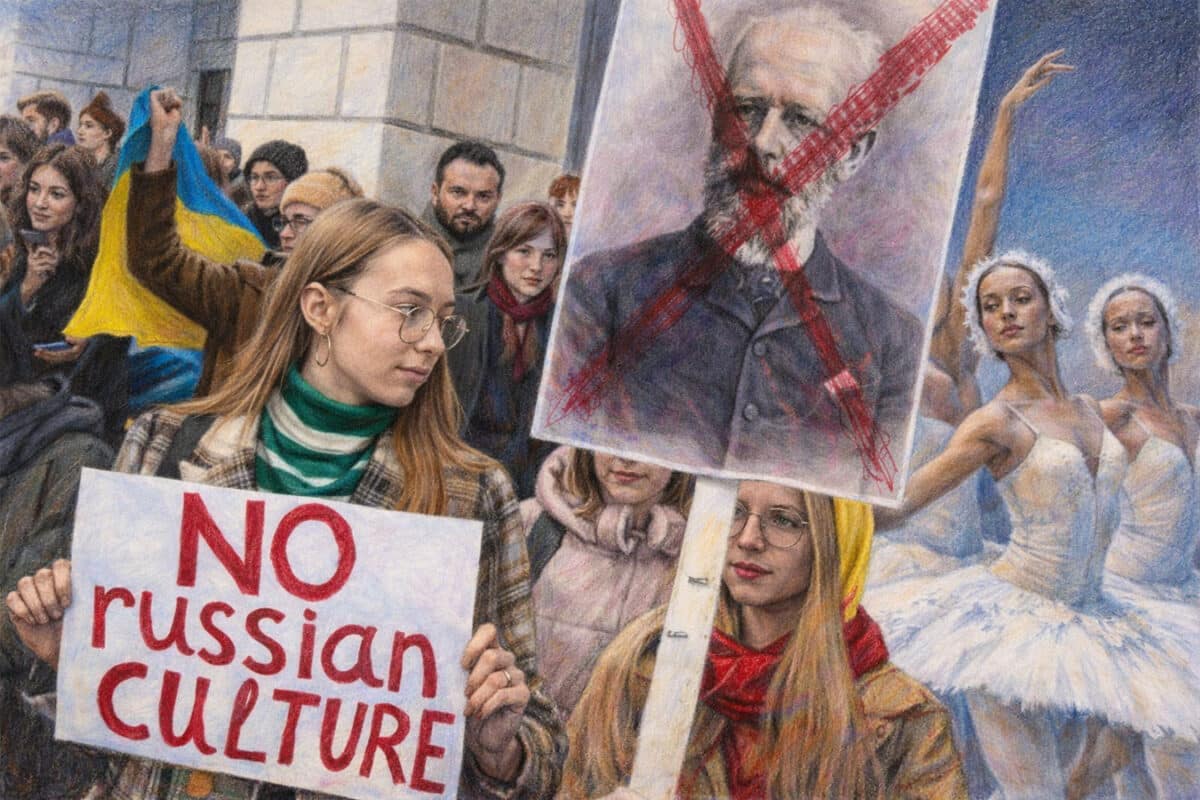
The history of the dispute dates back to 2022. At that time, students and some faculty members of the academy protested with crossed-out portraits of the composer and posters saying “No to Russian culture.” According to a survey within the institution, more than 75% of students supported the name change.
The academy’s leadership, on the contrary, insisted that Tchaikovsky should not be used as an “instrument of imperial narrative.” Arguments were made about his origins, love for Ukraine, and use of Ukrainian musical folklore. Poet Yuri Rybchinsky compared the composer to universal figures of world culture, “who do not belong to one nation.”
However, within the academy itself, this caused a sharp conflict. Some faculty members publicly stated that their opinions were not considered. Professor of music history Elena Korchova wrote that formally a Ukrainian institution actually looks Russian-oriented. Art critic Yuri Chekan called attempts to declare Tchaikovsky a Ukrainian composer a manifestation of postcolonial thinking.
The arguments of the parties diverged not only in emotions but also in logic. Yes, Tchaikovsky wrote music in Ukraine, used local melodies, and visited many times. But, as critics noted, the geography of life does not determine cultural affiliation, and the composer himself never considered himself Ukrainian.
Due to this conflict, several faculty members left the academy in 2022. Later, the administration even commissioned an examination from the Institute of Ukrainian Studies, which in 2023 declared Tchaikovsky’s “Ukrainian genetic code” — a conclusion that sparked a new wave of disputes.
The finale came in 2025 after a key amendment was made to the law “On the Fundamentals of State Policy in the Sphere of National Memory.” It allowed the governing body — the Ministry of Culture — to independently decide on renaming, without waiting for the institution’s initiative.
Deputy Yevhenia Kravchuk called it a matter of justice and self-respect. According to her, Tchaikovsky had no relation to the creation of the academy, which was founded in 1863 as the Kyiv branch of the Russian Musical Society. The composer’s name appeared in the title only in 1940 — on the centenary of his birth, simultaneously with the naming of the conservatory in Moscow.
For Russia, Tchaikovsky remains a key figure in the cultural canon — the author of “Swan Lake” and “The Nutcracker.” That is why, Kravchuk emphasizes, his name was used as a tool of Russification and displacement of the Ukrainian musical tradition.
The ministry’s decision also has a foreign policy context. According to the deputy, Ukrainian diplomats have faced the argument abroad for years: “If you have a conservatory named after Tchaikovsky in the center of Kyiv, what are you arguing about?” Now, in her assessment, this argument is removed.
Editorial Comment
To speak frankly, the decision seems logical in the context of war and decolonization, even if it is painful for part of the musical community. Tchaikovsky’s music does not disappear — it is not about the notes, but about the symbols. The name on the institution’s facade is a frame of identity. And in a situation where Russia is waging a war to destroy Ukrainian statehood, the preservation of imperial markers in the center of Kyiv is inevitably perceived as dissonance.
The key question here is not whether he is “Ukrainian or not.” Even if we accept the arguments about origin and love for Ukraine, Tchaikovsky is a fundamental part of the Russian cultural canon, which today is used as a tool of soft power. Ukraine has the right to step out of this frame and return the academy its own name, not imposed by the Soviet era.
The story of the renaming shows that cultural symbols in Ukraine are no longer considered neutral. The plaque on the building is not only about art but also about the narrative the country broadcasts to the world. And it is precisely such decisions that form the new cultural policy, which is being written about today by NAnews — News of Israel | Nikk.Agency.
