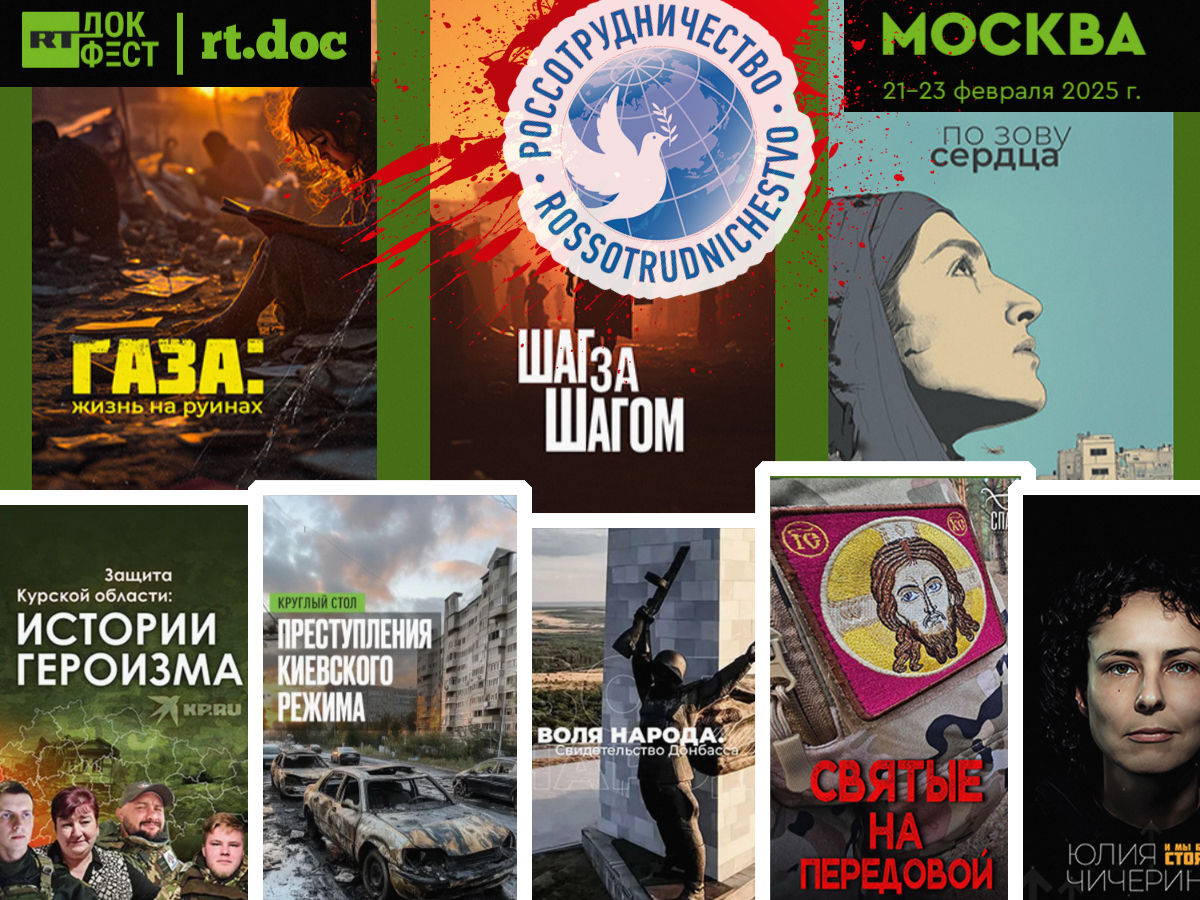
Russian propaganda has blended anti-Semitism and Ukrainophobia, presenting the “sacred struggle of the SMO” as a universal example of a “just war,” where Ukraine is portrayed as a “neo-Nazi enemy,” and Israel as an “aggressor” destroying “defenseless Palestinians.”
In this concept, the Kremlin justifies its own aggression against Ukraine while simultaneously inciting hatred towards Jews, promoting the narrative of “victims of Zionism,” which benefits Russia’s allies – Iran, Hezbollah, Hamas, and other terrorist organizations.
At the end of February, Moscow hosted the III International so-called festival “RT.Doc: The Time of Our Heroes,” presented by Russian propaganda as “the largest documentary film event.”
As described by the “organizers”, in addition to “condemning the crimes of the Kyiv regime,”:
“The festival program includes more than 70 films. These are works by RT war correspondents, Channel One, VGTRK, the Zvezda TV channel, the SPAS TV channel, and independent authors, including foreign filmmakers. The festival features documentaries from Italy, France, the USA, Palestine, Iran, and many other countries.”
The festival was timed to coincide with February 23 – the so-called “Defender of the Fatherland Day,” which in modern Russia has become less about honoring the military and more of a propaganda tool. In recent years, this day has been actively used to justify the war against Ukraine, which Russia started in 2014 and escalated into a full-scale invasion on February 24, 2022.
The event was dedicated to the so-called “SMO” – a pseudo-term introduced by Kremlin propaganda to replace the words “war” and “invasion.” In reality, it refers to Russia’s genocidal aggression against Ukraine, accompanied by war crimes, the destruction of Ukrainian cities, the killing of civilians, mass deportations, and torture.
The festival received support from Rossotrudnichestvo – an organization that formally promotes “cultural and humanitarian initiatives” abroad but in reality acts as a branch of the FSB, overseeing the activities of “Russian Houses” worldwide. These institutions are used to promote pro-Kremlin narratives, anti-Western propaganda, and Russia’s “soft power.”
At the same time, film screenings supported by Rossotrudnichestvo took place in “Russian Houses” across 21 countries: “Abkhazia, Armenia, Belarus, Bulgaria, Egypt, Zambia, India, Indonesia, Kyrgyzstan, China, Lebanon, Nicaragua, Pakistan, Palestine, Peru, Serbia, Tajikistan, Tanzania, Turkey, Uzbekistan, and South Ossetia.”
However, the “Russian House” in Israel was not mentioned in this context – perhaps due to the themes and content of the films?
“Documentary” Films: How They Were Presented…
The festival’s website features the following film descriptions (all films can be viewed via the provided links if desired):
“Lebanon: On the Brink” (Russia)
“Today, more than a third of Lebanon’s population consists of Syrian refugees. Palestinian refugees continue to arrive as well. In total, over two million people are seeking refuge in the country.
The situation is further complicated by the fact that Lebanon is constantly under fire from Israel. Farmers, leaving for the fields in the morning, do not know if their homes will still be standing by evening.”
However, the film’s description omits the fact that Lebanon serves as a base for the terrorist organization Hezbollah, which regularly launches attacks on Israel, provoking retaliatory actions. Additionally, it does not mention that Hezbollah uses civilian infrastructure to store weapons, putting the local population at risk.
“Step by Step” (“Palestine”)
“Lana Al-Astal lost her mother and younger sisters after one of the Israeli strikes. She was only 10 years old. For three days, she stayed next to her mother’s body; there was no way out—the school where they had tried to find shelter was surrounded. When the blockade was lifted, Lana walked out no longer a child. Now she takes care of her younger sisters, learning to survive among the ruins and rebuild her life.”
The description does not take into account that terrorist organizations such as Hamas frequently use schools and other civilian facilities to store weapons and launch rockets at Israel, leading to tragic consequences for civilians.
“By the Call of the Heart” (“Palestine”)
“Nada Hassan is an engineer, but the war in Gaza changed everything. Now she doesn’t build houses; she helps those who have lost them. In the Al-Mawasi refugee camp, which has become a temporary shelter for thousands of families, Nada distributes food, clothing, and does what seems impossible—trying to restore stolen childhoods.”
The film does not examine Hamas’s role in worsening the humanitarian situation in Gaza, including using civilians as human shields and rejecting peace initiatives.
“Gaza: Life in Ruins” (Iran)
“Israeli planes continuously bombed residential areas of Gaza. They dropped leaflets urging people to move south. But even those who listened didn’t make it—the humanitarian corridor turned out to be a trap. Bombs fell there too.”
“The Al-Masri family stayed behind. There was nowhere to go. They tell how they tried to find even a little food for the children, how they rationed the last drops of water, how every night they listened to explosions and didn’t know if they would wake up in the morning. This film amplifies the voices of those who endured the worst.”
The film fails to mention that Israeli forces take measures to minimize civilian casualties, including issuing warnings about impending strikes. It also omits the fact that Hamas actively prevents civilians from evacuating, using them for its own purposes.
Thus, the films presented offer a one-sided view of the situation, ignoring the actions of terrorist organizations that contribute to the suffering of both Israelis and “Palestinians.”
What Else Was Shown?
The “RT.Doc: The Time of Our Heroes” festival provided audiences with a collection of pseudo-documentary films steeped in Russian military propaganda. The very titles of these films make it clear what ideas were being implanted into public consciousness.
Here are just a few examples:
- “Yulia Chicherina. And We Will Stand” – a film about the “singer” who has long become a mouthpiece for Russian military propaganda.
- “Selidovo. A Crime with No Statute of Limitations” – a pseudo-“documentary investigation” in the spirit of Kremlin rhetoric.
- “SMO. No One But Us” – justifying Russian aggression through the glorification of the so-called “SMO.”
- “Darya Dugina: We Will Forever Be in This Summer…” – a film about the daughter of “Russian World” ideologist Alexander Dugin, considered one of the theorists of Russia’s neo-imperial policy.
- “The Will of the People. Testimony of Donbas” – a typical portrayal of the “heroic liberation” of occupied territories.
- “Christ’s People. Our Time” and “Saints on the Frontline” – an attempt to link Russian military aggression to a religious mission.
- “Protected by God” – another film justifying the occupation through Orthodox rhetoric.
- “New Regions: The Road Home” – even the title makes it clear that this is another attempt to legitimize the annexation of Ukrainian territories.
- “By Common Prayers” – a religious undertone used to justify Russian military aggression.
- “War Correspondents-3: He Prays in the Language of God” – the glorification of “war correspondents” working for Russian propaganda.
- “Zosima: The Testament of the Donetsk Elder” – yet another mix of pseudo-historical and religious motifs.
- “The Cross of Sievierodonetsk. Life After Death” – another attempt to present cities destroyed by the Russian army as “reclaimed” territories.
- “The Donetsk Goalkeeper” – a film built around the idea of the “heroic resistance” of local residents.
All these so-called “masterpieces” serve a single purpose – to promote the Kremlin’s narrative, justify aggression, demonize Ukraine, Israel, and the West, and link war to religion.
The “RT.Doc” Festival: Another Proof of Russian Anti-Semitic and Anti-Ukrainian Propaganda
The “RT.Doc: The Time of Our Heroes” festival in Moscow became yet another manifestation of the Russian propaganda machine, using cinema as a tool to manipulate public opinion. Under the guise of “documentary cinema,” audiences were fed one-sided films that justify terrorism and distort the real picture of events in Israel, Ukraine, and the world.
It is particularly telling that the festival’s online screenings took place in all “Russian Houses” except in Israel. The Kremlin clearly understands that its anti-Semitic rhetoric will not find support in a country where people know what terrorism looks like and who the real victims of violence are.
While Israel continues its fight against Hamas and other terrorist groups, Russia supports them on an informational and diplomatic level, cooperating with Iran, Hezbollah, and Palestinian extremists. This once again confirms that Putin’s policy is one of encouraging terror rather than combating it.
The festival was timed to coincide with February 23 – a date that Russian propaganda uses to glorify war and militarize the consciousness of its citizens. However, behind all the grand words about “heroes,” the reality is stark: Russian soldiers are involved in occupation, deportations, war crimes, and mass killings.
Israelis and Ukrainians should be aware: Russia and its allies support terror, anti-Semitism, and destruction.
🔴 NAnews‼️ – Israel News continues to monitor how Russia uses “culture” and “documentary cinema” to justify crimes against humanity.