
The story of the first Chief of the General Staff of the Israel Defense Forces did not begin in Tel Aviv, Jerusalem, or Haifa. It began in Odessa — a city in modern-day Ukraine, where in 1899 a boy named Yaakov was born into the Dostrovsky Jewish family.
A few years later, his father would be forced to hide after participating in Jewish self-defense during a bloody pogrom. The family would leave Odessa and move to Eretz-Israel. And four decades later, this child from Odessa, now known as Yaakov Dori, would lead the transformation of a Jewish underground defense organization into the regular army of independent Israel.
His biography combined two eras of Jewish history. In the first, the Jews of Odessa tried to protect their homes from pogromists, often without receiving protection from the authorities. In the second, a Jewish state emerged with its own army. Yaakov Dori was one of those who built a historical bridge between these eras.
…
Odessa, the Dostrovsky family, and the 1905 pogrom
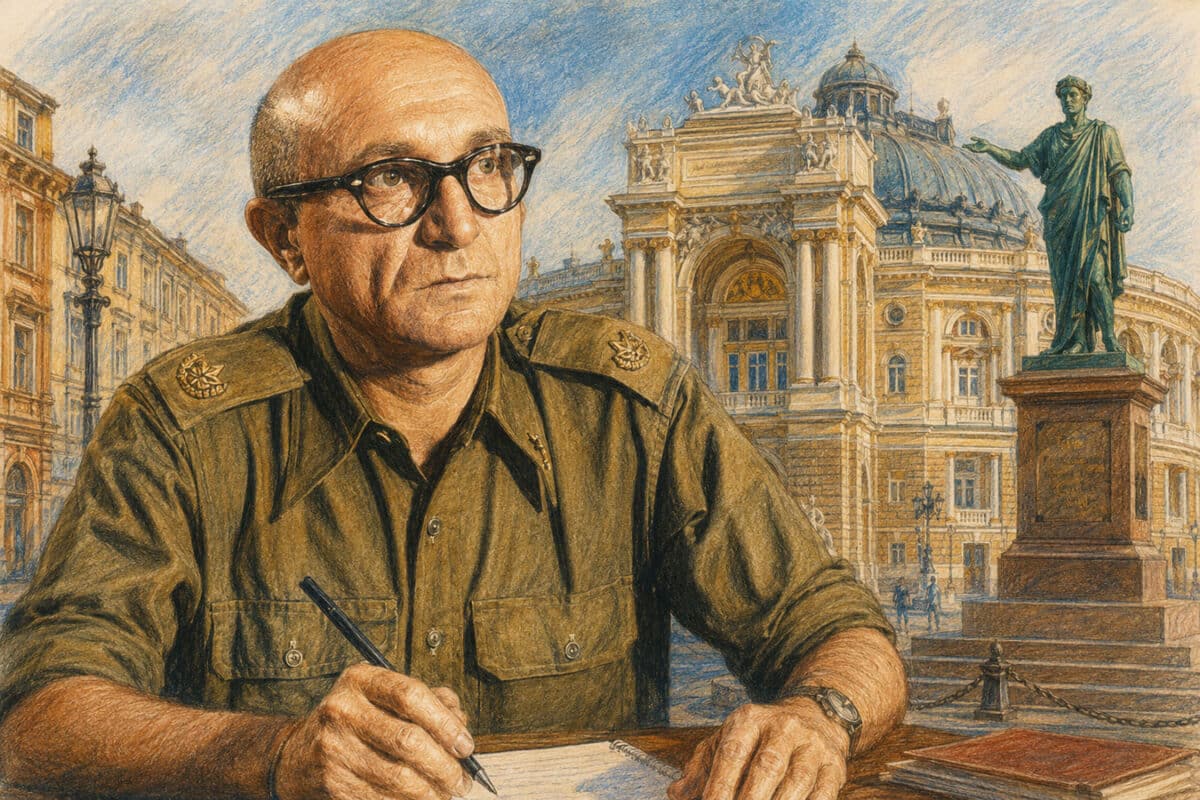
Yaakov Dostrovsky was born on October 8, 1899, in Odessa, which was then part of the Russian Empire and is now in Ukraine. The Israeli Museum of the Jewish People ANU directly calls him a native of Odessa, Ukraine, and notes that the family left after the anti-Jewish pogrom of 1905.
The early Israeli “Encyclopedia of the Founders and Builders of Israel” provides a more detailed family history. According to this source, the future Chief of Staff’s father was named Avraham-Zvi Dostrovsky, and his mother was Miriam, daughter of Yitzhak Levinson.
In 1905, Avraham-Zvi participated in the armed Jewish self-defense of Odessa. After the pogrom, the tsarist authorities intended to prosecute the Jews who resisted the attackers. Yaakov’s father was forced to hide and flee to Eretz-Israel. About a year later, his wife and three children — Shlomo, Yocheved, and little Yaakov — joined him. The family first reunited in Jaffa and then settled in Haifa.
The Odessa pogrom of 1905 became one of the bloodiest anti-Jewish outbreaks in the city’s history. According to the YIVO encyclopedia, about 300 Jews were killed in Odessa, including more than 50 members of self-defense units. These units tried to protect Jewish streets, homes, and families but faced not only pogromists but also hostility or inaction from imperial authorities.
It cannot be claimed that Yaakov Dori later publicly cited the Odessa pogrom as the main reason for his choice of a military career. There is no confirmed quote about this. However, the family continuity is evident: his father defended the Jews of Odessa with weapons, and the son dedicated his life to creating a system that would make organized defense of the Jewish people a state responsibility.
This is why NANews — News of Israel considers the story of Yaakov Dori not just as the biography of an Israeli general accidentally born outside the country. It is one of the key stories in the cycle “Jews from Ukraine” — the story of an Odessa family whose experience was linked to the formation of the defense doctrine of future Israel.
From Odessa to Haifa
In Haifa, Yaakov’s father initially worked as a laborer. The Dostrovsky home was open to Jewish pioneers moving between Judea and Galilee. Among the family’s guests were members of the “Ha-Shomer” organization, who spoke about protecting Jewish settlements, fighting robbers, and the need to independently ensure community safety.
Thus, the theme of Jewish self-defense, which arose in the family’s life back in Odessa, continued to accompany Yaakov in Eretz-Israel.
He studied at several Jewish schools in Haifa and then graduated from the famous “Reali” school. Even in his school years, Yaakov showed abilities in organization, planning, and maintaining discipline. In the student association, he led a group and gained his first experience in route planning, task distribution, and people management.
Later, these qualities would prove to be as important as weapon handling. Dori would go down in history not primarily as a field commander of a specific operation but as an engineer, organizer, and builder of a military system.
The Jewish Legion and first military experience
After the British troops entered Haifa, Yaakov Dostrovsky voluntarily joined the 40th Battalion of the Royal Fusiliers — one of the units of the Jewish Legion within the British Army.
He trained in Egypt, served in guarding the railway communication between Kantara and Lod, completed a machine gunner course, and received the rank of sergeant. After this, Dori himself trained soldiers in handling machine gun weapons.
The official biography of the IDF also confirms that during World War I, the future Chief of Staff served in the 40th Battalion of the Jewish Legion.
After the disbandment of the legion, Dori intended to continue serving in a Jewish defense formation. In 1921, he participated in the defense of Tel Aviv during Arab attacks. Later, he joined the “Haganah” and received the underground name Dan.
A symbolic historical parallel arises. In 1905, his father took up arms to defend the Jews of Odessa. In 1921, it was the son’s turn to defend Jewish quarters.
The engineer who began building an army
After military service, Dori went to Belgium and studied civil engineering at Ghent University. After receiving an engineering education, he returned to Eretz-Israel in 1926.
But his engineering knowledge was in demand not only in building structures and infrastructure. Dori became increasingly involved in the activities of the “Haganah,” which at that time was still an underground and largely territorially fragmented self-defense organization.
He commanded the “Haganah” forces in Haifa and its surroundings, developed a plan for the city’s defense, led the technical bureau, and the national system for training fighters.
The official biography of the IDF emphasizes that Dori was one of the early organizers of the “Haganah.” It was his engineering mindset, ability to create structures, and establish subordination that allowed the gradual transformation of voluntary local units into a unified military organization.
He built not just one defensive line or fortification. Dori created a system:
- training commanders;
- military training;
- technical support;
- defense planning;
- communication between territorial units;
- centralized force management.
His approach was engineering: a large structure must consist of reliably connected elements. It was this kind of “structure” that the future army of Israel gradually became.
From “Haganah” to regular armed forces
In 1939, Yaakov Dori was appointed Chief of the General Staff of the “Haganah.” His task was to transform the disparate self-defense organization into a disciplined and prepared military force.
Researchers at the Museum of the Jewish People ANU point out that it was during his leadership that the transition from improvised self-defense to a regular army model took place. Dori was involved in training commanders, establishing staff work, and developing the overall military structure.
Various sources have slight discrepancies regarding the last year of his first term as head of the “Haganah” staff. The Israeli Ministry of Defense archives indicate the period 1939–1945, while ANU and IDF biographical materials state until 1946. What is indisputable is that in June 1947, Dori was reappointed as Chief of Staff when the likelihood of a large-scale war was becoming increasingly apparent.
In 1946–1947, he also headed the Jewish Yishuv delegation engaged in purchasing weapons in the United States. For the future state, which was under British restrictions and preparing for war, establishing supply channels was critically important.
The Odessa publication “GRAD,” telling about its famous compatriot, also emphasizes that Dori commanded the “Haganah” forces in the Haifa area, led the technical direction, and participated in preparing the defense infrastructure. In Odessa itself, he is remembered as an Odessan who became the first head of the Israeli General Staff.
The first Chief of Staff of the IDF
On May 14, 1948, Israel declared independence. The new state immediately had to fight for its existence. At the same time, it was necessary to create a unified army subordinate to the government and general command.
The “Haganah” forces, “Palmach” units, former underground formations, volunteers, and new immigrants had to become parts of a single state military structure.
When creating the Israel Defense Forces, Yaakov Dori became its first Chief of the General Staff and the first officer to receive the highest rank of Rav Aluf, usually corresponding to the rank of lieutenant general. Official IDF materials indicate that he held this position in 1948–1949.
Sometimes publications claim that his official appointment took place precisely on July 27, 1948. However, Israeli military archives do not tie the start of his duties to this date: Dori led the “Haganah” staff even before the IDF was created and automatically became its first Chief of Staff after the army’s formation. Therefore, it is historically safer to say that he took this position upon the formation of the IDF in 1948.
Dori had to lead the army in conditions for which there were no ready-made instructions. The state had just appeared, fronts were changing, weapons and trained personnel were lacking, and military leaders had to simultaneously wage war and create army institutions.
Meanwhile, Dori’s health seriously deteriorated. Illness periodically prevented him from fully managing daily operations, so a significant part of the operational work was performed by his deputy, Yigael Yadin. Israeli sources do not hide this fact.
This, however, does not diminish Dori’s organizational role. He was not the sole author of victory and did not personally lead every battle. His main achievement was different: he helped create a staff, command system, and unified army where only recently there were underground organizations and territorial units.
The IDF did not emerge from nothing in one day. Its foundation was formed over years, and Yaakov Dori was one of the main architects of this process.
Key dates in the life of Yaakov Dori
| Year | Event |
|---|---|
| 1899 | Born in Odessa as Yaakov Dostrovsky |
| 1905–1906 | After the pogrom, the family moved to Eretz-Israel |
| 1918 | Joined the 40th Battalion of the Jewish Legion |
| 1921 | Participated in the defense of Tel Aviv |
| 1926 | Returned after studying in Belgium and joined the “Haganah” |
| 1939 | First became Chief of Staff of the “Haganah” |
| 1947 | Reappointed as Chief of Staff of the “Haganah” |
| 1948 | Became the first Chief of the General Staff of the IDF |
| November 9, 1949 | Completed service as Chief of Staff |
| 1951–1965 | Held the position of President of the Technion |
| 1973 | Died in Haifa |
Dori’s term as head of the IDF ended on November 9, 1949. His successor was Yigael Yadin.
After the army: building scientific Israel
After leaving the army, Dori did not retire from public work. He headed the Scientific Council at the Prime Minister’s Office and in 1951 became President of the Technion in Haifa.
He held this position until 1965. During his leadership, the Technion rapidly expanded: new scientific departments and research centers were created, and a new university campus was formed in the Neve Sha’anan area.
In 1951, under Dori, the Faculty of Natural Sciences was established, including departments of mathematics, chemistry, physics, and mechanics. In 1952, a research system was formed to support Israel’s infrastructural and technological development. In 1953, the Faculty of Aeronautical Engineering was created.
Thus, the engineer from an Odessa family who helped build Israel’s army engaged in developing its scientific and technological potential.
For Dori, the security of the state was not limited to the number of soldiers and weapons. It depended on education, engineering, research, industry, and the ability to independently create modern technologies.
This was the second part of his life’s mission. First, he participated in building Israel’s military system. Then he helped create its scientific infrastructure.
This dual role is emphasized by NANews — News of Israel: Yaakov Dori was simultaneously a soldier and a builder, a military organizer and an engineer, a man of the army and a man of science.
Family continuation
The military tradition of the family was continued by Dori’s son, Yerachmiel. He served in the IDF Engineering Corps and later became the commander of the Engineering Corps.
Yaakov Dori’s daughter, Etana Padan, became a renowned biochemist and professor of microbial ecology at the Hebrew University of Jerusalem.
Thus, the children of the first Chief of Staff continued both main directions of his life: the defense of the state and the development of Israeli science.
Yaakov Dori died in January 1973 in Haifa — the city where his childhood, service, academic activities, and most of his adult life took place. A military facility and streets in several Israeli cities were named in his honor.
Why Yaakov Dori is one of the Jews from Ukraine
Calling Yaakov Dori a “Ukrainian general” would be historically inaccurate. He left Odessa at about six years old, was not a military figure of the Ukrainian state, and dedicated his entire conscious life to the Jewish Yishuv and Israel.
But it would be equally wrong to reduce his Ukrainian connection to a mere record of his birthplace.
He was:
- a native of Odessa;
- a descendant of a Jewish family from the territory of modern Ukraine;
- the son of a participant in the Odessa Jewish self-defense;
- a child whose family left the city after the pogrom;
- a person who transferred the family history of the struggle for Jewish security into building Israel’s institutions.
Modern Ukrainian sources classify him as an Israeli military figure of Ukrainian origin, and Odessa publications preserve his memory as a famous Odessan. However, the main significance of this connection lies not in a modern national label.
Dori’s story shows the contribution of Jews born in Ukraine to the creation of the state of Israel. Odessa gave Israel not only writers, scientists, doctors, entrepreneurs, and politicians. In Odessa, a person was born who was destined to become the first Chief of the General Staff of the IDF.
His father defended Jews on the streets of Odessa in 1905 when the state authorities did not provide them with security and then intended to prosecute those who resisted. His son, decades later, led the army of a state created, among other things, so that the Jewish people would no longer depend on the will of others for their own existence.
Yaakov Dori left Odessa as a child. But it is with the Odessa story of his family that the path from disparate Jewish self-defense units to the regular army of independent Israel begins.
Category: Jews from Ukraine.
