
Millions of people live in Israel, but not all stories from this country make it to the news. For example, few know that in Netanya, Ukrainian Greek Catholics gather for services in a bomb shelter, in Jaffa, women caring for elderly Israelis meet with their compatriots on weekends, and in one monastery, clergy from different parts of the world sit at a common table. Among them is Ukrainian Patrick Sovyak, who came here for three months and stayed for ten years. Over these years, he has seen Israel in peaceful everyday life and under Iranian rockets.
In a major interview published by the Ukrainian Greek Catholic Church, the priest spoke about the people he lives and works with, their problems, habits, and destinies. For the column ‘This is Life…’ NANews selected from his story what allows us to see familiar Israel from an unusual side.
Author: Anton Pshedynsky
According to the Central Bureau of Statistics of Israel, published on September 9, 2026, the country’s population reached 10.305 million people. Of these, 7.828 million fall into the category of ‘Jews and others,’ 2.173 million are Arab population, and about 304 thousand are foreign residents. In official statistics, the word ‘others’ refers to non-Arab Christians, representatives of other religions, and people whose religious affiliation is not listed in the population register.
Behind these numbers lies a much more complex picture. Israel is home to people from dozens of countries, with communities speaking different languages, traditions, and religious customs. Some have existed alongside us for decades, although most Israelis know almost nothing about them. Among such communities are Ukrainian Greek Catholics, who gather in Jaffa, Haifa, Netanya, and other cities, help their compatriots, and experience Israeli wars together with everyone.
On November 5, 2026, a large interview appeared on the official website of the Ukrainian Greek Catholic Church with Father Patrick Sovyak — a Ukrainian Franciscan priest who has been serving in Israel since March 2016. He was interviewed by Anna Yashchenko from the Pastoral-Migration Department of the UGCC. The conversation was primarily intended for Ukrainian readers, but it contained many details about Israeli life familiar to us from another perspective.
NANews — Israel News | Nikk.Agency paid attention to this story also because Father Patrick talks not about a short pilgrimage or tourist impressions. He has lived here for ten years, knows the problems of foreign workers, communicates with Ukrainian diplomats, travels between cities, and has seen how ordinary Israeli life changes during rocket attacks.
Reference for Israeli readers: what is the Ukrainian Greek Catholic Church?
The Ukrainian Greek Catholic Church (UGCC) is a Christian church that is close to Orthodoxy in worship and traditions but recognizes the primacy of the Pope, like Catholics. At the same time, it maintains its own leadership, clergy, and Byzantine rite. The word ‘Greek’ refers to this rite, not Greek nationality.
The historical roots of the church go back to the Baptism of Kievan Rus in 988. In 1596, part of the Orthodox bishops of the Kyiv Metropolis concluded the Union of Brest with Rome, preserving Eastern traditions. The church spread especially widely in western Ukraine.
In 1946, the Soviet authorities forcibly liquidated its official structures, persecuted the clergy, and transferred churches to other religious organizations. Believers continued religious life underground for decades. Legal activity resumed in 1989.
Today, the UGCC is the largest Eastern Catholic church in the world. According to its official data, it unites more than 5.5 million believers and about 4 thousand parishes. In addition to Ukraine, large church structures operate in Poland, the USA, Canada, Brazil, Argentina, Australia, Germany, Italy, France, and the UK. Communities also exist in many other countries. In Poland alone, the church has more than 300 thousand believers.
The UGCC is headed by the Major Archbishop of Kyiv-Halych, Sviatoslav Shevchuk, elected in 2011.
Three months in the Holy Land turned into ten years
In March 2016, Patrick Sovyak flew to Israel to temporarily replace another Ukrainian monk. Brother Panteleimon, who served here before him, needed treatment and asked one of his brothers to come for three months. There were almost no volunteers. Patrick agreed on the condition that the necessary permits and documents would be arranged for him in advance.
Panteleimon spent the first month with him: showing him churches, explaining routes, service schedules, and the peculiarities of moving between cities. After that, he returned to Ukraine. The young priest stayed alone, expecting to soon follow him.
The first unexpected discovery for Patrick was the Mediterranean Sea. He knew he was going to the Holy Land but did not imagine that the monastery where he was to live was near the sea. He was also surprised by the warm climate, sometimes even too hot, and the friendly reception from other monks.
By that time, he already had a long church preparation behind him. A native of Ternopil, at nineteen, he became interested in monastic life. Before that, a friend suggested they enter the seminary together. Patrick then knew almost nothing about seminary education but agreed to try. A Franciscan superior wrote him a recommendation and then suggested he first get acquainted with monastery life.
Thus began the story that led him to Poland, where he underwent initial monastic training, and then to the Uzhhorod Theological Seminary. The Franciscans, to whom he belongs, conduct services according to the Byzantine rite. For an Israeli reader, this may seem unusual: Franciscans are more often associated with the Roman Catholic, Latin tradition. However, some Ukrainian monks of this order maintain Eastern worship.
After studying, Patrick served in Ternopil. The parish was so large that on Sundays, they held seven liturgies — from half-past six in the morning to eight in the evening. The priests alternated services and confessions, prepared for baptisms, weddings, and funerals, and worked with children.
But in his hometown, he continued to be perceived as the former acquaintance Igor, not as Father Patrick. He himself asked to be transferred to another place. Then there were Uzhhorod, a small monastery in the village of Nizhny Bystry between Khust and Mizhhirya, trips to services in neighboring settlements, and a return to Ternopil.
From this familiar circle of monastic life, he set off for Israel.
The appearance of Ukrainian Franciscans in the Holy Land had a quite practical reason. Previously, Ukrainian Greek Catholics in Haifa and Tel Aviv were served by a priest from Slovakia, Rastislav Dvorovy, whom Patrick knew from the seminary. However, there were problems with housing and conditions of stay. According to Sovyak, religious status allows a foreign clergyman to stay in Israel and engage in permitted church activities but does not grant the usual right to paid work.
For Rastislav, supporting himself became a serious problem, and he was forced to seek additional income by accompanying pilgrimage groups. Later, he could no longer continue his ministry.
Then the head of the UGCC, Sviatoslav Shevchuk, turned to the possibility of cooperation with the Franciscan Custody of the Holy Land — a Catholic structure that manages monasteries and numerous shrines in the region. The monastery could provide the arriving priest with housing and everyday conditions. Panteleimon was sent first, and after him, Patrick appeared.
As a result, the temporary replacement turned into permanent work, and Israel became the place where a significant part of his adult life passed.
Ukrainian Mother of God in Nazareth: a trace left back in 1976
Ukrainian religious presence in Israel began long before the arrival of Father Patrick Sovyak. Back in 1976, a mosaic with the image of the Zarvanytsia Mother of God — one of the most revered shrines of the Ukrainian Greek Catholic Church — was installed in the courtyard of the Catholic Basilica of the Annunciation in Nazareth.
The mosaic depicts the Mother of God surrounded by Ukrainian believers in national costumes, with Kyiv’s Sophia and Lviv’s St. George’s Cathedral visible in the background. The inscription in Ukrainian addresses the Mother of God with a request to pray for the Ukrainian people.
The project was created by Sister Vasylia Chikalo, and the funds were provided by Ukrainian priest Vasyl Turkovid, who served in Germany. The date of installation is of particular significance: in 1976, the UGCC in the USSR was banned and operated underground, but its image was already in one of the most important Christian shrines of the Holy Land.
The Basilica of the Annunciation is served by Franciscans — representatives of the same monastic order to which Father Patrick belongs. The history of the appearance of the Ukrainian mosaic in Nazareth was detailed by NANews in a separate article.
Ukrainian women, elderly Israelis, and Saturday instead of Sunday
Most of Father Patrick’s parishioners are not new repatriates or people who came to Israel specifically for religious life. According to his story, they are labor migrants, mainly women from the western regions of Ukraine. Some once came on a pilgrimage and later stayed to work.
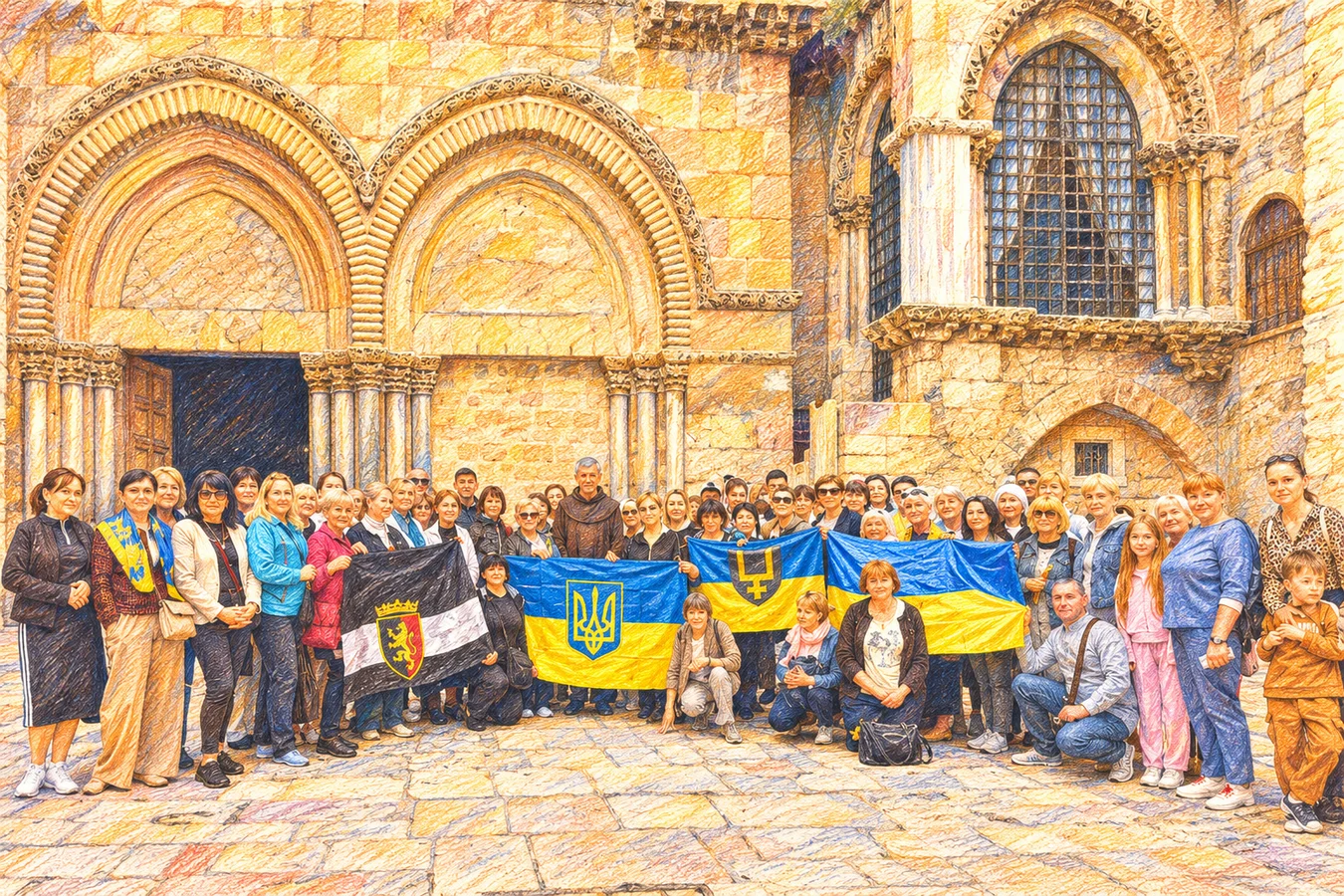
Many are engaged in caring for elderly and sick Israelis. This work in Israel is known as siud (סיעוד) — assistance to people who, due to health or age, cannot independently cope with everyday tasks. Depending on the employment conditions, the worker may live directly in the home of the ward, help them move, eat, maintain order, and perform other care duties.
This work has a side almost invisible to outsiders. When a person lives with their ward, their circle of communication is often limited to one family. Rest and the opportunity to leave the house depend on the schedule and organization of replacement. Patrick talks about women who stay near the elderly person almost all week and can only come to service, meet acquaintances, and solve their own affairs on Sunday.
That is why the Sunday community in Jaffa, consisting of about 20–25 people, has significance for them beyond religious life. Here they speak Ukrainian, learn news about relatives, exchange practical information. For many, this is the only regular meeting with their familiar linguistic environment.
The more numerous Saturday community in Jaffa gathers, according to the priest, from 40 to 60 people. They come not only from Jaffa itself but also from other settlements around Tel Aviv.
Why are services held on Saturday, although for most Christians, Sunday is considered the main church day? The answer is related to the Israeli work calendar. Saturday is Shabbat, the main weekly rest day in the country. For some Ukrainian workers, it is easier to free up time and get to the church then.
The community had to adapt the schedule to these conditions. In the first two years of his stay, Patrick started service in Jaffa every Saturday, then went to Netanya, and after that to Haifa, where he spent the night in the monastery. On Sunday morning, he served in Haifa, returned to Jaffa, and conducted another liturgy. Almost all weekends passed like this — with constant travels and short stops.
Before the full-scale Russian invasion, the situation of Ukrainian workers was unequal.
According to the priest, some had the status of asylum seekers, others were in Israel without settled documents. After February 2022, many managed to arrange legal stay. This is his observation of parishioners, not confirmed statistics for all Ukrainian citizens; permission to stay in the country does not in itself mean obtaining permanent residence or permission for any work.
Among Ukrainians, there are also men who come to work on construction sites through organized employment programs. There is indeed a mechanism between Ukraine and Israel for attracting Ukrainian workers to the construction sector, providing for the processing and selection of candidates. However, according to Sovyak, there are relatively few such men among his parishioners.
After 2022, the number of people from Ukraine who had the right to repatriation under the Law of Return increased, including thanks to the Jewish origin of parents or grandparents. Patrick noticed an increase in Ukrainian presence in the country, but his church communities did not grow significantly. Some new people started coming regularly, others appear only at Easter.
Thus arises the distinction between Ukrainians as a large group of people from one country and a small church community. They cannot be considered the same community. People may have different citizenship, religion, native language, family history, and attitude to Ukrainian identity.
Church in a bomb shelter, rent for money, and aspic in an international monastery
Ukrainian Greek Catholics do not have their own separate church in every city where services are held. Therefore, they use the premises of other Christian communities.
In Jaffa and Haifa, they are helped by Melkites — representatives of the Melkite Greek Catholic Church, historically associated with Arab Christians of the Middle East. Melkites, like Ukrainian Greek Catholics, have the Byzantine liturgical rite and unity with the Catholic Church, although languages, history, and local traditions differ.
In Netanya, the situation is even more unusual. According to Patrick, there is no suitable Melkite or Roman Catholic church for their community there, so Ukrainians hold liturgies in a bomb shelter rented by Protestants. The latter provide the premises to Ukrainians as well, but for money.
They also have to pay for the use of Melkite churches. After each service, the community leaves an agreed amount and participates in expenses for electricity and water. Even religious life requires quite ordinary household arrangements.
When asked in the interview whether services could be held for free, Patrick replied that in his own monastery, such an opportunity exists. In other places, everything depends on agreements with superiors and property owners. The issue of rent, in his experience, remains a constant concern for the small community.
The history of Ukrainian parishes, their organization, and differences between Christian traditions were already thoroughly examined by NANews in the article ‘Ukrainian Greek Catholic Church in Israel today: four parishes, five cities, and one large Ukrainian community’. In the new interview, something else is more interesting — how these parishes exist practically, without their own building and with limited resources.
Patrick himself lives in the Franciscan monastery at the Church of St. Peter in Jaffa. The church is also oriented towards pilgrims who come to visit places associated with Christian history. Previously, donations from numerous tourist groups helped maintain the church. But monastic life is not limited to pilgrimages.
Representatives from different countries live together in one house. A monk from Poland serves Poles and the Hebrew-speaking community, which includes people from Ukraine, Belarus, and Russia. A Filipino clergyman works with his national community, an Indian with Indian believers, and can conduct services in both Eastern and Latin rites.
There is a priest from Eritrea who does not belong to the Franciscans but lives with them and serves his community. Another brother came from Sri Lanka. Previously, a monk from Mexico lived in the monastery, serving Spanish-speaking parishioners. Among the Franciscans of the Custody, there are also local Arabs with Israeli citizenship, although, according to Patrick, most brothers came from other countries.
Living together creates situations rarely encountered outside such a monastery. On Ukrainian Easter, monks saw the blessing of Easter baskets and cakes for the first time. For some, it was so unusual that they photographed and filmed the event.
Patrick himself recalls his first visit to an Indian service. He was struck by the loud singing, musicality of the prayer, and the national clothing of the believers. The difference was noticeable even to someone well-acquainted with Christian rites.
Holidays in the monastery are accompanied by joint meals. Filipinos prepare their national dishes and invite others for Christmas. Indians bring traditional treats, and the Ukrainian priest introduces neighbors to Ukrainian cuisine.
Among these treats is aspic. Patrick says he brings it to his brothers, and they like it.
In several rooms of the monastery in old Jaffa, people who grew up in different countries, speak different languages, and belong to different Christian traditions coexist. But in everyday life, they solve very similar issues: how to organize a service, meet parishioners, welcome guests, and prepare a common meal.
Bethlehem before Christmas, Jerusalem on weekends, and Ukrainian life outside the church
The Ukrainian community has its own calendar of trips to holy places. Before Christmas, believers go to Bethlehem, before the Feast of the Transfiguration of the Lord — to Mount Tabor in Lower Galilee. When possible, they visit Jerusalem and other places associated with biblical history.
For the priest, these are pilgrimages, but he does not hide their everyday significance. People spend several hours together on the bus, talk, sing, pray. After visiting the shrine, they arrange a joint meal, for which the parishioners prepare dishes in advance.
Patrick explains that some Ukrainians work so much that they almost have no opportunity to communicate outside their workplace. Therefore, a trip to Bethlehem becomes both a religious event and a rare opportunity to spend a day among acquaintances. Sometimes even people who have visited these places many times sign up for the bus again just for the sake of communication.
The priest himself has not ceased to be amazed by the Holy Land, even though he has lived here for ten years. During his first visit to Jerusalem, he discovered that Golgotha and the Holy Sepulchre are in one complex — the Church of the Resurrection of Christ, also known as the Church of the Holy Sepulchre. Before arriving, he imagined them as two separate places.
The opportunity to take a bus and go to Jerusalem remains a special experience for him. Many Christians around the world save money for years to visit these shrines at least once, while he can make such a trip from Jaffa on an ordinary free day.
For Ukrainian parishioners, prayers in Jerusalem have acquired additional significance after the Russian invasion. They pray for their relatives, servicemen, the wounded, and those who remained in Ukraine. But the church is not the only place where Ukrainian life is preserved in Israel.
In Jaffa, cultural initiatives work to unite people through art, language, and common events. For example, NANews has already told about the Ukrainian cultural space nothing, where exhibitions, creative meetings, language classes, and events in support of the Armed Forces of Ukraine are held. This is a secular project, not connected with Father Patrick’s parish, but its story shows another side of the same environment: Ukrainians seek to communicate and help each other not only through religious organizations.
Patrick’s community has its own way of maintaining a connection with Ukraine — donations for the army. This began even before the full-scale invasion. One of the parishioners was engaged in volunteering and was acquainted with Serhiy Prytula. Through him, the priest learned about the needs of Ukrainian military personnel, and the collected funds were transferred to Prytula’s fund.
After February 2022, collections became more intense. People whose husbands, sons, or brothers served on the front turned to the community. Money was needed for vehicles, medical supplies, equipment, and other specific needs. The most active help, according to Sovyak, was in the first six months of the Russian full-scale invasion.
Later, collections became targeted. If a request appeared, the priest announced that money would be collected, for example, for a vehicle for a Ukrainian unit on the nearest Saturday. In church groups, they reported who the help was intended for. A donation box is constantly in the church.
By 2026, activity had decreased. Patrick associates this with fatigue from the prolonged war, not with a loss of interest in Ukraine’s fate. People continue to donate but do so less frequently and more often for specific requests.
Two wars: Ukrainians in Israel hide from rockets again
For many people from Ukraine, war ceased to be something distant long before they moved to Israel. After the Russian invasion in 2022, some of Patrick’s parishioners had relatives left in Ukrainian cities under shelling. However, in Israel, they had to face their own rocket danger, which became especially acute during direct confrontations with Iran.
In the interview, the priest distinguishes two periods. The first is the twelve-day war between Israel and Iran in June 2025. The second is a new armed conflict that began on February 28, 2026, with strikes by Israel and the US on Iran and subsequent Iranian attacks.
According to his memories, already in 2025, some Ukrainians decided to leave Israel. Patrick compares the threat from Iranian ballistic missiles to rocket attacks from the Gaza Strip, which Israelis had been getting used to for years. He believes that after the start of Iran’s attacks, the sense of danger changed significantly.
However, some of his words about previous attacks from Gaza require clarification. Rockets from the Gaza Strip were not always intercepted, and attacks led to casualties and destruction long before the direct war with Iran. Therefore, the priest’s comparison should be understood as a personal perception of different threats, not as an assessment of the effectiveness of Israel’s air defense.
June 2025 was especially difficult for the Ukrainian community. As a result of an Iranian ballistic missile hitting a residential building in Bat Yam, five members of a family from Odessa were killed. Among them was seven-year-old Nastya Burik, who was undergoing treatment for leukemia, her mother Maria, grandmother Elena, and two boys — Kostya and Ilya.
The girl’s father, Artem Burik, remained in Ukraine, where he served in the Armed Forces of Ukraine. The family came to Israel for the child’s treatment but ended up among the victims of an Iranian missile strike.
In its publication on June 19, 2025, NANews detailed the family from Odessa, the circumstances of the tragedy in Bat Yam, and the condolences of Ukrainian rabbis and the Jewish community. Father Patrick in the current interview mentions this death as one of the most difficult episodes of the war affecting Ukrainians in Israel.
The new conflict of 2026 began on a Saturday. This was especially significant for the community, as Ukrainians usually gather for services on Saturdays.
Patrick recalls how during the service, parishioners began receiving warnings on their phones and smartwatches. People understood that there was a threat of a rocket strike. The service was completed in time, but soon sirens sounded, and those present went to shelters.
The next day, the service was not held. Transport operated with restrictions, trips were dangerous, and getting to the church became difficult. In some places, there was no suitable shelter nearby, and the restrictions imposed by the Home Front Command did not allow for regular gatherings.
For some time, Patrick prayed alone in the monastery. People called and wrote to him, asking to pray for specific relatives, telling about explosions near their homes. Later, some parishioners began to come to services again, despite the remaining difficulties. The priest mentions the thick walls of the church, but they themselves do not replace an equipped protected room.
In his story, a scene characteristic of Israel appears. During a rocket alert, people interrupt their activities and go to shelter. After the danger ends, some return to what they were doing before, including relaxing on the beach.
The priest is struck by this ability to quickly return to normal life. He notes the organization of Israelis, knowledge of shelter locations, and willingness to help strangers find a safe place. In hotels and some public buildings, according to his observations, visitors were shown where to go during an alert.
However, his mentions of two to three minutes for shelter and advance warnings of five to seven minutes cannot be taken as a universal rule. In Israel, the protection time depends on the locality and the nature of the threat, and advance notice is not guaranteed. During an alert, it is necessary to follow the current instructions of the Home Front Command — Pikud ha-Oref (פיקוד העורף), which determines when to enter a protected room and when it is allowed to leave it.
Modern Israeli apartments often have a mamad (ממ”ד) — a reinforced room designed to protect residents. In older buildings, such rooms are often absent. Patrick specifically mentions Haifa, where in the old buildings there are problems with access to shelters and where threats from the north add to the limited reaction time. Basement rooms and parking lots should not automatically be considered safe shelters: their construction, suitability, and official instructions are important.
Ukrainian parishioners, according to his observations, reacted painfully to rocket attacks. Some already knew what it meant to live under the threat of strikes, but now they found themselves again in a situation where it was unknown what would happen in a few hours.
And yet they continued to ask when services would resume. For Patrick, this reaction was reminiscent of the first months of the full-scale war in Ukraine, when many people sought support in the church.
Ukrainian embassy, Russian-speaking Israel, and the dream of a road to Spain
Over ten years, Father Patrick has become familiar not only with the religious side of Ukrainian life in Israel. He participates in cultural events, communicates with public activists, and collaborates with the Ukrainian embassy.
According to his story, the new ambassador, after arriving in Israel, independently visited the Ukrainian church, met the priest, and left contacts for direct communication. Together, memorial events are held, including those dedicated to the anniversaries of the Holodomor. After the start of the full-scale invasion, the embassy turned to the community for joint prayers and memorial services.
Patrick also attends secular Ukrainian events — concerts, meetings, and workshops. Sometimes his participation is limited to meeting people and supporting communication.
There is also a more practical side to cooperation. Ukrainian citizens have questions related to passports, documents, and appointments at the consular section. Therefore, Patrick suggested that the consul come to the church about once a month and answer parishioners’ questions. In the interview, he talks about this request and good relations with diplomats but does not specify how regularly such receptions were ultimately held.
In small communities, such help is of particular importance. A person accustomed to turning to a priest for family or personal matters can learn through him about opportunities to solve administrative problems. This is not about replacing consular services, but about an additional way to get to the necessary information.
Patrick believes that many Israelis know Ukraine well. Some were born there, some have relatives, others visited Ukrainian cities as tourists. In his opinion, after February 2022, sympathy for Ukrainians in Israeli society increased.
At the same time, he notes the complexity of political relations. In his view, Israel sought to maintain contacts with both Ukraine and Russia. This is the priest’s personal assessment; the actual relations of the states changed depending on the war, diplomatic circumstances, and government decisions.
In Israel, he also met people with pro-Russian views, sometimes saw actions in support of Russia. Patrick associates part of such sentiments with people from the former USSR, but he considers their supporters relatively few. This observation is not a sociological study and does not allow judging the views of the entire Russian-speaking population of Israel.
At the same time, he positively assesses the freedom of his own religious activity. In his experience, Israeli authorities do not interfere with the lawful ministry of Franciscans and other foreign clergymen who receive the necessary permits. Although bureaucratic difficulties exist, he does not describe direct state interference in the liturgical life of his community.
A person who has been guiding pilgrims through the Holy Land for so many years also has his own travel dream. Patrick used to want to visit Italy, now he dreams of walking the Camino de Santiago — a pilgrimage route in Spain leading to the Cathedral of Saint James in Santiago de Compostela.
There is another story of choice in his biography. Patrick is his monastic name. In the secular world, he was known as Igor. In his youth, he was part of the Ukrainian scout organization ‘Plast’, where one of the leaders of his group was named Patrick. The name was memorable for its uniqueness.
When it came time to choose his own monastic name, he initially settled on Jeremiah. But in his monastic province, that name already belonged to another brother. He then considered Svyatoslav, but he didn’t like the Polish pronunciation of the name. He remembered Patrick — the name sounded good both in Ukrainian and Polish. Thus, Igor became Brother Patrick.
The decision to stay in the monastery for life, according to him, was no less serious than choosing a name. Years of preparation and temporary commitments were required before taking lifelong vows. Even directly before the ceremony in Uzhgorod, he was asked once more if he had changed his mind. He could have refused, but he stayed. For the local parish, this ceremony was an unusual event: many saw the taking of lifelong monastic vows for the first time.
When asked where he finds strength after the wars he has experienced, the priest speaks of personal prayer, reading the Holy Scriptures, communicating with other monks, and helping people. The latter holds a special place in his response. The opportunity to truly help someone, he says, restores his desire to continue his work.
In 2016, Patrick Soviak went to Israel for three months. Now he has ten years of trips between Jaffa, Netanya, and Haifa behind him, meetings with people working in Israeli families, communal meals in an international monastery, helping Ukrainian soldiers, and services under the threat of Iranian missiles.
Today, in his communities, there are women who have to find replacements at work to spend a few hours among compatriots; people sending prayer requests from shelters; parishioners continuing to collect money to help their relatives in Ukraine. And he still dreams of walking the pilgrimage road in Spain.
In the official Israeli statistics, these people are distributed among different categories of the population — citizens, repatriates, foreign workers, temporary residents. In Jaffa, on Saturdays and Sundays, they simply gather together. And they have been doing this for many years.
