
Introduction: the role of ImageSat International in covering the “Pautina” special operation
The Israeli company ImageSat International, operator of the Eros-B observation satellite, on June 4, 2025, provided the editorial team of Newsru.co.il (where these images can be viewed) and a number of other Israeli media outlets with unique satellite photographs showing the aftermath of the “Pautina” operation conducted by the Security Service of Ukraine (SBU) on June 1, 2025.
These images became the first public proof of a large-scale strike on Russian air bases within the Russian Federation and caused a broad public reaction both in Israel and beyond.
Who is ImageSat International and why is this important?
- ImageSat International (ISI) is an Israeli company specializing in space and intelligence solutions.
- They operate the Eros-B satellite, which performs high-precision imaging of strategic targets.
- By providing these images, they confirmed the destruction of Russian strategic bombers—information that was not previously publicly available.
Key facts about the “Pautina” operation
- Date conducted: June 1, 2025.
- Organizer: Security Service of Ukraine (SBU).
- Operational region: four Russian air bases—“Belaya” (Irkutsk Oblast), “Olenya” (Murmansk Oblast), “Dyagilevo” (Ryazan Oblast), “Ivanovo (Severny)” (Ivanovo Oblast).
- Targets: strategic bombers Tu-22M3, Tu-95MS, Tu-160, A-50 aircraft, and others.
- Attack method: swarm deployment of FPV drones launched from special truck-containers located in close proximity to the bases.
Destroyed aircraft and confirmed losses
In the satellite images provided by ImageSat International, it is clear that at the “Belaya” and “Olenya” air bases, strategic bombers were completely destroyed with no defensive cover.
| Air Base | Aircraft Type | Number of Destroyed Units |
|---|---|---|
| “Belaya” Irkutsk Oblast | Tu-22M3 | 4 |
| “Belaya” Irkutsk Oblast | Tu-95MS | 4 |
| “Olenya” Murmansk Oblast | Tu-95MS | 4 (by some reports, 1 additional An-12) |
Total: at least 12 strategic bomber-missile carriers destroyed across two bases.
Official data and assessments
- The Ukrainian General Staff’s reports on June 3 stated the elimination of 12 aircraft (without specifying types).
- Later, Ukraine announced the destruction of 41 Russian aircraft (including A-50, Tu-95MS, Tu-22M3, and Tu-160).
- According to NATO estimates, losses could be even greater:
- 15 Tu-95MS bombers
- 12 Tu-22M3 bombers
- 1 A-50 early warning aircraft
- Before the invasion, Russia had approximately 110 strategic bombers (around 70 Tu-160 and Tu-95, and about 40 Tu-22M3). Since neither the Tu-95MS nor the Tu-22M3 are still in production, these losses are irrecoverable for the Russian Air Force.
Operation timeline: four air bases—four strikes
- Air Base “Belaya”, Irkutsk Oblast (≈4700 km from the Ukrainian border).
- Air Base “Olenya”, Murmansk Oblast.
- Air Base “Dyagilevo”, Ryazan Oblast.
- Air Base “Ivanovo (Severny)”, Ivanovo Oblast.
- Each base hosted Russian strategic aviation: various bomber models (Tu-22M3, Tu-95MS, Tu-160), A-50 aircraft, Tu-154 transports, and support aircraft.
- FPV drones approached the bases under cover of truck-containers parked nearby.
- Explosions and fires were recorded in three damage zones at “Belaya”: one zone destroyed four Tu-22M3 bombers, another destroyed four Tu-95MS bombers.
- At “Olenya,” four Tu-95MS were destroyed (and reportedly one additional An-12).
- At “Dyagilevo” and “Ivanovo (Severny),” the information is less public, but significant damage was also recorded.
Strategic significance and geopolitical consequences
The “Pautina” special operation was the largest action undertaken by the SBU on Russian territory since the start of the full-scale invasion. Its outcomes demonstrated:
- The irrecoverability of Russian strategic aviation losses.
- The rising importance of unmanned technologies in modern conflicts.
- An increase in international support for Ukraine, particularly from Israel: it was the Israeli company ImageSat International that provided the evidence that would otherwise have been inaccessible.
Importance for Israel and Jews in Israel
For our audience—Jews in Israel, this news holds special significance.
Firstly, the involvement of the Israeli company ImageSat International underscores technological cooperation between Israel and Ukraine in the fields of security and intelligence.
Secondly, the publication of these images strengthens trust between the two peoples: Ukrainians are fighting for their independence, and Israel, by supplying intelligence data and technology, demonstrates solidarity and support.
NAnews — Israel News continues to closely monitor the events and analysis, fostering dialogue between Jews and Ukrainians.
Kremlin reaction: threats and attempts at discrediting
In the Kremlin, threats were issued to Ukraine in response to the “Pautina” operation, during which four Russian military airfields were struck. This was stated by the official representative of the President of the Russian Federation, Dmitry Peskov.
According to him, Vladimir Putin, speaking by phone with U.S. President Donald Trump on June 4, said that Russia “would respond to the airfield attack.” Peskov clarified that the response would be “as the military deems appropriate.” Additionally, Kremlin representatives complained that they had expected “strong international condemnation” of the Ukrainian strike.
“This strike is Ukraine’s attempt to break Russia’s potential, but we will not allow a threat to our security,” Peskov stated.
The same statement reported that Israeli intelligence Mossad highly praised the “Pautina” operation, calling it “a wake-up call in the drone warfare era.”
Propaganda narratives and rebuttals
On June 5, Russia’s Deputy Foreign Minister Sergey Ryabkov claimed that Russian aircraft were merely “damaged,” not destroyed, and that they would be repaired soon. Russian state-aligned media propagated versions that the “attack failed,” the aircraft were decoys, or that the planes “never flew.”
Meanwhile, the Ukrainian side waited until these “patriotic” publications appeared, then released fresh footage clearly showing numerous destroyed machines, including at least one A-50. With their “flying radars” lost, Russia’s Aerospace Forces have only a few airworthy examples left.
On the new images, special attention is drawn to the tires surrounding the bombers. They are placed extremely carelessly, indicating the work of conscripts, who, as commonly perceived, try to stay “far from their superiors and close to the mess hall.” Moreover, even if a drone does not directly hit a plane, it ignites the tires: burning rubber produces black plumes of smoke that obscure visibility and make the fire particularly noticeable.
As a result, all 12 strategic bombers were burned to ashes, and they are now literally being “swept away” from the parking areas. At least 25 more aircraft sustained serious damage. The situation is especially difficult for the restoration of Tu-95 and Tu-22 aircraft—these models have not been produced since the early 1970s, and no one knows where to source spare parts.
Although since the early 1990s, “cannibalization” (dismantling some aircraft for parts to repair others) has been used in practice, each bomber contains a unique set of components and assemblies that cannot be “grown” again like mushrooms.
Potential risks and future prospects
- A possible retaliatory strike by Russia on Ukrainian territory or even on the territory of Ukraine’s allies.
- Strengthening air defense at the “Belaya” and “Olenya” bases to prevent further drone attacks.
- Deepening cooperation between Ukraine and Western and Israeli intelligence: possible involvement of additional resources from ImageSat International.
- The growing strategic impact of Russian losses: the destruction of strategic aircraft reduces Russia’s combat potential.
Table: comparison of official SBU figures and NATO assessments
| Source | Destroyed Aircraft | Types (approximate) |
|---|---|---|
| SBU (June 3) | 12 (unspecified) | — |
| SBU (later) | 41 | A-50, Tu-95MS, Tu-22M3, Tu-160 |
| NATO | 28 (minimum) | Tu-95MS (15), Tu-22M3 (12), A-50 (1) |
| Open sources (war’s start) | 110 (Russian fleet) | Tu-160 and Tu-95 (~70), Tu-22M3 (~40) |
Conclusion: the echo of “Pautina” and future outlook
The “Pautina” operation became a symbol of a new era in military confrontation, where traditional forces yield to innovative technologies. The destruction of strategic bombers—aircraft that cannot be reproduced under modern conditions—dealt a significant blow to Russia, while simultaneously strengthening international support for Ukraine. In this context, the Israeli company ImageSat International acted not just as an observer but as an active participant in the information war, providing proof that altered the understanding of the enemy’s capabilities.
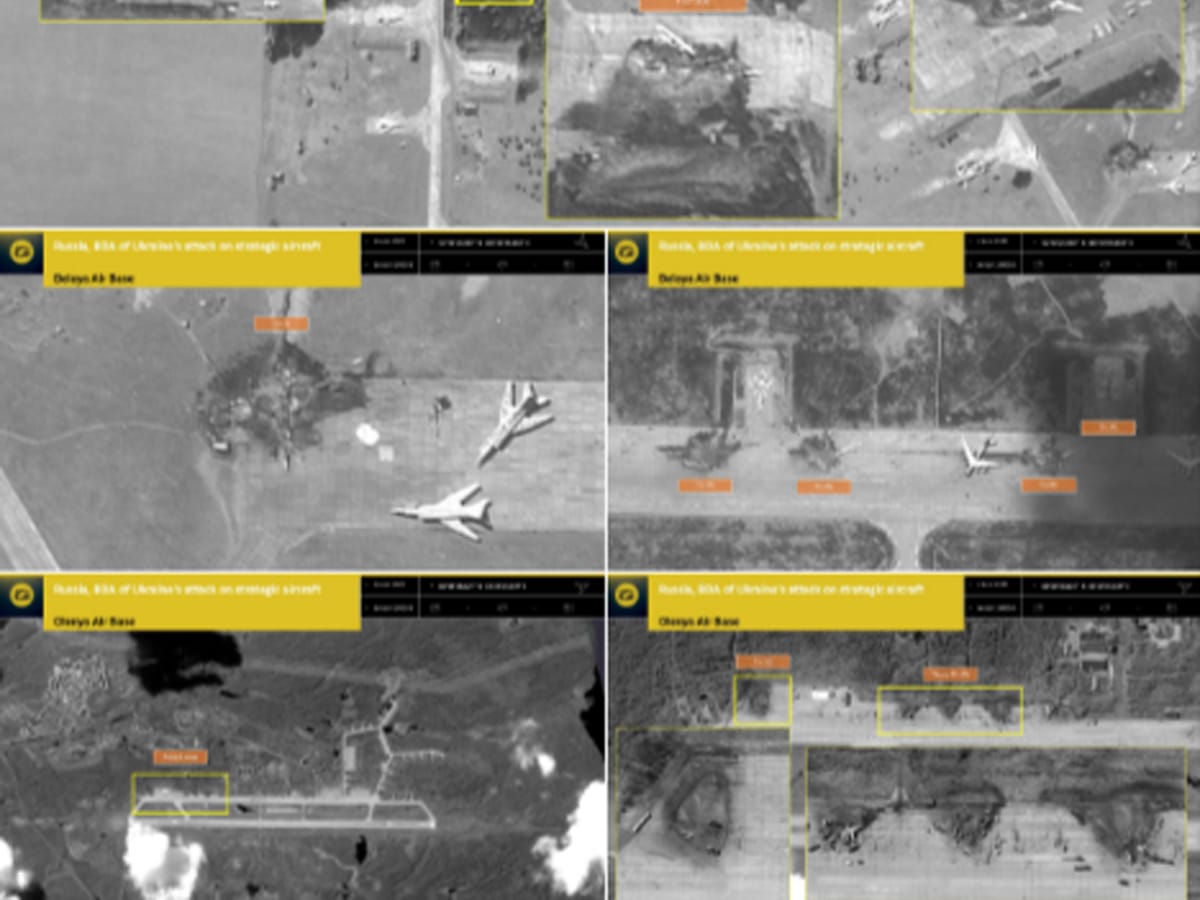
“The Israeli company ImageSat International once again confirmed its leading role in providing critically important data: without these images, the public would not have known about such a large-scale strike on Russian bases,” noted analysts at NAnews.