
When October descends on the Carmel Mountains, Haifa transforms into a city of light, film reels, and long queues at the halls. From October 5 to 14, 2025, the 41st International Film Festival takes place here — the oldest and largest in Israel, an event where the voices of the East and West sound in unison.
Where the festival takes place and who organizes it
The Haifa International Film Festival is a project of the Haifa Municipality with the support of the Israeli Ministry of Culture, the Film Fund, and the cultural center Ethos.
Screenings are held at five locations:
- Cinematheque Haifa — the heart of the festival.
- Tikotin Theater on Boulevard הנשיא 89.
- Kriger Cultural Center, 6 Eliyahu Hakim St.
- Rapaport Hall, where premieres and meetings with authors take place.
- Open venues in the Lower City, where free screenings are held under the sky in the evening.
Every year, the festival gathers up to 80,000 viewers, hundreds of journalists, and directors from around the world. Its mission is “cultural dialogue, freedom of expression, and belief in the power of cinema as a bridge between people.”
History and spirit of the festival
Founded in 1983, the Haifa Festival became Israel’s first international film screening. At that time, screenings were held in one hall and lasted only four days. Today, it is a 10-day marathon of premieres, discussions, exhibitions, and master classes.
Since 2022, the festival has been included in the Oscar Academy program, and winners in the short film category are eligible for Oscar nominations.
Program and key events of Haifa 41
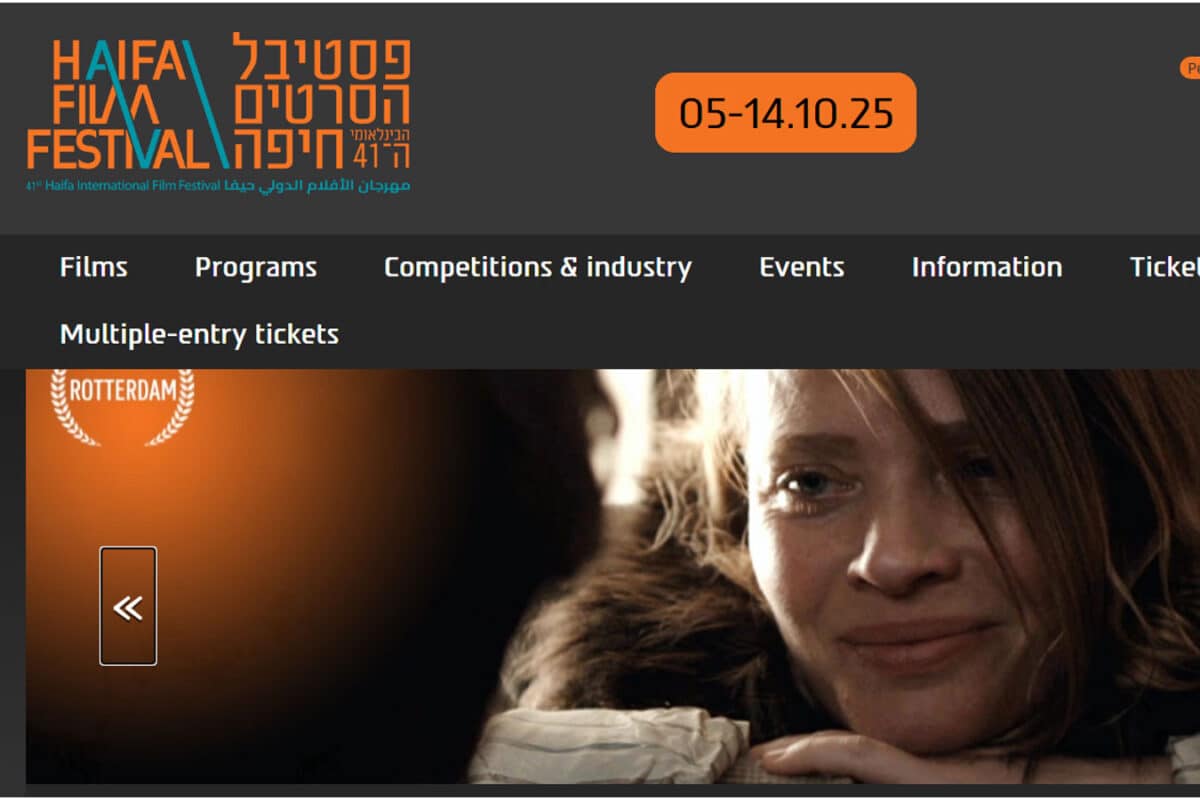
On the festival page haifaff.co.il a rich program is presented:
- Event and the Opening Film — opening ceremony and first screening.
- Industry Events — meetings with producers, critics, and directors.
- Special Events — thematic discussions, retrospectives, tribute screenings.
- Outdoor Events — outdoor screenings under the open sky, on the square near the Tikotin hall.
The festival lives not only in cinemas — it goes out into the streets. At night, film projections appear on the facades of buildings, and viewers watch movies sitting on the steps with a cup of coffee. Haifa breathes cinema these days.
Ukrainian presence: two films, two truths
Ukraine is represented this year by two powerful works — “Mariana’s Room” and “Two Prosecutors”.
Both films are not just artistic statements but a reminder of memory, conscience, and human dignity.
Mariana’s Room — a story of silence that hears everything
Screening schedule
- October 7, 2025, 11:30 — Rapaport hall
- October 11, 2025, 18:30 — Auditorium hall (screening in the presence of the film’s creators)
The film Mariana’s Room, made with the participation of France, Israel, Hungary, and Belgium, is spoken in four languages — Ukrainian, Yiddish, German, and Russian. It is based on a novel by Israeli writer Aharon Appelfeld, a native of Chernivtsi, whose life became a symbol of the survival of Jewish children during the Holocaust.
Ukraine, 1943. Silence in which a child lives
The plot takes the viewer to Ukraine during World War II. An eleven-year-old boy Hugo hides in a wardrobe in the house of a prostitute Mariana, escaping destruction.
Outside the walls — war and screams, inside — breathing, imagination, and the anticipation of an end that does not come.
Director Emmanuel Finkiel calls the film “a cinematic requiem for those who survived only by imagination.”
Actress Mélanie Thierry spent two years learning the Ukrainian language so that her character would sound natural and truthful.
This film is about how a child learns to hear the world through walls and how love for life becomes the last weapon against darkness.
When filming had to be saved from war
Initially, the film was planned to be shot in Lviv, in the old quarters where the walls remember the voices of different eras. But after Russia’s invasion of Ukraine in 2022, everything had to change.
The team moved the filming to Budapest, where an exact replica of a Ukrainian house was built on the outskirts of the city — with peeling walls, a mirror in a carved frame, and light trembling with every step.
Ukrainian project participants — costume designers, artists, assistants — worked remotely. Some connected from basements during alarms.
Finkiel recalls:
“Sometimes during casting on Zoom, sirens were heard. We waited. They returned — and we continued. Without them, the film would be dead.”
A boy from Ukraine who was saved twice
The performer of the main role, 11-year-old Artem Kyryk from Ukraine, had to be literally evacuated. He reached Budapest through Poland, where he was met by the film crew.
The director says:
“He was filming a movie about war but lived in war. And, it seems, understood it too well.”
Finkiel insisted that Artem live in the same small room where his character sleeps. So the child felt isolation, not just played it.
A voice learned anew
Mélanie Thierry learned Ukrainian words not for exoticism. Her pronunciation sounds with a slight accent, but there is truth in this — a woman hiding a boy speaks a language that is not her native one but becomes a language of love and compassion.
Her line at the end —
“My child, be silent until the world learns to listen”
(“Be silent, my child, until the world learns to listen”) —
made the hall freeze.
At that moment, silence became louder than all words.
Editing that the director could not endure
Finkiel admitted that editing the film was emotionally unbearable:
“I turned off the screen. I couldn’t listen to these screams. They too closely resembled real news from Ukraine.”
Editing lasted almost eight months. Each frame was polished manually, leaving pauses, breathing, and half-shadows. The film is built on sound — on its absence, on what the child hears through the walls, and on what we do not hear.
Why “Mariana’s Room” is important
This is not a film about the past. It is a reminder of human dignity that knows no time or borders.
In it, the Ukrainian language sounds as an act of resistance, and silence as the voice of conscience.
Haifa, a city where dozens of languages are spoken, understood this instantly. That evening, the screen will become a mirror of a world where kindness, memory, and hope are still alive.
Two Prosecutors — Loznitsa and the mirror of history
The film Two Prosecutors is a joint production of France, Germany, the Netherlands, and Ukraine.
The director is Sergei Loznitsa, one of the most respected Ukrainian documentarians, whose works have long been part of the European cinema canon.
What this film is about
The action takes place in 1937, during the height of Stalinist repressions. A young prosecutor finds a letter from an innocent prisoner and tries to challenge the soulless system.
This is a story about a person who suddenly realizes that truth is more valuable than career and silence.
Without spectacular scenes and loud slogans — only the weight of choice, endless corridors of power, and the cold light of a lamp under which fate is decided.
Loznitsa remains true to his style: precision, documentary, and ethical depth.
Critics call the film “an anatomy of conscience” — a film in which every glance and pause speaks more than dialogue.
A symbol of cultural resilience
For Ukrainian cinema, Loznitsa’s participation in the Haifa Festival is not just a prestigious mark on the poster.
It is a statement of presence and resilience — about a country that, despite the war, continues to be part of the European cultural conversation.
Loznitsa brings Ukrainian sensitivity into a universal context — where the question of conscience knows no borders.
When and where to watch
The film Two Prosecutors will be shown at the 41st Haifa International Film Festival:
- October 11, 2025, 19:15 — Rapaport hall
The film’s duration is 110 minutes.
The original language is Russian, with subtitles in Hebrew and English.
Production — 2025.
Why it is important
Loznitsa reminds us once again that history is not dates but the voices of people we have not heard for too long.
“Two Prosecutors” is a film where every frame seems cut from a chronicle but edited with the heart.
This cinema neither accuses nor justifies — it shows how difficult it is to remain human when surrounded by the silence of fear.
🎥 Ten most anticipated films of the Haifa 41 festival
Every October, Haifa becomes a crossroads of world cinema. This year, the program includes more than two hundred films, but these ten are discussed most often — viewers come from all over Israel and abroad for them.
The Promised Land
A historical drama by Danish director Nicolas Winding Refn with Mads Mikkelsen.
The action takes place in 18th-century Denmark: one man tries to turn barren lands into a place where hope will grow.
The film is called one of the most ambitious and profound discoveries of the festival.
The Disappearance of Josef Mengele
A French thriller based on real events.
The story of the Nazi criminal Mengele’s escape to South America after the war — and an attempt to understand whether it is possible to hide from guilt if it lives within you.
One of the most intense films of the program.
Love According to Dalva
A film by French director Emmanuelle Nicot — a tender but painful story of a girl rediscovering trust in the world after trauma.
The film received ovations at European festivals and became the “most honest female voice” of Haifa.
The Secret Agent
The spy thriller that opened the festival about double life and the price of lies.
The main character, who has lived undercover for years, loses the line between role and reality.
A stylish, dynamic, and captivating film, after which viewers linger in the hall.
The Great Lillian Hall
An HBO drama starring Jessica Lange.
The story of an elderly actress losing her memory but trying to play her last role.
The film is a quiet monologue about time, fame, and the fear of forgetting oneself.
Tenue de soirée
A retrospective of Bertrand Blier.
The 1986 French comedy returns to the screen to remind us how madness, sex, and philosophy can combine in one film.
The screening is accompanied by a discussion on the freedom of French cinema.
Colours of Time
A philosophical drama about memory, dreams, and inevitability.
The film is almost without dialogue, built on light and music.
It is called the most contemplative film of the festival — cinema for those who can listen to silence.
The Count of Monte Cristo
A new French adaptation of Alexandre Dumas’ classic.
The story of Edmond Dantès, but in a modern interpretation — the focus is not on revenge but on rethinking and inner freedom.
A large-scale costume film with a maritime element and psychological depth is expected.
Spinal Tap II
The sequel to the cult musical comedy of the 1980s.
Director Rob Reiner brings back the crazy rockers who have aged but not calmed down.
The most fun premiere of the festival — laughter, nostalgia, and rock ambiguity.
Mariana’s Room
The emotional pinnacle of the festival.
Emmanuel Finkiel’s film, connecting France, Israel, and Ukraine, is about a boy hiding from war in a wardrobe and a woman who saved him at the cost of her own life.
The hall stood — a rare acknowledgment in the quiet world of cinema.
This list reflects what people come to Haifa for: cinema that makes you feel, argue, and believe that even in an era of anxiety, the screen remains a place where people still seek meaning.
During the festival, there are panels for producers, pitches for young directors, meetings with authors, and night concerts at the Kriger hall.
When the screen becomes a bridge
The Haifa Film Festival is not just a celebration of cinema. It is a mirror of the world, reflecting the fears and hopes of different peoples.
And in this mirror, Ukraine is visible — not as a country of war, but as a source of cultural breath and humanity.
When the lights go out in the halls, and the Ukrainian language sounds on the screen, viewers feel: cinema still knows how to unite what politics divides.
On the festival page haifaff.co.il
