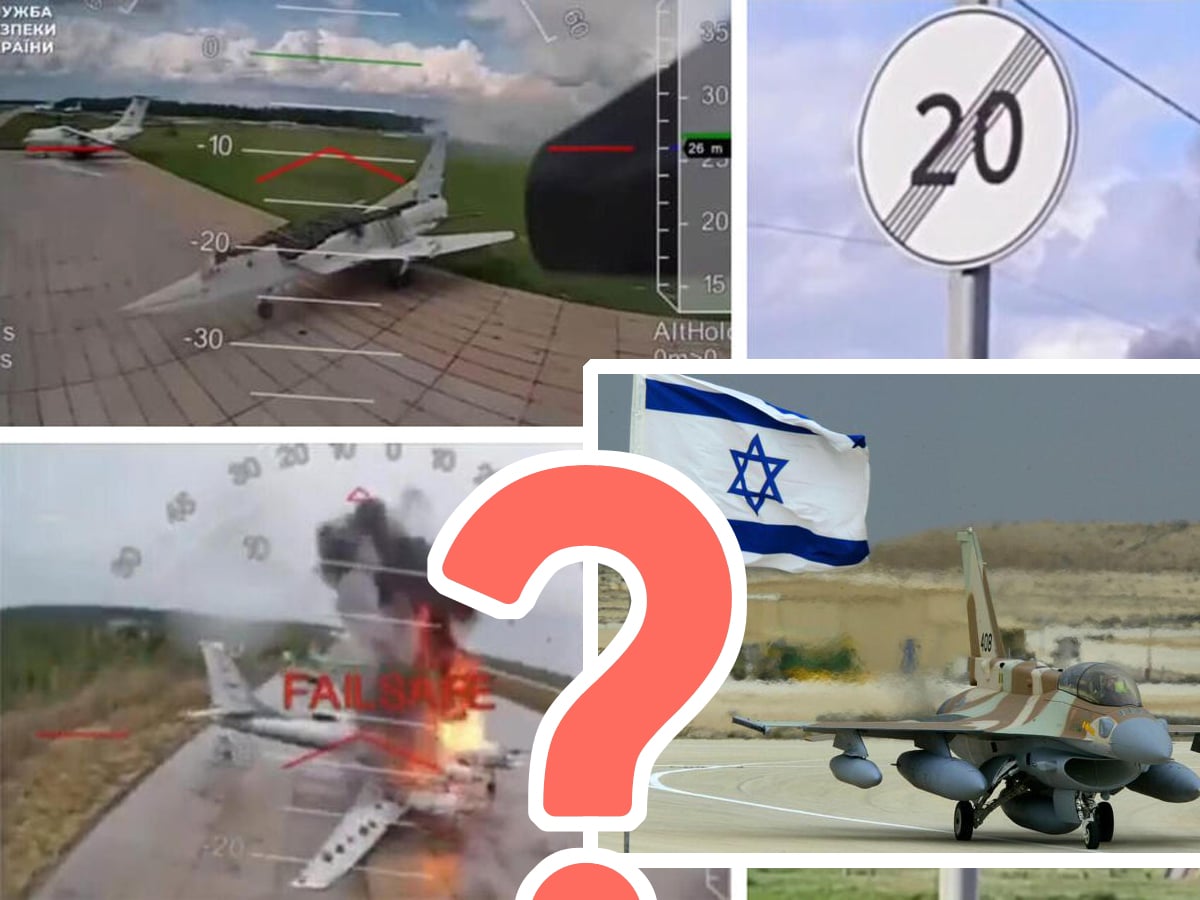
The Ukrainian SBU’s Operation “Cobweb” destroyed heavy bombers deep inside Russia and disabled putin’s critical capabilities. What type of drones were used, how were they controlled — and what could prevent inventive terrorists from striking Israel in the same way? The Israeli portal Calcalist analyzes and explains in a June 6, 2025 article.
Operation “Cobweb”: A 21st Century Strategic Strike
On June 1, 2025, Ukraine carried out a unique aerial operation deep inside Russian territory. A total of 117 drones, disguised in cargo containers and remotely controlled, hit four key Russian air bases. This daring attack, dubbed “Korei a’akvish” (“Cobweb”), has already been described by experts as one of the most ingenious in history.
According to the SBU and journalist Nitzan Sadan in Calcalist, the strike resulted in:
- Up to 17 strategic bombers Tu-95 and Tu-22M destroyed,
- Another 24 aircraft damaged,
- An A-50 AWACS plane taken out of operation,
- Operations at four airfields paralyzed.
How the attack was carried out
The SBU used “Osa” drones with a 2–3 kg payload. They were hidden in standard containers and transported deep inside Russia. All devices were activated remotely using Telegram and eSIM — without any satellite or military communications.
How Ukraine’s drones were controlled
Calcalist notes that the drones combined autonomous navigation with manual control in the final phase. Connectivity was ensured through mobile SIM cards, and video feeds were transmitted via Telegram. Operators prepared meticulously using civilian footage of the airfields, including videos from the Russian Air Force Museum in Monino.
Why couldn’t Russia stop the attack?
Nitzan Sadan in Calcalist points out the following:
- The attack didn’t use military frequencies and went unnoticed,
- The containers looked like regular trucks,
- The strike was synchronized across multiple directions at once.
Financial and Military Damage to Russia
| Aircraft Type | Destroyed | Damaged |
|---|---|---|
| Tu-95 | 10 | 8 |
| Tu-22M | 7 | 6 |
| A-50 (Recon) | 1 | 0 |
The Tu-95 and Tu-22M production ended in 1993, making their replacement nearly impossible. A new Tu-160 costs around $1 billion. The total financial damage is estimated at over $14 billion.
Could the Israeli Air Force become a similar target?
This is the main question posed by Calcalist.
Calcalist’s Key Question: Could Israel Share Russia’s Fate?
As journalist Nitzan Sadan emphasizes in Calcalist, the key issue is whether terrorists could replicate this against Israel.
Is Israel vulnerable to a drone swarm strike like the one that caught Russia off guard?
Calcalist answers bluntly: “Yes, theoretically — very vulnerable.”
According to Sadan, Hamas understands the value of Israel’s air bases and on “Black Saturday” — October 7, 2023 — it already tried to paralyze them with mass rocket attacks. The goal was clear: disable IAF jets and drone operations.
Had Hamas used drones in a surprise close-range strike, the outcome could have been catastrophic: a single hit on an F-15 during takeoff could ground the whole squadron inside hardened hangars.
Moreover, as Sadan explains, the drones wouldn’t even need to explode: scattering debris — from metal shards to candy — would shut down a runway for hours.
Why Didn’t Israel Face a “Cobweb”-style Attack?
Calcalist explains: unlike Russia, Israel has high-density surveillance, anti-infiltration systems, and — most critically — a high state of readiness. Hamas lacks satellite or secure mobile channels to control drone swarms. They opted for a different tactic: attacks on cameras and surveillance infrastructure.
Once the IDF entered Gaza, Hamas drones were used to drop explosives. But, Calcalist reports, they were soon neutralized — by smart-scope rifles and other close-defense systems.
Why a Ukrainian-style strike is unlikely in Israel
Calcalist highlights:
- Israel’s territory is small, making hidden drone deployment nearly impossible,
- IDF proactively prevents hostile infrastructure from taking root,
- There are classified anti-drone systems in place for such scenarios.
Calcalist’s Conclusion
Operation “Cobweb” shows how tech and ingenuity can corner even a superpower. Israel is safe for now, but must remain alert. Future wars are won not by brute force, but through speed, agility, and innovation.
NAnews — Israel News continues to track how Israel’s defense sector adapts to 21st-century threats — and how Ukraine’s experience can offer vital lessons.
Calcalist warns: such attacks could reshape warfare. Not tanks or missiles, but stealthy, cheap, and smart drone swarms could change the rules of engagement.
Why This Matters for Ukraine and Israel
This operation proved: technological ingenuity can defeat numerical superiority.
Conclusion: Lessons from Ukraine
Ukraine’s operation showed that even superpowers are vulnerable to compact, well-planned strikes. Israel must prepare for asymmetric threats — and never underestimate “small” enemies.
NAnews — Israel News continues to monitor developments linking the futures of Ukraine and Israel.