
“Six people died while trying to save the animals of the eco-park. Two, who tried to bring food to the animals, were killed by the Russians, and their bodies were found about a month and a half later. Another trainer was forced into a cage with lions after a shell broke the cage, and he was immediately torn apart.”
“More than 1500 animals were killed.”
“Large predators killed their young due to stress. Monkeys fled into the surrounding forests — imagine how they suffered in the cold of the Ukrainian winter,” from the story of the founder of the zoo near Kharkiv, Alexander Feldman, for Israel Hayom.
Jerusalem Jewish Film Festival 2025: Program, Meanings, and Films to Talk About
The Jerusalem Jewish Film Festival in 2025 celebrates its 27th anniversary and remains one of Israel’s key cultural platforms where memory, identity, trauma, and contemporary challenges are discussed through cinema.
The festival will traditionally take place during Hanukkah — from December 13 to 18 at the Jerusalem Cinematheque. The program includes over 40 films from 15 countries, as well as a special thematic block dedicated to the profession of nurses — as a humanitarian, social, and cultural phenomenon.
Festival website – https://jer-cin.org.il/he/JJFF2025_HEB
The artistic palette of the festival covers almost all forms of cinema:
- documentary films about Jewish culture and history around the world;
- international feature films;
- Israeli films addressing acute social issues;
- rare archival tapes;
- films about outstanding thinkers, artists, and cultural figures of the Jewish world;
- Israeli short films;
- restored classic works and experimental projects.
Alongside the screenings, there will be meetings with directors and actors from Israel and abroad, lectures by historians and researchers of Jewish culture, introductory comments to films, and discussions with the audience after screenings. A special place in the program is occupied by panel discussions — about Jewish portraits in cinema, propaganda during the Holocaust, modern anti-Semitism, and mechanisms of collective memory.
One of the films already attracting special interest is a documentary telling the story of the war in Ukraine from an unexpected, almost unlit angle.
“It was hell”: What Feldman told Israel Hayom
In an interview with the Israeli publication Israel Hayom on December 11, 2025, the founder of Feldman Ecopark, Alexander Feldman, describes almost protocol-like, without emotion, what happened in the first months of the Russian invasion.
“Six people died while trying to save the animals of the eco-park. Two, who tried to bring food to the animals, were killed by the Russians, and their bodies were found about a month and a half later. Another trainer was forced into a cage with lions after a shell broke the cage, and he was immediately torn apart.”
According to him, Russian military prohibited feeding and watering the animals, effectively using the zoo as a hostage of the situation.
“Russian soldiers did not allow trainers to feed and water the animals. Mastiffs in the park, weighing from 80 to 100 kilograms, many of which won medals at world and European championships, lost about two-thirds of their weight due to hunger.”
Feldman also recalls the story of an elderly man who had no connection to the eco-park but tried to help out of compassion:
“An 85-year-old local resident, living near the eco-park and not being our employee at all, came here out of pity and brought water to the animals. Russian soldiers mocked him — demanded that he do squats and push-ups as a condition for the animals to receive water from him.”
Feldman speaks briefly about the scale of the destruction without attempting to dramatize:
“I lost 70 percent,” he notes dryly.
According to him, the eco-park had to be literally demined and cleared:
“We removed three truckloads of bombs and weapons from the site.”
He emphasizes that the war changed the life of his entire family. His wife, who was almost not connected to the eco-park before the war, now works there every day:
“She is engaged in repairs, painting, cleaning from morning till night. The war is not over yet, shells still fall on the eco-park, and sometimes what has already been repaired is destroyed again.”
Feldman admits that before, when visiting Israel, he did not fully understand how it was possible to live under constant shelling:
“Before the war in Ukraine, I visited Israel and was amazed at how rockets fall here, and yet the country continues to live. Now I live in such a reality myself. Now I understand.”
On February 22, 2022, two days before the full-scale invasion, Feldman was in Kyiv. The news of the bombings in Kharkiv was a shock to him:
“At the moment when I was told that Kharkiv was being bombed, I couldn’t believe my ears,” he says, and this horror, according to him, has not let go since.
A few days later, Russian troops approached the city and occupied the territory of the eco-park:
“The eco-park was the center of hostilities and changed hands: sometimes Ukrainian troops managed to push the Russians out, and sometimes the Russians captured it again.”
According to Feldman, more than 1500 animals were killed. Everything that could be saved, he transported to his own home in the center of Kharkiv:
“For three months, the house and yard looked like a living room: lions in huge cages on the lawn, marabou and giant tortoises in a drained pool, small animals in every closet and on every sofa, monkeys in the living rooms, and a caracal in the bathroom.”
Not all animals could be saved:
“Large predators killed their young due to stress. Monkeys fled into the surrounding forests — imagine how they suffered in the cold of the Ukrainian winter.”
One episode, according to him, became a symbol of the entire war for him:
“Three months later, a Ukrainian unit found a monkey whose limbs were completely blackened from frostbite. She clung to one of the soldiers and tried — like a human — to crawl under his uniform to warm up.”
The film features not only testimonies of destruction but also observations on how animals reacted to the war — sometimes unexpectedly for people themselves.
“I thought they would be in complete panic, but I was wrong. Chichi, for example, was surprisingly calm when she ran to Freedom Square. However, during explosions, many animals were very frightened and simply clung to their trainers.”
According to the film’s heroine, it became clear at these moments that the bond between humans and animals works both ways:
“I was struck by the fact that the emotional connection was mutual: animals gave people stability, just as trainers gave them a sense of security. This changed my understanding of animal behavior in extreme situations.”
One of the most powerful episodes of the film is the scene of the meeting of Ukrainian volunteers with a wounded lion. The animal first looks at people warily and aggressively, but then gradually calms down — this moment, according to the filmmakers, brings tears even to those accustomed to working with heavy themes.
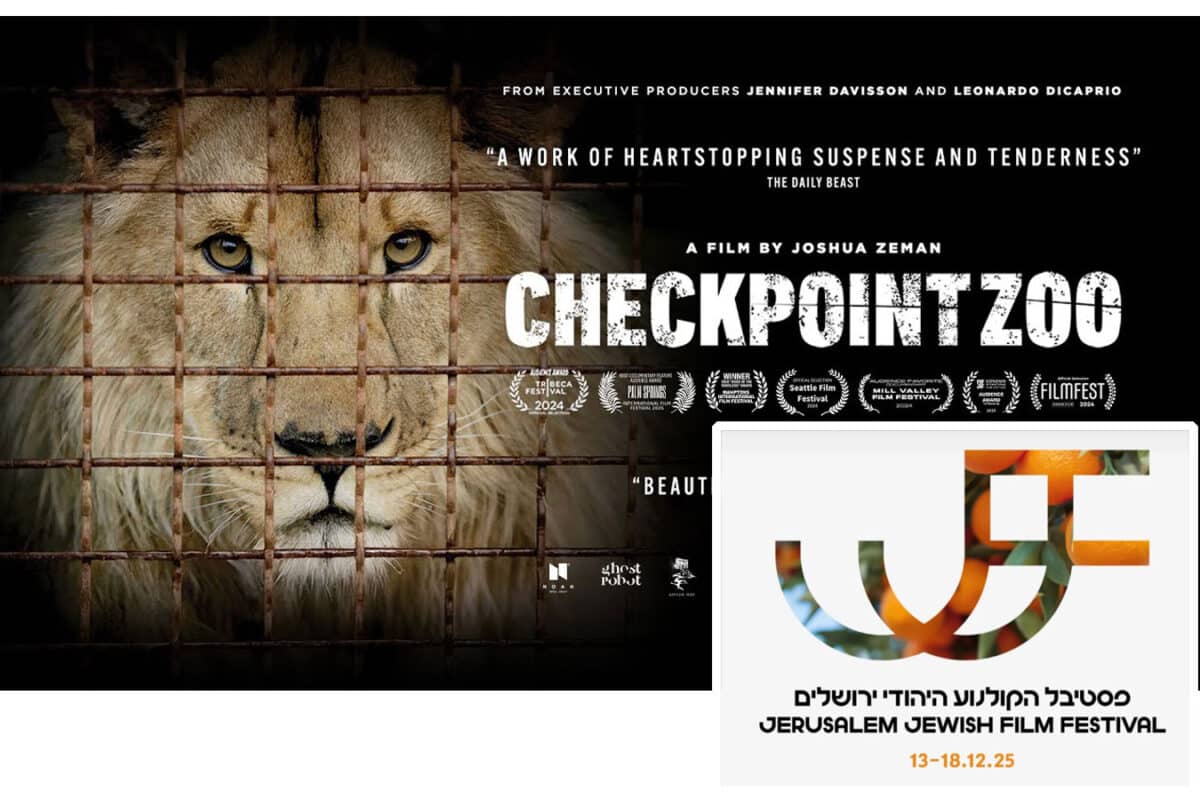
“Checkpoint Zoo”: The War in Ukraine Through the Eyes of Those Who Cannot Speak
The documentary film “Checkpoint Zoo” offers viewers an unusual and painful look at the war in Ukraine — not through front maps and reports, but through the fates of people and animals caught in the epicenter of hostilities.
The film is dedicated to the Ecopark in Kharkiv — one of the largest zoological complexes in Eastern Europe, where more than 5,000 animals lived before the full-scale invasion. The park was created by Ukrainian entrepreneur and public figure Alexander Feldman as a space for recreation, education, and therapy — especially for children with special needs.
The plot of the film is dedicated to the 71-day operation to evacuate thousands of animals from the Kharkiv Feldman Ecopark. Documentary footage, shot both by the zoo workers themselves and the film crew, shows the tense struggle for the survival of animals and the unparalleled dedication of people trying to save them.
Here it is on the map.
With the start of Russian aggression, Kharkiv came under constant shelling, and the Ecopark was practically on the front line. The film shows how the familiar “paradise” landscape turns into a survival zone in a matter of weeks. Animals die from explosions and stress, enclosures are destroyed, and park employees continue to go to work under shelling, trying to feed, treat, and evacuate those who can still be saved.
Several Ecopark employees died performing their duties. The camera captures not heroization, but exhausting, almost hopeless routine: lack of food, fear, moral choice — who to save first when resources are catastrophically scarce.
A separate line of the film is the personal story of Alexander Feldman, who speaks not only about the destroyed project of his life but also about the principled decision to restore the park after the war. For him, the Ecopark is not a business or an attraction, but a symbol of human responsibility to those who are completely dependent on people.
The film’s director, Joshua Zeman, emphasizes that he was interested not only in the cruelty of war but also in how compassion, attachment, and solidarity manifest in extreme conditions. Animals in the film become silent witnesses to human decisions, and sometimes a mirror of who we remain in the moment of catastrophe.
The director was inspired by a viral video of a chimpanzee named Chichi wandering around Freedom Square in Kharkiv, which prompted him to create the film. The original music was composed by Anne Nikitin, and the editing was done by a team of editors, including Sai Christiansen and Andrew Ford.
The film avoids direct political journalism but clearly shows the cost of war — not abstract, but physical and emotional. It is a film about the fragility of life and how war destroys not only cities but also spaces created for protection and care.
The screening of “Checkpoint Zoo” at the Jerusalem Jewish Film Festival makes this story part of a broader conversation — about humanism, responsibility, and what it means to remain human when the familiar world collapses.
The world premiere of the film took place on June 6, 2024, at the Tribeca Film Festival.
Awards for the film “Checkpoint Zoo”
The documentary film “Checkpoint Zoo” received wide international recognition and was awarded a number of prestigious awards and prizes at international film festivals:
- Desert Views Award and Audience Award — Palm Springs International Film Festival
- Jury Prize — Annapolis Film Festival
- Audience Award — Mill Valley Film Festival
- Best Documentary Film Award — Minneapolis St. Paul International Film Festival
- Audience Award for Best Film — Salem Film Festival
- Audience Award (second place) — Tribeca Film Festival
- Zelda Penzel “Giving Voice to the Voiceless” Award — Hamptons International Film Festival
- Jury Prize for Achievement in Documentary Filmmaking — Miami International Film Festival
In addition, the film was nominated for the Grand Jury Prize at the OKO International Ethnographic Film Festival.
When and Where to Watch “Checkpoint Zoo”
The documentary film Checkpoint Zoo will be shown as part of the Jerusalem Jewish Film Festival 2025 at the Jerusalem Cinematheque.
Screening Schedule:
- Wednesday, December 17, 2025
20:00
Cinematheque Hall 3
Screening followed by a discussion and conversation with the audience - Thursday, December 18, 2025
18:00
Cinematheque Hall 4
Tickets:
https://jer-cin.org.il/en/movie/89641
Film Information
Checkpoint Zoo
UK, USA, 2025
Duration: 107 minutes
Languages: English, Russian, Ukrainian
Subtitles: Hebrew, English
Genre: Documentary
Director: Joshua Zeman
Producers: Joshua Zeman, Zachary Mortensen
Production: After Hours Productions
The film is included in the documentary film program and the Films for English Speakers block of the Jerusalem Jewish Film Festival 2025.
For viewers in Israel, this film is not only a look at what is happening in Ukraine but also an opportunity to reflect on their own responsibility, memory, and capacity for compassion in a world where the fragility of life is increasingly felt. Such stories — about people, choices, and the cost of war — remain in the focus of the Israeli audience, as consistently reported by NANovosti — News of Israel | Nikk.Agency, capturing cultural and humanitarian meanings beyond dry news reports.
