
On February 15, 1989, the withdrawal of Soviet troops from Afghanistan was completed.
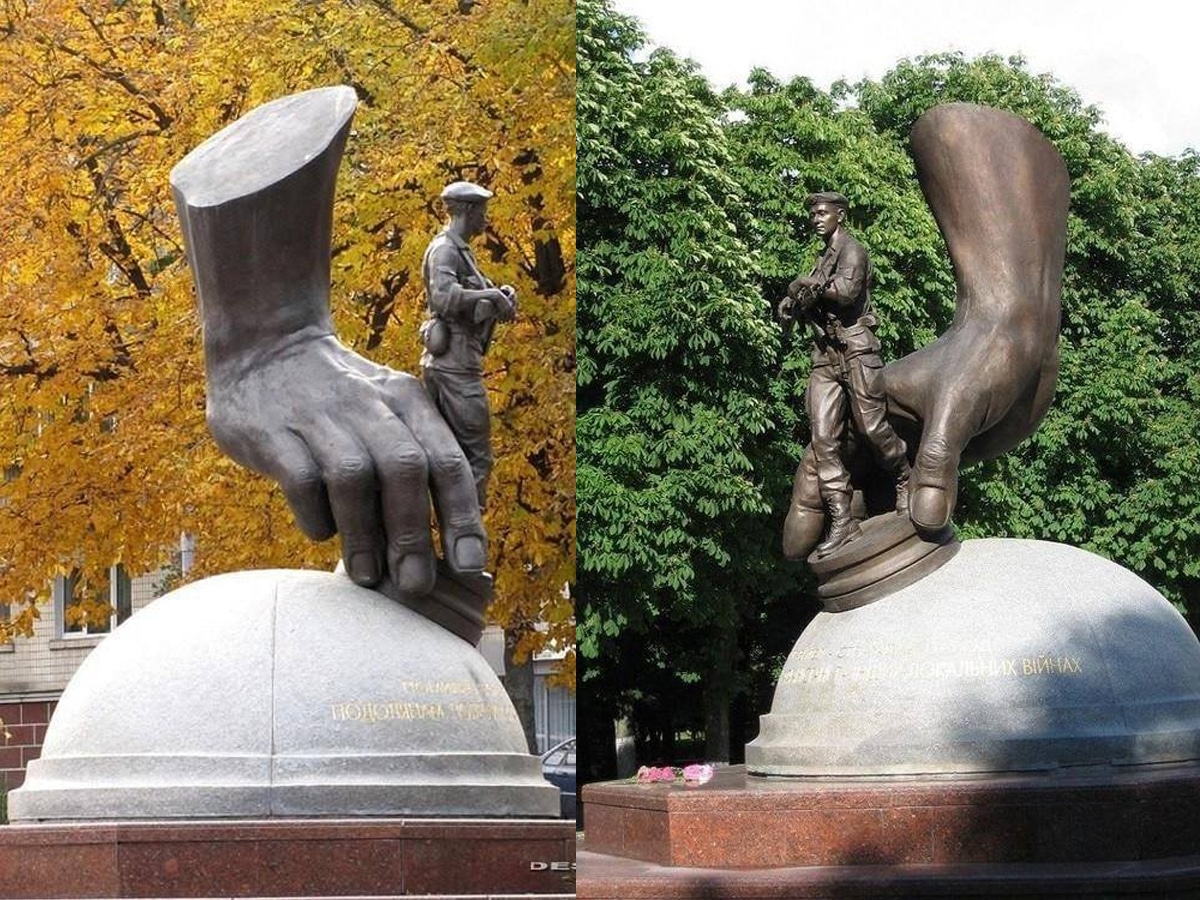
About how the ‘Afghan war’ is perceived in Ukraine – a monument in the city of Khmelnytskyi called ‘Pawn’ – someone’s large hand moves a soldier figure across the globe like a pawn. The monument was opened in 2007.
Inscription under the monument: ‘Rulers make mistakes – the people suffer’. The memorial is dedicated, as noted on the pedestal, to ‘Podolians who died in Afghanistan and other local wars’.
Probably one of the best anti-war monuments in memory of the Afghan war.
The Day of Remembrance for Combatants on the Territory of Other States was established by a decree of the President of Ukraine in 2004 and is timed to the completion of the withdrawal of former USSR troops from Afghanistan on February 15, 1989.
But the content of this date has significantly expanded in recent years.
The scale of the war that defined a generation
After World War II, the USSR participated in dozens of armed conflicts outside its territory. The Afghan campaign became the longest and the most difficult.
Ten years.
About 620 thousand military personnel went through it, of which approximately 150 thousand were Ukrainians. More than 15 thousand people died. Ukrainian losses exceeded four thousand.
Today, more than 150 thousand veterans of that war live in Ukraine. More than eight thousand were wounded, over six thousand are disabled.
For decades, these numbers seemed to be the limit of the acceptable price of foreign policy.
How February 15 is observed today
Across the country, veterans and families of the deceased gather on this day. They lay flowers, names are read, meetings are held.
In Kyiv, they traditionally go to the memorial for the fallen. In churches and monasteries, prayers are read — for the dead, for those who died after returning, for the living and their relatives.
The form may vary, but the meaning is the same: society recognizes their experience as part of its own history.
And this experience has ceased to be just a memory of the past.
A new war has changed the perspective
In 2014, thousands of Afghan veterans were among the first to volunteer to defend the Ukrainian east. People who already knew what the front was like found themselves in the trenches again.
Some died for the second time — already in the war for the independence of their country.
That is why the Ukrainian perception of Afghanistan today is not museum-like. It is a living line leading to current events.
This connection is constantly emphasized by historians, public organizations, and journalists. In the materials of NANews — Israel News | Nikk.Agency, the topic is presented as an example of how an old imperial war helps to understand the motives of current resistance.
When comparison becomes inevitable
Afghan losses — more than 15 thousand dead over ten years — were long perceived as a tragedy of exceptional scale.
But after the start of Russia’s full-scale invasion of Ukraine, a new background emerged.
Moscow does not disclose exact data.
Information is collected from regional reports, journalistic investigations, analysis of cemeteries, and contracts. The picture is incomplete, but the trend is obvious.
Okay — without references, just numbers, dates, and who evaluated it.
What is known by mid-February 2026
1) Total losses of Russia (killed + wounded)
- General Staff of the Armed Forces of Ukraine as of February 15, 2026: 1,253,270 ‘personnel losses’ (this is the total of killed and wounded, not just the dead).
- British intelligence estimate (in the retelling of its regular reviews) for February 2026: about 1,245,000 losses killed and wounded since the start of the full-scale invasion.
2) Minimum for the dead (confirmed by name)
- Joint database of BBC Russian + Mediazona (based on obituaries, registers, and public reports) as of February 13, 2026: 177,433 identified dead.
This is the lower boundary, because not all deaths are included in open sources.
3) Estimate of the dead (range, model estimate)
- In analytical estimates, which are based on the total ‘casualty’ figure (~1.2 million by the end of 2025) and typical ‘killed/wounded’ proportions, the order of ~275–325 thousand dead often appears (as a guideline, not as an exact counter).
What they see in Ukraine
For Ukrainian society, this comparison is not abstract.
It reinforces the meaning of the very inscription on the monument in Khmelnytskyi. Decisions are made at the top. Those who go to fight pay the price.
The only difference is that now Ukrainian veterans of the past conflict are fighting for their own state.
Between the oath and the assessment of history
The war in Afghanistan is often called an aggressive war in Ukraine. This assessment has become part of the public consensus.
At the same time, the attitude towards the soldiers remains respectful. They followed orders, lived within the system, and did not choose the political strategy.
This distinction is fundamentally important today.
It allows for simultaneously remembering the dead and drawing conclusions about the actions of the authorities.
Why February 15 is a conversation about the present
Every new year adds new names of another war to the memorials.
Therefore, February 15 in Ukraine is not only about what happened in 1989. It is a day when society once again asks about the price of state decisions.
And the answer, carved on the monument, requires no additional explanations.
Rulers make mistakes — the people suffer.
