David Mikhailovich Levin (1938–2025) was a civil engineer, an executive in the agricultural sciences system, a poet and a public figure. Born in Luhansk and orphaned at an early age, he spent much of his life in Uzbekistan before immigrating to Israel at 55. In Israel, Levin became chairman of the All-Israel Association of Immigrants from Ukraine, devoting decades to defending immigrants’ interests, preserving Jewish-Ukrainian historical heritage and strengthening relations between the two countries. His achievements were recognized with two Ukrainian state decorations: the Order of Merit, Third Class (2007), and the Order of Prince Yaroslav the Wise, Fifth Class (2013).
From the editors
We believe David Levin’s story deserves a place in our series “Jews from Ukraine”. This is the story of a man whose personal fate was closely entwined with the history of several generations of Jews in Ukraine and Israel, and whose public work extended far beyond an ordinary association of people from the same homeland.
In this article, we trace his childhood, family history, education and professional career in Soviet Uzbekistan. We recount his immigration in 1994, the history of the All-Israel Association of Immigrants from Ukraine, its local branches and the people with whom Levin worked.
Using Israeli state registry records, Knesset transcripts, materials from the Ukrainian Embassy and publications from different years, we examine his campaign for immigrants’ pension rights, assistance with housing and employment, involvement in public diplomacy, Ukrainian cultural festivals and many years of work to preserve the memory of Babyn Yar. We also explore his literary legacy, family, state awards, final years and the association’s work after his death.
The editors of NAnews — Nikk.Agency do not claim to offer an academic study or an exhaustive biography. What follows is a popular-history profile based on publicly available documents, publications and accounts by contemporaries.
Links to the sources and documents used are provided at the end of this article. Where information remains incomplete, contradictory or uncorroborated by independent evidence, we say so explicitly, distinguishing established facts from recollections and conjecture.
By Stas Shifer.
David Mikhailovich Levin
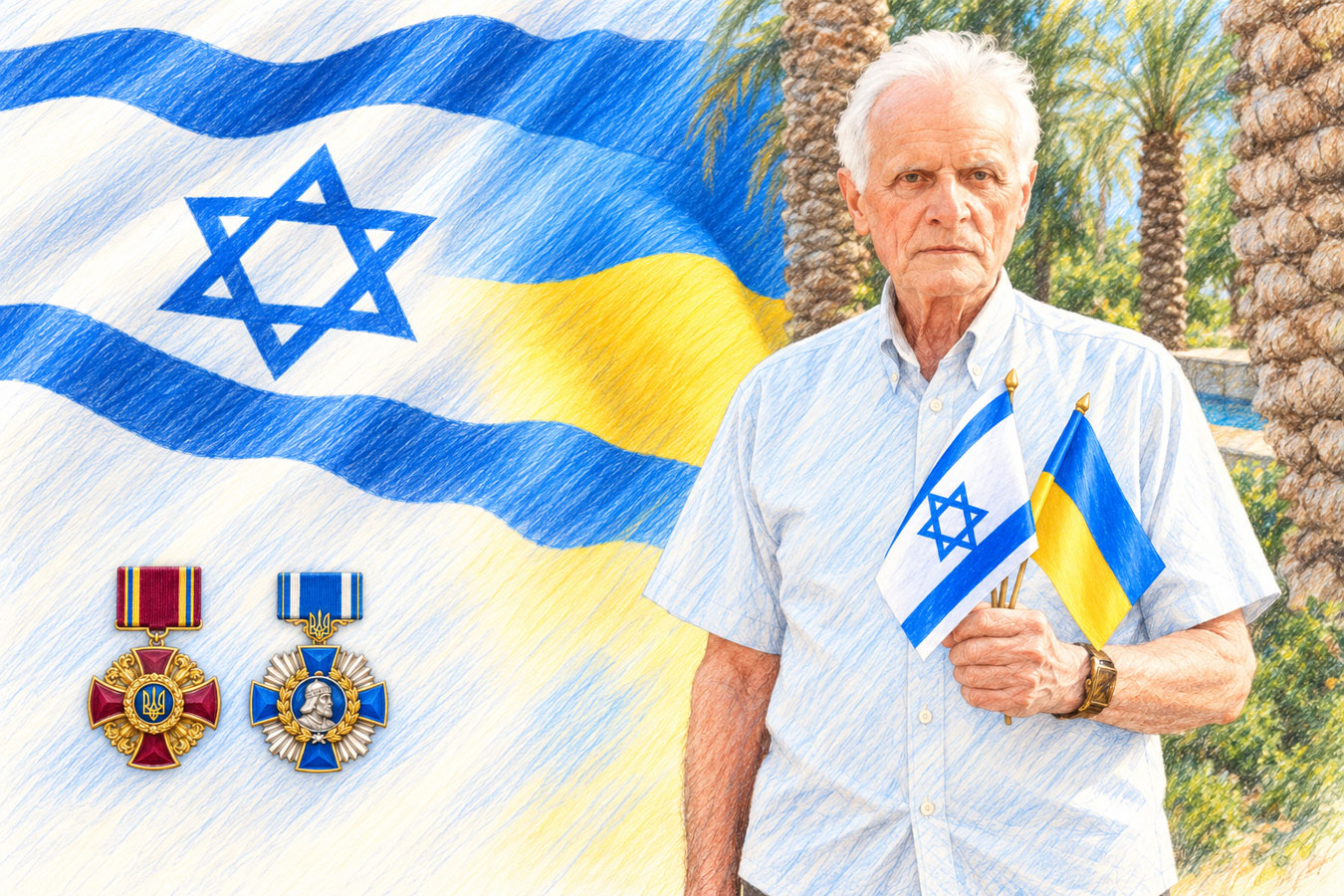
On October 12, 1938, David Mikhailovich Levin was born in Luhansk, then part of the Ukrainian Soviet Socialist Republic. His childhood was overshadowed by war. His father was killed at the front; his mother died when he was ten. He subsequently made his life in Uzbekistan, starting out in construction, obtaining an engineering education and, according to a biographical reference work, rising to a senior position in the agricultural sciences system.
In March 1994, already a mature man, Levin immigrated to Israel. Another major chapter of his life began there.
He became the long-serving chairman of the All-Israel Association of Immigrants from Ukraine, an organization that brought together dozens of local branches, addressed immigrants’ problems, developed cultural ties between the two countries and helped preserve the memory of the Holocaust.
Levin wrote poetry, published books and met politicians and diplomats. Yet one of the most revealing records of his life is neither a presidential award decree nor a literary biography, but a speech before the Knesset.
On July 1, 2008, he spoke to Ukrainian and Israeli parliamentarians about people who had worked in Ukraine for decades, moved to Israel and were still waiting for a resolution concerning their earned pensions. At the same meeting, Knesset member Michael Nudelman offered an estimate: of 50,000 immigrants from Ukraine (specifically people of pensionable age — editor’s note), around 32,000 were still alive by then. The figure came from Nudelman, not Levin, and was not a count of everyone awaiting pension payments.
Behind that number lay a problem familiar to many Israeli families who came during the great wave of immigration from the former Soviet Union: moving to a new country did not erase decades of employment in the old one.
David Levin died on March 12, 2025, aged 86. His life connected Ukraine, Uzbekistan and Israel — three different places, each of which formed an important part of his story.
Luhansk, 1938: the beginning of a life
David Mikhailovich Levin was born on October 12, 1938 in Luhansk.
An important historical clarification is needed: when he was born, the city was officially called Voroshilovgrad. The name Luhansk was restored in 1958, before the city was renamed again in the Soviet period. Biographies therefore use its modern name, although documents from 1938 would have used a different one.
Information on Levin’s birth appears in a biographical profile published by the All-Israel Association of Immigrants from Ukraine on the anniversary of his birth, and in the reference book Russian Literature in Israel.
His parents’ names, occupations and the family’s exact address have not yet been established from public documents.
When David was not yet three, the German-Soviet war began. His father went to the front and was killed.
Little is known of his father’s fate. No record has yet been found identifying his military unit, place of death, burial date or entry in wartime archives. It would therefore be wrong to claim that he died in any particular battle.
The war brought Levin’s family its first great tragedy. The second came after the war.
Orphaned at ten: his mother’s death and the move to Uzbekistan
His mother died when David was ten. If that age is accurate, this was around 1948.
A literary and biographical reference book preserves a detail missing from most brief accounts of Levin: after his mother’s death, the boy was taken in by her brother — David’s maternal uncle.
His subsequent life in Uzbekistan was connected with his uncle’s family.
The reference book describes a move to Central Asia “during evacuation.” There is, however, a chronological uncertainty: if the move followed his mother’s death around 1948, the war had already ended. The family may have left earlier, with the events presented out of sequence in the brief biography. Alternatively, “evacuation” may have been used to describe a longer period of resettlement.
No documents have yet been found that would allow us to choose between those explanations.
This matters. It is a reminder that the life of someone born in the USSR shortly before the war must often be reconstructed from later recollections rather than surviving family archives.
Nor have the exact places where Levin lived in Uzbekistan during his early years there been established.
But Uzbekistan was where he spent much of his life, from youth until his immigration to Israel.
Uzbekistan: construction worker, engineer and scientific administrator
For a long time, little was known about Levin’s Soviet years beyond the fact that he became a civil engineer.
The reference book Russian Literature in Israel allows us to reconstruct a more complex picture.
David first worked on construction sites. He combined work with study, working by day and attending classes in the evening. He eventually qualified as a civil engineer.
One particularly telling episode involves documents which, according to the reference book, he brought with him when he immigrated.
The first certified his qualification as a fourth-grade carpenter.
The second identified him as vice president of the Republican Uzbek Academy of Agricultural Sciences.
Between these two qualifications lay a remarkable professional journey.
The same source reports that Levin worked for many years at the All-Union Lenin Academy of Agricultural Sciences, known by the abbreviation VASKhNIL.
What was VASKhNIL, and why does it matter?
To Israeli readers, the name of this Soviet academy may sound like an unfamiliar acronym.
VASKhNIL was an extensive network of scientific institutions concerned with agriculture, plant breeding, agronomy, animal husbandry and other fields of agricultural science. Within the Soviet economy, these institutions were involved not only in research but also in production management, scientific infrastructure and state administration.
Uzbekistan played an important role in Soviet agriculture, particularly through cotton cultivation and its irrigation systems.
The report of Levin’s long service in the academy system therefore deserves attention. It suggests that his professional career probably extended far beyond ordinary construction work.
Accuracy is essential here: our information about his position as vice president of the republican academy comes from a biographical reference book. His appointment order, official identification and precise dates of service have not been published.
Nor have we established the name of the institution from which he graduated, the year he earned his degree, or the particular enterprises and institutions where he worked.
Even so, the known facts reveal an important aspect of his life: someone orphaned early went from manual labor and evening studies to a position of considerable administrative responsibility.
Family: a pediatrician wife, children, grandchildren and great-grandchildren
Brief official accounts of David Levin say very little about his private life.
The literary reference book, however, provides several valuable family details.
According to the biography published there, his wife worked as a pediatrician. The couple had two children.
When the reference book was compiled, Levin was said to have four grandchildren and three great-grandchildren. It also mentions his grandchildren’s service in the Israel Defense Forces, the IDF.
This is already the story of several generations of one family.
Levin himself was born in prewar Ukraine, grew up in Soviet Central Asia and moved to Israel after the collapse of the USSR. His descendants made their lives in Israeli society, including through military service.
The names of his wife, children and other relatives have not yet been established in verified public sources. It would therefore be wrong to publish names based on chance surname matches or social media profiles.
In a memorial post by Larisa Levkovskaya dated October 12, 2026, Levin’s family also features prominently. The author emphasizes that his loved ones continue to preserve his memory.
March 1994: immigration to Israel at age 55
David Levin immigrated to Israel in March 1994.
He was 55 years old.
This was the period of the great aliyah from the former Soviet Union. Following the USSR’s collapse, hundreds of thousands of people came to Israel, often leaving behind established careers, familiar social standing, homes and decades of employment.
Aliyah means Jewish immigration to Israel. Immigrants receive the status of oleh hadash — a new immigrant — and face challenges familiar to several generations of Israelis: learning Hebrew, obtaining recognition for qualifications, finding jobs, settling their families and dealing with housing and social-service issues.
For someone arriving at 55, these challenges could be particularly difficult.
The biographical reference book says that Levin came to regard Israel as his country. However, where he first lived, how he found employment and his early years of public activity still need to be reconstructed from documents.
Another distinction is important: March 1994 is the immigration date supported by biographical sources, not an established date for his election as association chairman.
Documents from later years confirm his leadership role.
David Levin belonged to a generation of immigrants who arrived after the State of Israel had already been established. Yet the links between Jews from Ukraine and the future Jewish state went back much further. One example is Leo Motzkin, born in Brovary, Ukraine, after whom the Israeli city of Kiryat Motzkin was named. NAnews devoted a separate article in the “Jews from Ukraine” series to his life.
The All-Israel Association of Immigrants from Ukraine: history, leadership and 35 branches
In Israel, “immigrants from Ukraine” refers to people whose families have ties to that country, regardless of whether they speak Ukrainian, Russian, Hebrew or Yiddish. Local associations brought together people from particular Ukrainian cities and districts, while the nationwide organization helped them address shared challenges after immigration.
The organization existed in Israel before Levin arrived
The All-Israel Association of Immigrants from Ukraine began long before David Mikhailovich Levin became its chairman. Different sources, however, give different dates for its establishment, which must not be confused.
An archived account of the Ukrainian community in Israel associated with the Ukrainian Embassy website gave 1979 as the founding year of a nonpartisan, nonprofit civic organization. This information also appears in a July 21, 2020, Ukrinform report, which lists its activities: helping new immigrants during their first months, overcoming language barriers, fostering social interaction and everyday adjustment, cultural integration, arts festivals and sports championships.
This is also reported on the Facebook page of the Ukrainian Foreign Ministry’s department for Ukrainians abroad.
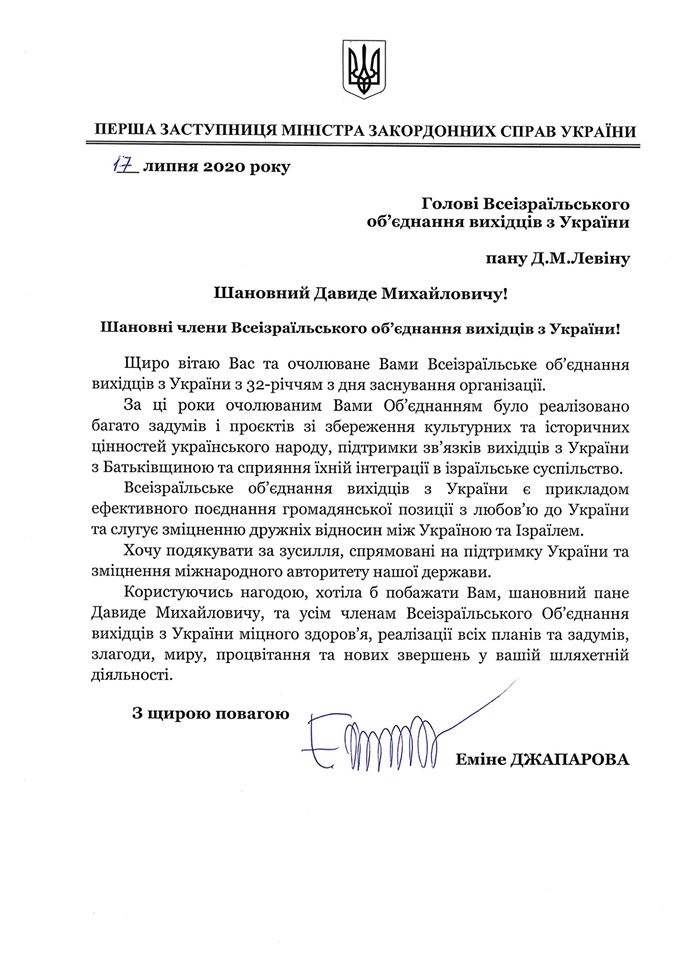
“I sincerely congratulate you and the All-Israel Association of Immigrants from Ukraine under your leadership on the 32nd anniversary of the organization’s founding!”
Ukrainian organizations in Israel: what the Ukrainian Embassy archive preserves
An important document for reconstructing the association’s history is the archived Ukrainian Embassy page “Ukrainians in Israel”, preserved by the Internet Archive as it appeared in February 2017.
This was not a separate article about David Levin, but an official directory of civic organizations of Ukrainians abroad and people originating from Ukraine in the State of Israel. The embassy listed organizations active in the country, described their origins and purposes, named their leaders and published contact information.
The surviving page describes five organizations and cultural initiatives.
The Israeli Society “Ukrainians in Israel” was founded in 2002. Its chair was listed as Svitlana Glaz. The society was described as a nonpolitical organization promoting Ukrainian culture in Israel: literature, folk art, traditions, songs, dances and aspects of Ukrainian everyday life.
The All-Israel Association of Immigrants from Ukraine, headed by David Levin, held a distinct place on the list. The embassy stated that it was founded in 1979 and described it as a civic, nonpartisan, nonprofit organization.
Its main activities were helping new immigrants from Ukraine during their first years in Israel, adapting to new circumstances, overcoming language barriers, building social networks and managing everyday life. The association also encouraged social and cultural integration, helped immigrants develop their creative talents, and organized Hebrew-language classes, music and poetry workshops, arts festivals and sporting events.
The archive also preserved the organization’s contact details at the time: David Levin, 1 Agozi Street, P.O. Box 3416, Rishon Le-Zion 75133, Israel. Telephone — ***, fax — ***, email — ***. These are historical details, not contact information verified as current in 2026.
The civic organization Israeli Friends of Ukraine emerged in 2014 from the volunteer initiatives Israel Supports Ukraine and Israel Helps Maidan Wounded. Participants supported Ukraine’s Revolution of Dignity and helped people injured during the confrontations on the Maidan. The organization aimed to support Ukraine through volunteer work, cultural and social projects and other activities. The embassy named Anna Zharova and Vyacheslav Feldman among its leaders.
The Association of Jews from Transcarpathia represented another part of the Ukrainian-Israeli community. It was created by people who came to Israel after the Second World War and during immigration in the 1970s. Its primary objectives were preserving the historical and family heritage of Transcarpathian Jews and maintaining contacts among people from the same region in Israel and abroad, including Transcarpathia. Its leader was listed as Yitzhak Klein.
The fifth entry concerned the Ukrainian Culture Festival in Israel, held since 2011 on the initiative of an Israeli folklore theater. Its aims were to preserve Ukrainian cultural traditions, maintain spiritual ties between immigrants and their country of origin, and introduce Israeli audiences to Ukrainian art. Both Israeli and Ukrainian artists took part. The festival’s artistic director and the theater’s director was listed as Lena Dzeiko.
The embassy page thus portrayed not a single organization but an entire civic environment: longstanding hometown associations, cultural societies, immigrant organizations and new volunteer movements that emerged after the events of 2014 in Ukraine.
It is also notable that a separate website for Israel’s Ukrainian community was established in late 2015. The embassy gave its address as sglaz2.wix.com/ukraina and explained that it was intended mainly to cover cultural events in the Ukrainian community. The editors invited Ukrainian poets, prose writers and anyone interested to contribute. It was a community website, however, not an established independent website belonging to Levin’s association.
For Levin’s biography, the archived page matters for several reasons. It officially confirms his leadership, documents specific areas of the association’s work and places the organization alongside other participants in Ukrainian civic life in Israel.
There is also an important historical question. The embassy gave 1979 as the association’s founding year, whereas the Israeli state registry records the registration of legal entity No. 580131480 on July 17, 1988. Another document confirms that its name was changed on November 29, 1995: a society assisting people from Kyiv became an association for immigrants from across Ukraine.
The discrepancy also appears in Ukrinform’s July 21, 2020, report. It describes congratulations to Levin and the association on their 32nd anniversary, which points to 1988, while the historical background again gives 1979.
A civic movement may have existed before formal registration, or the dates may refer to different stages in the organization’s development. Without the founding documents, this remains conjecture.
One fact, however, is documented: under David Levin, the All-Israel Association of Immigrants from Ukraine was part of a much wider network of civic ties between Ukraine and Israel. It worked alongside cultural societies, hometown associations, volunteer initiatives and artistic groups, while retaining its own focus on supporting immigrants and people originating from Ukraine.
The Israeli registry of nonprofit organizations records the registration on July 17, 1988 of a civic association later named התאחדות יוצאי אוקראינה בישראל (ע״ר) — “Association of Immigrants from Ukraine in Israel.”
Its registration number is 580131480. The registered address is 3 Sde Yitzhak Street, Rishon LeZion.
Rishon LeZion, south of Tel Aviv, became one of Israel’s major centers of Russian-speaking immigration.
But the organization’s legal history did not end there.
The Israeli nonprofit registrar’s records show that the organization officially changed its name on November 29, 1995.
Originally it was called:
עמותה למען יוצאי קייב בישראל — “Society for the Assistance of Immigrants from Kyiv in Israel.”
After the name change, it became:
התאחדות יוצאי אוקראינה — “Association of Immigrants from Ukraine.”
This is an important detail. An organization initially oriented toward people who had arrived from Kyiv adopted a name embracing immigrants from across Ukraine.
David Levin immigrated to Israel in March 1994. Thus, by the time he arrived, the registered organization had existed for almost six years, and the name change took place about one year and eight months after his immigration.
Whether Levin participated in the decision to change the name is still unknown to us.
Also not established are the names of the organization’s founders in 1988, its first chairman and the original composition of its board. These details should be sought in the nonprofit’s registration file, particularly the founding documents and minutes of general meetings.
There are other clues. In the Knesset on February 22, 2016, as translated by MK Tali Ploskov, Levin said that the organization had existed for around forty years. Funding records for 2017 refer to the association’s 40th anniversary. Yet in July 2020, Ukraine’s first deputy foreign minister, Emine Dzhaparova, personally congratulated Levin and the association on its 32nd anniversary — consistent with 1988. The same Ukrinform report, meanwhile, separately gives 1979.
Thus, 1979 appears in the community history, July 17, 1988, is the legal registration date, and November 29, 1995, is the date of the name change. The anniversary claims made between 2016 and 2020 are not entirely consistent. An early civic initiative may have preceded nonprofit registration, but there is as yet no documentary proof of legal continuity or the exact founding date.
When did David Levin become chairman?
We do not yet know the precise date on which David Levin was elected chairman of the All-Israel Association of Immigrants from Ukraine.
There is, however, an official Ukrainian document confirming that he already held the position in 2007.
On November 12, 2007, Ukrainian President Viktor Yushchenko signed Decree No. 1090/2007 honoring individuals who had made significant contributions to Ukrainian-Israeli relations.
David Mikhailovich Levin received the Order of Merit, Third Class.
The decree identifies him as chairman of the Association of Immigrants from Ukraine in Israel.
The same document honored two other people: Second World War veteran and partisan Leonid Berenshtein, awarded the Order for Courage, First Class, and historian Shimon Redlich, awarded the Order of Merit, Third Class.
Consequently, Levin was already heading the association by November 12, 2007, at the latest. He may have led it much earlier, but no public source has yet allowed us to determine the year of his election.
July 1, 2008: 35 branches and representatives from 24 cities in the Knesset
Especially valuable information on the organization’s size survives in the transcript of a meeting held at the Knesset on July 1, 2008.
A delegation of Ukrainian parliamentarians and civic leaders visited Israel’s parliament. The Israeli side included Knesset members, representatives of the Ukrainian Embassy and heads of civic organizations.
Among those organizing and attending the meeting were Knesset member Michael Nudelman, who worked to strengthen Israeli-Ukrainian interparliamentary relations, and Ukrainian parliamentarian Oleksandr Feldman.
David Levin spoke as chairman of the national association. He reported that it had 35 local branches across Israel, from north to south.
When Nudelman asked how many cities the organization’s representatives had come from, Levin replied: from 24 cities; the others were still expected.
These are two different figures: 35 was the association’s total number of branches; 24 was the number of cities represented at the meeting when Levin spoke.
The meeting addressed relations between Israel and Ukraine, cultural ties, Holocaust remembrance and the situation of immigrants who retained pension entitlements from Ukraine.
Levin spoke of the importance of remembering Babyn Yar, concerts and events where Ukrainian speech and song could be heard alongside Hebrew and Yiddish, and the role of civic contacts between the two countries.
He paid particular attention to Ukrainian pensions for people who had moved permanently to Israel. Many had worked in Ukraine for decades, but the question of receiving their earned pensions remained unresolved.
The transcript also mentions Leonid Yefimovich Berenshtein, a former partisan detachment commander and member of the association’s leadership. Levin conveyed his greetings to the participants because Berenshtein could not attend in person.
Full transcript of the Knesset meeting of July 1, 2008.
Who headed the local branches?
The 2008 parliamentary transcript helps identify some of the organization’s representatives.
Kiryat Shmona. Yaakov Eisenberg is identified as chairman of the local branch. Kiryat Shmona lies in Israel’s far north, near the Lebanese border.
Ashdod. Roman Kaon is named as chairman of the local branch. Ashdod is a major Mediterranean port city with a substantial Russian-speaking community.
Jerusalem. The 2008 participant list includes V. Feinman as a branch representative and also names Alex Veksler from Jerusalem. A separate parliamentary committee record dated February 12, 2008 identifies Valery Fainer (V. Feiner) as head of the Jerusalem branch and an association coordinator. His participation alongside Levin is recorded again in 2009 parliamentary records. These materials help clarify the full name and position of one of the local leaders.
Dimona. Vladlen Kapon was among the association’s representatives. Dimona is in the Negev desert region of southern Israel.
Ashkelon. The transcript mentions Yuri Zamoshchik from Ashkelon. The city is also mentioned in a discussion of possible meetings between the Ukrainian delegation and immigrants. His position is not given, however, so he cannot yet be confirmed as a branch chairman.
The parliamentary record also names two regional coordinators: Yosef Alterman, responsible for northern cities, and Nahum Israel, who coordinated the association’s work in central Israel.
This shows that the organization had regional coordination in addition to city representatives. At another parliamentary meeting in 2009, Levin and Fainer appear among the invited representatives of civic organizations discussing the role of Jews in the fight against Nazism.
January 2012: from Kiryat Shmona to Dimona
In January 2012, the newspaper Jewish Kyiv, No. 23, published an article about the work of the All-Israel Association of Immigrants from Ukraine.
It reported that the organization’s network covered 35 Israeli cities, from Kiryat Shmona in the north to Dimona in the south.
Besides those two cities, it specifically named Jerusalem, Tel Aviv, Haifa and Beersheba.
The newspaper also noted that the association included the Vinnytsia hometown association and the “Bershad” hometown association.
Hometown associations brought together people connected by their origins to particular Ukrainian cities and districts. They should not therefore be counted as additional Israeli city branches.
According to information published at the time, more than 35,000 people were registered with the association after submitting registration applications.
The newspaper described the association as one of the large civic organizations representing immigrants from Ukraine. It covered the defense of their interests, memorial events, cultural ties with Ukraine and efforts to combat antisemitism.
The same issue reported that Ukrainian President Viktor Yanukovych had sent David Levin a personal New Year’s greeting.
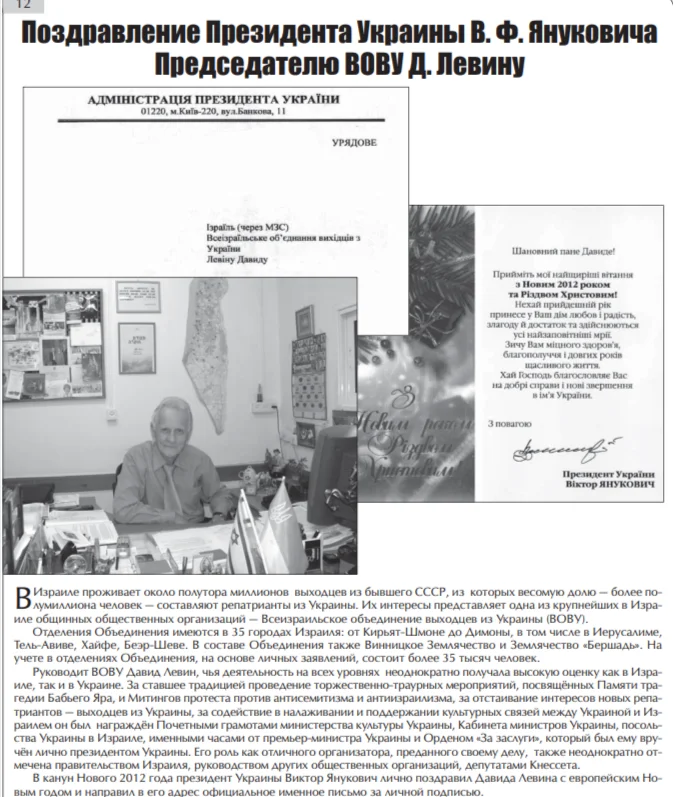
Jewish Kyiv, No. 23, January 2012, page 12.
Other cities identified through documents
No complete list of all 35 branches in 2008–2012 has yet been found in the available sources. Further Israeli publications and documents, however, identify several more cities and local leaders.
Or Akiva. In a notice published on March 21, 2012, the association’s Or Akiva branch announced a group trip to Kyiv planned for May–June that year. Participants were offered subsidized airline tickets, the possibility of sanatorium treatment and help finding accommodation.
Or Akiva branch notice, March 2012.
Karmiel. In the transcript of a Knesset meeting on July 24, 2017, Lev Tsimkovsky is named chairman of the association’s Karmiel branch.
Arad. At the same meeting, Lev Groisberg is identified as chairman of the Arad branch.
The two cities are in different parts of Israel: Karmiel is in the Galilee in the north, while Arad is in the south, near the Dead Sea.
Transcript of the Knesset meeting of July 24, 2017.
Rishon LeZion. In April 2021, the association’s board published an obituary for Pavel Shataylo, one of its longstanding leaders.
The notice said Shataylo had organized the association’s Rishon LeZion branch and become its first chairman, then served as deputy chairman of the nationwide association for about a quarter of a century.
It also noted that he was born in Odesa, survived wartime evacuation, lost his father during the Second World War and later became a prominent lawyer.
In memory of Pavel Shataylo — association board statement of April 8, 2021.
Bat Yam. In municipal records from 2025, Maria Foxman Till is named head of the association’s local branch.
The municipality praised her work with Russian-speaking children, organization of cultural events, literary activities and assistance to new immigrants. That year she received the title of honorary resident of Bat Yam.
Official publication by the Bat Yam municipality.
Documentary traces of the association’s work can be found in other cities as well.
In Rehovot, the association, registration No. 580131480, is mentioned in the minutes of a municipal committee on nonprofit support dated November 23, 2023. The calculation includes ₪4,427; the document confirms that financial support was considered, but not that the money was actually transferred. The municipal archives of Nazareth Illit, now Nof HaGalil, likewise mention the association in discussions of municipal support.
But receipt of municipal support, or the mere mention of an organization in city documents, does not by itself prove that a separate local branch existed.
Thus, sources from various years identify 12 Israeli cities with direct evidence of branches or their representatives:
Kiryat Shmona, Haifa, Tel Aviv, Jerusalem, Beersheba, Dimona, Ashdod, Or Akiva, Rishon LeZion, Bat Yam, Karmiel and Arad.
Ashkelon remains another probable point in this network. Rehovot and Nof HaGalil are confirmed as cities connected to the association’s activities, but not as locations of definitively established independent branches.
The documents also cover different periods — from 2008 to 2025. The list should not therefore be presented as the complete official roster of all 35 branches operating simultaneously under Levin.
Other staff and representatives: evidence from the Knesset
The minutes of the Aliyah, Absorption and Diaspora Committee meeting of June 23, 2014, on assistance to Holocaust refugees, identify David Levin as the association’s chairman and Bina Samkhova (בינה סמחובה) as its press secretary. Other participants included representatives of government agencies, the pension-rights movement, veterans’ organizations and Yad Vashem.
In parliamentary documents dated July 24, 2017, Arkady Naidits appears alongside the leaders of the Karmiel and Arad branches, described as a branch head without a reliably identified city in that particular record. The invitation list for a 2018 discussion of a memorial project also includes Mikhail Malkovsky as an association member. Appearing on a participant list establishes a civic connection but does not prove involvement in specific decisions.
2016: Levin again speaks of 35 branches
On February 22, 2016, David Levin spoke at a parliamentary committee meeting discussing elderly immigrants who had survived the Holocaust, wartime evacuation and the Second World War.
He found it difficult to speak in Hebrew, so he spoke in Russian.
Knesset member Tali Ploskov, who chaired the meeting, conveyed the main points of his remarks to the other participants.
According to Levin’s words as she relayed them, the association had 35 branches across the country and around 35,000 people were connected to its work.
A substantial share of those it helped were Holocaust survivors, wartime refugees and veterans.
Levin pointed out that many elderly immigrants had limited Hebrew. The language barrier made it difficult for them to deal with Bituach Leumi, Israel’s National Insurance Institute, and municipal social services.
He also spoke of the need to help people get to know Israel, arrange trips, observe traditional holidays and maintain intergenerational ties.
Many elderly immigrants from Ukraine continued to live largely in a Russian-speaking environment, while their children — and especially their grandchildren — had become much more integrated into Israeli society.
Housing costs were another problem: for some elderly people, a large proportion of government benefits went toward rent.
Association representatives emphasized that a shortage of funds and staff limited what volunteers could do.
Transcript of the Knesset meeting of February 22, 2016.
The speech is also significant because the figures of 35 branches and roughly 35,000 people were heard again in parliament eight years after the 2008 meeting.
What financial reports and the organizational registry reveal
The Israeli registry also allows us to trace certain areas of the association’s work.
Its officially stated purposes include preserving the memory of those murdered at Babyn Yar, assisting people from Kyiv, and establishing and supporting scientific, educational, cultural, artistic and civic projects.
The funding records identify specific cultural initiatives. Moreover, the organization’s financial history extends much further back than the published reports for 2017–2019.
In 2006, an entry for association No. 580131480 appears in an Israeli government list of allocated funds under the Ministry of Absorption, with an amount of ₪40,000. The stated purpose was to participate in commemorating those who died during the Second World War and to hold a ceremony at Yad Vashem. This documents a budget allocation; evidence that the full amount was actually paid has not yet been found.
In 2017, for example, the published registry information lists receipts of ₪29,886 for anniversary events and a Ukrainian culture festival, plus ₪11,535 for a literary almanac and meetings with writers.
In 2018, a further ₪11,100 appears for a literary publication and meetings between Israeli and Ukrainian authors.
In 2019, the records show ₪28,157 for the activities of the Shahar theater and the Ukrainian-language literary and civic publication Vidlunnia (“Echo”). These sums represent receipts recorded in available summary registry data, not independently established costs of each event. Until primary accounting records are examined, they must be treated accordingly.
These figures complement Levin’s parliamentary appearances: the association’s cultural activities were not merely subjects of public statements; they were also reflected in its financial reporting.
Registration and financial data for organization No. 580131480.
Available summary registry data for 2025 lists 35 nonprofit members and 169 volunteers, no paid employees and annual income of ₪39,493. In October 2026, the Taagidim database showed the organization as a registered nonprofit with certificates of proper management (ניהול תקין) for 2026 and 2027. This describes its legal and reporting status, but does not prove that all 35 former city branches were still active.
At the same time, an older Israeli archival data extract associated with 2021 listed 18,275 members and 183 volunteers. This sharp difference may reflect incomparable counting categories, changes in reporting or organizational structure; the figures cannot be meaningfully compared without the original reports.
Several distinct indicators must therefore be kept separate.
35 branches is the number of territorial divisions reported by David Levin.
More than 35,000 people is the association’s reported number of registered participants in a 2012 newspaper article. These figures were supplied by the civic organization and reproduced in the press; they are not government census data.
35 nonprofit members in the 2025 summary reporting is a legal indicator, not equivalent to the number of branches, all participants or people receiving assistance. Nor can it automatically be compared with the 18,275 members recorded in an older data extract.
No complete named list of ordinary nonprofit members, the founders in 1988 or the original board was found in the open materials reviewed. The names of authorized signatories and members of a later board, however, are published in GuideStar’s officeholders section and appear at the end of this article.
To identify the missing people, it is necessary to examine the association’s registration file held by Israel’s nonprofit registrar, including the original application, bylaws, general meeting minutes and documents concerning the 1995 name change.
Official Israeli Ministry of Justice service for obtaining nonprofit documents
An association connecting two societies
The documents show that David Levin’s work was far broader than simply running a hometown association.
The All-Israel Association of Immigrants from Ukraine worked on pension provision and social protection, helped elderly people navigate Israeli institutions, supported cultural projects, preserved the memory of Babyn Yar and developed civic ties between Israel and Ukraine.
Behind its network of 35 branches stood real people: local association leaders, regional coordinators, volunteers and participants in memorial ceremonies and cultural events.
The scale of this activity is corroborated not only by the association’s own publications, but also by Knesset transcripts, Israeli municipal documents, nonprofit registration records and official Ukrainian award decrees.
The question of exactly when David Levin became chairman and who led the organization before him remains open. It is established that he held the post no later than November 2007.
His documented achievement was his many years of leadership of an organization combining social assistance, cultural remembrance and relations between the two countries.
Pensions from Ukraine: why Levin spoke in the Knesset
Pensions were among the most pressing issues in David Levin’s public work.
Many immigrants from the former USSR arrived in Israel shortly before or after retirement age. They might have worked for decades in their countries of origin, but payment of pensions earned there after moving abroad depended on legislation and international agreements.
Israel’s social security system could not automatically replace all pension rights accrued in another state.
The issue was therefore not about abstract diplomatic formalities, but the everyday lives of elderly people.
A parliamentary estimate of 32,000 people and Levin’s demands
At the meeting on July 1, 2008, it was a reference to 32,000 surviving immigrants from Ukraine made by Knesset member Michael Nudelman. He estimated that 18,000 of the 50,000 people under discussion had already died. These were a parliamentarian’s figures, not an independent census or an exact count of those awaiting pension payments. David Levin himself reminded participants of the decades immigrants had worked in Ukraine, urged Ukrainian parliamentarians to support a future pension agreement and expressed the hope that people would live to receive the benefits they had earned.
His remarks contain a revealing incident: recalling an earlier pension debate, Levin admitted that he could no longer bear endless discussions and demanded a move from words to decisions. This is a rare firsthand record that illuminates not just his position, but his manner of public engagement.
The online archive has a technical peculiarity: the page heading refers to a meeting in 2009, but the transcript itself is dated July 1, 2008. We use the date of the actual document when citing his remarks.
Appeals, meetings and negotiations
Materials from the pension-rights movement report that in 2008 Levin appealed to Israeli Foreign Minister Tzipi Livni to accelerate a resolution of the pension issue. There is independent evidence as well: on November 23, 2008, the Israeli news outlet Ynet reported his meeting with Tzipi Livni, then head of the Kadima party, alongside leaders of other immigrant and veterans’ organizations.
Levin told journalists that people who came to Israel at approximately 45 or older had too little time to build up an adequate Israeli pension. He wanted promises of assistance to become concrete decisions. The meeting also addressed conversion to Judaism, the situation of new immigrants and the effects of the economic crisis. This is his own statement in the Hebrew-language press, not a later retelling.
During Ukrainian President Viktor Yanukovych’s visit to Israel in 2011, pensions again became a subject of public discussion. The newspaper Jewish Kyiv reported that Levin, as association chairman, had been invited to an official dinner attended by the leaders of the two countries.
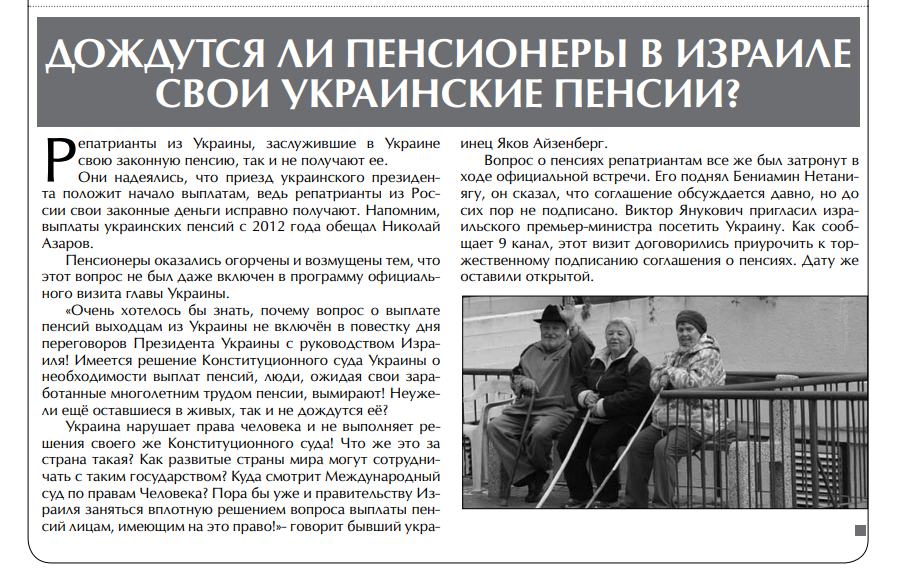
The same publication reported discussions of Ukrainian pensions at the interstate level.
It would, however, be wrong to claim that Levin single-handedly secured the subject’s inclusion in the talks. Several civic organizations, activists and politicians worked on the pension issue.
In the same issue, the newspaper ran another article with the sharp headline “Israel’s Ukrainians Offended by Ukrainian President — Viktor Yanukovych Ignored Israel’s Ukrainian Community”.
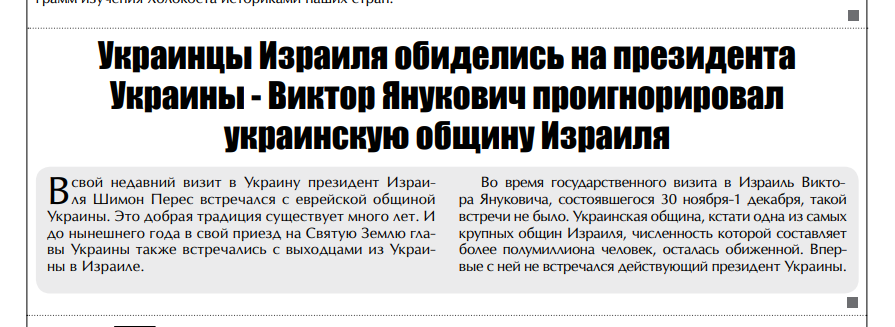
The newspaper recalled that Israeli President Shimon Peres had met the local Jewish community on a visit to Ukraine. Previous Ukrainian presidents visiting Israel had, according to the paper, followed a similar tradition.
During Yanukovych’s visit, however, there was no general meeting with representatives of Israel’s Ukrainian community. The newspaper called it an unprecedented omission and noted the dissatisfaction of immigrants from Ukraine, whose number it estimated at more than half a million. The latter figure was a newspaper estimate, not a verified census result.
In December 2013, a report in a civic archive recorded Levin’s appearance at a Knesset conference devoted to pensions from countries of origin. This event should be distinguished from the extensively documented 2008 meeting.
Sources: Jewish Kyiv, No. 22, December 2011; archives of the immigrant pension-rights movement; Open Knesset.
David Levin’s story is not just the biography of someone from Ukraine who rebuilt his life in Israel. Behind his long public career were problems familiar to tens of thousands of Israeli families: pensions, housing, care for elderly parents, preserving language and ties to the country of origin. For the editors of NAnews — Israel News | Nikk.Agency, this story is especially important because it shows the role that immigrants from Ukraine have played, and continue to play, in Israeli society. Their contribution is measured not only by individual achievements, but also by work on behalf of others facing similar circumstances.
Beyond pensions: employment, housing and help for new immigrants
The association’s work was not limited to older people.
According to the organization’s own materials, under Levin it assisted new immigrants, worked on housing issues and cooperated with municipalities, Knesset members and government agencies.
Particularly important evidence emerged after the beginning of Russian aggression against Ukraine in 2014, when immigration increased.
On June 8, 2015, the Knesset’s Aliyah, Absorption and Diaspora Committee discussed preparations to receive immigrants from Ukraine and France.
Levin was listed among the invited participants as chairman of the Association of Immigrants from Ukraine.
The meeting discussed shortages of public housing, employment difficulties and the need to help newcomers not only upon arrival but also after their initial adjustment. Avraham Sharnopolsky, deputy leader of the civic movement “Front of Dignity”, specifically cited Levin’s association. He said it had 35 branches whose volunteers helped people find jobs and rental housing, but that the branches had virtually no funding. This was testimony from a representative of another organization, not Levin’s own statement, and it independently corroborates the network’s activity in 2015.
Israeli readers will recognize the problem: sal klita, the initial absorption allowance, helps in the first stage but cannot by itself resolve long-term housing, employment and income problems.
Levin represented an organization working precisely at this level — between people’s everyday problems and government institutions.
Source: Knesset committee transcript of June 8, 2015.
People-to-people diplomacy: Ukraine and Israel through personal connections
Another area of Levin’s activity was relations between Ukraine and Israel.
He cooperated with the Ukrainian Embassy and participated in cultural events and meetings with diplomats, lawmakers and representatives of civic organizations.
His name appears in Ukrainian diplomatic mission materials among participants in events devoted to bilateral relations.
For example, the embassy archive preserves a report on an evening in Bat Yam in 2017 marking an anniversary of Israeli-Ukrainian diplomatic relations. Levin and theater director Grigory Grumberg were among those mentioned.
Archived Ukrainian Embassy report.
In his 2008 speech, Levin stressed cultural exchanges and interpersonal ties. He spoke about visits by Ukrainian artists, concerts, meetings and trips by Israelis to Ukraine.
Such work is often described as people-to-people diplomacy.
It is neither formal diplomatic service nor negotiations between governments. It consists of ties maintained through communities, cultural societies, performing groups, families and personal acquaintances.
For Levin, the Ukrainian origins of Israeli citizens were not simply memories of the past, but a basis for practical cooperation.
Ukrainian culture in Israel: festivals, theaters and books
Among the association’s most visible projects were Ukrainian culture festivals in Israel.
The first festival reported in contemporary news coverage took place in Rehovot in 2011. The All-Israel Association of Immigrants from Ukraine, under David Levin, was among its organizers.
The gala concert was called “Dnipro Stars”.
By August 2013, the third festival had taken place.
A detailed account survives in a publication by the Vaad of Ukraine — the Association of Jewish Organizations and Communities of Ukraine.
The festival was supported by Israel’s Ministry of Culture, the Ukrainian Embassy, the Rehovot municipality and other partners.
Ukrainian and Israeli performers appeared on stage.
They included the vocal ensemble Pikkardiyska Tertsiya, Lviv Opera soloist Oleh Lykhach, singer Liudmyla Yasynska, and the Israeli folk group Tapuach BeDvash led by Anatoly Geiko, as well as dance troupes and performers of Ukrainian and Jewish songs.
The work of the festival’s artistic director, Lena Dzeiko, received particular recognition.
The concert was hosted in Russian and Hebrew, and its program combined Ukrainian folk songs, klezmer music, contemporary compositions and dance.
This was an important feature of the festivals: they were intended not only for immigrants from Ukraine, but for a broader Israeli audience.
According to Levin’s own materials, by 2018 the association had held six Ukrainian cultural festivals. This number comes from his account of the organization’s work and still requires separate verification against the programs of all six events.
In addition to festivals, the association’s materials mention the theatrical projects Shahar and Portrait, meetings with writers and performers, cultural and educational initiatives, the magazine Vidlunnia (“Echo”), the Ukrainian Abetka (“Alphabet”), and mobile consular appointments.
The exact dates, organizers and archived programs of some of these projects have yet to be reconstructed. They nevertheless illustrate the breadth of the civic community in which Levin worked.
Source: Vaad of Ukraine — Ukrainian Embassy reception and third Ukrainian Culture Festival, August 2013.
Babyn Yar: a memory he preserved for many years
A special place in Levin’s public work was occupied by the memory of Babyn Yar.
Babyn Yar is a ravine in Kyiv where mass murders took place during the Nazi occupation. On September 29–30, 1941 alone, 33,771 Jews were shot there, according to a contemporary German report. The Nazis later murdered other people there as well.
For Jews from Ukraine, Babyn Yar became one of the central symbols of the Holocaust. For Israel, it is part of the shared memory of Europe’s destroyed Jewish communities.
For Levin’s generation, this history carried particular significance because the war had destroyed his own family.
2006: “Book of Life” and Holocaust survivor testimonies
Even before the earliest well-documented ceremonies involving Levin, the association was mentioned in connection with the “Book of Life” (ספר החיים) project. An account in Hebrew of the history of Amigour — a Jewish Agency housing organization serving older people — states that in 2006 Amigour, together with Yad Vashem, the All-Israel Association of Immigrants from Ukraine and the Ministry of Absorption, took part in documenting the lives of Holocaust survivors living in Amigour housing.
Amigour’s own website confirms the project itself: more than 50 individual books were prepared containing Holocaust survivors’ memories, photographs and poems, along with a collected volume of 1,000 life stories presented to Yad Vashem at a ceremony in September 2006. The Hebrew-language account mentioning the association connects the event to the 65th anniversary of the mass murder of Jews in Ukraine at Babyn Yar, Bohdanivka and Drobytsky Yar. The National Library of Israel also has a bibliographic record of a collection of reminiscences by Amigour residents. However, the association’s involvement is mentioned in an account rather than an organizers’ agreement we have located; David Levin’s personal contribution to preparing the books has not been established separately.
2009: a ceremony at Yad Vashem
In September 2009, a report on a Babyn Yar memorial ceremony in Jerusalem explicitly identified Levin as the association’s chairman and the event’s host.
The ceremony was held at Yad Vashem, Israel’s national Holocaust memorial and research complex.
Over the years, the association’s participation in such events became an established tradition.
2013: an official memorial program
An official Yad Vashem invitation to a ceremony on September 11, 2013 survives, marking the 72nd anniversary of the murder of Jews in Ukraine, including Babyn Yar and other mass shooting sites.
The program identifies Levin as chairman of the association, alongside Absorption Minister Sofa Landver, Yad Vashem chairman Avner Shalev, Jewish Agency chairman Natan Sharansky and Ukrainian Ambassador Hennadii Nadolenko. The invitation specified a memorial ceremony in the Hall of Remembrance at 3:00 p.m. and a gathering in the auditorium at 3:30 p.m.. This is therefore a dated document issued by the organizer, not merely a later recollection.
2016: Babyn Yar, Kyiv, the tragedy’s 75th anniversary
On September 29, 2016, David Levin was in Kyiv for events marking the 75th anniversary of the Babyn Yar massacre.
This is confirmed by more than written reports.
The UNIAN photo archive preserves image No. 736253, which identifies Levin as chairman of the All-Israel Association of Immigrants from Ukraine.
The photograph identifies the date, location and photographer — Oleksandr Synytsia.
UNIAN photographic record of September 29, 2016.
This photograph is among the most valuable visual records of his life.
2018: memorial work and public debate
On June 19, 2018, Levin appears on the attendee list for a Knesset meeting about the Babyn Yar memorial center project, a museum and educational center commemorating the Jews of Ukraine and other parts of the former USSR. Invitees included Natan Sharansky and representatives of Yad Vashem, Israel’s Foreign Ministry and the memorial project team. The account in the transcript of being detained on the way to Babyn Yar belongs to Sharansky, not Levin; it must not be attributed to David’s personal biography.
That year, the collection Minsk Ghetto: 75 Years Later published Levin’s essay “Activities of the All-Israel Association of Immigrants from Ukraine and the Continuity of Holocaust Remembrance”.
The title alone shows that Levin sought not merely to organize commemorations but also to understand the association’s work as a way of transmitting historical memory to future generations.
2019, 2021 and 2023: the tradition continues
On October 7, 2019, Yad Vashem held an event commemorating the murdered Jews of Kyiv. The memorial institution’s materials again mention Levin’s participation.
Yad Vashem — event of October 7, 2019.
In September 2021, for the 80th anniversary of the Babyn Yar massacre, Levin attended a Knesset gathering reported by Israel’s Ynet. A central participant was Mikhail Sidko, a survivor of the mass killings at Babyn Yar. Those invited included Knesset Speaker Mickey Levy, Natan Sharansky, Yad Vashem chairman Dani Dayan, Colette Avital and Levin, as chairman of the association of immigrants from Ukraine.
On September 20, 2023, he once again attended a commemorative ceremony at Yad Vashem.
Those present included Israeli Minister of Aliyah and Integration Ofir Sofer, Ukrainian Ambassador Yevgen Korniychuk, Natan Sharansky, Holocaust survivors and members of the public.
The ceremony was also covered by NAnews.
NAnews: Babyn Yar remembrance ceremony at Yad Vashem, September 2023.
Levin’s contribution to the remembrance of Babyn Yar can thus be traced in documents at least from 2009 through 2023.
Why this work mattered
The history of Babyn Yar is not only the history of a crime committed in 1941.
In Soviet times, the Jewish identity of many victims was often subsumed into the general formula of “Soviet citizens killed.” Restoring the memory of who was murdered and why became a separate civic undertaking.
Efforts to preserve the memory of Babyn Yar began long before Levin’s public activities in Israel. In September 1966, Kyiv residents gathered spontaneously at the mass shooting site despite pressure from Soviet authorities. They included writer Viktor Nekrasov and literary scholar Ivan Dziuba. NAnews has examined the history of the first civic commemorations at Babyn Yar, the surviving film footage and the Soviet authorities’ response in detail.
Another important context is the fate of Anatoly Kuznetsov’s book Babyn Yar, whose text was subjected to Soviet censorship. In 2026, NAnews reported on a new Ukrainian edition of the work.
Levin’s civic work belonged to this wider history of restoring names, testimonies and the memory of Ukraine’s destroyed Jewish communities.
David Levin the poet: from teenage verses to six books
The public figure David Levin also had another life — a literary one.
According to the reference book Russian Literature in Israel, he began writing poetry as a teenager. Some early works were published in newspapers.
But it was only after immigration that he began seriously pursuing poetry.
This means his literary activity developed in a new way after age fifty, at the same time as he was actively involved in civic life.
Levin belonged to the Union of Russian-Speaking Writers of Israel. In 2014, his name appeared in accounts of literary meetings of Russian-speaking Israeli authors.
In 2019, according to the reference book, he won a competition for the best poem and short story organized by the writers’ association. His poems appeared in the collection Poetry.
The same source says Israeli composers set his poems to music.
Levin was not the only writer whose life connected Ukraine and Israel. Haim Hazaz, born in the Ukrainian village of Sydorovychi, had a very different life and became the first recipient of the Israel Prize for Literature. Hazaz wrote in Hebrew, while Levin wrote mainly in Russian. What connects them is not a literary school but a continuing link to Ukraine’s Jewish past.
David Levin’s six books
2004 — Melodies of the Soul. Poetry collection; Lira Publishing House, Jerusalem.
2007 — Love Like a Bright Comet. Poetry collection; Lira Publishing House, Jerusalem.
2013 — On the Sails of Love. Poetry collection; Medial Publishing House, Rishon LeZion.
2014 — Muse. Poetry collection; Medial Publishing House, Rishon LeZion.
2017 — My Love, Druskininkai. Poetry collection; Medial Publishing House, Rishon LeZion.
2019 — Society and Community. Nonfiction commentary; Medial Publishing House, Rishon LeZion.
Bibliographic source: Russian Literature in Israel, entry “David Levin,” p. 160.
The existence of the book Love Like a Bright Comet is also confirmed by the international library catalog WorldCat, OCLC 782126465.
The first five books are poetry collections. The final one, Society and Community, is described as a work of nonfiction commentary.
This distinction matters: Levin’s literary legacy was not limited to verses about love, emotions and personal life. He also addressed society, the community, remembrance and public service.
A memorial article published by the association quotes lines he wrote about Babyn Yar. The specific book in which they first appeared, however, has not yet been established.
A comprehensive literary study would require copies of all six books, their title pages, ISBNs where available, circulation details and independent reviews.
Two Ukrainian orders: what the presidential decrees confirm
David Levin received state decorations from Ukraine.
And in this case the evidence is not limited to recollections or newspaper reports: both awards are confirmed by specific presidential decrees.
November 12, 2007 — Order of Merit, Third Class
On November 12, 2007, Ukrainian President Viktor Yushchenko signed Decree No. 1090/2007, “On Awarding State Decorations of Ukraine.” It cited major personal contributions to the development of Ukrainian-Israeli ties and many years of productive civic activity.
Three people representing different aspects of Israel’s civic and historical life received awards.
David Mikhailovich Levin, chairman of the Association of Immigrants from Ukraine in Israel, received the Order of Merit, Third Class.
Leonid Yefimovich Berenshtein, a Second World War veteran and member of both the association’s Central Board and Israel’s Central Committee of Disabled Veterans and Partisans, received the Order for Courage, First Class.
Shimon Redlich, emeritus professor at Ben-Gurion University of the Negev, also received the Order of Merit, Third Class.
It is especially noteworthy that Levin and Berenshtein represented the same civic association. Their simultaneous decoration reflected the Ukrainian state’s recognition both of work on behalf of immigrants and efforts to preserve historical memory.
The decree is also important for reconstructing Levin’s life: it documents that David Mikhailovich was already heading the All-Israel Association of Immigrants from Ukraine in November 2007.
Source: Ukrainian Presidential Decree No. 1090/2007 of November 12, 2007.
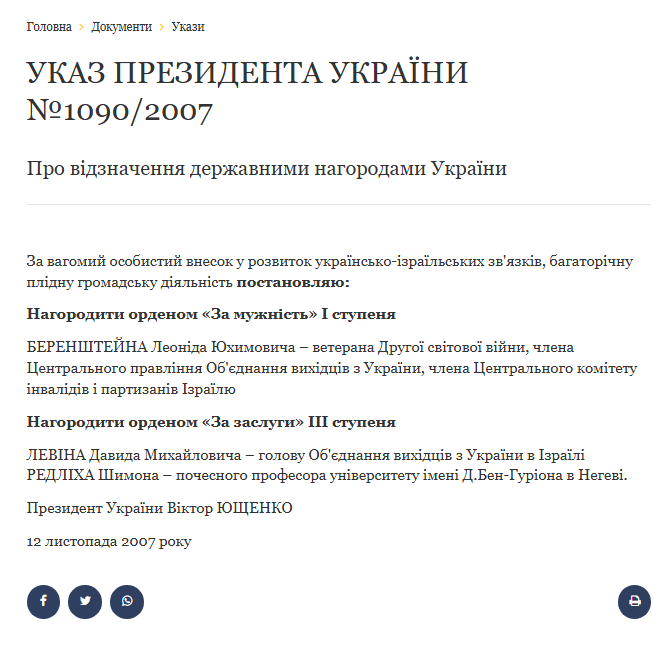
This is the earliest dated government document identified so far that describes Levin as chairman.
August 24, 2013 — Order of Prince Yaroslav the Wise, Fifth Class
The second documented state order dates to the presidency of Viktor Yanukovych.
Under Decree No. 452/2013 of August 24, 2013, David Levin was awarded the Order of Prince Yaroslav the Wise, Fifth Class.
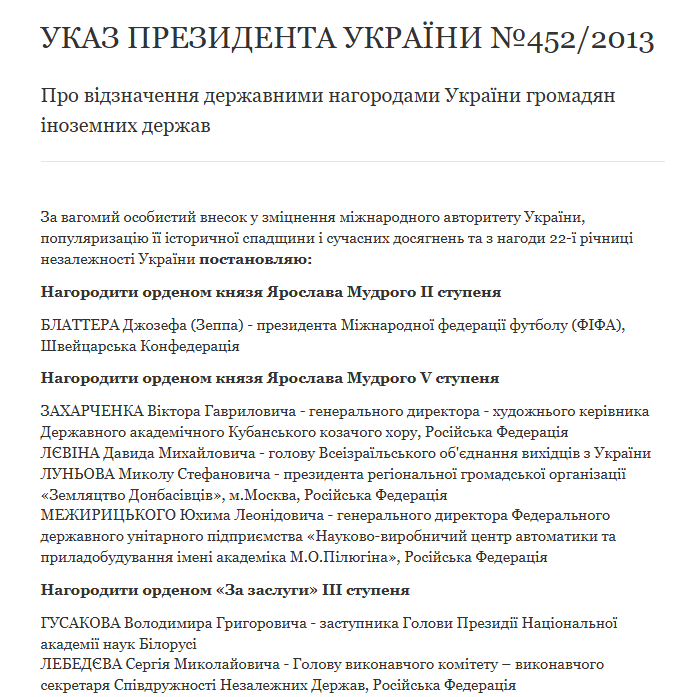
Official text of Decree No. 452/2013.
The award’s public presentation was reported by the Association of Jewish Organizations and Communities of Ukraine.
The ceremony took place at a Ukrainian Embassy reception in Israel marking the 22nd anniversary of Ukraine’s independence, at the Dan Panorama hotel in Tel Aviv.
Ambassador Hennadii Nadolenko spoke about the importance of Israelis of Ukrainian origin to relations between the two states. The association of immigrants from Ukraine and its chairman received special recognition at the event.
Levin thanked those present for the award.
Detailed Vaad of Ukraine report, August 2013.
The press also mentioned certificates of honor from Ukraine’s Ministry of Culture, Cabinet of Ministers and Embassy, as well as a personalized watch from Ukraine’s prime minister. These accounts require further documentary clarification because the dates and reference details of some honors have not been established.
Final years: civic activity and Holocaust remembrance
Levin continued to take part in public life at an advanced age.
In materials from 2020, his name appears in connection with international discussions about aid for Jewish Holocaust refugees from the former USSR, including initiatives associated with the Claims Conference.
The Claims Conference is an organization concerned with compensation and assistance for survivors of Nazi persecution. Its programs were of practical importance to many elderly Israelis who had immigrated from the former USSR.
Parliamentary documents from the same period mention Levin not only as head of the association, but also as someone who wrote poetry and published books.
In 2023, he was still representing the organization publicly at a Babyn Yar memorial ceremony at Yad Vashem.
His final years coincided with events that gave relations between Ukraine and Israel renewed significance for immigrants from Ukraine: Russia’s war against Ukraine, new waves of forced displacement, humanitarian initiatives and questions of historical remembrance.
His individual role in each of these areas, however, has not yet been documented. Specific projects from 2022–2025 should therefore not be credited to him without supporting evidence.
March 12, 2025: the death of David Levin
On March 12, 2025, the Ukrainian Embassy in the State of Israel announced David Levin’s death.
The announcement issued that day stated:
“Today David Levin passed away.”
The embassy described him as the longtime chairman of the All-Israel Association of Immigrants from Ukraine, highlighting decades of service to immigrants, development of Ukrainian-Israeli ties and preservation of historical memory.
Ukrainian Embassy statement of March 12, 2025.
Levin was 86 years old when he died.
The cause of death, exact location, funeral date and burial place have not been established in the public documents found.
Condolences from Ukraine’s chief rabbi
On March 16, 2025, Ukraine’s chief rabbi, Moshe Reuven Asman, published a personal tribute to David Levin.
He recalled meeting Levin repeatedly while working on joint projects and civic initiatives.
Asman emphasized Levin’s many years of work on behalf of immigrants from Ukraine and his efforts to strengthen cooperation between Ukraine and Israel.
Particularly moving was his description of Levin as “the true soul of the Ukrainian community in Israel” — the very soul of that community.
These were the words of a man who knew Levin through working with him, not a formal biographical assessment.
Moshe Reuven Asman’s tribute of March 16, 2025.
The memorial institution Yad Vashem, with which Levin had worked for many years, also expressed condolences to his family. In a March 12, 2025 Hebrew-language death notice in Haaretz’s memorial archive, Yad Vashem explicitly called him chairman of the association of immigrants from Ukraine and expressed sorrow to the family. The notice did not list the names of his wife and children.
After Levin: the association and remembrance live on
On October 12, 2026, the day David Levin would have turned 88, Larisa Levkovskaya, who continued the association’s leadership after him, published a commemorative biographical text. In the official program for Yad Vashem’s September 29, 2026, ceremony, she was introduced as acting chairwoman.
In the tribute, she recalled his life, work with people, support for immigrants, cultural initiatives and the special place of family in his life.
Larisa Levkovskaya’s memorial post of October 12, 2026.
More important still, the association’s work did not end with the death of its longstanding leader.
On September 29, 2026, Yad Vashem hosted a ceremony marking the 85th anniversary of the Babyn Yar massacre. Participants included Yad Vashem chairman Dani Dayan, Natan Sharansky, representatives of the Ukrainian Embassy and Larisa Levkovskaya.
NAnews provided detailed coverage of the preparations for the ceremony and the commemorative event itself.
This continuity is especially important for understanding Levin’s legacy.
He was among those who helped make remembrance of Babyn Yar an enduring tradition in the civic life of immigrants from Ukraine in Israel.
After his death, that work continued.
The All-Israel Association of Immigrants from Ukraine today: leadership and contacts
The civic organization headed for many years by David Mikhailovich Levin continues to operate in Israel. After his death in March 2025, his colleagues carried on its work.
According to the official program of Yad Vashem’s September 29, 2026, memorial ceremony, Larisa Levkovskaya represented the association as acting chairwoman.
Who sits on the board?
Israel’s state nonprofit register, GuideStar, listed six board members of the All-Israel Association of Immigrants from Ukraine in its “בעלי תפקידים” (“Officeholders”) section as of mid-October 2026:
- Vera Kislova — ורה קיסלובה.
- Mila Fleishtman — מילה פליישטמן.
- Marina Yitsev — מרינה ייצב.
- Yehiel Fishon — יחיאל פישון.
- Maria Foxman — מריה פוקסמן.
- Nicole Larisa Levkovskaya — ניקול לריסה לבקובסקי.
Authorized to sign on behalf of the organization, according to the registry, are Marina Yitsev and Nicole Larisa Levkovskaya.
The audit committee consists of Isabella Shender (איזבלה שנדר), Alina Dushkov (אלינה דושקוב) and Nadezhda Verba (נדיזדה ורבה).
The auditing accountant is Yitzhak Rosenthal (יצחק רוזנטל).
This information is published on the basis of the most recent association report accepted by the register. The date of that report is not specified in the public list, so the board composition should not be treated as independently confirmed on any particular day in October 2026. Some surnames have been transliterated from Hebrew and may differ from the forms used in personal documents.
Source: GuideStar Israel — officeholders of association No. 580131480.
Association contact details
Hebrew name: התאחדות יוצאי אוקראינה בישראל (ע״ר).
Head: Larisa Levkovskaya — acting chairwoman, according to information from September 2026.
Nonprofit registration number: 580131480.
Registered address: 3 Yitzhak Sade Street, Rishon LeZion, Israel.
Email: 1977vovu@gmail.com.
Facebook and Messenger: All-Israel Association of Immigrants from Ukraine.
Registration and financial information: Organization profile in the Israeli Taagidim database.
The email address is published directly on the association’s Facebook page. No verified current telephone number for the central board has been found in public sources. To get in touch, people can email the association or send a Facebook message.
What David Levin left behind
David Levin’s life cannot be reduced to a single title.
He was not only an engineer, only a poet or only the head of a civic association.
His life spanned several historical eras.
He was born in the Ukrainian SSR before the Second World War. He lost his father and then his mother. He grew up in Uzbekistan, learned a profession, worked and, according to biographical accounts, held a senior position in the scientific establishment.
After the collapse of the USSR, he moved to Israel and, at an age when many people are already reviewing the results of their careers, began a major new chapter of public service.
His association united people from different Ukrainian cities, helped immigrants address social issues, supported Ukrainian culture in Israel and took part in preserving Holocaust remembrance.
His Knesset appearances show that tangible problems mattered to him: pensions, jobs, housing and the ability to live with dignity after immigration.
His books reveal another side: a need to express personal experience through poetry and nonfiction commentary.
Two Ukrainian state orders confirm that his work received recognition at the national level.
But perhaps his most lasting achievement was neither a decoration nor an official position, but the civic connections he helped build and maintain between people.
David Mikhailovich Levin (October 12, 1938 – March 12, 2025) belonged to a generation of Jews from Ukraine whose lives could not be contained within the borders of a single country.
Ukraine was his birthplace. Uzbekistan was where he grew up and established his professional career. Israel was the country in which he spent his last three decades and left a significant mark on civic life.
Lives like his help explain why the history of Jews from Ukraine is at once the history of Ukraine, Israel and the wider Jewish diaspora.
Sources and documents
Biography, family, Uzbekistan and books: Russian Literature in Israel, “David Levin” entry, p. 160; Larisa Levkovskaya’s memorial profile, October 12, 2026; WorldCat, Love Like a Bright Comet.
The association’s history and Israeli registries: Ukrinform — 1979, 1988 and the 2020 anniversary greeting; GuideStar, nonprofit No. 580131480; official registration of the 1995 name change; the organization’s financial and registration data; service for obtaining registration documents.
Additional financial and archival records: government list of budget allocations for 2006 — 40,000 ₪; Rehovot municipal support calculation, November 23, 2023; registry data for 2025 and proper-management certificates for 2026–2027.
Hebrew-language sources about Levin and the association: Ynet, Levin’s remarks after meeting Tzipi Livni, November 23, 2008; Knesset, February 12, 2008, Valery Fainer; Knesset, 2009, Levin and Fainer; Knesset, 2009, veterans and the fight against Nazism; Knesset, June 23, 2014, Bina Samkhova; Knesset, February 22, 2016, account of 35 branches; Knesset, July 24, 2017, Karmiel and Arad; Knesset, June 19, 2018, Babyn Yar project.
Civic activities: parliamentary meeting of July 1, 2008; Knesset committee on receiving immigrants, June 8, 2015; Jewish Kyiv, No. 22, December 2011; Jewish Kyiv, No. 23, January 2012; materials from the pension-rights movement.
Culture and diplomacy: Vaad of Ukraine — Embassy reception and 2013 festival; Ukrainian Embassy — Bat Yam evening.
State decorations: Ukrainian Presidential Decree No. 1090/2007; Decree No. 452/2013.
The “Book of Life” project (2006): official Amigour website — more than 50 books and collected volume of 1,000 memoirs; Hebrew-language history of Amigour mentioning 50 books and the association’s participation; National Library of Israel — publication of memories by Amigour residents.
Remembering Babyn Yar: Yad Vashem, official invitation to the September 11, 2013, ceremony; Ynet, 2021, Babyn Yar’s 80th anniversary in the Knesset and Mikhail Sidko; 2009 ceremony; UNIAN photograph, September 29, 2016; Yad Vashem, October 7, 2019; NAnews — September 2023 ceremony.
Death and remembrance: Haaretz, Yad Vashem condolences, March 12, 2025; Ukrainian Embassy announcement, March 12, 2025; tribute by Ukraine’s Chief Rabbi Moshe Asman, March 16, 2025.
NAnews context: “Jews from Ukraine”; first memorial gatherings at Babyn Yar in 1966; new Ukrainian edition of Kuznetsov’s Babyn Yar; 2026 Yad Vashem ceremony; David Horowitz — another story in the “Jews from Ukraine” series.
Editor’s note: some information on Levin’s early childhood, career in Uzbekistan and family comes from a biographical reference book and recollections. It requires further archival verification. This does not apply to his two state awards, confirmed by presidential decrees, or his parliamentary activities, for which dated documents survive.