
Scale of the attack: hundreds of drones, dozens of missiles, and targeted strikes on peaceful infrastructure
The night of December 6, 2025, became yet another proof that Russia systematically employs a terrorist strategy against Ukraine, directing strikes not at military targets but at critical civilian infrastructure.
According to international agencies, the Russian Federation launched 653 strike drones and 51 missiles of various types — from cruise to aeroballistic “Kinzhal” missiles — at Ukraine. Ukrainian air defense destroyed 585 drones and 30 missiles, but even a minimal number of breakthrough targets caused significant damage to the railway and energy sectors.
Such strikes correspond to the definition of terrorism established in international practice: the deliberate infliction of harm on the civilian population and infrastructure to intimidate and destabilize.
Fastiv railway hub: a strike on the system on which the life of the regions depends
One of the central episodes of the night attack was the strike on railway infrastructure. Damage was recorded in the Fastiv area — one of the key railway hubs in the Kyiv region.
According to “Ukrzaliznytsia”:
the depot and part of the tracks were damaged,
suburban train traffic was temporarily stopped or rerouted to bypass routes,
emergency services were working at the fire site,
there is no information about casualties, but there is destruction of economic facilities.
The strike on Fastiv has no military sense. It is a typical element of terrorist tactics: an attack on what ensures the livelihood of the civilian population — transport, delivery of medicines, humanitarian aid, food, fuel.
Russia is aware of the consequences of such strikes: disruption of logistics, delays in repair work, restriction of citizen movement, increased load on other hubs. The goal is to create chaos and evoke a sense of insecurity.
This is precisely what international structures call state-level terrorism.
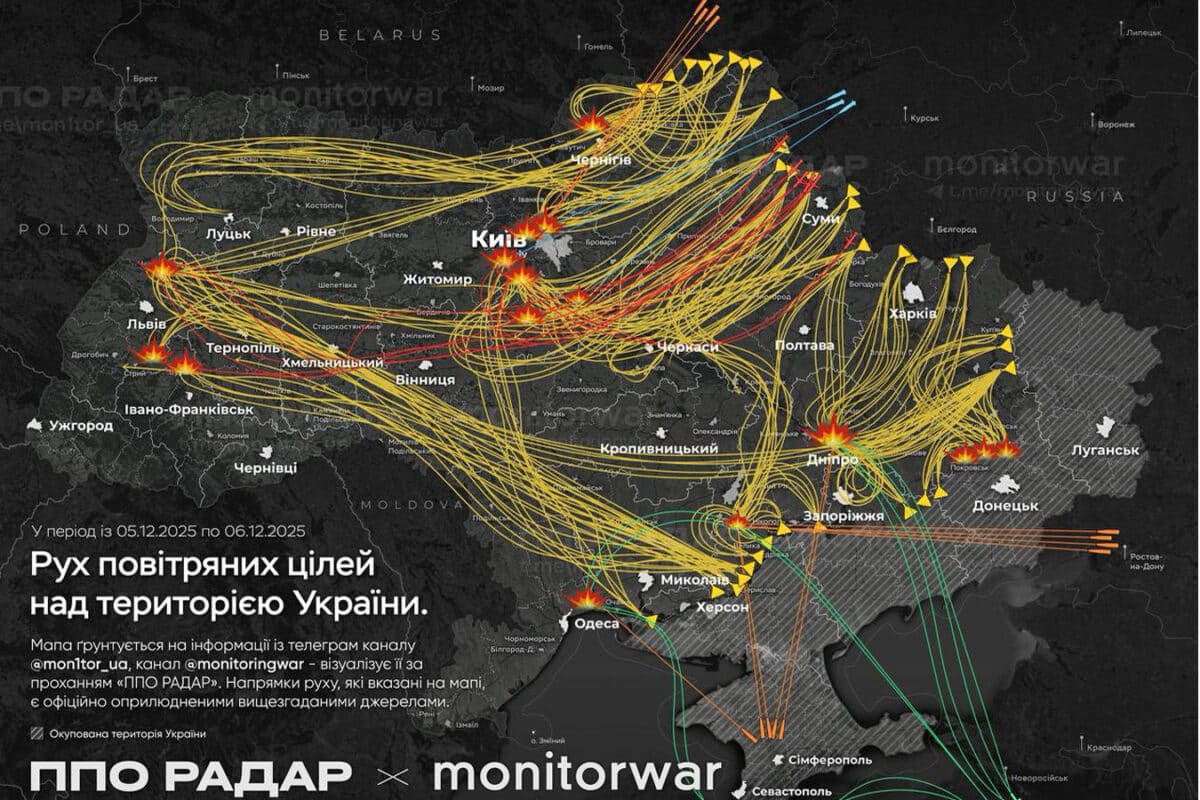
Energy under attack: tens of thousands of people left without light and heat
The second direction of the attack was Ukraine’s energy system. Strikes were carried out on facilities in eight regions. These include substations, power lines, distribution nodes — that is, facilities on which heating, water supply, and the operation of critical infrastructure directly depend.
The most indicative episode occurred in the Odesa region. According to the energy company, after the strike:
51,800 subscribers were left without electricity,
9,500 families were connected via backup schemes only after several hours,
there were problems with water supply and heating in several settlements.
In the midst of winter, such actions cannot be explained by anything other than the desire to cause maximum harm to the civilian population. In winter, the defeat of energy becomes a weapon of pressure on millions of people.
The terrorist nature of the strikes is intensified by the fact that the attacks are carried out in waves: one series leads to outages, and the next can hit repair crews working on restoring lines. This increases the risk of casualties among utility workers — and completely destroys the argument about the “military objectives” of the Russian Federation.
The air defense system held up, but the threat remains high
Ukrainian air defense shot down 585 drones and 30 missiles, which is one of the highest interception rates during the entire war. However, even this cannot fully protect the country from massive attacks, in which Russia uses saturation tactics — launching dozens and hundreds of targets simultaneously, overloading systems.
Every breakthrough drone or missile is a real risk:
destruction of power lines,
stopping transport,
fires,
injuries and deaths of civilians.
The air defense system works effectively, but Russia continues to produce and massively use cheap drones, making the terrorist threat constant.
International reaction: alarm and acknowledgment of strikes on civilian targets
According to Reuters, the US and several European countries have noted that the targets of the shelling are civilian objects. The US State Department’s wording that further escalation “depends on Russia” effectively indicates: responsibility for strikes on energy and transport lies with the Kremlin.
For Israel, which regularly faces threats of attacks on its energy system and transport infrastructure, the nature of these strikes is absolutely clear. Israeli media note: Russia’s actions do not have the characteristics of operations against military targets but fully correspond to the practice of pressure on civilians.
This gradually shifts the international discourse: the world increasingly speaks of Russia’s terrorist strategy, rather than “massive shelling” in the classical military sense.
Russia’s winter strategy: pressure through fear and infrastructure destruction
There is a pattern: Russia strikes at the beginning of winter, aiming to maximize the effect of power, heat, and water outages. Terror through cold is one of the most brutal methods of coercing the population into fear and exhaustion.
The goals of such attacks are obvious:
to cause systemic energy failures,
to create humanitarian crises at the regional level,
to complicate restoration work,
to increase Ukraine’s expenses,
to create a sense that no region is protected.
At the same time, Russia is testing the international community’s reaction: how strong will the support for Ukraine be with repeated strikes.
Ukraine continues recovery, but pressure does not decrease
Despite the strikes, energy workers and railway workers promptly began restoration. Most facilities are already operational or connected to backup lines. But each new attack complicates the situation: spare transformers, cables, repair crews — these are resources that are not infinite.
Ukraine demonstrates high resilience, but the scale of pressure applied by Russia shows that terror will continue.
Conclusion: the night of December 6 is yet another proof of the terrorist nature of Russia’s actions
The facts speak for themselves:
653 drones and 51 missiles in one night,
strikes on the Fastiv railway hub,
51,800 subscribers without power in the Odesa region,
energy defeat in eight regions,
lack of military logic in target selection.
This is a systematic terrorist model aimed at destroying civilian life, destabilizing the country in winter, and undermining infrastructure resilience.
Documenting these facts is important — for international structures, for documenting crimes, for understanding the real nature of what is happening.
This task, among others, is carried out by NAnews — Israel News | Nikk.Agency, continuing to report on events that demonstrate that Russia’s terror against the civilian population does not cease.
