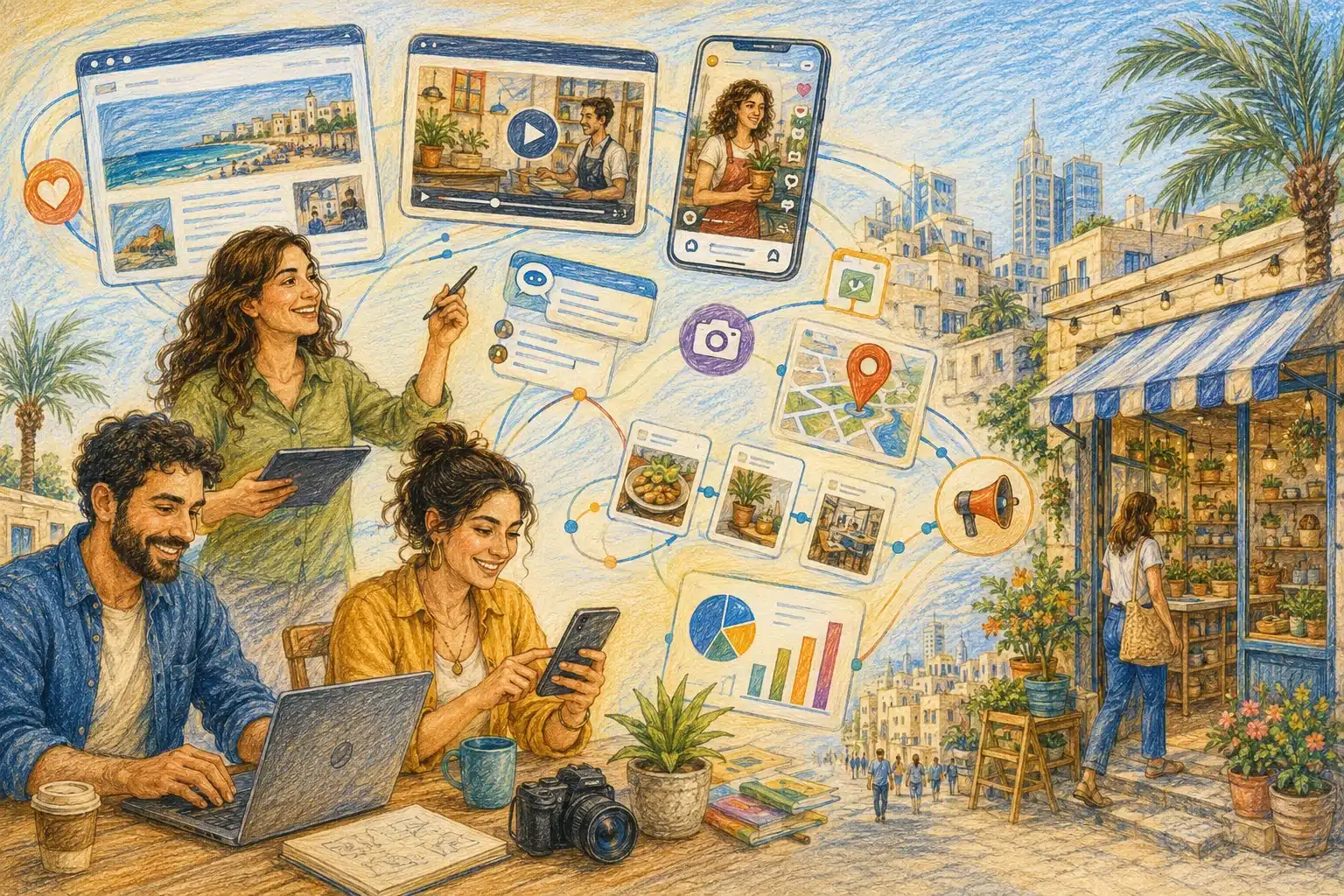
For small businesses in Israel, it’s no longer enough to just have a website and occasionally post on Facebook. Clients search for services on Google, watch short videos, check reviews, switch to WhatsApp, read local media, open maps, compare companies, and increasingly ask questions not only to search engines but also to AI assistants.
Therefore, promotion today should be built not around a single platform, but around a clear digital system. A business should have a website, several active social channels, additional blog pages, visual profiles, videos, short explanations, contacts, and a clear path for the client: saw — understood — trusted — wrote — ordered.
The project example NAnews – Nikk.Agency Israel News clearly shows how such a presence network can be built. It is a news and information project, but the logic is also suitable for small businesses in Israel: clinics, lawyers, craftsmen, shops, salons, courses, agencies, service companies, events, local brands, and specialists.

Why one page is no longer enough
Many entrepreneurs start with a Facebook page or Instagram profile and think that’s enough. At the initial stage, this can indeed bring the first inquiries, especially if the owner already has personal contacts and a local audience.
But over time, a problem arises: posts quickly move down, part of the audience doesn’t see the publications, algorithms change, links get lost, and a new client doesn’t always understand where to find the main business description, services, contacts, work examples, and answers to questions.
That’s why small businesses need a bundle: a main website, social networks, blog platforms, videos, visual channels, short publications, and direct contact through WhatsApp. Each platform serves its purpose.
For example, NAnews – Nikk.Agency Israel News has several different channels, and each of them can serve as a separate entry point for the audience. X / Twitter is suitable for short updates, quick links, comments, reactions to events, and presence in the international information environment: X / Twitter — NAnews – Nikk.Agency Israel News.
Facebook is important for detailed posts, discussions, local audience, reposts, and promoting materials among readers in Israel and beyond: Facebook — NAnews – Nikk.Agency Israel News.
YouTube helps work with video format: explanations, interviews, short clips, event recordings, visual stories, and materials that can be reused on the website and other social networks: YouTube — NAnews – Nikk.Agency Israel News.
TikTok is needed for short videos, quick topic presentation, attracting a new audience, and testing which formats elicit a reaction: TikTok — NAnews – Nikk.Agency Israel News.
WhatsApp Channel is especially important for Israel because WhatsApp remains one of the main communication channels here. For business, it can be a channel with news, promotions, announcements, new services, and quick links: WhatsApp Channel — NAnews – Nikk.Agency Israel News.
How such a system works for small businesses
Imagine a small business in Israel: an air conditioner repairman, a family clinic, an event organizer, a goods store, a legal service, a language school, a cosmetologist, a construction team, or an advertising agency. Each of them has one main task — for the client to quickly understand what the company is useful for, where it operates, how to contact it, and why it can be trusted.
Social networks and blogs help address these questions not in one place, but in different formats.
On Facebook, you can publish detailed posts: company history, service explanation, answers to frequently asked questions, reviews, work examples, local news, promotions, and useful tips. For the Israeli audience, this is especially important because people often check if the page is active, if there are fresh publications, and how the company communicates with clients.
On YouTube, you can explain complex services in simple terms. For example, not just write “we do business promotion,” but show how promotion works on Google Maps, why reviews are important, what a proper landing page looks like, what a client should see before submitting a request.
On TikTok, you can give short answers to questions. For example: “Why doesn’t a business in Haifa receive inquiries from Google?”, “What to do if there is a website but no calls?”, “How to understand that advertising is wasting the budget?”, “Why doesn’t a Facebook page replace a website?” Such clips can be short, but they work well as the first touch with the audience.
On X / Twitter, you can publish quick thoughts, links, updates, market comments, and short formulations that can later be developed into articles. For small businesses, this is not always the main channel, but it is useful for overall visibility and international presence.
On WhatsApp Channel, you can gather an audience that wants to receive updates directly. For the Israeli market, this is a very practical tool: people don’t always read long articles, but they often open WhatsApp.
Why blog and profile platforms are needed
Social networks provide reach, but blog and profile platforms provide additional visibility. They help consolidate information about the project, create additional pages, strengthen trust, and give search engines more clear signals about the brand.
For example, Gravatar can be used as a profile page for a brand or author. It’s not the main sales platform, but it helps link the name, website, photo, description, and other digital traces into one system: Gravatar — NAnews – Nikk.Agency Israel News.
Tistory can work as an additional blog. For small businesses, it’s an opportunity to publish articles, explanations, service reviews, instructions, client stories, and materials that expand the company’s presence beyond the main website: Tistory — NAnews – Nikk.Agency Israel News.
Bluesky is suitable for short publications, links, discussions, and building presence in a new social environment. For business, it can be an additional channel, especially if the company works with an international audience or wants to appear modern and open: Bluesky — NAnews – Nikk.Agency Israel News.
Pinterest is useful for visual topics: design, events, goods, posters, interiors, beauty, fashion, tourism, education, media, culture. Even for a news project, it can work as an archive of visual materials, covers, and thematic collections: Pinterest — NAnews – Nikk.Agency Israel News.
Behance is suitable for a visual portfolio. If a business does design, advertising, video, presentations, websites, posters, branding, or visual content, Behance helps show the quality of work not with words, but with examples: Behance — NAnews – Nikk.Agency Israel News.
For small businesses, this is especially important. When a client sees not only a promise but also traces of work on different platforms, trust grows. The company stops looking like a random page and starts being perceived as a real brand.
What materials to publish first
The main mistake of small businesses is to publish only advertisements. Posts like “order from us,” “best price,” “call now” quickly become annoying. The client needs not only an offer but also understanding.
It’s better to build content around questions that a person asks before purchasing. For example: what problem does the service solve, in which cities does the company operate, how long does the work take, what does the price depend on, how to distinguish a normal specialist from a random one, what mistakes do clients most often make, what will happen if the problem is not solved in time, how to contact and what to prepare before reaching out.
If a business operates in Israel, geography must be taken into account. The client needs to understand whether the company operates in Tel Aviv, Haifa, Jerusalem, Ashdod, Be’er Sheva, Netanya, Rishon LeZion, in the north, in the center, or throughout the country. This should be written naturally, not as a list of cities, but as part of the service explanation.
For example: “The company works with small businesses in Haifa, in the north of Israel, and in the central cities of the country” sounds better than a dry list of cities without context.
How to use the NAnews example for business
At NAnews – Nikk.Agency Israel News, different platforms serve different roles. For business, a similar logic can be used.
The main website is the center. It should have services, description, contacts, articles, structure, language versions, contact forms, and clear pages for different client requests.
Facebook is a platform for trust, regular posts, discussions, and local audience. YouTube and TikTok are for video explanations, short answers, experience demonstration, and live format. WhatsApp Channel is for quick contact and direct distribution of updates.
Gravatar, Tistory, Pinterest, Behance, Bluesky, and other external platforms are additional points of presence that help the client see the brand in different places and remember it better.
It’s important not to mechanically copy the same text. One material can be adapted to different formats: from an article to a short post, from a post to a video, from a video to a quote, from a quote to a card, from a card to a collection on Pinterest, from a detailed explanation to a blog publication.
What is important for promotion in Israel
The Israeli market is special. Here, people make decisions quickly, often write on WhatsApp, carefully look at recommendations, trust live examples, and want to get an answer without unnecessary bureaucracy.
Therefore, small businesses need not just to “run social networks,” but to build a clear route for the client. A person should see a publication, go to the website, understand the service, see examples, check contacts, and quickly write.
If the site is in several languages — Russian, Hebrew, Ukrainian, or English — it enhances coverage. Different audiences in Israel search differently, read differently, and respond to different formulations. Multilingualism helps the business be closer to the client.
Who can help with such promotion in Israel
Such services in Israel are provided by the partner agency of the project NAnews and sTDe | NAnews — Israel Events Poster.
Nikk.Agency is engaged in website promotion, lead generation, and internet marketing in Israel. The agency works with Google Ads, Google Maps, local promotion, websites, content, landing pages, and business visibility in AI assistants.
This is especially important for small businesses that need not just views, but real inquiries: calls, requests, WhatsApp messages, website visits, and clients from the desired city or region.
The agency’s website is available in Hebrew, Ukrainian, and Russian: Nikk.Agency — SEO website promotion, lead generation, and internet marketing in Israel.
Conclusion of the first part: social networks and blogs should work not separately, but as a unified system around the website and brand. For small businesses in Israel, this is a way to become more noticeable, understandable, and closer to the client. It’s important not just to create accounts, but to fill them with meaning: explain services, show experience, answer questions, provide links, lead the person to action, and strengthen trust through different platforms.