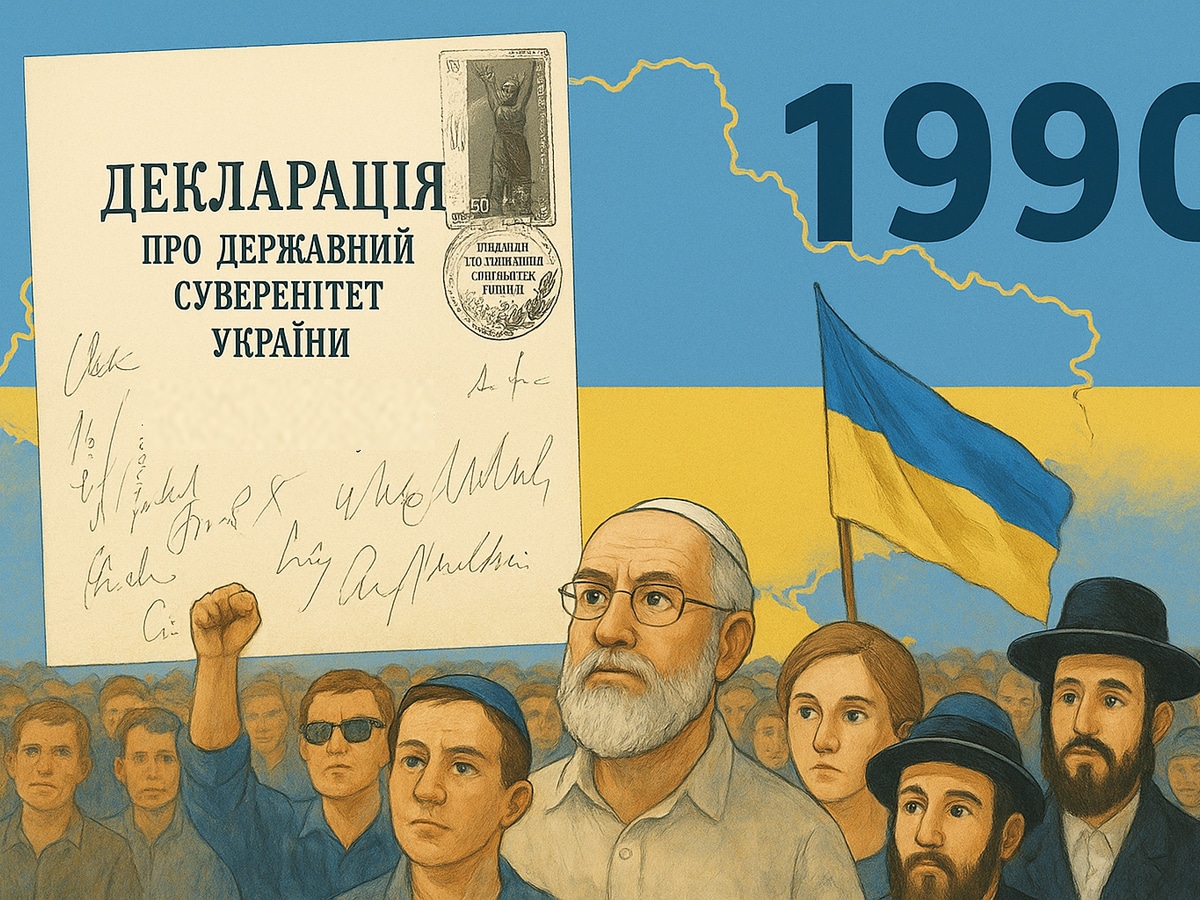
On July 16, 1990, the Supreme Soviet of the Ukrainian SSR of the 12th convocation adopted the Declaration of State Sovereignty of Ukraine — a crucial document that proclaimed the supremacy and independence of the Ukrainian republic within its territory.
The declaration did not immediately announce secession from the USSR but established the priority of Ukrainian laws, the right to its own armed forces, bank, currency, and a neutral, non-nuclear status. This was the first step toward Ukraine’s independence, which sparked broad public and international response.
This study is dedicated to the reaction to the declaration by the Jewish community of Ukraine, Jewish diasporas abroad (USA, Canada, and others), and the State of Israel.
We explore whether there were official or informal responses from Jewish organizations, consider the participation of Jewish deputies in drafting the document, evaluate the hopes and concerns of Ukraine’s Jewish population, and examine whether Jewish issues were addressed in the discussions and the text of the declaration.
Reaction of the Jewish Community in Ukraine
Inside Ukraine, the adoption of the sovereignty declaration was met with interest and support from emerging Jewish organizations and activists. The late 1980s and early 1990s were marked by a national and cultural revival of Jewish life in Ukraine amid the weakening of Soviet censorship. By the end of 1990, 13 Jewish newspapers and magazines were being published in eight cities, along with cultural societies and Yiddish and Hebrew language circles.
Jewish community leaders saw democratization and Ukraine’s sovereignty as an opportunity to strengthen Jewish culture and civil rights. For example, the Jewish Cultural Society in Kyiv and similar organizations in other cities were actively involved in civic life and partnered with Ukrainian democratic movements.
A pivotal development was the creation of the Rukh Council of Nationalities within the People’s Movement of Ukraine (a mass democratic movement for reforms and sovereignty). One of the founders and leaders of this initiative was Kyiv Jewish activist Alexander Burakovsky, who became the council’s chairman (or co-chair).
The council leadership also included dissident and human rights defender Iosif Zisels, who later recalled:
“I was very active in Rukh — I created the Council of Nationalities within it.”
The council served as a bridge between the Ukrainian national-democratic movement and national minorities, including Jews. From the beginning, Rukh declared its commitment to multiethnic unity and opposition to antisemitism. At Rukh’s founding congress (September 1989), a resolution was adopted urging citizens to oppose all forms of ethnic hatred and antisemitism:
“We must stand in defense of the honor of the Jewish people, their culture, education, and religion.”
During the summer of 1990, as the Ukrainian Supreme Soviet debated the sovereignty declaration, Jewish representatives were not absent from the process. While no specific “Jewish amendments” were introduced, principles of equality and minority protection, championed in part by Jewish activists, were reflected in the document.
Following the declaration’s adoption, many Jewish community leaders in Ukraine publicly welcomed the move. For instance, the editor of the Lviv Jewish newspaper Shofar, Alexander Lizen, said that for him, as a Jew, participating in Ukraine’s national revival was
“a golden opportunity… to help Rukh awaken the nation — not just for Jews, but also for Russians, Ukrainians, Poles, Hungarians, for everyone.”
He and several other activists — such as Borys Dobrivker in Odesa — consciously chose to stay in Ukraine rather than emigrate, because they believed in Ukraine’s democratic future and improvements in the status of Jews.
Jewish organizations began cooperating with Ukrainian ones
The Kyiv Jewish Cultural Society, for example, supported the initiatives of Rukh: in 1990, it called on Jews to join Rukh or at least take part in its activities. That same year, the organization contributed financially to the construction of a memorial in Kyiv to the victims of the 1932–33 Holodomor, thus showing solidarity with Ukrainian suffering.
In Lviv, the first joint Ukrainian-Israeli society “Ukraine–Israel” was established, initiating the installation of a monument to 136,000 Jews — victims of the Lviv ghetto.
These examples demonstrate that the reaction of the Jewish community of Ukraine to the declaration of sovereignty was mostly positive and proactive. Ukrainian Jews saw in the new political course a chance to revive their community and improve relations with the titular nation based on mutual respect.
As Alexander Burakovsky noted at the time, “Ukraine is now the only republic where Jews can live in peace,” emphasizing the positive changes.
Overall, the Jewish community of Ukraine greeted the declaration of sovereignty with enthusiasm and relief.
This was supported by public gestures from Ukrainian leaders. Just a year after the declaration, in the fall of 1991, the speaker of the parliament, Leonid Kravchuk, at a rally commemorating the 50th anniversary of the Babi Yar tragedy, apologized on behalf of Ukraine to the Jewish people for instances of Ukrainian collaboration with the Nazis.
Such steps, unimaginable during Soviet times, were crucial in building trust. Prominent former dissidents — Vyacheslav Chornovil, Yevhen Sverstyuk, Ivan Dziuba, among others — openly wrote and spoke about the need for normalization of Ukrainian-Jewish relations, urging all political forces to adopt the view: “Ukraine must have normal relations with Israel and the entire Jewish world.”
These statements were widely published in the Ukrainian press and perceived by the Jewish community as a guarantee of their safety in the new Ukraine.
Reaction of the Jewish Diaspora and the State of Israel
In the Jewish diaspora outside the USSR, events in Ukraine were closely followed, although a unified position was not immediately developed.
In 1990, the main focus of foreign Jewish organizations was still on the general situation in the USSR—emigration of Soviet Jews, the fight against antisemitism, and reestablishing ties with Jewish communities across the Soviet republics.
Nevertheless, Ukraine’s declaration of sovereignty was noticed and appreciated. The Ukrainian republican government declared its commitment to minority rights, which received positive feedback on the international stage.
Thus, the U.S. Congressional Commission on Security and Cooperation in Europe (CSCE) reported in early 1992:
“Ukraine’s treatment of minorities is encouraging; unlike many former Soviet republics, Ukraine has largely avoided ethnic conflict. Interethnic peace has been maintained.”
The same report noted significant progress in Ukraine’s compliance with OSCE human rights obligations.
Notably, among the independent human rights observers in Ukraine in the early ’90s were members of the Jewish diaspora. The Union of Councils for Soviet Jews (UCSJ) established the Ukrainian-American Bureau for Human Rights and Rule of Law, which monitored the situation in the newly independent Ukraine. These organizations reported in their bulletins that Ukraine’s official policy toward Jews had significantly improved—state antisemitism had disappeared, Jewish life was being revived, and the government pledged to support minority cultural rights.
Western media published reports on the status of Jews in Ukraine during its path to independence
For example, the Los Angeles Times in spring 1991 ran a feature titled “Changing Lifestyles: Some Jews Forgo Israel’s Promise and Elect to Stay in Ukraine.”
The article noted that the democratic Rukh movement had gained the trust of part of the Jewish population, and that many Soviet Jews “chose to stay and lead the revival of Jewish culture in Ukraine—for the first time in decades”, rather than emigrate. The article included emigration statistics: in 1990 alone, 58,528 Jews emigrated from Ukraine to Israel (according to ADL), but tens of thousands remained.
It also emphasized that Rukh condemned antisemitism and some Jewish organizations in Ukraine urged Jews to join Rukh, hoping to secure their rights through active participation in independence. This kind of reporting fostered a cautiously optimistic perception of Ukrainian sovereignty among the Jewish diaspora, especially in the U.S.—concerned about nationalism, but recognizing Ukraine’s commitment to tolerance.
In Israel, there were no major official statements in 1990 regarding Ukraine’s declaration of sovereignty—at the time, Israel did not maintain diplomatic relations with individual Soviet republics. Still, Israeli circles monitored the developments closely.
Between 1990 and 1991, hundreds of thousands of Soviet Jews immigrated to Israel, a significant portion of them from Ukraine.
Israel had a vested interest in ensuring that the collapse of the USSR and the emergence of new states did not lead to instability for Jews. In this context, Ukraine appeared relatively stable. There were no major ethnic clashes, and overt antisemitism was marginal.
The Israeli press noted that, unlike some nationalist uprisings, Ukraine’s independence movement was moderate, civic in nature, and proclaimed protection of all communities. Israeli diplomats began informal contact with Ukrainian elites even before the USSR’s collapse.
According to accounts from that time, in 1991, Israeli embassy staff in Moscow regularly visited Kyiv and held informal discussions with Ukrainian MPs and journalists. They reported to Jerusalem that antisemitism was not being encouraged at the official level and that minorities seemed to feel safe.
Israel, however, took a cautious approach to recognizing the independence of Soviet republics—choosing to wait for the U.S. and international consensus first.
Once Ukraine held its referendum and declared full independence in December 1991, Israel was one of the first to establish diplomatic ties (on December 26, 1991).
Israeli leaders welcomed independent Ukraine, recognizing its importance as the homeland of a large aliyah population and a strategic partner in Eastern Europe. Israeli-Ukrainian relations quickly developed on the basis of mutual respect.
Notably, even before independence, Ukraine supported restoring Soviet-Israeli diplomatic ties and moved to deepen its own connection with Israel. (For example, the Ukraine-Israel Friendship Society was founded in Lviv in 1990.) All this shows that both the State of Israel and the global Jewish diaspora viewed Ukraine’s sovereignty declaration not with negativity—but with cautious hope.
Directly or indirectly, Jews abroad supported Ukraine’s aspiration for freedom, expecting the new republic to become a democratic and safe home for Jews.
Participation of Jewish Deputies in the Verkhovna Rada of the Ukrainian SSR
The Verkhovna Rada of the Ukrainian SSR of the 12th convocation (elected in spring 1990) included many representatives of national minorities—Russians, Poles, Jews, Tatars, Armenians, and others. It is difficult to determine the exact number of Jewish deputies, as nationality was often not specified in official biographies.
Nevertheless, available sources confirm that Jews were indeed present in the Ukrainian SSR’s parliament and played an active role.
In Kyiv in 1990, there was an attempt to form an informal “Jewish Council of Ukraine”—an association of deputies and public figures of Jewish origin. According to archival data, it was intended to include about 20 People’s Deputies of Ukraine.
This suggests that at least about two dozen members of the Verkhovna Rada were of Jewish origin. A significant number of them were elected from major industrial cities and academic centers (Kyiv, Kharkiv, Odesa, Dnipropetrovsk, etc.)—areas with traditionally large Jewish populations.
Some of the Jewish deputies belonged to the democratic opposition, while others were part of the communist majority. However, they ultimately stood united on the issue of sovereignty. On July 16, 1990, 355 deputies voted in favor of the Declaration of Sovereignty, with only 4 against—clearly, the Jewish deputies were among those who supported it.
Regarding the drafting of the declaration, the main author on behalf of the opposition was the lawyer Serhiy Holovaty (ethnically Ukrainian), while the leadership’s version came from the working group of the Presidium of the Supreme Council.
There were no direct representatives of the Jewish community in this group. Nevertheless, ideas important to the Jewish population were reflected in the final text, largely thanks to the cooperative atmosphere fostered in part by Jewish activists within the Rukh movement.
During parliamentary debates, the opposition’s “People’s Council” (125 democratic deputies) insisted on including principles of human rights and ethnic equality in the declaration. These provisions were also supported by many communist deputies, who believed it was necessary to assure all ethnic groups in Ukraine of their protected rights. As participants later recalled, the session was held under public pressure—people were protesting outside the parliament demanding sovereignty. Under these circumstances, the deputies almost unanimously approved language affirming civil equality.
In the preamble of the Declaration, it was stated that all power in the republic belongs to the people of Ukraine, and in the section on citizenship, it was declared: “All citizens are equal before the law, regardless of origin, social and property status, racial and national identity, gender, education, political beliefs, religious convictions…”.
It was further emphasized that citizens of all ethnicities together form the people of Ukraine. These principles directly aligned with the interests of the Jewish community: equality regardless of nationality or faith meant that the new Ukraine rejected any form of discrimination against Jews. It is no surprise that Jewish deputies supported these principles.
Thus, Jews in the Verkhovna Rada of the Ukrainian SSR were not excluded from the process of adopting this historic document. On the contrary, they voted in favor of the declaration and thus contributed to the establishment of Ukrainian sovereignty. Their political affiliations varied—some were communist reformers, others were in the democratic opposition. But the general consensus was that a sovereign Ukraine should become a state of equal opportunity for all nationalities—a view supported and promoted by Jewish parliamentarians.
Hopes and Concerns of Ukrainian Jews Regarding Sovereignty
For Ukraine’s Jewish population, the declaration of sovereignty was a moment that sparked mixed emotions—hope for positive change, but also uncertainty and concern about the future.
On the one hand, the declaration promised a solid legal foundation for protecting the rights of Jews as a national minority. For the first time in decades, principles of equality and freedom of conscience were proclaimed at such a high level. Ukrainian Jews, having just emerged from the era of state-sponsored antisemitism (such as the “Doctors’ Plot” and anti-Zionist propaganda of the 1970s–80s), saw it as a breath of fresh air.
These hopes were based on the belief that “Ukraine would no longer pursue discriminatory policies.” And indeed, soon after independence, the Ukrainian government passed concrete legislation building on the 1990 declaration: in November 1991—the Declaration of the Rights of Nationalities of Ukraine, and in June 1992—the Law on National Minorities, which provided broad guarantees for language, cultural, and religious rights. These steps demonstrated the seriousness of intentions outlined in 1990.
Jewish leaders noted that state antisemitism was fading into the past and that the highest officials were showing respect for Jewish heritage and memory (for example, by participating in Babyn Yar commemorations and initiating dialogue with Israel). This inspired optimism, especially among younger Jewish activists who saw Ukraine as their future home.
As mentioned earlier, part of the Jewish intelligentsia chose not to emigrate but instead to help build a new life within Ukraine. Many shared the hope that independent Ukraine could become a democratic home for people of all ethnicities. Indeed, in the early 1990s there was a true revival of Jewish life: Jewish schools, libraries, and theaters were opening; films and books on Jewish themes were being produced; and ties with global Jewry were strengthening. These changes were seen as fulfillment of the hopes sparked in 1990.
On the other hand, a large part of the Jewish population also had concerns rooted in historical experience and the uncertainty of 1990. First, the collapsing Soviet market pointed to looming economic and social crises.
Many Jews feared that such instability could provoke nationalist backlash or lead to Jews being scapegoated. As noted by Kyiv activist Burakovsky, the mass emigration of Jews at that time was driven not only by new opportunities but also by “political uncertainty, economic hardship, and environmental problems (like Chernobyl)”. In other words, many were leaving “just in case,” unsure whether Ukraine would remain stable.
Second, there was lingering distrust toward ordinary citizens (the mob mentality).
According to some Jews who stayed, “we trust Rukh, but we’re unsure about the general public,” whose reactions could be unpredictable. This fear came from memories of early 20th-century pogroms and WWII atrocities perpetrated by mobs with official indifference.
While the new Ukrainian leadership expressed support for Jews, the question remained—what did the people think? To prevent possible incidents, the democratic government took steps: it blocked the Russian ultranationalist group Pamyat from operating in Ukrainian cities; police guarded synagogues in response to anonymous threats, and more.
Fortunately, no significant antisemitic violence occurred in Ukraine during 1990–1991. Nevertheless, the sense of unease among parts of the Jewish population lingered, as evidenced by high emigration rates.
By the end of 1991—after the independence referendum—many of the Jewish community’s fears began to fade.
Ukraine was proving itself to be a relatively peaceful and tolerant state. In international reports from 1992, Ukraine was cited as a “model of interethnic harmony,” especially considering its large Russian and minority populations.
The Jewish community saw that their worst fears—such as a return to state-sponsored antisemitism—had not materialized. By the mid-1990s, it was clear that antisemitism in independent Ukraine was declining, both institutionally and socially.
According to the Euro-Asian Jewish Congress, incidents of antisemitic discrimination by state agencies had ceased in the early 1990s; antisemitism became marginal, limited to fringe publications and individual extremists. This progress was rooted in the decisions of 1990–1991 that laid the foundation for equality. Thus, the hopes of Ukraine’s Jews linked to the declaration of sovereignty were largely fulfilled, while earlier fears gradually subsided.
Conclusion
The adoption of the Declaration of State Sovereignty of Ukraine on July 16, 1990, was a turning point not only for the Ukrainian people but also for all national communities of the republic, including Jews. The analysis leads to the following conclusions:
- The official and unofficial response of Jewish organizations in Ukraine was generally positive. Jewish activists actively engaged in the processes of perestroika and sovereignty, seeing in them an opportunity to secure their rights. As early as 1990, Jewish communities (in Kyiv, Lviv, Odesa, and others) cooperated with the Rukh movement, jointly opposing antisemitism and defending democratic ideals. No major Jewish organization in Ukraine opposed the declaration; on the contrary, many publicly supported it. They viewed the declaration as a guarantee of equality. Abroad, major Jewish institutions (such as the World Jewish Congress and the American Jewish Committee) did not issue special statements on Ukraine in 1990, as their focus was broader—the entire USSR. However, indirectly, the reaction was positive: international Jewish human rights groups noted the absence of pogroms or persecution during the rise of the Ukrainian national movement. In 1990, the State of Israel maintained official neutrality, awaiting Ukraine’s formal independence. Yet immediately after the December 1, 1991 referendum, Israel was among the first to recognize the new Ukraine. This signaled trust: Israelis saw Ukraine as a friendly state where Jews were not persecuted.
- Jewish deputies participated in drafting and adopting the declaration, though there were no clearly identified Jewish authors. Jewish presence in the 12th convocation of the Ukrainian Supreme Soviet was significant—dozens of MPs were of Jewish origin. They represented various political factions but unanimously supported sovereignty. It can be said that the Jewish community’s contribution to the declaration’s ideology was evident in the proclamation of Ukraine as a multiethnic democratic state. Jewish deputies, alongside other minority representatives, acted as a kind of parliamentary conscience, reminding the majority of the value of tolerance.
- Ukraine’s Jewish population in 1990 viewed the event with both hope and concern, though optimism predominated. Many Ukrainian Jews saw the declaration as a long-awaited step toward freedom, promising cultural and religious revival. Jewish leaders spoke of a new era of cooperation between Ukrainians and Jews. At the same time, there were fears: historical trauma, economic instability, and rising extremism raised concerns that things could go wrong. These fears were compounded by ongoing emigration—over 58,000 Jews left for Israel in 1990 alone. Still, some 400,000 Jews remained in Ukraine, and by the end of 1991 it became clear that their situation was improving—the state committed to protecting minorities, there were no ethnic clashes, and antisemitism was openly condemned by major forces. Statements by Jewish activists from that time reflect a dominant tone of cautious optimism. The prevailing sentiment was: “Yes, there are risks, but we cannot miss this chance to live with dignity in our homeland.” History proved that this optimism was largely justified—Jews in independent Ukraine gained opportunities for development that were unthinkable in the Soviet Union.
- The “Jewish issue” was present in the declaration and its discussions indirectly, through general references to equality and freedoms. The Jewish people or antisemitism were not specifically mentioned—which made sense, given the declaration’s universal nature. Still, the spirit of the document—nation-building without discrimination and with guarantees for all cultures—implied that Jewish interests were considered. The declaration paved the way for further legislation on minority rights and freedom of religion. In parliamentary debates, democratic leaders repeatedly emphasized that independent Ukraine must exemplify interethnic harmony—especially in contrast to conflicts elsewhere in the USSR. This consensus helped avoid the notion of “special status” for the titular nation. Ukraine was proclaimed the common homeland of all its citizens—something vitally important for the Jewish population.
In conclusion, it is clear that Ukraine’s Jewish community welcomed the proclamation of sovereignty with support and active participation, seeing it as a path to democratic change and enhanced security.
Jewish diasporas abroad and the State of Israel, though not issuing immediate official responses, generally viewed Ukraine’s emergence as a sovereign state positively—especially admiring its leaders’ commitment to tolerance.
The event of July 16, 1990, was a turning point in the Jewish history of Ukraine: it marked the beginning of a new chapter in Ukrainian-Jewish relations, grounded in partnership and mutual respect—as confirmed both by the documents of the time and the subsequent development of independent Ukraine.