
Nicolas Maduro and his wife Cilia Flores were sleeping in their bedroom on January 3, 2025, until they were awakened by American special forces. As of now, this episode is considered the starting point of one of the most high-profile special operations in recent years, which has already changed the political configuration not only in Venezuela but far beyond its borders.
The collected information indicates: Venezuelan intelligence services, as well as structures from Russia, Iran, and China, either did not know about the impending operation or knew but did not react. This question remains open. It is especially noteworthy that just a few hours before the visit of the American special forces, a Chinese delegation met with Maduro — without any signs of alarm or expectation of a forceful scenario.
The capture was carried out by the elite American unit Delta Force — the 1st Special Forces Operational Detachment. The operation took place on the territory of the Fort Tiuna military complex in Caracas, where Maduro’s residence was located. This facility was considered one of the most protected in the country and was part of the core of the presidential security system.
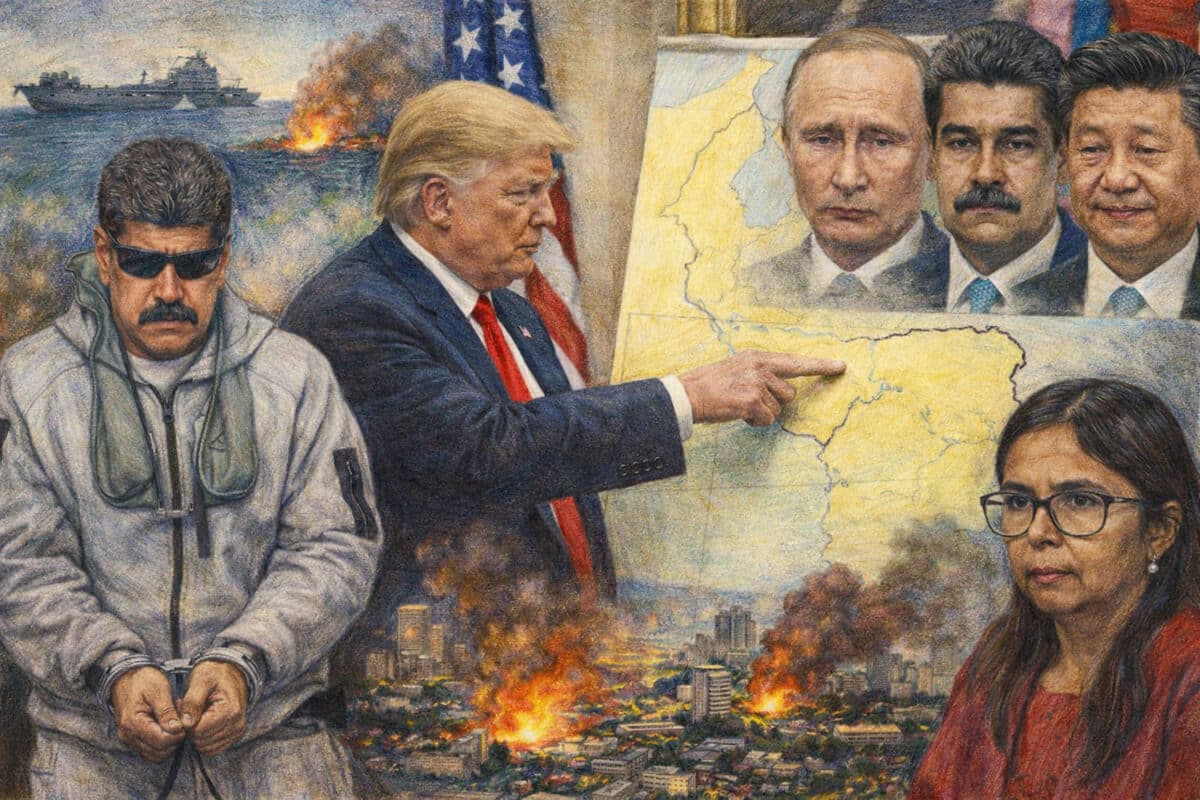
Simultaneously with the capture, a series of powerful airstrikes were carried out on key military infrastructure facilities in Venezuela. The strikes were diversionary in nature and allowed the disabling of air defense elements. This ensured complete tactical surprise and excluded a quick reaction from the guards and allied contingents.
For months, the US deliberately spread signals that they planned to limit themselves to “economic strangulation” of the regime. Maduro regularly complained about US pressure to the Kremlin and Tehran. According to sources, it was this set of measures and informational signals that lulled the vigilance of Venezuelan counterintelligence, as well as foreign structures — including the Russian GRU and the Iranian Quds unit.
US President Donald Trump publicly confirmed the capture, stating that Maduro is “not a president” but “the head of a drug cartel.” Secretary of State Marco Rubio reported that the active phase of military actions is over, as the main goal of the operation has been achieved.
US Attorney General Pamela Bondi stated that Nicolas Maduro and Cilia Flores have been brought to the US for trial. Maduro faces charges on four key counts.
The first is narco-terrorism: conspiracy with the terrorist organization FARC to “flood the US territory with cocaine” and undermine the nation’s health.
The second is drug smuggling: organizing the supply of hundreds of tons of narcotics through Venezuela to the US.
The third is illegal use of weapons: possession and use of large-caliber weapons and explosive devices to facilitate drug trafficking.
The fourth is money laundering: concealing billions of dollars obtained through criminal means via international financial systems.
For these charges combined, Maduro faces life imprisonment. Pamela Bondi confirmed that the first court hearing could take place as early as Monday in Miami. Later, information emerged that the trial might be moved to New York.
In the wake of the arrest, a state of emergency was declared in Venezuela. Vice President Delcy Rodriguez demanded “confirmation of life” of the president, effectively acknowledging the loss of contact with him. This was accompanied by panic in the ruling circles and reports of high-ranking regime officials fleeing.
Particular attention was drawn to information about the involvement of Russian structures in Maduro’s security. His personal safety was ensured, among others, by fighters from the Wagner PMC. Russian mercenaries were first recorded in Venezuela in 2019. In 2024–2025, the presence of Russian instructors and fighters involved in suppressing protests and guarding strategic facilities was noted.
In late October and December 2025, Il-76 transport planes, previously associated with Wagner PMC logistics, arrived in Caracas. It was believed they delivered up to 200 “advisors” to strengthen security amid threats from the US.
Maduro’s protection system included several levels. Casa Militar — the main corps of the presidential guard consisting of the most loyal officers. Cuban intelligence services G2, long considered key in counterintelligence within the presidential palace. And also Colectivos — pro-government paramilitary groups responsible for the outer perimeter and residential areas around government facilities.
Despite this, the American special forces conducted the operation so covertly that neither the outer security rings nor foreign contingents managed to react.
The reaction of Maduro’s allies was nervous. The Russian Foreign Ministry called the operation an “act of international piracy” and a “gross violation of sovereignty.” Russian advisors in Caracas are urgently evacuating to the embassy building.
China expressed “serious concern” and emphasized the need for “peaceful resolution,” avoiding direct accusations against the US. Analysts interpreted this as distancing from Maduro and an attempt to protect Chinese investments.
Tehran called the US actions “state terrorism.” Iranian media discuss the version that Iranian facilities in the region could be the next target, although a large-scale crisis is currently unfolding within Iran itself.
According to the US Department of Justice, Maduro was transported under heavy guard to Homestead Air Reserve Base in Florida, after which he was transferred to a detention center in Miami. He is held in a cell with enhanced supervision. Cilia Flores is also detained but is in a separate block for women.
CNN reports that Maduro and his wife may later be transported from Guantanamo by air to a military facility, and then by helicopter to New York. After that, they will be taken to a federal facility for document processing. CNN’s chief law enforcement analyst John Miller explained that this is a transition from a military operation to a criminal justice system: the accused will be fingerprinted, photographed, and sent to a detention center in Brooklyn. Joint detention for the spouses is not provided.
Simultaneously, the question of the so-called “Maduro’s gold” arose. About 31 tons of gold worth over 2 billion dollars are stored in the Bank of England. Most likely, these assets will be transferred under the control of the future transitional administration. Previously, British courts denied Maduro access to them.
Citgo Petroleum — the American subsidiary of Venezuela’s PDVSA — is considered a key economic asset for the country’s recovery. The Trump administration has already indicated that the US will be actively involved in managing Venezuela’s oil sector.
Tens of billions of dollars of Venezuelan funds in the US and Europe remain frozen, but a mechanism is being prepared for their unblocking under the pretext of humanitarian aid and stabilization — after the formation of a transitional government.
The opposition perceived Maduro’s arrest as a chance for the immediate restoration of democracy. Maria Corina Machado declared the need to transfer power to Edmundo Gonzalez, whom many countries consider the legitimate winner of the elections stolen by the dictator. The opposition called on the armed forces not to resist and to side with the people, promising amnesty to those who have not committed serious crimes.
In fact, Venezuela found itself in a state of political vacuum and dual power. Delcy Rodriguez declared herself the interim head of state, demanding Maduro’s release and trying to maintain control over the army. Later, reports emerged that she might be in Russia.Ukraine
Donald Trump stated that the US will temporarily “manage processes” in Venezuela until stability is restored. This drew criticism even among allies, including Spain, fearing direct occupation.
Russia and China initiated an emergency meeting of the UN Security Council. Colombia and Brazil put their troops on high alert, fearing an influx of refugees and border clashes. Amid the events, markets are preparing for a rise in oil prices — especially if fighting or sabotage on oil facilities begins in Caracas.
Ukrainian Foreign Minister Andriy Sibiga reminded that Kyiv did not recognize Maduro’s legitimacy after the rigged elections and violence against protesters and emphasized support for the right of peoples to live freely.
Marco Rubio noted in his statement: “The era of impunity for tyrants in our hemisphere is over. Maduro will receive a fair trial, which he never gave to the Venezuelan people.”
The story is far from over. But the fate of all dictators, as practice shows, has a similar end — regardless of the amount of security, allies, and gold in foreign banks.
NANews — News of Israel | Nikk.Agency
