On September 22–23, 2026, researchers from Ukraine, Israel, the USA, and Hungary will meet at the international conference “Jews and Encyclopedic Knowledge: 19th–21st Centuries” organized by the Ukrainian Association for Jewish Studies. They will discuss encyclopedias, but the topic is much broader than old multivolume works: who has decided over the past two hundred years what should be written about Jews, Jewish history, Hebrew, Yiddish, and Israel — and how what was written then became accepted knowledge.
Author: Victoria Katsman
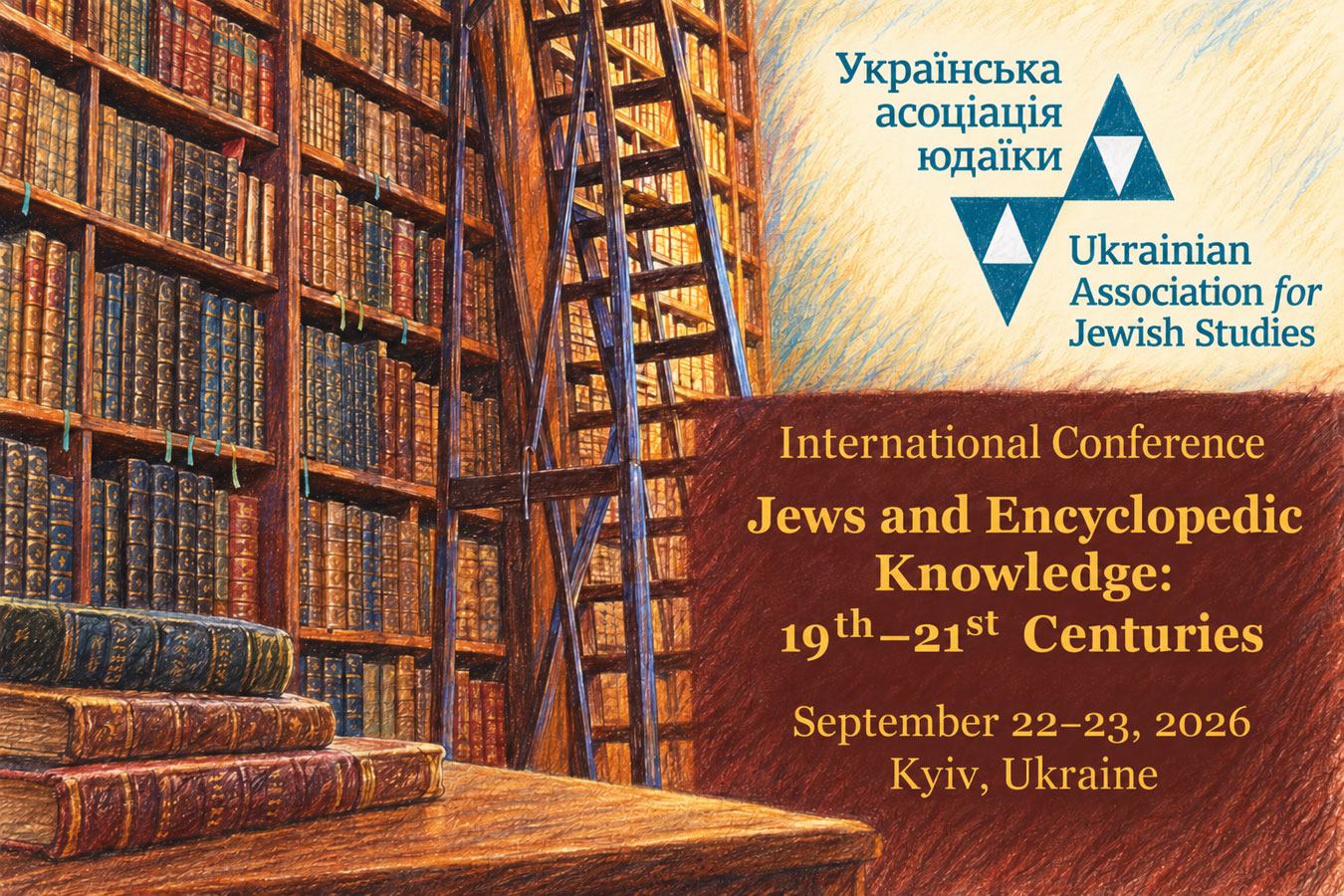
On September 17, the Ukrainian Association for Jewish Studies (UAJS) announced the international conference “Jews and Encyclopedic Knowledge: 19th–21st Centuries”, which will take place on September 22 and 23, 2026.
Researchers from four countries — Ukraine, Israel, the USA, and Hungary — are participating. The conference will be entirely remote, and the working language is English. The organizers have included Zoom links directly in the program.
Initially, everything was supposed to look different. On the official conference page, the original dates are still visible — August 18–19, 2026 — and Kyiv as the venue.
But there, UAJS separately clarifies: due to the current security situation in Ukraine, including Kyiv, the conference has been postponed to September 22–23 and will be held online.
The war enters this story quite literally. The international scientific meeting, which researchers from different countries were supposed to attend, will not physically take place in Kyiv.
The organizer of the conference is the Ukrainian Association for Jewish Studies. Financial support is provided by the European Association for Jewish Studies, and the initiative itself is implemented in partnership with UNESCO with financial support from the European Union.
UAJS calls this conference the first international meeting specifically dedicated to Jewish encyclopedias and Jewish topics in encyclopedias of the 19th–21st centuries.
And behind the wording, which initially seems purely academic, lies a rather understandable question: who actually determined what the world should know about Jews?
When an editor decided what would become a “fact”
Today, a person opens Wikipedia, finds an article, looks at the edit history, and, if desired, tries to correct something themselves. A hundred or a hundred and twenty years ago, the mechanism was completely different.
The encyclopedia editor and a circle of invited authors decided which events deserved a separate article, who should be considered a significant historical figure, how to explain Zionism, Judaism, or anti-Semitism, and how much space to allocate to a particular event. Their decisions determined what the next generation would read.
This is especially significant for Jewish history, which has been described for centuries in different languages and in different countries — often by people outside the Jewish community itself.
The conference organizers trace back to the era of Haskalah — השכלה, the Jewish Enlightenment of the late 18th–19th century.
For the Israeli reader, the term is familiar, but here it is worth clarifying the meaning. Haskalah was associated with the spread of secular education among Jews, the development of modern literature in Hebrew, the study of European languages, and the gradual expansion of the intellectual space beyond traditional religious literature.
It was against this backdrop that the first modern encyclopedic projects appeared.
New York, St. Petersburg, and the first encyclopedias in Hebrew
One of the largest projects of the early 20th century was The Jewish Encyclopedia, published in New York from 1901 to 1906. It consisted of 12 volumes.
Almost immediately after, the sixteen-volume “Jewish Encyclopedia of Brockhaus and Efron” appeared in St. Petersburg, published from 1908 to 1913.
At the same time, another important movement was taking place — the formation of modern encyclopedic knowledge already in Hebrew. In New York, the ten-volume Oẓar Yisrael was published from 1906 to 1913.
In the interwar period, the German-language Jüdisches Lexikon appeared, published from 1927 to 1930, and the pre-war Encyclopaedia Judaica edited by Jakob Klatzkin and Ismar Elbogen. Of the planned fifteen volumes, ten were published from 1928 to 1933.
All these projects were created by large international teams. Among the authors were scholars, writers, public and political figures, people from different countries of the diaspora and Eretz Israel.
Hence the question arose, which the conference organizers formulate quite openly: to what extent can an article’s author be neutral, especially when writing about a political movement to which they themselves belong, or about a people still fighting for their own state?
Israel changed the rules
After the establishment of the State of Israel, the system of Jewish encyclopedic knowledge changed.
Specialized and universal reference books began to be published in Hebrew, and in 1949, one of the largest intellectual projects of the young country began — האנציקלופדיה העברית, “The Hebrew Encyclopedia”.
Its publication stretched until 1985. As a result, 32 main and five additional volumes appeared.
For Israel in its first decades, this had a very special significance. The country was building state institutions, universities, an army, receiving huge waves of aliyah, and Hebrew was finally becoming the language of everyday life for millions of people.
At the same time, in modern Hebrew, it was necessary to describe practically the entire world — physics and medicine, European history and philosophy, geography, literature, religions, Jewish history, new states.
Thus, the encyclopedia also participated in creating the language with which the new society spoke about knowledge.
Dan Tsahor: how the encyclopedia built the Israeli canon
The main invited speaker of the conference will be Professor Dan Tsahor from Adelphi University in the USA.
The topic is not accidental for him. In 2023, De Gruyter published his book The Book of the People: The Hebrew Encyclopedic Project and the National Self.
Tsahor explores how encyclopedic projects in Hebrew participated in forming Zionist and then Israeli national culture. The creators of these publications not only collected information — they tried to determine what set of knowledge a modern Hebrew reader should have and how they should see their own society.
The history of “The Hebrew Encyclopedia” therefore turns out to be a story much larger than a multivolume edition on a bookshelf.
It is also an attempt by a young state to gather its own intellectual canon.
And what does Ukraine have to do with it
A very large part of Eastern European Jewish history took place on the territories of modern Ukraine.
Kyiv, Odessa, Lviv, Chernivtsi, Zhytomyr, Berdychiv, and many small towns were centers of Jewish religious, cultural, and public life. There were communities, schools, printing houses, synagogues, theaters, political movements, literature in Yiddish and Hebrew.
Therefore, the question of who and how records Jewish history is not abstract for Ukraine.
On NAnovosti, we recently talked about the new Ukrainian edition of “Babi Yar” by Anatoly Kuznetsov. The history of this book itself shows what happens when a state gets the opportunity to edit memory: Soviet censorship cut entire fragments from the text, and the author had to smuggle the full version out of the USSR on film.
A completely different example is the Kyiv exhibition “Drawn Prayers”, dedicated to the murals of synagogues in Ukrainian Bukovina, which are under threat of disappearance.
There, it is not about an encyclopedia article. But the principle is similar: if an old synagogue, document, image, or human testimony is not preserved and described in time, in a few decades, society may simply not know that it existed.
That is why NAnovosti — News of Israel | Nikk.Agency returns to such stories not as a separate section “about Jews of Ukraine.” For a huge number of Israeli families, this is part of their own history, which remained in Kyiv, Chernivtsi, Odessa, Lviv, and dozens of other places.
Gathering research from independent Ukraine in one database
A separate round table at the conference will be dedicated to the project Jewish Studies in Independent Ukraine.
UAJS is creating a bibliographic database of works on Jewish history, culture, and literature published in Ukraine after the restoration of independence in 1991.
It includes monographs, scientific articles, collections, dissertations, conference materials, and educational publications. The project team is expected to present the results of their work at the conference, including the website of the database itself.
At first glance, it is a technical task. In practice, Ukrainian studies on Judaica have been published for many years in various universities, institutes, journals, and small publishers, and not everything is easy to find even for a professional researcher.
Gathering these works in one system means at least seeing the scale of what has already been done.
In its own way, this is a continuation of the same encyclopedic history. Only instead of thirty volumes on a shelf — a digital database and a search bar.
Ukraine and Israel meet already in modern history
The connection between the two countries does not end there.
After the start of the full-scale Russian war against Ukraine, thousands of Ukrainians eligible for aliyah found themselves in Israel. The Leonid Nevzlin Center for Russian and East European Jewry Studies at the Hebrew University of Jerusalem separately studied how war, relocation, and new life change the identity of these people.
NAnovosti detailed the study “Ukrainian Jewish Repatriates in Israel: Jewish Identity in the Context of the Russian-Ukrainian War”.
There is also movement in the opposite direction. In Kyiv, Ukrainian students perform songs in Yiddish and Hebrew — we talked separately about the group “Bou Nashir”. For some of these young people, Jewish culture becomes a subject of study and performance regardless of family background.
It turns out to be quite an interesting chain.
Jewish history of Ukraine is preserved and re-studied in Ukraine. People from Ukraine bring their family histories to Israel. Israeli researchers work with Eastern European Jewish heritage. And researchers from both countries meet again — albeit now because of the war and only through a screen.
From Brockhaus editor to Wikipedia user
In one hundred and twenty years, the medium of knowledge has changed almost completely.
When the first major Jewish encyclopedias were created, an article could be prepared for months, then reprinted for decades, and perceived by the reader as a finished version of an event.
Wikipedia is arranged the opposite way. An article can be written and edited by dozens of people simultaneously, the debate over wording is visible in the edit history, and a final edit in the usual sense may not exist at all.
Therefore, the conference program talks not only about specific encyclopedias. Researchers are going to discuss editors and authors, Jews and non-Jews among the compilers, translations, publishers, funding, scientific institutions, the development of terminology in Hebrew and Yiddish, and the influence of the collective Wikipedia model on the very concept of encyclopedic knowledge.
On September 22–23, this conversation will take place among researchers from Ukraine, Israel, the USA, and Hungary.
They will not meet in Kyiv this time — the security situation does not allow it.
But the question itself has not gone anywhere: who records memory, who chooses words — and why, decades later, do we open these words as historical fact.
How to join the conference
The conference “Jews and Encyclopedic Knowledge: 19th–21st Centuries” takes place online on September 22 and 23, 2026. In the preliminary program, the organizers have placed two separate Zoom links — for the first and second day, so all one needs to do is open the program and click “Zoom for Day 1” or “Zoom for Day 2”.
Open the conference program and Zoom links
On September 22, the opening begins at 14:45, at 15:00 the main invited speaker Dan Tsahor will speak, followed by two thematic panels. On September 23, the program starts at 13:30, and at 16:30 there will be a presentation of the bibliographic database “Jewish Studies in Independent Ukraine”; the conclusion is scheduled for 17:30.
All times in the program are indicated in Kyiv time — GMT+3. For Israeli listeners, there is no need to recalculate the time: on September 22–23, Israel is also in GMT+3. The working language of the conference is English.
