
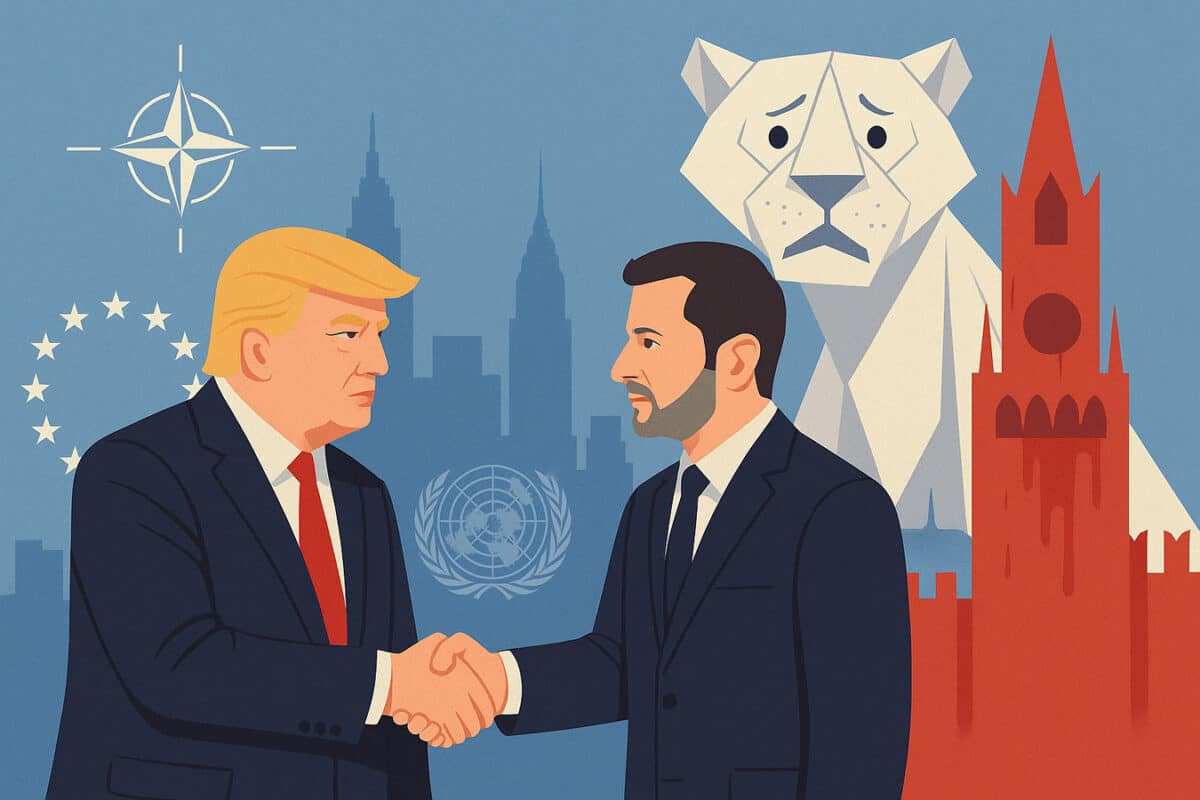
In New York, on the sidelines of the UN General Assembly, Donald Trump, after meeting with Volodymyr Zelensky, delivered a formula that Kyiv had long awaited: Ukraine is “capable of reclaiming all its territories” with strong support from Europe and NATO. On Truth Social, he called Russia a “paper tiger” and emphasized that Alliance countries should shoot down Russian air targets if they violate their airspace.
For Kyiv, this is not just a “pleasant phrase.” It is a potential framework for future decisions if words become policy: from the pace of arms deliveries to the coalition architecture of air defense/missile defense over Europe and the Black Sea.
What exactly did Trump say: three key ideas
1) Ukraine’s victory is possible.
For the first time, he stated that Ukraine is capable of “reclaiming all territories within its original borders” — implying both Crimea and Donbas. The phrase “paper tiger” is addressed to the Russian army and economy.
2) The EU and NATO are the main engine.
In public theses, the emphasis is shifted to Europe: allies pay for weapons, and the US supports, but without open promises of “new packages from Washington tomorrow.”
3) Air escalation is not taboo.
Trump directly said: if Russian planes violate NATO countries’ airspace, they should be shot down. To a clarifying question about US “backup,” he gave a cautious answer, “depends on the circumstances.” It sounds tough — and at the same time leaves a loophole.
What Kyiv and Moscow responded
Kyiv.
Zelensky diplomatically noted a “big shift” and emphasized that he cannot disclose details of the meeting: Trump now has “important information about the front.” An important nuance: Kyiv notes changes without attaching inflated expectations to them.
Moscow.
The public reaction is predictable: the Kremlin dismissed the “paper tiger,” repeating the mantra about the “bear” and “stable economy.” But the very fact that Press Secretary Peskov explained for the US president is already an indicator of nervous sensitivity to Washington’s rhetorical signals.
Is this a turnaround? Yes, but for now rhetorical
In recent months, Trump has wavered between ideas of a “deal” with partial concessions and theses about “ending the war quickly.” Now, in the public part, the focus has shifted: if Europe pays and accelerates the pace, Ukraine’s victory is permissible and even likely. But in practical terms, the puzzle is incomplete:
- no new sanction packages from the American side have been announced;
- no new specific nomenclatures for weapons (timing, volumes, financing);
- the emphasis is on strengthening the role of the EU/NATO, which sounds good but requires synchronization of 27 capitals and several bureaucracies.
Media in the West from NYT to Sky News interpret this as a noticeable turnaround that still needs to be “cemented with decisions.” Some Republican Party speakers are indeed “encouraged,” but Congress awaits signals on further steps — from sanctions to tariffs on Russian oil buyers. Otherwise, everything will remain at the level of “strong words.”
What this means for Kyiv in the next 90 days
1) A window for coalition air defense and “air rules.”
If the thesis about “shooting down violators” takes the form of joint NATO instructions, it reduces the risk of “accidental” pressure on the eastern flank and closes the sky over the Baltic/Black Sea more tightly. Ukrainian arguments about long-range air defense and SEAD-class missiles gain additional political weight.
2) Acceleration of European decisions is key.
With such a framework, it is beneficial for Kyiv to directly link supplies with Brussels, Bonn, Paris, and Warsaw: financing, training, repair bases, joint ammunition purchases. Washington essentially says: “the engine is in Europe,” and the US is insurance and integrator. This is realistic if the Commission/EDF and major capitals synchronize annual contracts for shells and air defense.
3) Communication of victory.
The thesis of “reclaiming all territories” is once again a legitimate public goal. But expectations need to be measured: Kyiv has already been burned by the dissonance between loud formulas and logistics on the ground.
Looking broader: Europe and Israel
Europe.
For the EU, this is a test of maturity: “are we ready to maintain the pace without the American autopilot?” If Trump’s thesis is cemented, the EU will have to argue less about “who pays,” more about production and joint risk. The topic of “shooting down violators” will require a clear link between the political mandate and combat management at NATO.
Israel.
The Ukrainian-Israeli theme is not only about societal empathy. “Paper tiger” is a formula about the opponent’s resilience, which Israelis know well in practice: the winner is the one who learns faster, suppresses the enemy’s logistics, and keeps allies on their toes. For the Israeli audience, another thing is important — European security and air control directly affect the Middle East through energy markets, shipping, and the “transfer” of drone solutions.
Where are the risks
Inconsistency of rhetoric.
Trump himself left room for maneuver — “depends on circumstances.” This is both flexibility and risk: it can too easily turn into “back” on the next round of the domestic political agenda.
European heterogeneity.
“Let the EU pay” sounds logical, but the EU is a compromise of 27 capitals. There will be countries ready to sign tough decisions, and there will be those who slow down.
Kremlin’s counterplay.
Moscow is already trying to ridicule the “paper tiger” formula and push the narrative “America is leaving, Europe can’t handle it.” The louder Washington’s words, the more active Russia’s attempts will be to prove the opposite — on the front and in the information field.
What Kyiv should do right now
- Map European capacities for ammunition, air defense, and repair: who, how much, when, under what conditions — and tie this into a single supply matrix.
- Press for “air rules” with specifics: what types of violations, what ROE, who makes the fire decision, what is the role of the US as “insurer.”
- Demonstrate the effect of each new batch of weapons: the link “supply → tactical result → loss reduction” is the best advertisement for continued funding.
- Maintain the pace of strategic communication. “Victory is possible” is now not only a Ukrainian mantra but also a quote from the White House. It needs to be filled with numbers and facts.
What will happen next: three scenarios
S1. Consolidation of the course (optimistic).
Congress and the administration convert rhetoric into decisions: sanctions on Russian oil revenues, coalition contracts for air defense, an increase in shells/drones — and unified rules for intercepting violators.
S2. “Europe pays — US insures” (basic).
Brussels and major capitals accelerate purchases, the US — without loud announcements supports key positions (air defense, ISR, cyber). Risks: timeline spread and logistics overload.
S3. Pendulum back (negative).
Domestic political ripple in Washington returns theses about a “deal.” Then Europe again bears the main burden, and the Kremlin tries to “push through” its interpretation of the West’s exhaustion.
Quotes of the day
- Trump: Ukraine with European help “is capable of reclaiming all its territory”; Russia is a “paper tiger.”
- Trump on NATO: countries should shoot down Russian violator planes; US participation “depends on circumstances.”
- Zelensky: “I can’t share details… President Trump now has important information about the front.”
- Peskov: “Russia is a bear. There are no paper bears.”
Conclusions
Trump’s rhetoric has changed — and this is an opportunity. If Europe takes the ball and accelerates decisions, and the US provides a “safety net” on critical positions, the “paper tiger” risks becoming a self-fulfilling prophecy. But this will only happen when the theses are tied to contracts, timelines, and norms of force application. And yes — Moscow loudly jokes about the “bear” precisely because it heard the signal.
