
In December, underground tunnels nearly 100 meters long and about one and a half meters high were discovered at the Belarus-Poland border. According to Polish services, migrants were illegally transported through them. The British newspaper The Telegraph on February 25, 2026, claims: Middle Eastern groups with experience in underground warfare could have been behind the construction.
This is about a new stage of Russia’s hybrid pressure on the European Union — using Belarusian territory and the migration factor as a tool of destabilization.
What is known about the tunnels on the Polish-Belarusian border
The tunnels were discovered in December 2025. According to Polish border guards, 130 migrants were detained immediately after a group of people exited the underground passage.
The construction turned out to be professional: reinforced walls, well-thought-out ventilation, depth allowing for covert border crossing. Later, other underground routes were identified, built with a high degree of engineering preparation.
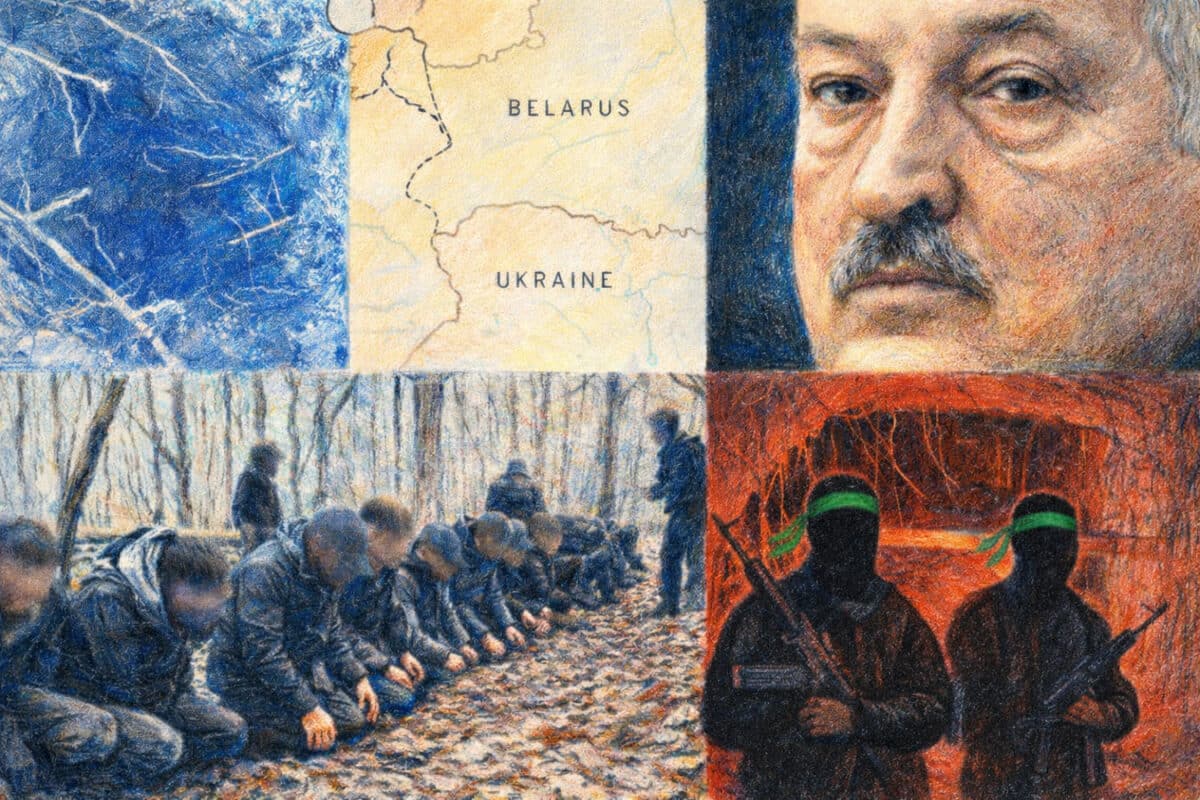
The Telegraph, citing military experts, reports that such technologies are characteristic of groups with experience in underground operations in the Middle East.
Who could be behind the construction: expert versions
The British publication presents the opinions of specialists familiar with the tactics of underground warfare. Among the groups with proven ability to dig deep and complex tunnels are:
Hamas and Hezbollah
Experts note that Hamas and Hezbollah have been perfecting underground infrastructure in the Gaza Strip and southern Lebanon for decades. In their assessment, the technical level of the Polish-Belarusian tunnels resembles Middle Eastern samples.
It is separately emphasized that both structures receive support from Iran and, according to Western analysts, are in tactical interaction with Russia on a number of fronts.
Kurdish formations and ISIS
Sarit Zahavi, a former Israeli intelligence officer, stated that the list of potential executors is broader. According to her, similar technologies are used by Kurdish forces in Syria, as well as ISIS militants.
Polish sources cited by The Telegraph do not rule out the involvement of specialists from Kurdish units. However, official Warsaw emphasizes that political responsibility lies with the Belarusian regime.
Moscow’s hybrid strategy and Minsk’s role
The essence of what is happening fits into the model of hybrid warfare, where the migration flow is used as a tool of pressure on EU countries.
According to The Telegraph, Russia is sending migrants through Belarus to Europe, using hidden routes. The construction of tunnels is considered part of a broader operation to undermine stability on NATO’s eastern flank.
Belarus, led by Alexander Lukashenko, has previously been accused of organized migrant transfers to the Polish border. The new element — underground infrastructure — takes the situation to a different level of complexity.
Experts note that such operations require coordination, funding, and technical preparation. This excludes the spontaneous nature of what is happening.
In the context of the Middle Eastern trace, the topic acquires an additional dimension for Israel. If specialists associated with Hamas or Hezbollah were indeed involved in the construction, it is about transferring technologies used against Israel to the European direction.
This is precisely what the publication NAnovosti — News of Israel | Nikk.Agency focuses on, analyzing possible consequences for Israeli security and strategic alliances.
Why this story is important for Israel and Europe
For Poland and EU countries, it is a matter of border protection and national security.
For Israel, it is a matter of technology transfer and cooperation between anti-Israeli structures and states opposing the West.
If the versions of Middle Eastern groups’ involvement are confirmed, it will be evidence of the expansion of their activity geography and a new form of cooperation within the anti-Western axis.
The investigation is ongoing. Polish authorities are strengthening border control. In London and Berlin, additional measures to protect the eastern flank are being discussed.
There are no final conclusions. But the very fact of the appearance of complex underground routes between Belarus and Poland already changes the picture of the migration crisis in Europe and takes it from the plane of a humanitarian problem to the sphere of geopolitics and security.
