
Short answer: Ukrainians generally have a positive attitude towards Israel. This was recorded in a study by Experts Club/Active Group, presented on September 9, 2025, in Kyiv.
The share of “positive” is higher than “negative,” and the share of “neutral” provides space for dialogue. Below are the figures, dynamics since May, and practical conclusions for the Jewish community and diaspora.
While global sympathy for Israel is declining due to the war in Gaza and political crises, a different dynamic is observed in Ukraine. Here, the perception of Israel remains stable and has even slightly improved: from May to September 2025, the share of positive assessments increased, and the number of “undecided” decreased.
Ukrainians, like Israelis, are experiencing a difficult war for freedom and security. This sense of common struggle creates a special closeness. History amplifies this effect. Jewish communities have lived in Kyiv, Odesa, Lviv, Chernivtsi for centuries, and the connections have been preserved to this day. For many Ukrainians, Israel is not a foreign country but “almost their own.”
Therefore, in Ukraine, Israel is perceived more warmly than in many other regions: here, not only politics matter but also shared memory, kinship of destinies, and personal stories.
What it’s all about and why it matters
This is not just a table of world sympathies. It’s a snapshot of how Ukraine sees key partners and where Israel stands on this map. For the audience of NAnews and readers of Israel News, this is an indicator of where to move in humanitarian, cultural, and economic projects.
Presentation and methodology: how it really was
The full study is available via the link (Eng).
Israel in numbers: without fog
Data obtained
44.7% — positive attitude towards Israel. 40% — neutral. 13.7% — negative. About 1.7% admitted they are not familiar enough with the country to form an opinion.
The slide shows the exact wording of the question on which the data was collected:
The exact wording of the question:
“What is your attitude towards Israel: rather positive or rather negative?”
And then in the chart — the response options:
- “Completely positive – 12.0%”
- “Rather positive – 32.7%”
- “Neutral – 40.0%”
- “Rather negative – 10.7%”
- “Completely negative – 3.0%”
- 1.7% → “Not familiar with this country”
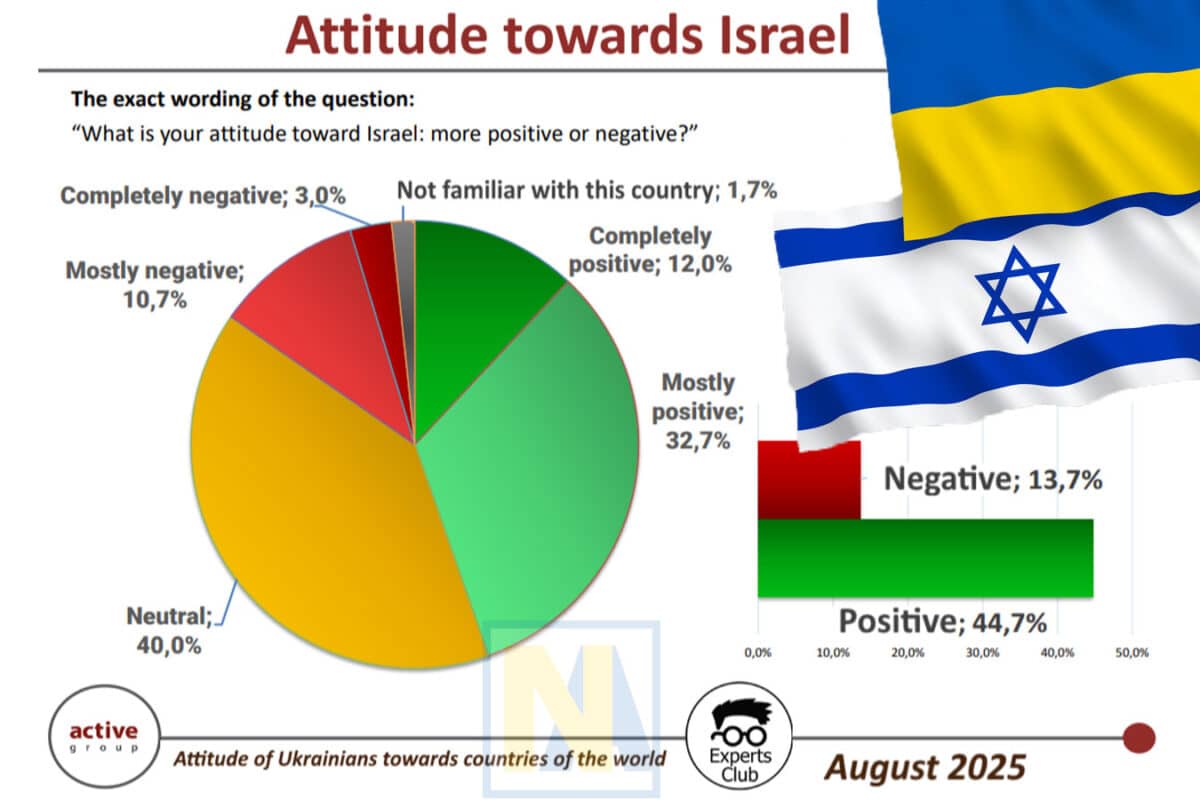
In other words, almost every second person looks at Israel with sympathy. The neutral layer is large, which is not a dead end but a chance to explain the benefits — from medicine and rehabilitation to technology and education.
“Despite a certain percentage of criticism, Ukrainians’ attitude towards Israel remains generally positive. This is explained by both historical ties and cooperation in the fields of medicine, science, and military technology,” commented Active Group director Alexander Pozniy.
In turn, Experts Club co-founder Maksim Urakin drew attention to the trade and economic component:
“By the end of 2025, bilateral trade between Ukraine and Israel amounted to over 353 million dollars. Ukrainian exports amounted to 132.4 million dollars, while imports of Israeli goods exceeded 221 million dollars. This led to a negative balance of about 88.6 million dollars. Such an imbalance indicates the need to expand Ukrainian exports and find new niches in the Israeli market,” he emphasized.
Dynamics over 4 months: May → September 2025
May 2025 (published May 12): 42.1% — positive, 39.8% — neutral, 13.8% — negative, 4.3% — undecided.
see our article – “In Ukrainians’ attitude towards Israel positive prevails over neutrality and negativity. How Ukrainians perceive the world: results of a sociological study” from May 13, 2025.
September 2025 (presentation September 9): 44.7% — positive, 40% — neutral, 13.7% — negative, 1.7% — undecided.
What changed in practice
- Positive increased by 2.6 percentage points — a small but stable wave.
- The number of undecided halved: people are making up their minds and more often in favor of Israel.
- Neutral and negative practically did not shift — an important signal for targeted communication.
Thesis for discussion: over four months, the image of Israel has become clearer, and the “gray zone” has narrowed. The more clarity and benefit — the more “positive.”
“Peace” and “partnership”: how Ukrainians see the role of countries
When asked “who contributes more to peace in Ukraine,” the most frequent answers were EU countries (~42%). Then USA (~25.8%) and UK (~12.8%). China, India, Brazil — symbolic shares.
Priorities for trade — EU, USA, UK, and Southeast Asia. China and the Arab world are less frequently included in the “growth” list. For Israel, this is a clear hint: synchronize with the European agenda and demonstrate practical benefits.
TOP-7 positive and negative assessments: what Ukrainians think
Before delving into details, it is important to note: Ukrainians’ sympathies and antipathies towards other countries reflect not only politics but also history, culture, and economic ties. Leaders of positivity are most often associated with supporting Ukraine on the international stage, while “anti-leaders” are associated with conflicts, distrust, and current political problems.
TOP-7 countries with the most positivity
- Norway — 77.7% positive assessments.
- Germany — 76.7%.
- Sweden — 76.3%.
- UK — 75.3%.
- France — 75.0%.
- Denmark — 73.7%.
- Finland — 73.4%.
Comment: Scandinavia and the core of the EU are the most reliable partners in the eyes of Ukrainians. Support for sanctions, military aid, and humanitarian projects played a key role here.
TOP-7 countries with the most negativity
- Hungary — 55.7% negative assessments.
- China — 40.7%.
- Iraq — 37.0%.
- India — 26.3%.
- Serbia — 26.0%.
- Slovakia — 25.7%.
- USA — 18.0%.
Comment: Hungary leads the “negative list” due to political conflicts and blocking Ukraine’s initiatives in the EU. China and India are perceived cautiously, which is related to their cautious position on the war. The USA simultaneously ranks among partners with high support but also evokes a noticeable percentage of criticism — this reflects polar perception.
Israel (44.7% — positive attitude, 13.7% — negative) — slightly below the middle of the “sympathy rating,” but steadily on the positive side. The key to growth is working with the “neutral.”
Economic background: where the pain is and where the opportunities are
According to speakers and industry reviews, in 2025, the bilateral turnover Ukraine–Israel exceeded ~353 million dollars. Ukraine’s export — ~132.4 million, import from Israel — over 221 million; negative balance — about 88.6 million.
What Kyiv should strengthen: agro-processing, food products with added value, metal products, creative services. What drives Israel: high-tech goods, medicine, equipment, knowledge, and services.
Why the “NAnews — Israel News” audience reads this
Because numbers are not just about trade. It’s about the feeling of a reliable partner and everyday benefits. When the material mentions clinic projects, veteran rehabilitation, joint R&D, pilgrimages, and cultural festivals — the “neutral” starts to move.
Subtle points that cannot be ignored
- Traumatic memory: careful speech about war, security, religion, and identity.
- Transparency: fewer slogans — more details: who, where, when, how much benefit to people.
- Communication ethics: respect for different groups, from the community to the secular audience.
Where the sympathy curve is heading: the main conclusion
The trend is moderate but steady: the “positive” towards Israel is growing, uncertainty is melting. This is a window for those ready to fill the agenda with specifics, not slogans.
This means a simple thing: the more real cases at the intersection of Israel–Ukraine–diaspora, the less “neutral” and the higher the trust.
Conclusion in two sentences
Ukraine sees Israel more as a partner than a controversial topic, and this trend has strengthened from May to September 2025. The next step is to turn “neutral” into “positive” with live stories, services, and joint projects.
FAQ
When were the results presented and who conducted them?
Presented on September 9, 2025; the survey was conducted in August by Active Group and Experts Club, sample — 800 people 18+, online panel SunFlower Sociology.
What do the numbers say about the attitude towards Israel?
About 44.7% positive, 40% neutral, 13.7% negative; in May, the positive was ~42.1%, and the undecided ~4.3%.
Who, according to Ukrainians, helps peace the most?
Primarily EU countries (~42%), then the USA (~25.8%) and the UK (~12.8%).
What does this mean for the Jewish community?
There is a demand for understandable, useful, and human stories. The more specifics and joint projects, the stronger the positive towards Israel.
