
Uman is preparing for Rosh Hashanah amidst war, complex logistics, and diplomatic tensions. The rabbi warns of a complete ban on “medical cigarettes,” Israel and Ukraine coordinate security, Moldova maintains its interests, and the local hospital receives a water purification system.
The 2025 pilgrimage will take place amidst Russian aggression against Ukraine, and preparations are being made not only by rabbis and communities but also by Ukrainian police, military structures, and the diplomacy of Israel and Ukraine.
What is known as of September 4, 2024?
The PR director of the International Charitable Foundation named after Rabbi Nachman, Anastasia Baryshnikova, reports:
“I want to officially refute the information that has spread by some media around the world, claiming that the pilgrimage is either canceled or banned. This is not true; no official decisions have been made on this matter,” she noted.
The PR director added that preparations for the arrival of pilgrims continue in Uman.
“This year, we expect about 45,000 people. We are checking the condition of shelters, purchasing food. Any pilgrim or resident of Uman can come at any time to have coffee or water. We are also purchasing books and various ritual elements. It’s a very extensive list,” Baryshnikova explained.
The main question is how the pilgrimage will proceed, calmly? — yes, if the rules are followed and the coordination between Israel and Ukraine works. The second answer is yes, flights will take place, but their stability depends on politics as much as on the weather.
Every September, Israelis have the same question: will it be possible to travel and pray at Rabbi Nachman’s grave without disruptions? In 2025, three factors have been added that cannot be ignored: strict restrictions on the import of “medical cigarettes” and any substances, diplomatic ties along the Netanyahu–Zelensky line, and unexpectedly — good news from local medicine: Uman’s hospital received a water purification system.
The Rabbi and the “Red Card” for “Medical Cigarettes”
The Rabbi of Uman, R. Yaakov Jan, preemptively cuts off speculation: “do not bring anything prohibited,” including trendy “cigarettes with medical substances.” The wording is strict but targeted: last year, there were arrests and noise around “medical” justifications. At stake is the reputation of the holiday and the safety of tens of thousands of people.
“Entry into Ukraine is prohibited with any drugs containing narcotic substances or psychotropic medicines of any kind. None of you will receive permission from the Ukrainian authorities, even if you present a doctor’s prescription from Israel. The Ukrainian police do not accept such excuses. Therefore, if anyone is detained with prohibited substances, they will be arrested and face legal proceedings in Ukraine, which will cause serious problems and severe consequences.
Therefore, I ask and warn you with all severity: do not bring cigarettes with any narcotic content, under any circumstances! Anyone who needs treatment with medical drugs must obtain confirmation from a doctor in advance that their medicines do not contain prohibited substances in Ukraine” — the message in the official letter is clear even to those who like to read between the lines.
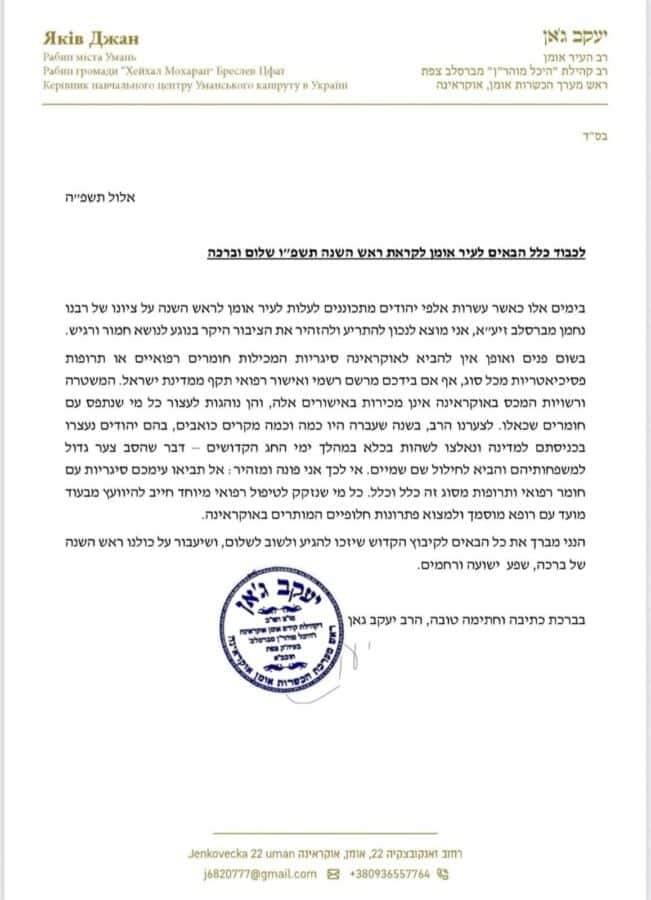
Why is it important to say this now? Because about 50,000 people come to the city for Rosh Hashanah, and any incident turns into a headline. Here, the rabbi acts not as a moralist but as a crisis manager: it’s better to warn publicly than to put out a fire live.
The letter appeared against the backdrop of various types of drug smuggling and arrests of Hasidim last year, as well as information that the Ukrainian police are preparing for a massive influx of drugs and plan to enforce the ban on drug imports into the country.
Israel’s Ambassador in Uman: A Signal That the State is “Involved”
Israel’s Ambassador to Ukraine, Mikhail Brodsky, met with the rabbi and local organizers: they checked who is responsible for what and where the “bottlenecks” are. For pilgrims, this is an important symbol: the state has not distanced itself; on the contrary, it keeps its finger on the pulse and helps establish interaction with Ukrainian services.
The picture is simple but effective: diplomacy + community coordinators + Ukrainian police. Such a triplet breaks under load less often than the solitary efforts of volunteers. Israel News here is not about “what was said,” but about “what was agreed upon and who is responsible at night when a question arises.”
Cherkasy: When the Plan is Written Together with the Military
A separate scene is a meeting in Cherkasy with representatives of the military administration: police, SBU, city authorities, “Ihud Breslav” — all in one room. They discuss not slogans but details: routes, checkpoints, medical points, evacuation in case of alarm, compliance with the curfew, and the banal “no parking here.” Like it or not, but without the army in Ukrainian reality-2025, such events do not survive.
The meeting, which took place in the offices of the military government of the Cherkasy region, aimed to coordinate preparations for the arrival of masses, with an emphasis on the security situation and emergency directives of the military government.
The conference was led by the governor of the Cherkasy region, Igor Taborets, and attended by senior representatives of the Ukrainian police, the Security Service of Ukraine (SBU), the National Guard, and the State Emergency Service.
On the other hand, the Uman municipality was represented by Mayor Irina Plantova and Deputy Mayor Oleg Ganich, who discussed logistical and municipal issues. The Breslov Hasidim were represented by the head of the Breslov Union in Uman, Rabbi Natan Ben Nun, who noted the existing cooperation between activists and representatives of the Breslov Union with representatives of local and national authorities.
During the discussions, emphasis was also placed on implementing the emergency recommendations of the military government, which are still in effect against the backdrop of the war in Ukraine: a ban on the use of fireworks, a ban on movement during curfew (except for arrivals in and departures from Uman), a ban on photographing security forces and military movements, etc.
The dry extract: strengthening medical services and firefighters, clear role distribution, a separate focus on informing pilgrims about wartime bans — from fireworks to filming military objects. NAnovosti sees this not as a “facade,” but as a real roadmap for day X.
Crowd Logistics and Community Image
In a city not designed for tens of thousands of guests, order is maintained not only by the number of police officers. It is maintained by the discipline of the pilgrims themselves. Organizers openly say: follow the rules, do not provoke conflicts, respect your neighbors on the street. And this appeal is not “for show,” but for people who will come not in the tourist season, but to a country living under military regulations.
NAnovosti — Israel News has repeatedly written: against the backdrop of war, alongside prayer, there is always simple everyday culture — “don’t litter, don’t make noise, don’t argue with the police.”
Moldova: Money, “Additional Conditions,” and Disruption of Direct Charters
According to Israeli reports, it was Chisinau that first put the pilgrimage logistics “on pause”: financial demands were made for accepting charters (about 10 million shekels) and linking flights with a guarantee letter from the Ukrainian side. Sources on Emess described the dynamics as: “after agreement, new conditions appeared” — a step perceived in Israel as an attempt at “arm-twisting” and delaying negotiations. Practically, this meant fewer direct flights through Moldova, more bypass routes, and longer travel times for passengers.
“Flight issues are tied to Ukraine’s guarantee letter and Moldova’s additional conditions” (Emess).
Further details only enhance the picture. On Emess, phrases like “the rope broke, heading for an explosion” were heard, and Moldova’s behavior was compared to “the criminal world.” Besides money, the key demand was to keep the equipment purchased for the hangar. Israel expected it to remain with them and be used in the future, but Chisinau insisted: the equipment stays in Moldova, and “next year negotiations will start anew” — a transparent signal of a new round of demands.
A separate point in Moldova’s response was “mines”: “we reserve the right to cancel the agreement” and “immediately transfer the money.” In Israeli diplomatic circles, quoted by Emess, this was commented on sharply: “This is distrust, almost the criminal world.” There was also an emotional reaction: “In Israel, there are about 15,000 workers from Moldova — maybe return some to learn to understand us?”
Israel reportedly signed the proposed document “as is,” but Chisinau returned it three days later with new amendments — as if it were Israel’s project, not Moldova’s. As a result, negotiations effectively collapsed, and the Israeli side began preparing plan “B” — redirecting flights to other points.
Status of the guarantee letter (as of now): there is no public confirmation that Ukraine has issued it, none. For the Moldovan side, this means maintaining the “linkage” of flights with the letter, and for pilgrims — the risk of route changes at the last minute.
Primary sources: radio broadcast Emess (negotiations and Moldova’s conditions), for general context — JDN (meeting in Cherkasy), Kikar/BHOL (meetings of the Israeli ambassador and the rabbi of Uman).
Ukraine: “Without Leaders’ Conversation — No Letter”
From the Ukrainian side, the decisive political trigger was: according to the same Israeli reports, Kiev refused to issue a guarantee letter until a personal conversation between Prime Minister Benjamin Netanyahu and President Volodymyr Zelensky. The formula was crystal clear: “without conversation — no letter.” On the ground, Ukrainian structures demonstrated readiness to receive (police, SBU, military administration plans were publicly discussed), but the legal “staple” — the letter itself — remained in the realm of inter-leader contacts.
“Without conversation — no letter” (Emess).
Status of the guarantee letter (as of now): not issued / not publicly confirmed. The consequence is that the charter schedule remains dependent on diplomacy; pilgrims should follow updates and allow time for possible adjustments.
Primary sources: Emess (position on the letter and linkage to leaders’ conversation); general readiness background — JDN, Kikar, BHOL.
What Israel is Doing: Diplomacy, Plan “B,” and a Little More Diplomacy
Externally, it looks like a “skirmish” with Moldova, but inside, the usual work of the Israeli system is underway: looking for backup corridors, negotiating parallel lines, sewing up risks. In such a scheme, the Netanyahu–Zelensky call is not a gesture of courtesy but a key to the paper, without which Moldovan doors may remain locked. Pilgrims are not explained this — and they don’t need to be. They need a ticket and assurance that boarding will take place.
Not Just About Flights: The Hospital Received a Water Purification System
There is also good news, and it is about respect for the host city. During a visit to Uman, Ambassador Mikhail Brodsky handed over a modern water purification system to the local hospital. The story is not for pomp but for practice: improving water preparation in a medical institution is about dialysis, sterilization, patient and staff safety. According to Ukrainian media and city pages, the installation is already operational.
What effect does this have? Firstly, it is concrete help to the residents of Uman — not just pilgrims. Secondly, it fits well into the picture of Israel–Ukraine relations: not only the security of a religious event but also a contribution to local infrastructure. For those following NAnovosti — Israel News, this is exactly the link that makes the headline not “arrived and left,” but “arrived, prayed, and helped.”
“Israel continues to assist Ukraine. By decision of Israel’s Foreign Minister, Gideon Sa’ar, several water purification installations will be handed over to Ukraine shortly. Today, such an installation began operating in Uman. Thanks to this, patients of the local hospital and nearby homes will be able to receive high-quality drinking water without interruption,” said Mikhail Brodsky.
What Everyone Going to Uman Should Remember
- No “medical cigarettes” or anything that border guards will consider drugs. Even “by prescription” — don’t risk it.
- Curfew, wartime bans, and security requirements are not “local whims,” but rules for which one is legally responsible.
- Be prepared for route and connection changes: some charters may bypass Moldova, and travel time may increase.
Why All This Resonates in Israel
The answer is simple: because it’s about our people and our reputation. For Israelis, the pilgrimage to Uman is not “exotic from the feed,” but a topic of courtyard conversations in Tel Aviv and Jerusalem. Here, faith, diplomacy, and basic human responsibility intertwine. And when NAnovosti — Israel News writes about bans, flights, and hospital filters, it’s not “editorial bird language,” but practical advice on how to return home without adventures.
Quotes of the Day
“Do not bring any types of drugs into Ukraine” — the rabbi’s message sounds like insurance against unnecessary headlines and detentions.
“The agreement is signed, but conditions change on the fly” — the essence of Israeli complaints about Moldovan charter conditions.
Conclusions
- The religious agenda does not cancel the laws and regulations of wartime.
- Diplomacy “before leaders’ conversation” can reshape air transport maps.
- A small “plus” with great benefit — the water purification system in the local hospital.
The bottom line: follow the rules, stay updated, and remember that Israel News is not only about politics but also about people and infrastructure.
FAQ
How many pilgrims are expected?
The target is about 50,000 people, as mentioned during the rabbi and ambassador meetings.
Who coordinates security on-site?
Ukrainian security structures (police, SBU, military administration) together with the city and community coordinators.
What about flights through Moldova?
The story is tense: money, guarantee letters, dependence on Netanyahu–Zelensky contact; some flows may be redirected.
What is the help for the hospital?
The Israeli embassy handed over a water purification system to Uman’s central hospital; it is already operational, according to Ukrainian sources.
Rosh Hashanah in 2025 and Why Uman
In 2025, Rosh Hashanah, the Jewish New Year, falls on the night of September 22 to 23 and lasts two days, until the evening of September 24. For religious Jews, this is a time of prayer and spiritual renewal, when, traditionally, it is decided “who will be inscribed and sealed in the Book of Life.”
But why has the city of Uman in Ukraine become a point of attraction for tens of thousands of pilgrims from Israel and around the world? The answer is simple: here lies the grave of Rabbi Nachman of Breslov (1772–1810), the founder of the Breslov Hasidic movement. He bequeathed to his students to come to him on Rosh Hashanah and promised special spiritual intercession to anyone who would pray at his grave on this day.
“My place on Rosh Hashanah is Uman, and no one should doubt it,” Rabbi Nachman told his students.
Since then, Uman has become a point of annual pilgrimage. Even in times of crises and wars, Hasidim strive to come — even through third countries, even through long flights. For them, it is not a tourist trip, but the fulfillment of a spiritual covenant. That is why about 50,000 people are expected in 2025, despite the war in Ukraine, curfew, and complex flight logistics.

Sources
- Kikar HaShabbat: ambassador’s visit, rabbi’s warning, number 50,000
- BHOL: details of the ambassador’s meeting with the rabbi and police plans
- JDN: meeting in Cherkasy with military and local authorities
- Emess: Moldova’s conditions, linkage to Netanyahu–Zelensky conversation
- RBC-Ukraine: water purification system for the hospital
- 24tv: details of equipment installation in Uman