
Watch this interview. It is a heavy but necessary testimony — for both Ukraine and Israel.
Israeli journalist Dan Goldman, in collaboration with the organization Israeli Friends of Ukraine, published a large interview that is difficult to perceive as ordinary media material. This is not a report or a political analysis — it is a testimony.
The protagonists of the video are journalist of the agency UNIAN Dmytro Khilyuk and former mayor of Kherson Volodymyr Mykolayenko. Both are civilians. Both were abducted by Russian military in the first weeks of the full-scale invasion. Both spent three and a half years in Russian prisons and colonies.
No charges, no trial, no status. Only captivity.
What this video is about — and why it is addressed to Israelis
At the very beginning, Dan Goldman honestly sets the framework: he is not a war correspondent and does not analyze battle maps. His task is to tell the stories of people to whom the war came.
This is where a direct and painful parallel with Israel after October 7, 2023, arises. Abduction, isolation, physical and psychological violence, turning people into bargaining chips — all this no longer needs to be explained to the Israeli audience.
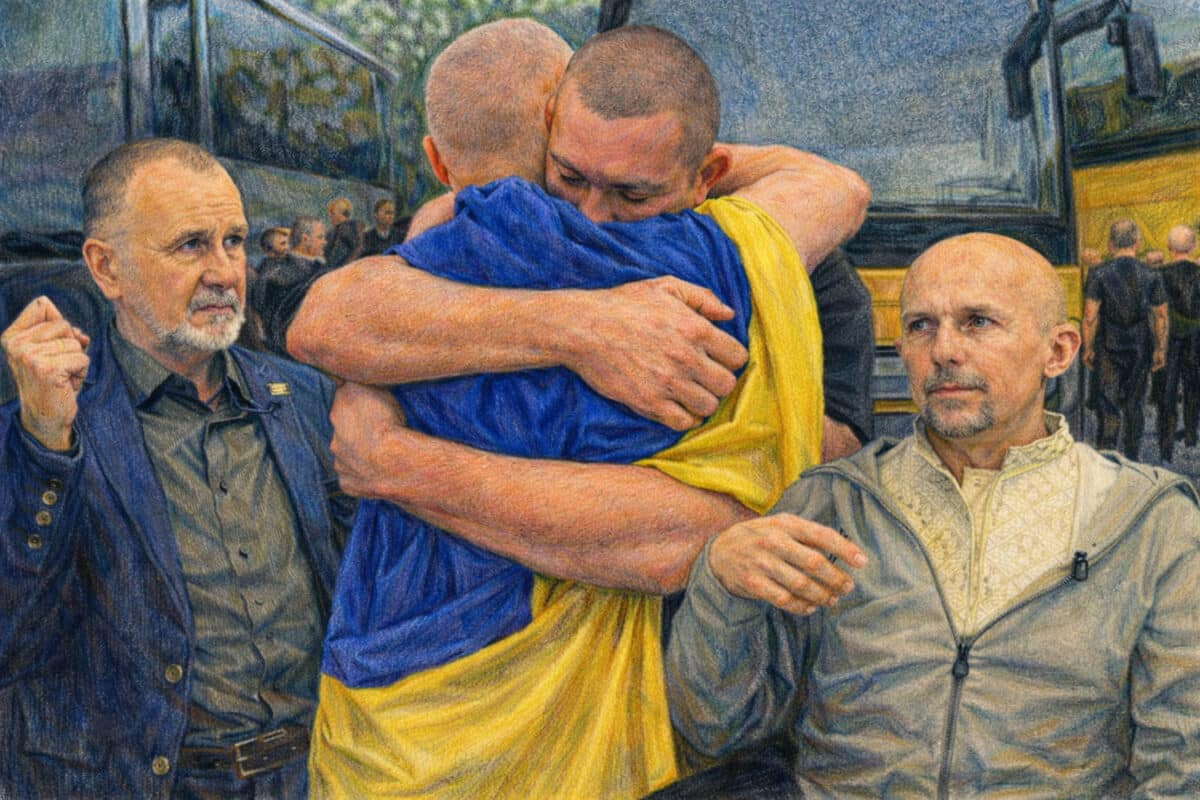
Who they are: Dmytro Khilyuk and Volodymyr Mykolayenko
Dmytro Khilyuk
A journalist who worked at UNIAN. He was abducted in his native village near Kyiv in March 2022 — just a few dozen meters from his own home. He and his father were stopped by Russian military during a “cleansing.” His father was later released, Dmytro was taken through Belarus to Russia.
Almost until his release, there was no information about his fate. No lawyers, no contact with family.
Volodymyr Mykolayenko
Former mayor of Kherson, pro-Ukrainian politician, Euromaidan activist. After the occupation of the city, he refused to cooperate with the Russian military, joined the territorial defense, and stayed with the residents.
He was offered to “lead the city” again. In case of refusal, they threatened to break his legs. In April 2022, he was abducted, beaten, transported through Crimea to Russia, and attempted to be used in propaganda videos under the threat of violence.
“We were taken as an exchange fund”
One of the key theses of the interview sounds harsh and without emotion: the Russian army deliberately captured civilians.
Not by age, not by profession, not by “guilt.” Men from 20 to 60 years old — for the numbers. They were immediately considered not as detainees but as a future resource for exchange.
Captivity: the first days and the first breakdown
Both protagonists describe the first days of captivity as a state of complete shock. You are at home, in your village, where you felt safe even in the 1990s — and suddenly you are laid face down on the ground, tied up, blindfolded, thrown into a dark room without windows.
The hardest part is not the pain, but the lack of explanations. You don’t understand for what, why, and for how long.
Transfer to Russia
After a few days, a dry phrase comes: “Tomorrow you will be taken to Russia.”
No documents, no decisions. Army trucks, curtained windows, orientation by the sun — this is how Dmytro realized they were being taken north, towards Belarus and Russia.
The first place was a pre-trial detention center in the Bryansk region, then colonies in the Vladimir region. Ukrainians were kept separately, completely isolated from Russian prisoners.
Interrogations, propaganda, and absurdity
Formally, Dmytro was involved in cases as a “witness.” During interrogations, he was asked about “biolabs,” “phosphorus bombs,” “crimes of the Armed Forces of Ukraine in Mariupol” — at a time when he didn’t even know the city was already occupied.
Investigators were genuinely surprised to learn that “Right Sector” and “National Corps” are legal political organizations. It was not working with facts, but reproducing myths.
Treatment: “like animals”
In both prisons, the treatment is described the same way: humiliation, swearing, beatings, systematic deprivation of dignity.
One of the protagonists formulates a fundamental thought: the state can deprive of life, but it has no right to deprive of dignity. In the Russian system, this rule does not exist.
Psychology and madness
A separate block of the interview is dedicated to people who mentally broke down in captivity. Solitary cells, constant beatings, isolation led to severe disorders.
Mykolayenko talks about cases when he consciously refused exchange, giving up his place to seriously ill prisoners. After that, the Russian side crossed him off the lists for years.
Bodies as hostages
One of the most terrifying fragments is the story that Russia even holds the bodies of the dead. They are used as a bargaining tool: territory in exchange for bodies.
This logic directly echoes the practices of terrorist organizations. The interview draws a direct parallel with Hamas.
Language as a reason for violence
The Ukrainian language in captivity became a trigger. They were beaten for speaking Ukrainian. Beaten for Surzhyk. Beaten for incorrect pronunciation.
This is where the phrase that became the title of the video is born: “We can no longer be made Russian.”
“Russia created Putin”
One of the key philosophical conclusions of the interview: it was not Putin who made Russia what it is — Russia created Putin because there was a social demand for him.
This thought is especially difficult to express by a person who is, by education, a Russian philologist, a specialist in the Silver Age and Russian literature. Captivity destroyed the illusion of “culture without violence.”
Release
The release took place on August 24, 2025 — on Ukraine’s Independence Day. Without explanations. “With things, to the exit.”
Plane, blindfolded, command to remove the blindfolds — and Belarusian buses on the runway. Only then did it become clear: this was an exchange.
Kherson today
Returning to Kherson is described as a second shock. The city on the front line, drones, hunting for civilians, destroyed infrastructure, hospitals, and maternity wards.
The city administration no longer exists — only ruins.
Why this video needs to be watched
Dan Goldman emphasizes: the stories of Dmytro and Volodymyr confirm the thought formulated by the Israeli writer who survived Auschwitz Yehiel Dinur:
to become a soldier of the army of absolute evil, you don’t need to be special. It’s enough to be a person consumed by hatred.
We saw this in Bucha. We saw it on October 7 in southern Israel.
Video
This video is not about Ukraine “somewhere out there.” It is a conversation about the mechanisms of evil that work the same way — in Russia, in Gaza, in any system where a person becomes a tool.
Watch this interview.
It is a heavy but necessary testimony — for both Ukraine and Israel.
YouTube channel Dan Goldman – https://www.youtube.com/@dangoldman13
Video from January 26, 2026:
Who is Dan Goldman
Dan Goldman is an Israeli journalist, blogger, and podcast author working in the Russian-speaking media space of Israel. He leads author video projects and journalistic formats dedicated to Israeli politics, war, the Middle East, and international conflicts.
Goldman is known as the author of YouTube interviews and analytical conversations, as well as the creator of the Telegram channel “First Dan: Israel | News | Opinions,” where he comments on key events and discusses them with the audience. His format is not a news feed or propaganda, but an attempt to understand what is happening through human stories and the personal experiences of interlocutors.
Since the beginning of Russia’s full-scale war against Ukraine, Dan Goldman regularly addresses the Ukrainian topic, viewing it through a prism understandable to Israeli society. His works draw parallels between the Ukrainian experience of captivity and the Israeli hostage theme, between state propaganda and violence, between a war “somewhere far away” and a reality that suddenly becomes very close.
NANews Israel News Nikk.Agency
