
Global Fire Power published the world army ranking 2025 based on available firepower. Such GFP rankings have been published annually since 2016.
Every time the Global Firepower ranking is updated, for a couple of days it feels like the world is trying to reduce war to a table again. In 2025, it’s the same story. Countries are lined up by indices, arrows up and down, numbers with three decimal places. But for those living in Ukraine or Israel, these numbers are read differently. Where for some it’s just statistics, for others it’s a matter of survival.
The picture at the top: everything is familiar, but details matter
In the top ten, almost nothing moves.
In first place is the USA with an index of 0.0744.
Next are Russia (0.0788) and China with the same value — a formal tie, although everyone understands that reality is more complex.
The fourth place is occupied by India (0.1184), fifth is South Korea (0.1656).
Then the United Kingdom, France, Japan, Turkey, and Italy. This top ten has long turned into a “permanent club.”
Israel: 15th place and moving up
Israel is on the rise this year — 15th position with an index of 0.2661.
Formally, this is the result of a strong defense industry, developed logistics, and a well-structured mobilization system. But the ranking does not have a column for “threat from Iran” or “constant readiness for missile attacks.” There is no assessment of the country’s ability to switch to military mode within hours.
Therefore, the position looks high, but it still simplifies the real situation: Israel in the region plays on a field that the ranking cannot measure.
Ukraine: twentieth place, but the number is not about the front
Ukraine is 20th in the world. Index 0.3755.
The “Down” arrow next to the number says one thing — a decline compared to previous years. But a person who has seen the front line at least once understands: GFP compares only what can be entered into a table — equipment, manpower reserves, air fleet, roads, industry.
It does not see the ability of Ukrainians to hold the front under constant attacks, does not take into account improvised technical solutions, does not know what a war lasting years is. But despite this, Ukraine remains in the company of countries with a developed army — between Egypt (19th place — 0.3427) and Poland (21st place — 0.3776).
On what criteria is the ranking based and where does the data come from
If you break down the GFP methodology into parts, it turns out to be a rather down-to-earth scheme. They compile dozens of parameters: the number of active troops, reserves, amount of equipment, state of aviation, fleet, fuel resources, supply infrastructure, industry, access to seas, transport corridors. All this is dry mathematics, without trying to look into how a country actually conducts war.
Sources are only open data. Reports from defense ministries, international arms catalogs, defense procurement data, research from analytical centers, satellite observations, commercial equipment databases. No secret intelligence. Therefore, the ranking is not an assessment of hidden power, but a snapshot of what can be publicly verified.
From a methodological point of view, this is fair, but that’s why the indicator does not capture morale, command, or societal resilience. It shows how much “hardware” and resources a country has, and whether the economy can withstand a prolonged conflict.
Why it’s important to consider Ukraine and Israel separately
Both countries are ranked alongside major military players, but each lives in unique conditions. Ukraine holds the front line against an army that in size and resources belongs to the top three in the ranking. Israel lives in constant tension, where threats appear faster than official reports can be released.
Therefore, the numbers provide only a starting point. Real power lies in how well countries can hold on in conditions where the ranking no longer works.
Conclusion
Global Firepower is a useful tool, but it only shows the surface. Nevertheless, the fact remains: Israel is 15th, Ukraine is 20th.
Two countries for which defense is not a budget item, but something that determines the future. And we at NAnews — News of Israel | Nikk.Agency will continue to monitor how these numbers relate to real events — on the front and in the region.
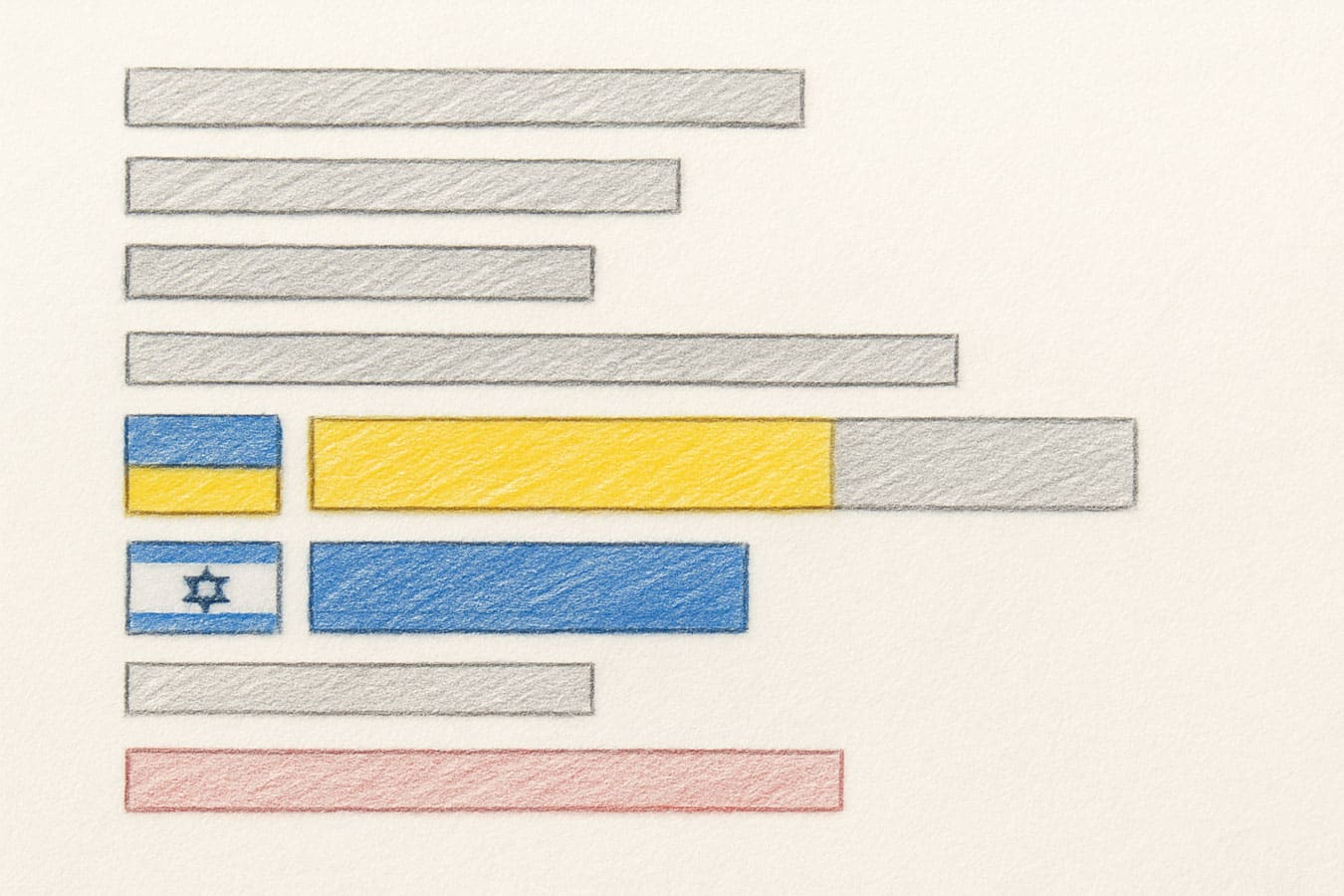
Top-20 armies of the world according to Global Firepower — 2025
United States — PwrIndx: 0.0744
Russia — 0.0788
China — 0.0788
India — 0.1184
South Korea — 0.1656
United Kingdom — 0.1785
France — 0.1878
Japan — 0.1839
Turkiye — 0.1902
Italy — 0.2164
Brazil — 0.2415
Pakistan — 0.2513
Indonesia — 0.2557
Germany — 0.2601
Israel — 0.2661
Iran — 0.3048
Spain — 0.3242
Australia — 0.3298
Egypt — 0.3427
Ukraine — 0.3755