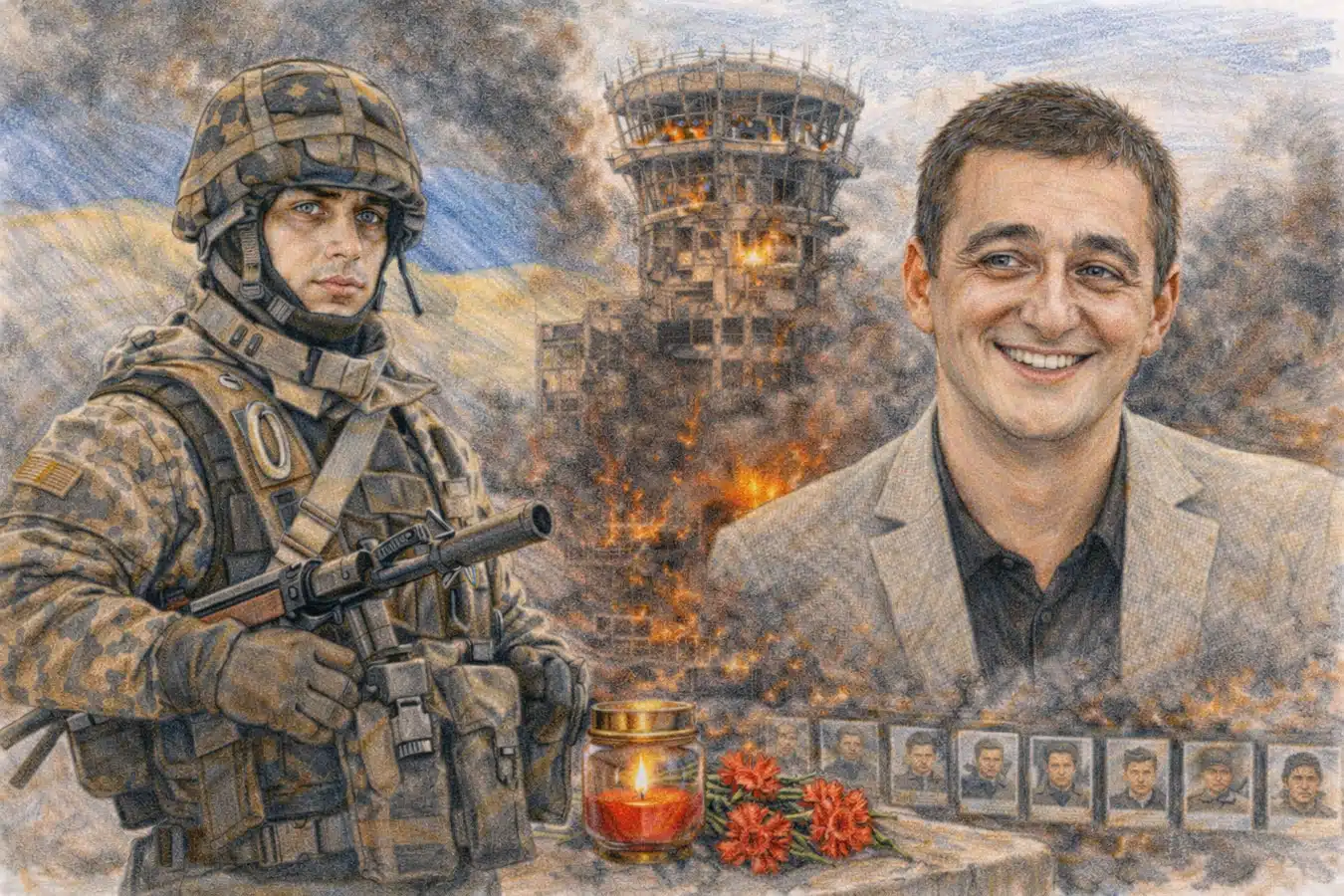
In Ukraine, January 20 is observed as the Day of Remembrance for the Defenders of Donetsk Airport. It marks the anniversary of the end of the battles for the airfield. The events of those days became an important milestone in the modern history of the country. The battles for the Donetsk Airport lasted from May 26, 2014, to January 22, 2015 — 242 days of fierce resistance by Ukrainian warriors against Russian occupation forces.
For many, this is not a “commemorative date” or a formality. Donetsk Airport became one of the first symbols of Russian aggression against Ukraine — long before the full-scale invasion. It was there that what would be repeated over and over again first manifested in a concentrated form: when the enemy cannot break the defense in direct combat, they try to destroy the point of resistance itself along with the people, turning the building into a mass grave.
On this day, all the “cyborgs” — the defenders of the airport — are remembered. But in the section “Jews from Ukraine“, it is impossible to overlook the name Yevhen Yatsyna, call sign “Benya” — the youngest cyborg warrior who died in January 2015 in the new terminal of Donetsk Airport.
More about the defense of Donetsk Airport – “People endured, concrete did not”: in Ukraine, January 20 is the Day of Remembrance for the Defenders of Donetsk Airport
Who is Yevhen Yatsyna and why his call sign is especially resonant
Yevhen was born on January 25, 1989. A native of Kyiv, Pechersk. He studied at the Kyiv National Linguistic University, in the Faculty of Economics. Friends remembered him as a star of the university KVN and a “one-man band” — bright, lively, very sociable.
The nickname “Benya” was part of his life even before the front, and later became his call sign. And in this detail, there is an important intonation for the Jewish community: Yevhen greeted friends with the word “shalom”, responded to “Benya”, and this manner of communication was remembered by many more strongly than any official biographies. It was later reported that Yevhen’s mother was Jewish, and he himself had visited Israel and been to Jerusalem.
These strokes are important not for “origin for the sake of origin”. They show that the Jewish line in Yevhen’s history is not a decorative signature at the end, but part of his living language, habits, and connections.
The Defense of Donetsk Airport: Why It Became a Symbol
The defense of the airport lasted for months. The new terminal was turning into ruins right during the battles — under shelling, assaults, explosions. There, the war was fought not on a map, but on stairs, corridors, breaches in walls. People held positions in conditions where every day could be the last.
The word “cyborgs” appeared as an attempt to explain what seemed impossible: Ukrainian soldiers held on so persistently that even the enemy called them “not human”. And this is an important point for understanding the modern war: the Russian side from the very beginning acted on the logic of destruction, not “negotiations” or “disputes”.
Then, in 2015, the terminal was blown up, and part of the defenders ended up under the rubble. Today, in the years of full-scale war, the same principle works throughout the country: strikes on cities, energy, residential buildings — to destroy not only the defense but also the ability of society to live.
The Last Connection and Days That Ended in the Terminal
The last time Yevhen, a soldier of the 81st Brigade of the 90th Separate Airmobile Battalion, made contact was on January 18, 2015. He was definitely in the new terminal of Donetsk Airport that day.
According to his comrades, on January 19, he was wounded (a torn wound on the cheek) and concussed.
On the evening of January 20, Yevhen was caught under the collapse of the airport building after an explosion. His comrades pulled him out from under the rubble. According to them, he had fractures in both legs and a severe spinal injury — he could no longer move. He had a tag with his surname and individual code.
He did not live to see his 26th birthday — January 25 was just a few days away.
Different testimonies record different dates of death — January 19, 20, or 21. But the meaning is the same: Yevhen died in the last days of the defense of the new terminal, at the very point where the war led to the literal collapse of the building on people.
“To Georgiy Borisovich, shalom…”: Words of Georgiy Tuka
Volunteer Georgiy Tuka remembered Yevhen briefly and as one speaks of a close person — without unnecessary “literature”:
“Zhenya. Zhenya Yatsyna. Call sign ‘Benya’. A native of Kyiv. Pechersk. 25 years old. I met Zhenya back when the battalion was stationed in Zhytomyr. Zhenya had the opportunity to ‘dodge’ the draft, but as a man, as a citizen, he did not do this, and honestly went to fulfill his duty. Zhenya was the youngest fighter in the battalion. Without exaggeration, everyone’s favorite. The funniest, most sociable, most contactable. Every time our phone conversation started with the words: To Georgiy Borisovich, shalom!… Still a lump in the throat…”
This quote holds what is often lacking in official memory: voice, habit, life. Not a “hero’s portrait”, but a person who is truly missed.
“Jerusalem Thread”: A Story from His Mother
Yevhen’s mother, Svetlana, said that her son died due to closed fractures of the legs. And she recalled a detail that really brings a lump to many throats:
Once she brought a Jerusalem thread from Israel. When Zhenya came from Zhytomyr, she secretly sewed this thread into his uniform — into pockets, cuffs, “everywhere”. She did it quietly because her son considered such things “nonsense”.
But before leaving for Vodiane, Yevhen put on Pavlo Tuka’s pants — his own were dirty. And later, when the mother found out about this, she said: “Well, now it’s clear why it was the legs — there were no mother’s threads on the pants.”
This story is not about mysticism or “amulets”. It’s about a mother’s attempt to keep her son alive by any means, even the most inconspicuous. And about how war breaks such attempts mercilessly and routinely.
Help from Friends and What They Didn’t Have Time to Deliver
After Yevhen went to the army, friends collected over 40,000 hryvnias on social networks for a thermal imager, thermal underwear, and protective equipment. But they didn’t have time to deliver it to him.
This detail very accurately shows how Ukraine lived in the early years of the war: the front was held not only on orders and headquarters but also on horizontal support — when people collected money “from the world by a thread” to protect a specific fighter. Sometimes they made it. Sometimes — not.
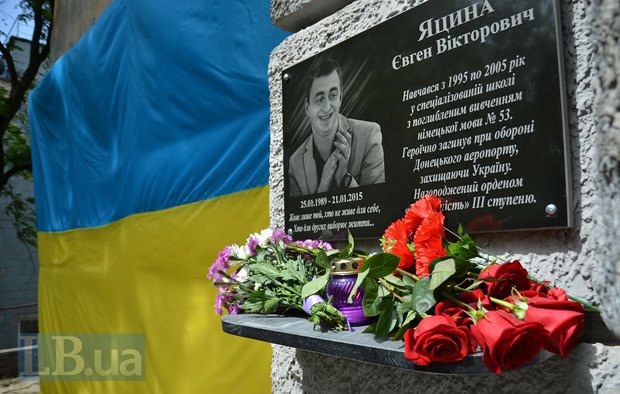
“Wall of Memory of Those Who Fell for Ukraine”: Portrait and Exact Location
Another point of Kyiv’s memory is the memorial “Wall of Memory of Those Who Fell for Ukraine”, open to the urban space. This place is arranged so that a person can come and find a specific face — not “in the general list”, but nearby, at arm’s length.
Yevhen Yatsyna’s portrait on the “Wall of Memory” is placed with precise marking: section 5, row 3, place 38. This precision turns memory into action: you can come and stop right at his portrait.
In recent years, the “Wall of Memory” has also become part of the public diplomacy of memory: Volodymyr Zelensky often brings foreign guests there to show the cost of Russian aggression not in the language of statistics, but with the faces of the fallen.
Order “For Courage” III Degree: Fixing the Feat at the State Level
The feat of Yevhen Yatsyna is also enshrined in a state document. He was awarded the Order “For Courage” III Degree (posthumously).
The basis is Presidential Decree of Ukraine No. 270/2015 of May 15, 2015. The decree states that the award is given “for personal courage and high professionalism shown in the defense of the state sovereignty and territorial integrity of Ukraine, loyalty to the military oath”.
Together, these elements — the funeral in Kyiv, community participation, memorial plaques, portrait on the “Wall of Memory”, and state order — form a coherent line: Yevhen Yatsyna did not dissolve in the war as “one of”. He remained a name, a face, and a story — for Ukraine and for the Jewish community, which shared this loss as their own.
Knesset and Words About the Contribution of Jews from Ukraine
On December 23, 2015, during a speech in the Knesset, President of Ukraine Petro Poroshenko said a phrase that still sounds like a political and human testimony:
“In confronting external aggression, our country has revived its army. And in this army, citizens of Ukraine of different nationalities are fighting. And we are proud of the contribution that Jews make to the defense of the country. I cannot but recall the glorious cyborg warrior who died in January this year at Donetsk Airport, Yevhen Yatsyna with the call sign ‘Benya’. We are proud of his feat. Posthumously, he was awarded the state order ‘For Courage’.”
This is not just a “mention of a name”. It is a public acknowledgment that the Jewish community of Ukraine is not an observer and not a “separate topic”, but part of the resistance to Russian aggression.
And this is especially important now, when Russia continues the war and continues to try to blur responsibility, substitute cause-and-effect relationships, and play the card of societal division. Stories of such people break this propaganda because they are very simple and very direct: a citizen of Ukraine went to defend the country, died, and he is remembered — by the state, the university, and the community.
Why the Story of “Benya” Sounds Sharper Today Than Ten Years Ago
Donetsk Airport was one of the first places where the war showed its true face. Back then, many still hoped that “everything would end soon”. Today, after the full-scale invasion, it has become clear: Russian aggression is a long-term project of destruction, exhaustion, terror in the rear, and an attempt to erase identity.
Against this background, the story of Yevhen Yatsyna looks not like an “episode of the past”, but as a point from which much began. It shows that resistance in Ukraine was initially nationwide — including with the participation of the Jewish community, which provided the country with warriors, volunteers, doctors, support for the families of the fallen, and public memory.
And in the end, there remains a simple formula that sounds especially honest in the section “Jews from Ukraine“:
Memory is us with you. As long as we name names and tell stories in living words, the war cannot turn people into impersonal numbers. NAnews — Israel News | Nikk.Agency.