
Israel’s decision to stop importing Russian wheat — including grain exported from temporarily occupied territories of Ukraine — goes far beyond a trade dispute. It is a step that primarily hits the economy of Putin’s Russia and its ability to finance the war, even if it means higher prices for Israeli consumers.
Jerusalem and Washington, reports the Israeli globes on January 29, 2026, are finalizing negotiations to switch to American grain. In early February, a delegation from Israel’s Ministry of Agriculture will travel to the US to finalize the agreement. The context is clear: the Donald Trump administration is seeking to redistribute markets in favor of American farmers, offering in return a reduction in tariffs on Israeli goods.
Until recently, Israel was almost entirely dependent on the Black Sea region. In 2024–2025, about 89% of wheat imports came from Russia, with another portion from Ukraine. Short logistics made such deliveries convenient and cheap. But this is where the line of principled rupture lies.
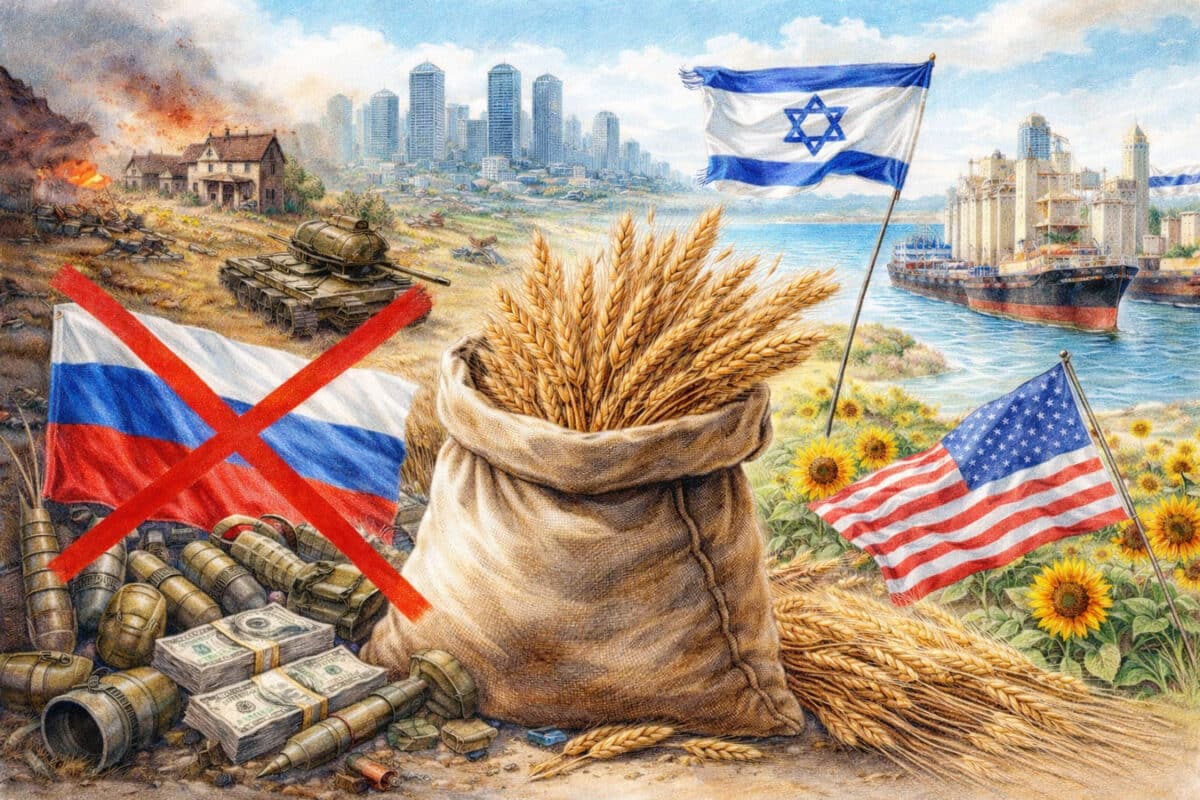
Russia systematically exports Ukrainian grain from temporarily occupied territories — from elevators, farms, ports. These volumes are labeled as “Russian,” mixed with legal batches, and enter the global market. Revenues from this trade go to the budget of the aggressor country and directly support the war against Ukraine. Every purchased ship of such grain means additional money for missiles, drones, and the killing of civilians.
Israel’s refusal of such supplies is not only an economic but also a political-moral decision. NAnews — Israel News | Nikk.Agency has repeatedly noted: more and more countries and companies do not want to “stain” themselves with grain of dubious origin and become indirect sponsors of Putin’s aggression.
It is important to emphasize: for Ukraine, this step is not critical. Ukrainian grain is in demand on the global market and can be sold to dozens of countries — from the EU to the Middle East, Africa, and Asia. Despite the war, Ukraine remains one of the key global exporters and diversifies routes and sales markets.
However, for Putin’s Russia, the situation is different.
Massive sanctions have been imposed against it, and the circle of countries willing to buy Russian grain — especially with the reputational trail of looting in occupied territories — is narrowing. Israel has not formally joined the sanctions against Russia, but most major consumer countries have imposed restrictions or de facto refuse such purchases. Every lost market is a problem for the Russian economy.
Simultaneously, Israel is changing its tariff policy. A duty of up to 50% is being introduced on Russian and Ukrainian wheat instead of the previous duty-free regime within two million tons per year. Formally — part of the new agreement with the US. In fact — closing the market for Russian grain, including that stolen from Ukraine.
Within the Israeli government, the debates were intense. Finance Minister Bezalel Smotrich opposed due to rising costs. Ministers of Agriculture and Economy — Avi Dichter and Nir Barkat — supported the switch to American grain. Prime Minister Benjamin Netanyahu made the choice in favor of a strategic decision, despite the cost.
The economics of the issue are simple and harsh. Israel imports about 2.15 million tons of wheat per year. American grain costs about $25 more per ton, including delivery across the Atlantic. Annually, this is about $54 million in additional expenses — approximately 166.6 million shekels. This money will fall on consumers and taxpayers.
A separate effect is the rise in feed prices and, consequently, dairy products. Israeli analysts previously warned about this: the increase in the cost of feed grain automatically reflects on the price of milk, cheese, and butter.
But in a strategic sense, the effect is the opposite. For Ukraine, it is merely a change of one market, not undermining exports. For Putin’s Russia, it is another closed income channel and another signal: fewer and fewer countries are willing to turn a blind eye to the origin of grain and sponsor the war through trade.
Israel makes a choice that will be felt in supermarket price tags. But at the same time, it is a choice that reduces the Kremlin’s financial ability to continue aggression. And in the context of global sanctions, such decisions — painful but concrete — are becoming increasingly sensitive for Putin’s economy.
