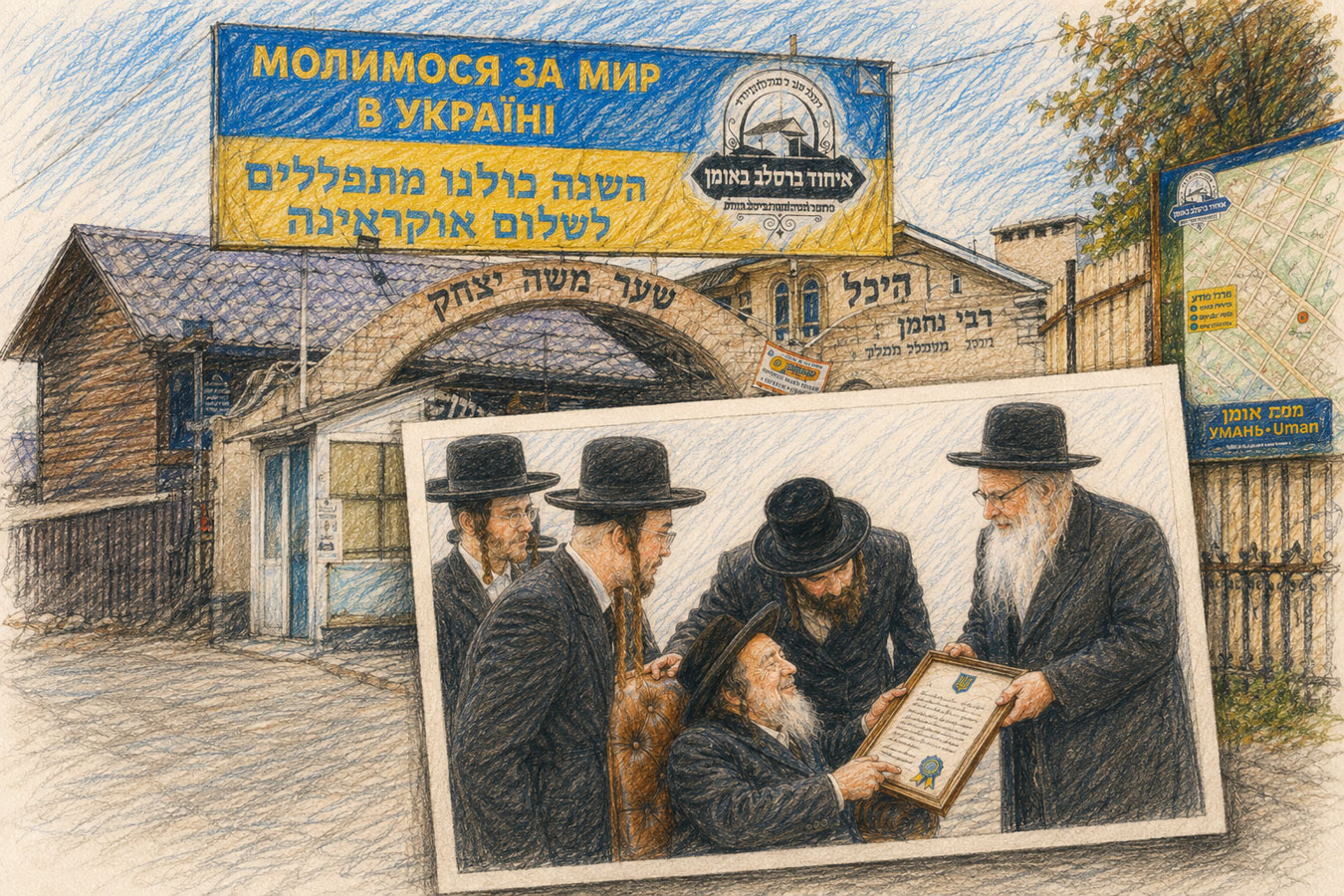
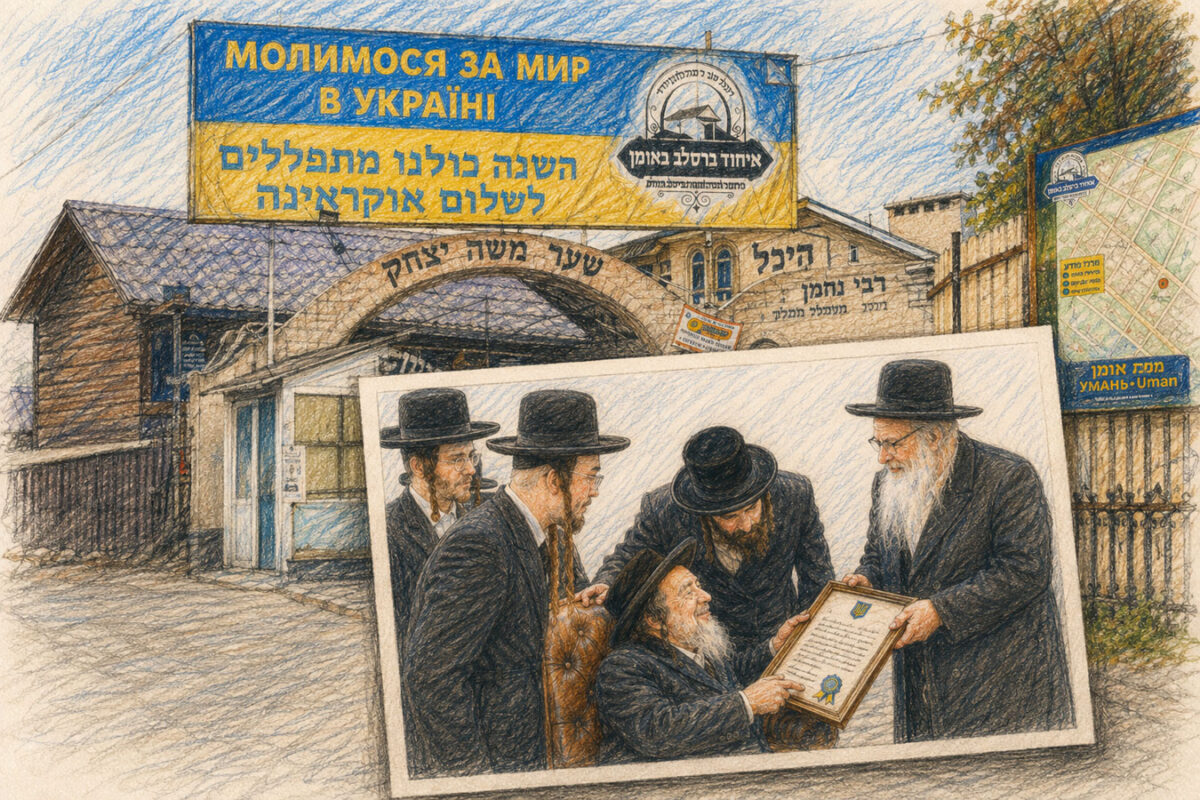
On August 7, 2026, on the eve of Rosh Hashanah 5787, leading representatives of the Breslov Hasidic community thanked Ukraine for continuing to support the traditional pilgrimage to Uman even during a full-scale war. A special meeting was held at the home of one of the oldest and most famous Breslov mentors, Rabbi Yaakov Meir Shechter.
The initiative was reported by Anastasia Baryshnikova, PR director of the International Charitable Foundation named after Rabbi Nachman. According to her, the foundation is already preparing for Rosh Hashanah and is involved in delivering an official letter to the Ukrainian state. In 2026, the celebration in Uman will take place from September 11 to 13. The Ukrainian State Service for Ethnopolitics and Freedom of Conscience also confirms that preparations for receiving pilgrims are already underway.
According to the August 7, 2026 report by “Uman Media — Uman media, the meeting was also attended by Rabbi Shmuel Moshe Kramer, the official rabbi of Uman Yaakov Shiloach, and other spiritual leaders. They asked the head of the International Charitable Foundation named after Rabbi Nachman Natan Ben-Nun to convey a letter of gratitude and congratulations to the President of Ukraine and the Ukrainian people on the occasion of the Jewish New Year.
For NAnovosti — Israel News | Nikk.Agency in this story, not only the letter itself is important, but also its wording. Breslov representatives emphasize that the opportunity for tens of thousands of Jews to come for prayer to a state that lives daily under the threat of Russian attacks is not considered automatic.
“We highly appreciate the efforts of Ukraine, which, being in a state of war, opens its doors to tens of thousands of Jews coming to Uman for prayer. This is not something taken for granted. Gratitude is our moral and Jewish duty. The President of Ukraine, central and local authorities pay significant attention to organizing the traditional pilgrimage despite numerous security and logistical challenges,” said representatives of the Breslov community.
What exactly Breslov rabbis thank Ukraine for
There is important context here.
Ukraine does not just allow pilgrims to come to Uman. For several tens of thousands of foreign citizens, it is necessary to reorganize border crossing, transport, public order, fire safety, shelters, medical assistance, accommodation, food, and interaction between Ukrainian services and representatives of the religious community every year.
On July 14, 2026, the State Service of Ukraine for Ethnopolitics and Freedom of Conscience held a separate interdepartmental meeting on pilgrimage preparation. It is planned to use 21 checkpoints for entry and exit through the state border. 16 mediators are expected to arrive in Ukraine to assist law enforcement in interacting with pilgrims. An operational headquarters has already started working in Uman.
The reason for such distributed logistics is simple: Ukrainian airspace is closed to civilian aviation, so pilgrims first arrive in neighboring European countries and then continue their journey by land. The main routes include Moldova, Romania, Poland, Hungary, and other countries. At the same time, Ukrainian border guards warn that routes may change depending on the situation with air communication with Israel.
Simultaneously, the Ukrainian side does not hide the danger. On July 29, the Ministry of Foreign Affairs of Ukraine urged Hasidim planning a trip to consider military risks and refrain from visiting Uman. Reasons include Russian air attacks, possible transport infrastructure problems, curfews, martial law restrictions, limited shelter and local medical system capabilities. Thus, Ukraine’s two positions do not contradict each other: the state warns that it cannot guarantee safety during the war but prepares infrastructure for those who, despite the warning, still decide to fulfill the religious tradition.
This logic helps to understand the words of gratitude. For the Ukrainian authorities, the task is simultaneously to protect religious freedom, manage the multi-thousand flow of foreigners, and reduce risks for the pilgrims and Uman residents themselves. For Breslov Hasidim, the opportunity to visit Rabbi Nachman’s grave on Rosh Hashanah is part of a two-hundred-year-old religious tradition, so the state’s organizational efforts are perceived by them not just as a tourist service.
Moreover, this gratitude is not the first. On May 28, 2026, Rabbi David Niederman, president of the United Jewish Organizations of Williamsburg and North Brooklyn, during a meeting with the leadership of the Ukrainian State Ethnopolitics, also separately thanked the Ukrainian state for the opportunity to continue the pilgrimage under conditions of full-scale Russian aggression and for supporting freedom of religion.
NAnovosti previously reported on the participation of Shmuel Moshe Kramer, Yaakov Shiloach, Natan Ben-Nun, and other Breslov representatives in the preparation of the 2025 pilgrimage. At that time, Israeli religious sources also reported on direct interaction between Breslov rabbis and Ukrainian authorities. This shows that the current letter appeared against the backdrop of already existing constant contact, not as a single gesture.
Why Uman and who are Breslov Hasidim
To understand the significance of the current appeal, it is necessary to separate two often mixed concepts. Not every person coming to Uman on Rosh Hashanah is a Breslov Hasid. But it was Breslov that created the tradition of this pilgrimage and remains its religious core.
Breslov, or Bratslav, Hasidism arose around Rabbi Nachman of Breslov, a great-grandson of the Baal Shem Tov, who lived from 1772 to 1810. The movement’s name comes from the Ukrainian Breslov, where Rabbi Nachman lived and taught his followers. He spent the last months of his life in Uman and was buried there after his death.
Rosh Hashanah occupies a special place in his teachings. Even during his lifetime, Rabbi Nachman urged his students to gather around him for the Jewish New Year. After his death, followers continued the annual gathering at his grave. Thus, the famous “kibbutz Rosh Hashanah” arose — here the word “kibbutz” means a gathering of people and is not related to Israeli agricultural settlements.
During the Soviet period, mass pilgrimage was practically impossible.
After the collapse of the USSR, Uman once again became a global center for the annual gathering of Rabbi Nachman’s followers. In July 2025, Ukraine additionally secured the special status of this place: the Cabinet of Ministers transferred the “Grave of Tzadik Nachman“ from the category of local significance monuments to the category of national cultural heritage monuments. The object received protection number 230068.
In 2025, by the beginning of Rosh Hashanah, Ukrainian border guards reported more than 35,000 arriving pilgrims. Other organizational and final estimates were higher, so this figure cannot be considered the final number of the entire pilgrimage. In 2026, preparation representatives say they expect approximately last year’s scale, but the final number is not yet available. Therefore, fixing a forecast of 40, 45, or 50 thousand as an established fact would be incorrect.
The economic scale is also noticeable. According to Suspilne, pilgrims in 2025 contributed about 20 million hryvnias in tourist fees to Uman’s budget — a record amount for the city.
At the same time, the phrase “tens of thousands of Hasidim” hides a very heterogeneous audience. In Uman, there are actual Breslov Hasidim of different directions, representatives of other Hasidic courts, Sephardic and Lithuanian Haredim, religious Zionists, Baalei Teshuva — people who came to religious life as adults — as well as Jews who do not belong to a specific Hasidic court but consider Rabbi Nachman their spiritual teacher. Therefore, the number of people in Uman cannot be used as a statistic of the Breslov community’s size.
Why Breslov has no single modern Rebbe
Breslov significantly differs from such well-known Hasidic courts as Gur, Belz, Vizhnitz, or Satmar. After Rabbi Nachman’s death, no new hereditary Rebbe appeared. He did not appoint a successor, and the movement has existed for more than two centuries without a single living leader.
His followers are united by Rabbi Nachman’s teachings, the works of his closest student Rabbi Nathan of Nemirov, and a common religious tradition. Therefore, modern Breslov is more of a network of communities, rabbis, yeshivas, publishing houses, and groups than a single centralized Hasidic court. The Breslov Research Institute explicitly states that the movement has no common membership list, and its institutions are managed independently of each other.
This feature explains the diversity of people associated with Breslov: old Haredi families can exist alongside Sephardic communities, Baalei Teshuva, and people who study Rabbi Nachman’s works but formally do not belong to an organized Breslov community.
Permanent Breslov community in Uman itself
Today, Uman is not only a place where tens of thousands of Jews come for a few days of Rosh Hashanah. There is also a permanent Breslov community in the city, whose representatives live here year-round with their families.
The most recent specific estimate in September 2025 was provided by Rabbi Yaakov Jan of Uman. According to him, in the area known as “New Uman,” about 110 Breslov Hasidic families permanently resided. Separately, he mentioned about 180 families of local Ukrainian Jews. Thus, these two groups cannot be mixed: 110 families are an estimate of the permanent Breslov community, not the entire Jewish population of the city.
Sources from different years allow us to see how this community was formed. In 2013, the Israeli Haredi publication Behadrey Haredim reported about 50 Breslov families permanently living in Uman. Even then, their children had their own educational structures, and alongside the pilgrimage infrastructure, ordinary family life gradually emerged.
By 2018, Ukrainian journalists wrote about approximately 70 permanently residing families. In 2020, JTA and The Times of Israel also mentioned about 70 families and approximately 200 religious Israelis living in Uman year-round. By this time, the community already had its own rabbi, schools for boys and girls, a kindergarten, kosher stores, restaurants, and other religious infrastructure.
After the start of the full-scale Russian aggression in 2022, some families, primarily women and children, left Ukraine. However, the permanent community did not disappear. Moreover, the estimate of 110 families provided in 2025 shows that Uman continues to be not only a place of annual pilgrimage but also one of the real centers of permanent Breslov life.
At the same time, turning 110 families into an exact number of residents would be incorrect. There is no reliable open statistics on the number of adults and children in these families, and the sizes of Haredi families can vary significantly. Therefore, it is more accurate to speak of approximately 110 permanently residing Breslov families as of 2025, rather than trying to independently calculate the number of people.
For understanding the scale, this is crucial. Tens of thousands of people coming to Uman for Rosh Hashanah are temporary pilgrims from Israel, the USA, Europe, and other countries. The permanent Breslov community is significantly smaller and lives in the city year-round. It is the one that maintains continuous religious life near Rabbi Nachman’s grave between annual multi-thousand pilgrimages.
Where Breslov Hasidim live and what directions exist
The historical centers of Breslov were located in the territory of modern Ukraine and other regions of Eastern Europe.
After the migrations of the 19th–20th centuries, Soviet persecution of religious life, and the destruction of the Eastern European Jewish world during the Holocaust, the main permanent communities moved primarily to Israel and North America. The Breslov Research Institute names Israel and the New York area as the main modern centers of organized Breslov life, while emphasizing the presence of small groups worldwide.
In Israel, the most notable communities and institutions operate in Jerusalem, Bnei Brak, and Safed. In addition, Breslov structures and groups exist in Beit Shemesh, Beitar Illit, Yavne’el, Ashdod, Tel Aviv, and other cities.
The old Jerusalem Breslov environment is especially important for the current news.
One of its historical centers is associated with Mea Shearim and the traditional Haredi society of Jerusalem. It is to this circle that Rabbi Yaakov Meir Shechter and Rabbi Shmuel Moshe Kramer belong. Israeli Haredi sources call Shechter one of the oldest and most influential Breslov rabbis. Kramer heads Breslov institutions in Jerusalem and Beit Shemesh and is part of the leadership of “Eda HaCharedit.”
This adds additional context to their gratitude to Ukraine.
It is not about representatives of the Israeli state or religious-Zionist establishment, but about the old Haredi environment, part of which traditionally distances itself from Israeli state institutions. Therefore, the appeal to the President of Ukraine and the Ukrainian people should be perceived primarily as a religious-social gesture related to Uman, rather than automatically as political support for Ukraine on all issues.
In Safed, a separate historical community Kiryat Breslov operates. Its own resource indicates about 130 families — Ashkenazi and Sephardic, hereditary Hasidim and Baalei Teshuva, from different countries.
In Yavne’el, the Heichal HaKodesh community was formed, historically associated with Rabbi Eliezer Shlomo Shick. Today, this structure indicates its centers in Yavne’el, Jerusalem, and Miami.
Within modern Breslov, there are other notable directions. The old Jerusalem Haredi environment is oriented towards traditional Breslov elders. Around Rabbi Shalom Arush and the Chut Shel Chessed institutions in Jerusalem, a notable circle of Sephardic followers and Baalei Teshuva has formed. There is Shuvu Bonim — Nechamat Zion, an environment that emerged in the late 1970s, associated with the return of secular Israelis to orthodox religious life.
Separately, there are the widely known in the Israeli public space Na Nach — “Na-Nachis,” followers of Rabbi Yisrael Dov Ber Odesser. They are most often associated with musical vans, street dances, and white kippahs with the formula “Na Nach Nachma Nachman Meuman.” However, it is incorrect to consider all Breslov Hasidim as “Na-Nachis”: this is just one of the directions of a much broader movement.
Outside of Israel, the most significant historical center has formed in the New York area.
Breslov synagogues, classes, and communities exist in New York and its surroundings, including Brooklyn and Monsey; groups also exist in Lakewood and Los Angeles. The Breslov Research Institute operates in the USA and notes the presence of regular Breslov activities also in London, Manchester, Paris, and other cities.
In Canada, the Breslev Centre of Montreal operates with a kollel, prayers, classes, and a youth program. In France, a French-speaking network for spreading Rabbi Nachman’s teachings operates; Breslev.fr indicates work with audiences in Paris, Canada, Los Angeles, and other places. Small communities and groups of followers also exist in the UK, South Africa, and other countries with a significant Jewish population.
Ukraine occupies a completely special position. It is no longer the main place of permanent residence for Breslov Hasidim, but it remains their main world sacred center — the grave of Rabbi Nachman in Uman. Therefore, the geography of modern Breslov is unusually arranged: the main families and institutions are primarily in Israel and North America, while the point of the largest annual gathering is in Ukraine.
How many Breslov Hasidim are there in the world
There is no exact number. This is not a lack of statistics from one state, but a consequence of the movement’s structure itself. There is no single Rebbe, central administration, or membership register by which the number of families could be compiled.
The Breslov Research Institute provides only a very approximate guideline: several thousand families in the main traditional communities of Jerusalem and Bnei Brak, dozens of families in Safed, and many families and small groups in North America. Besides organized communities, there are hundreds of separate groups and individuals worldwide who consider themselves connected to Rabbi Nachman’s teachings.
That is why the number of pilgrims in Uman will always be significantly broader than the formal “core” of the movement. A person may belong to another Haredi environment or not consider themselves a Hasid at all but come to Rosh Hashanah because of a personal connection to Rabbi Nachman’s teachings.
Why this gratitude is important for Israel and Ukraine
For the Israeli reader, Uman is not a remote Ukrainian religious story.
A significant part of the pilgrims comes from Israel, and the war directly affects their routes, travel costs, border logistics, and security requirements. It is the possible changes in air communication with Israel that the Ukrainian border service names as one of the factors making it difficult to determine the main routes of pilgrims in advance.
There is also a less obvious level. Between the Ukrainian state and part of the Israeli and international Haredi world around Uman, a constant practical channel of interaction has arisen, which is not limited to ordinary diplomacy: border regime, security, shelters, medicine, religious freedom, maintenance of the holy place, and annual logistics of tens of thousands of people.
For Ukraine, the motivation is clear: it is about simultaneously observing freedom of religion, controlling security, and the state’s responsibility to a large number of foreign guests. For the Breslov side, the motivation is different: to preserve the opportunity to fulfill the tradition of Rosh Hashanah at Rabbi Nachman’s grave even when Ukraine itself is at war.
It is at this point that the meaning of the current letter lies. Senior Breslov rabbis thank not for abstract “good treatment of Jews,” but for the specific work of Ukrainian state and local structures, thanks to which the multi-thousand pilgrimage continues to exist under conditions of full-scale Russian aggression.
At the same time, the boundaries of facts must be maintained. The “Uman Media” report confirms the initiative to deliver the letter, the meeting participants, and the content of the public gratitude. The full text of the letter itself has not been published at the time of editorial review. The exact number of pilgrims who will actually arrive in September 2026 is also unknown. The gratitude of Shechter, Kramer, and other meeting participants is not a statement on behalf of all Haredim and does not automatically mean support for all decisions of the Ukrainian state.
What the NAnovosti editorial team verified: the original report on the meeting was compared with data from the State Service of Ukraine for Ethnopolitics and Freedom of Conscience on the preparation for Rosh Hashanah 2026, information on the 2025 pilgrimage, the resolution of the Cabinet of Ministers of Ukraine on the national status of Rabbi Nachman’s grave, as well as profile Breslov and Israeli sources on the structure of the movement and participating rabbis. Where there is only an estimate from the community or religious organization itself, it is not presented as official statistics.
Source (07.08.2026): “Uman Media — Uman media,” original report.