
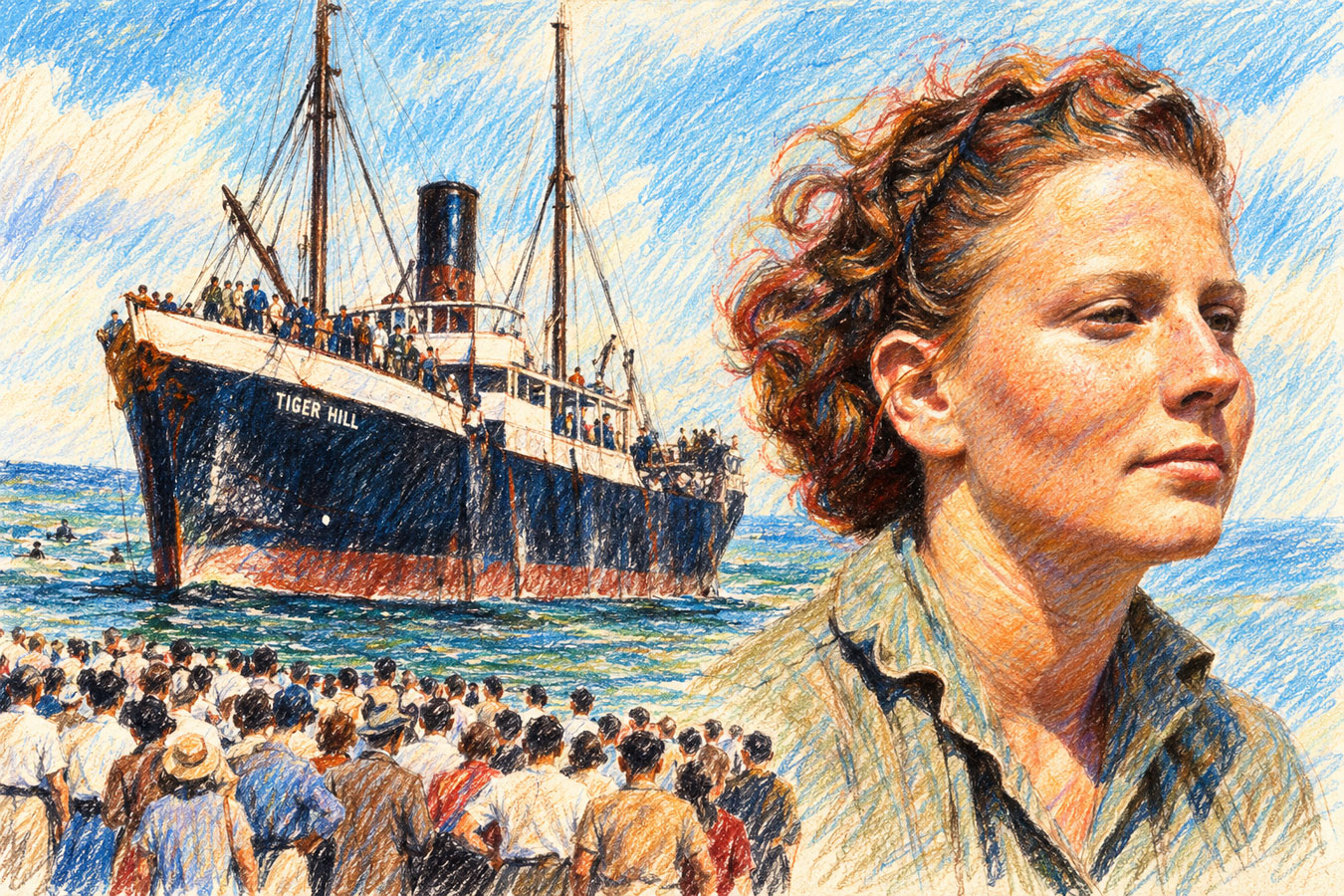
In the summer of 1939, a train with Polish Jews was under guard in Romanian Constanța. These people were supposed to transfer to the Tiger Hill — an old steamship prepared for an illegal voyage to Eretz Israel. But the Romanian authorities received orders to stop further dispatch of such groups, and the train was placed on a guarded track.
One of the organizers of the operation was not going to put up with this.
Author: Stas Shifer
Her name was Ruth Kluger. With the support of Bucharest Jewish banker Gheorghe Mandel, she pushed her way to people who could change the decision: to high-ranking officials, the entourage of King Carol II, and Foreign Minister Grigore Gafencu. Historian Jurgen Rover describes how, after Gafencu’s intervention, the ship was finally allowed to set sail. Another source dedicated to the Jews of Bessarabia also records the joint work of Ruth and Yosef Bar-Pal and her personal appeal to Gafencu regarding the detained refugees.
A few weeks later, Tiger Hill would be off the coast of Tel Aviv. British forces would open fire. Two people would die.
But the story of the woman who reached the Romanian king for the sake of a ship with Jewish refugees did not begin in Romania.
It began in Kyiv.
Before Kluger and Aliav, she was Ruth Polishuk
According to the most detailed version of her biography today, Ruth Polishuk was born on April 27, 1910, in Kyiv, then part of the Russian Empire. She was the youngest of eight children in a Jewish family. Her father, a horse trader, left shortly after her birth, and Ruth effectively grew up without him.
Old directories mention the year 1914, and notes to her biography record several other options. But the Chernivtsi Museum of the History and Culture of Bukovina Jews and the modern Hebrew biography use the date April 27, 1910, and Kyiv.
For our section “Jews from Ukraine“, this is not a formal line “place of birth”. The first approximately two decades of Ruth’s life are associated with several territories of modern Ukraine: Kyiv, Podolia, and Chernivtsi.
Even before the start of World War I, little Ruth was sent to her grandmother and her mother’s sisters. By the summer of 1914, she was already living with them in one of the Jewish shtetls near Kamianets-Podilskyi, then the administrative center of the Podolia Governorate of the Russian Empire. The name of this shtetl is not reported in biographical sources. Within a few dozen kilometers of Kamianets were large Jewish communities of Zhvanets, Orynyn, Kytayhorod, Balin, Smotrych, and Dunaivtsi.
At the same time, Kamianets-Podilskyi itself was a major Jewish center of Podolia. In 1910, about 22.3 thousand Jews lived in the city — about 47% of the total population. There were dozens of synagogues and prayer houses, Jewish schools, charitable institutions, and a hospital.
When World War I began in 1914, four-year-old Ruth was with her grandmother and maternal aunts in one of the Jewish shtetls near Kamianets-Podilskyi. Its name is not mentioned in known biographies. Possible options include Orynyn and Zhvanets: both were located about 15–20 kilometers from Kamianets and had large Jewish communities. However, no direct document linking Ruth’s family to one of these shtetls has been found yet.
A regular trip to relatives turned into a long separation from her mother, brothers, and sisters. Due to the war, Ruth could not return to Kyiv and, along with her aunts, moved from place to place in the following years, while the Russian Empire collapsed around them, borders and power changed. Biographies mention the anti-Jewish violence seen by the child during those years; in Orynyn, for example, anti-Jewish demonstrations were documented as early as 1914, and later — pogroms of 1919–1920. But there is no basis to assert that Ruth was there.
About seven years later, the family reunited in Chernivtsi. These seven years were not a road from Kamianets to Chernivtsi, but a time of separation, war, and multiple relocations. Ruth learned very early what it means to be caught between war, changing borders, and a road that suddenly closes.
Two decades later, she would be opening such roads for others.
Chernivtsi: the city where the future participant of Aliyah Bet was formed
The Chernivtsi Museum dates Ruth’s reunion with her family to 1918. The Hebrew biography speaks of seven years of separation, which rather leads to the early 1920s. It is difficult to determine the exact date today, but both versions agree on one thing: after her childhood wanderings, Ruth ended up with her mother, brothers, and sisters in Chernivtsi.
For an Israeli reader, it is easy to get lost on the map here. Today, Chernivtsi is a regional center in western Ukraine. But after the collapse of Austria-Hungary, Bukovina became part of Romania, and in Ruth’s youth, the city was called Cernăuți. It was not a provincial episode of her biography but one of the largest Jewish cultural centers in Eastern Europe.
Ruth finished primary school and secondary school here — in sources, it is usually called a gymnasium. The name of the specific educational institution has not yet been established, and attributing her to one of the well-known Chernivtsi gymnasiums would be incorrect.
It is much better known what she did outside of school.
In Chernivtsi, Ruth joined “Ha-Shomer Ha-Tzair” — Hashomer Hatzair. For a modern Israeli, the name is familiar, but in 1920s Bukovina, it meant much more than an ordinary youth movement. The Chernivtsi organization grew out of groups of Jewish teenagers who returned from Vienna after World War I. Already in 1918, they began creating the first groups of the future Hashomer Hatzair in the city, holding meetings, learning Hebrew, discussing Zionism and Eretz Israel.
By 1923, the Bukovina center had united with groups from Bessarabia. In 1924, the movement became part of the worldwide structure of Hashomer Hatzair, with the Romanian organization, in which Chernivtsi played a significant role, considered one of the largest. In the city itself, hakhshara groups appeared — practical training for young Zionists for aliyah and future life in Eretz Israel. One of them bore the name Yosef Trumpeldor and consciously switched to Hebrew in everyday life even before departure.
There is no basis to assert that Ruth was part of this group. But this was her environment.
Therefore, Ruth Polishuk’s road to the future Israel did not begin in a Romanian port or on the deck of Tiger Hill. It began in Chernivtsi — among Jewish youth for whom aliyah was not a beautiful slogan but a plan for their own lives.
Seven languages, eight or nine — and why Chernivtsi is more important than the number
Later, Ruth’s ability to talk to almost anyone would become one of the reasons for her success in underground work.
The Hebrew biography lists seven languages she spoke: Russian, Yiddish, German, Romanian, English, Spanish, and Hebrew. Later, she learned Portuguese. The Chernivtsi Museum provides a broader list of nine, adding French and counting Portuguese among the main languages.
Here, the interest is not in the debate over the number but in the origin of this ability.
Jewish Chernivtsi lived in several linguistic spaces at once. Even after Bukovina came under Romanian rule, German remained an important language of the city’s Jewish culture; simultaneously, there was the Romanian state environment, Ukrainian, Yiddish, Hebrew, and the languages of families who came from the former Russian Empire. In the history of Bukovina’s Hashomer Hatzair, it is directly noted that German remained the everyday language of its participants for a long time, alongside the persistent study of Hebrew.
Ruth grew up within this multilingualism. Later, it would become a practical tool: with one person, she would need to speak as with an official, with another — as with a banker, with a third — as with a ship’s captain, and sometimes switch between several countries and several political worlds in one day.
Vienna, law, and aliyah
After finishing school in Chernivtsi, probably in the late 1920s, Ruth went to Vienna, where she began studying law. The exact years of her studies are not specified in the found biographical sources, so tying her admission to a specific year would be incorrect.
Old encyclopedias contain the wording that Ruth graduated from the Faculty of Law of the University of Vienna. However, modern Israeli biographies clarify: she completed a significant part of her studies but left Austria before completing her final work. Therefore, it is more correct to say that Ruth studied law in Vienna but did not formally complete her university education.
For her further biography, the question of a diploma is not the only important one. To the multilingual environment of Chernivtsi were added legal training, life in a European capital, and another experience of existing between different cultural and political worlds.
By 1934, Ruth was still in Europe. That year she married Emanuel Kluger. A year later, in 1935, the couple made aliyah to the British Mandate “Palestine” and settled in Mishmar HaEmek — a kibbutz of the Hashomer Hatzair movement in the north of the country.
For Ruth, this was a logical route. Already in Chernivtsi, she entered the Hashomer Hatzair environment, where aliyah and life in Eretz Israel were not an abstract idea but part of the practical preparation of young Zionists. Now what was discussed in the Chernivtsi youth groups became her own life.
The first years were difficult. Ruth and Emanuel’s first child died of meningitis at an early age. Ruth found it hard to adapt to kibbutz life, and already in 1936, she moved to Tel Aviv, where she began working in the foreign relations department of Histadrut — the General Federation of Jewish Workers in Eretz Israel, one of the key institutions of the Yishuv before the creation of the state.
This work turned out to be more important for her than it might have seemed from the outside. To the multilingual environment of Chernivtsi and the legal training of Vienna were added international contacts, negotiations, and constant communication with people from different countries. It was this set of skills that would soon make Ruth especially valuable to those involved in illegal aliyah.
By this time, the Ukrainian period of her life had already ended geographically. But Chernivtsi continued to be part of her biography: it was there that Ruth came to the Zionist movement, learned to exist between several languages and cultures, and first linked her own future with Eretz Israel.
The next turn in her life would again be connected with Romania — but first not at all as it would happen in the summer of 1939.
Sixteen people in sailor uniforms
During this period, Ruth’s biography first mentions a trip to Romania. What exactly brought her there, available biographical sources do not specify. Therefore, linking this trip to a specific assignment from Histadrut or future work in “Mossad le-Aliyah Bet” would be incorrect.
It is known that on the way back from Romania, Ruth met 16 Polish Jews in one of the Greek ports. They were trying to get to Eretz Israel but did not have the necessary certificates, documents, and money.
There was no pre-prepared operation. Kluger began to act on her own.
She collected money from first-class passengers and even from Greek Orthodox priests. Then she made arrangements with two officers of the ship.
Sixteen people were dressed as sailors. Among them were four girls — they had to cut their hair short. At night, the group was brought onto the ship and hidden in a free first-class cabin.
For these sixteen people, the improvised operation meant the opportunity to continue their journey to Eretz Israel. For Ruth herself, it became the moment when all the skills acquired earlier unexpectedly converged at one point: languages, negotiations, the ability to quickly find money and the right people, and act where there was simply no official solution.
When Eliyahu Golomb and Berl Katznelson, already familiar with Ruth from work in Histadrut, learned about this story, it became clear that her abilities would be useful for much larger operations.
And this was happening at a time when such people were becoming especially needed.
After Kristallnacht in 1938, the danger for Jews in Germany and Austria sharply increased. At the same time, in May 1939, Britain established a new immigration policy for the British Mandate “Palestine”: about 75,000 Jewish immigrants over the next five years, after which further Jewish immigration was to depend on the consent of the Arab population. The document separately provided for the fight against illegal immigration.
The number of European Jews who needed a way out of Europe was growing precisely when legal opportunities to reach Eretz Israel were shrinking.
One of the Yishuv’s responses was Aliyah Bet — illegal, from the point of view of the British authorities, transportation of Jews to the British Mandate “Palestine”. The coordination of these operations was handled by the “Haganah” structure “Mossad le-Aliyah Bet”, led by Shaul Avigur.
This is not the current Israeli “Mossad”. We are talking about another, earlier organization created to bypass British immigration restrictions. USHMM dates the systematic coordination of its operations to 1938.
In June 1939, Ruth joined “Mossad le-Aliyah Bet”. She became the tenth member of the organization and the only woman in its then team.
And now Romania appeared in her life in a completely different capacity.
Ruth was sent there with a specific task to organize illegal aliyah. Her knowledge of the country and the Romanian language was especially useful. In Romania, Yosef Bar-Pal was already working, with whom she was to organize the dispatch of refugees.
Officially, Kluger represented Keren Kayemet LeIsrael. In fact, her work looked different: raising money, finding ships, establishing contacts, obtaining permits for Jewish refugees to enter Romania, and then — permits for ships to leave Romanian ports.
What began in a Greek port as a spontaneous attempt to help sixteen people now turned into systematic work, where it was already about hundreds of human lives.
NANews — News of Israel | Nikk.Agency has already analyzed how deep the Ukrainian trace turned out to be in the history of Israeli intelligence services. Ruth is important here also because her activities relate to the earlier world of underground structures of the Yishuv, from which later the state institutions of Israel would grow.
Jews from Ukraine: how immigrants from Ukraine formed the “Mossad”
Romania: train, banker, minister, and king
So Ruth found herself in Romania again. Only now she came there as a participant in “Mossad le-Aliyah Bet”.
Together with her worked Yosef Bar-Pal, and one of the financial supports was the Bucharest Jewish banker Gheorghe Mandel. For the next operation, an old Greek steamship was chartered, named Tiger Hill.
Initially, small groups from Bulgaria, the Baltics, and Germany boarded. Then a train with about five hundred chalutzim — young Zionists preparing for aliyah — was sent from Poland.
The Romanian authorities tried to stop it at the border. Kluger managed to get the train further, but in Constanța, the train was placed on a guarded track.
Hundreds of people found themselves very close to the ship that was supposed to take them out of Europe, but they could not get on it.
The very cabinet war began, with which this story opens.
With the support of Gheorghe Mandel, Ruth reached the highest echelons of Romanian power and the entourage of King Carol II. Foreign Minister Grigore Gafencu intervened.
Permission was obtained.
Tiger Hill left Romania with approximately 729 people on board.
But this is not the final number.
At the end of August, the ship approached Beirut and took on passengers from another refugee ship — Frossoula, stranded off the Lebanese coast. After loading people, Tiger Hill was overcrowded.
That is why different sources cite different final numbers: the Israeli biography speaks of 1,417 passengers, while the official report of the American Consul General in Jerusalem records 1,205 people on board when the ship was off the coast of Tel Aviv.
On September 1, 1939, Germany attacked Poland. World War II began. On the same day, Tiger Hill was already near Tel Aviv.
To the shore, for which Ruth fought through the offices of Romanian officials, there were only a few kilometers left.
The American diplomatic document records that on September 2, the ship was grounded near Tel Aviv, British authorities opened fire, and two passengers were killed.
Their names have been preserved: Zvi Binder, a member of the “Chalutz” movement from Poland, and Dr. Robert Schneider from Czechoslovakia, who, according to a passenger, tried to help the wounded.
Residents of Tel Aviv gathered on the shore. Some of the arrivals managed to escape and blend into the crowd. One of the passengers recalled about 300 people who managed to leave and about approximately 1,200 detained, sent to Sarafand.
On September 11, they were released.
The numbers of this testimony do not fully match the diplomatic statistics, but the sequence of events matches: landing, an attempt to hide some people, mass detention, and subsequent release.
The operation, which began with a detained train in Romania and negotiations in royal offices, ended on the shore of the future Israel.
Chernivtsi appeared in her life again
There is a detail that makes this story especially fitting for the section “Jews from Ukraine”.
While working in Romania in 1939–1941, Ruth met her own brothers, their wives, aunts from Chernivtsi and Vienna, as well as her youthful love and his family from Chernivtsi.
Now she was persuading them to board ships while such an opportunity still existed.
Once, the war cut off little Ruth Polishuk from her Kyiv family and led her through Podolia to Chernivtsi. Now adult Ruth Kluger was trying to get people out of Europe from the very world in which she grew up.
Chernivtsi returned to her life not as a city of youth, but as the faces of people she knew and whom she was now trying to open a road out of Europe.
This is not the only Ukrainian-Israeli maritime story of those years. In our section, we have already told about Aryeh Grevnov from Ichnia, who in 1933 raised the blue and white flag with the Magen David over his own ship.
Jews from Ukraine: Aryeh Grevnov and the Jewish flag over the sea
After Tiger Hill were Hilda and Darien II
Tiger Hill was not the culmination of Kluger’s career. Rather, it was the moment when the scale of her work became especially noticeable.
In December 1939, the operation Hilda began. The ship was long blocked in Bulgarian Balchik. Conditions on board were becoming increasingly difficult, passengers were exhausted, and there was a conflict with the crew and local authorities.
Ruth again had to deal with not one specific task, but everything at once. She managed to obtain new supplies and even arranged for people to wash in an abandoned hammam at the palace of Romanian Queen Maria.
After new delays, Hilda reached Eretz Israel on January 23, 1940; the men among the passengers were sent by the British authorities to the Atlit camp.
In the same 1940, Ruth divorced Emanuel Kluger.
By the end of 1940, the situation in Romania became too dangerous for Kluger herself. She moved to Istanbul but did not stop working.
The next big story was Darien II, related to Jewish refugees stranded in Yugoslav Kladovo and Šabac.
On February 19, 1941, Darien II departed from Romanian ports, passed through Varna, and eventually reached Haifa with almost 800 people. Among them were 70 survivors from the sinking of another refugee ship — Salvador.
The same Kladovo–Šabac refugees who could not be evacuated were later killed during the Holocaust.
A heavy conflict arose around Darien II within the Yishuv itself: the leadership of the Haganah wanted to use the ship in cooperation with the British for military tasks against Germany, while the people of Mossad LeAliyah Bet, including Kluger, insisted on rescuing the refugees.
This dispute later became known as the “Darien Dilemma”.
Egypt, France, and liberated Europe
By 1943, Ruth found herself in Egypt as a representative of Mossad LeAliyah Bet and the Jewish Agency. Officially, she was engaged in fundraising for soldiers of the Jewish units of the British army; simultaneously, she sought ways to evacuate Jews from Egypt, Syria, and Lebanon, sources of weapons for the Haganah, and contacts with allies, including representatives of “Free France” under Charles de Gaulle.
In 1944, Ben-Gurion sent her to France as one of the first representatives of the Yishuv.
After the liberation of the camps, Kluger entered a world for which her previous experience with secret ships was only preparation: displaced persons camps, searching for Jewish children hidden during the war, negotiations with military administrations.
She visited Bergen-Belsen a week after its liberation, participated in organizing a Passover Seder for approximately four thousand children, including survivors of Buchenwald, and helped search for children who had been hidden during the war.
In 1945, after meeting with General Dwight Eisenhower, American Colonel Ernest Witte gave her the opportunity to use the transport ship Ascania to transport approximately 2,500 Jewish refugees.
In the memoir-biographical tradition, this episode is also described as Kluger receiving an honorary colonel status, allowing her to issue necessary orders. The Americans did not allow a repeat voyage due to British pressure.
The scale changed, but the principle of her work remained the same as it once was in the Greek port: to find an opportunity where officially there was almost none.
The state that did not yet exist finally appeared
In 1947, Ruth returned to Eretz Israel, but not for long. In early 1948, she was sent to raise funds in South America for the future state and its defense.
On May 14, 1948, the day the State of Israel was proclaimed, she was in the United States.
For a woman who had been sending ships to the shores of a country that legally did not yet exist for years, this day marked the end of one era and the beginning of another.
Around that time, the name by which she is most often remembered in Israel today appeared in her life — Aliav. JTA wrote that David Ben-Gurion suggested she take this surname because of her many years of work in Aliyah Bet. Encyclopaedia Judaica directly associates “Aliav” with the name of this underground aliyah.
In early 1949, she returned to Israel and joined ZIM. She organized and led the Jerusalem office of the company until 1955, then established ZIM representations in South America, represented the company in East Asia and Australia, and from 1958–1972 headed the public relations department.
For her work during the war, Ruth received the French Cross of Lorraine and the Legion of Honor. In 1974, the National Council of Jewish Women of the USA named her Woman of the Year.
Her memoirs, written with Peggy Mann, were published in English in 1973 under the title The Last Escape. Later, the book The Secret Ship, dedicated to the story of Hilda, appeared.
She adopted and raised two children who survived the Holocaust.
Ruth Kluger-Aliav died on February 16, 1980, and was buried in Mishmar HaEmek — the very kibbutz where she arrived at the beginning of her life in Eretz Israel.
From Kyiv to Tel Aviv
In Israeli history, she can be described in various ways: an activist of Aliyah Bet, a representative of the Yishuv in Europe, an organizer of refugee ships, an employee of ZIM.
But in the history of Jews from Ukraine, her path begins earlier than all these positions.
First, there was Ruth Polishuk from Kyiv. Then — a child with relatives near Kamianets-Podilskyi. Then — Chernivtsi, school, gymnasium, German and Yiddish around, Hebrew in Hashomer Hatzair, and conversations about the land yet to be reached.
From Chernivtsi, she went to Vienna. From Vienna — to Eretz Israel.
And then the road turned back.
First, there was a trip to Romania, the purpose of which biographical sources do not explain, and a chance meeting on the way back with sixteen Polish Jews in a Greek port. Then — joining Mossad LeAliyah Bet and a new trip to Romania, now with a specific mission: to evacuate hundreds of people from Europe, find ships, money, and permits for them, argue with officials, and reach ministers and the royal entourage.
In 1939, the former Kyiv girl was seeking permission from the Romanian authorities to evacuate Tiger Hill. In the same year, the ship reached the shores of Tel Aviv, and the people for whom negotiations were held set foot on the land of a country that did not yet exist.
Nine years later, the State of Israel appeared.
And a little later, the name of the cause to which Ruth dedicated years of her life became part of her own name — Ruth Kluger-Aliav.
For Ruth, Ukraine is not just a formal line ‘place of birth’. The first approximately two decades of her life are connected with several territories of modern Ukraine: Kyiv, Podolia, and Chernivtsi. It is precisely such fates — of people whose journey began in Ukraine and continued in the history of Israel — that we collect in the section “Jews from Ukraine”.
In the Ukrainian Wikipedia, there is a separate article about Ruth Kluger-Aliav.
