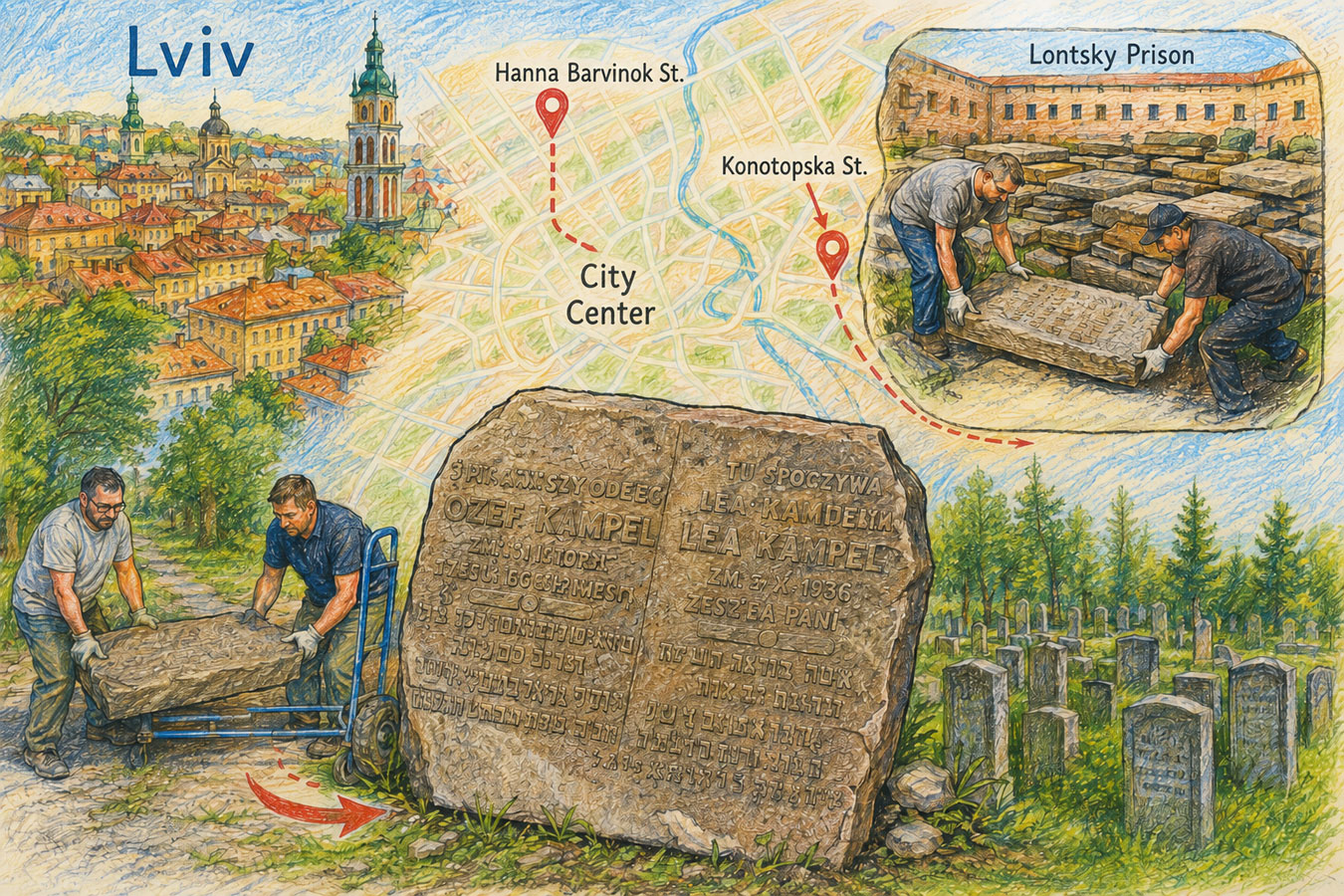
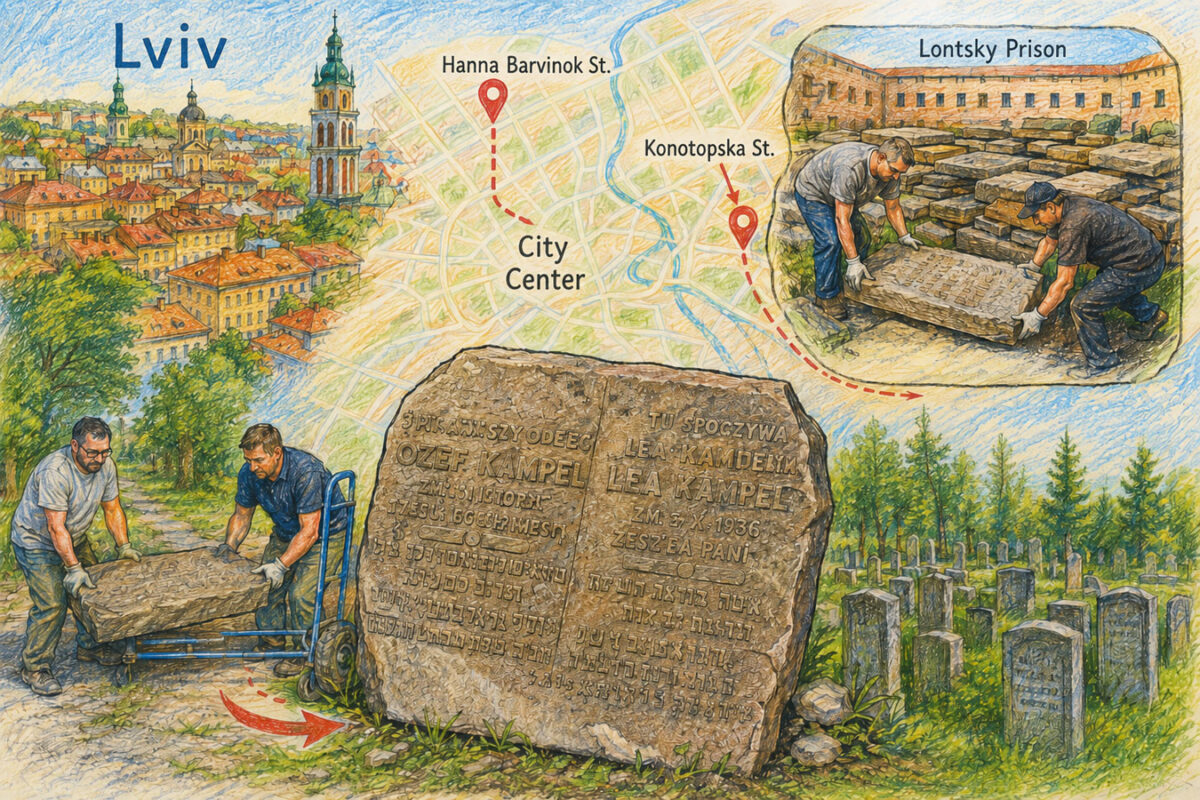
In Lviv, a Jewish tombstone was found, which after discovery was transported and returned to the territory of the Jewish cemetery. Residents of the city joined in the rescue of the matzevah. The Lviv Volunteer Center separately thanked Julian Lahun and Andriy Lahun for their help in preserving Jewish heritage.
This was reported on August 7, 2026, by the Federation of Jewish Communities of Ukraine. Its message is the original source of this publication.
The news could have ended with one line: they found an old Jewish tombstone and returned it to where it belongs.
But in Lviv, one found matzevah is almost never the story of just one stone.
Under roads, in courtyards, retaining walls, and other city structures, tombstones from destroyed Jewish cemeteries still remain. Sometimes names can still be read on them. Sometimes dates. Sometimes the place of birth, the name of the father or husband.
And then from under the asphalt, they return not just a stone.
They return a person.
For this material, NAnews — News of Israel compared the current message from the Federation of Jewish Communities of Ukraine with the open database Jewish Stones UA, materials from the Lviv Volunteer Center, and documented previous operations to return Lviv’s matzevot. The author of the material, Alexander Khmelnitsky, is responsible for the editorial conclusions. However, the publication is not an epigraphic or archaeological examination of the specific found slab: NAnews did not decipher its inscription independently and does not establish its origin without documentary confirmation.
What is known about the matzevah found now — and what we do not yet know
According to the message from the Federation of Jewish Communities of Ukraine, the tombstone was discovered in Lviv, after which it was transported to the territory of the Jewish cemetery.
Residents of the city helped in this work. The Lviv Volunteer Center thanked Julian Lahun and Andriy Lahun.
At the time of the editorial check on August 7, 2026, in the original message available to NAnews, the exact location of the find, the name of the person on the tombstone, the date of death, and the original place of installation of this matzevah are not named.
This is fundamentally important.
We will not write that this particular slab was removed from the cemetery by the German occupiers. Nor will we claim that it was used as building material by the Soviet authorities.
Both practices in Lviv are documented. But the history of a specific matzevah must be confirmed separately.
If a readable epitaph has been preserved, the next question is much more interesting than the mere fact of the find: whose grave is this?
Why Jewish tombstones ended up under Lviv
Before World War II, there were four large Jewish cemeteries within Lviv and its then suburbs.
The oldest was located west of the historical center. The first documentary mention dates back to 1414, although the cemetery may have existed even earlier. By the official closure in 1855, there were, according to researchers, 25–30 thousand graves on an area of about three hectares.
During the German occupation, the cemetery was systematically destroyed, and the tombstones were used as building material.
A particularly terrible testimony remained in the report of the head of the SS and police of the Galicia district, Friedrich Katzmann, in 1943. The document, next to a photograph of the Lviv Jewish cemetery, reported receiving approximately 2000 cubic meters of building material from the Jewish cemetery in Lemberg — as the occupation authorities called Lviv.
After the end of the war, the process did not stop.
Jewish Stones UA indicates that the Soviet authorities removed the remaining matzevot and used them for paving streets, squares, and courtyards of public buildings, as well as for constructing retaining walls. In 1947, the Krakiv Market appeared on the land of the old Jewish cemetery.
Thus, the stone on which the family paid the master for the name of the deceased and the prayer formula became road material.
This detail is important because it explains the current finds: most of the matzevot removed then did not disappear anywhere.
They remained within the city.
New cemetery: the likely source of many found matzevot
After the closure of the old cemetery in 1855, a new Jewish cemetery was opened at the western end of the current Zolota Street, next to Yanivsky.
It was also heavily destroyed during the years of German occupation. Thousands of tombstones were toppled, removed, and reused.
Researchers of Jewish Stones UA believe that many matzevot found under Lviv streets and inside walls in recent years were likely removed from here. This is indicated, in particular, by the dates on the found slabs — often the first decades of the 20th century.
But here again, the boundary of proof is important: this is a conclusion regarding the array of finds, not the established biography of that specific matzevah reported by the Federation now.
“The whole street is made of matzevot”
The scale of the problem became especially noticeable in the summer of 2018 on Hanna Barvinok Street.
During roadworks, Jewish tombstones were discovered under the asphalt.
Residents of the area knew about them before: during previous utility works, individual slabs had already appeared from the ground. When the road surface was opened again, the information reached the Lviv Volunteer Center.
The head of the center, Sasha Nazar, then described what he saw very simply:
“The whole street is made of matzevot.”
At first, the stones were removed manually. Shovels, crowbars, lifting straps, and jackhammers were used. Some tombstones weighed more than 300 kilograms. Then, thanks to collected donations, it was possible to attract heavy road equipment and a truck.
During the operation, volunteers extracted 125 whole tombstones and large fragments and transported them to the new Jewish cemetery in Lviv.
Initial media reports featured smaller preliminary estimates — about a hundred slabs. This is not a contradiction: the count continued as the stones were extracted, and the final documented result of the project was 125 tombstones and large fragments.
And this is a good example of why NAnews distinguishes between operational figures and the final result of the work.
The stone from under the road became the grave of Chaim Salomon Davidman again
Here appears the human layer, without which the history of matzevot turns into mere statistics.
In the Jewish Stones UA database, there is a tombstone with the number LVN010.
Once it lay under the asphalt of Barvinok Street.
The slab preserved a Polish inscription:
CHAIM SALOMON DAWIDMAN.
From it, researchers established that Chaim Salomon Davidman was born in 1855 in Ozimina and died on May 15, 1936.
While the stone was under the street, it split into two parts. But both main halves were found together and returned to the Jewish cemetery.
And here the meaning of all this work changes.
One could write: one of 125 slabs was extracted from under a Lviv street.
Or one could write differently:
the grave of Chaim Salomon Davidman, a man who lived about 80 years and died in the spring of 1936, was extracted from under a Lviv street.
Before the Holocaust.
Before the destruction of the Lviv Jewish world.
Before his tombstone was turned into part of the road.
This is no longer “old building material.”
This is a name.
Another woman returned from under the asphalt: Reizel Weinreb
There are also more detailed epitaphs.
The matzevah LVN029, also raised from Barvinok Street, belonged to a woman named Frima Reizel, daughter of Shimshon Weinreb.
The preserved text also mentions her husband’s name — Yosef Grosstern. The slab also indicates that Reizel Weinreb was from Busk. The upper part of the tombstone is lost, but most of the text is preserved.
For a casual passerby, this is a stone slab.
For a descendant of the Weinreb, Grosstern family, or a person researching Jews from Busk and Lviv, this is already a genealogical document.
This is where a direct connection with Israel arises.
Why Israel is relevant
A huge number of descendants of Galician Jews today live outside Ukraine — including in Israel.
After the Holocaust, the family history of many lineages survived fragmentarily: the grandfather’s surname, the name of the town, a few photographs, a story about relatives “from Lviv” or “from Galicia.”
A found matzevah can sometimes add a specific date, father’s name, spouse’s name, place of origin, or a variant of the surname spelling to this.
And this is not a theoretical possibility.
The Jewish Stones UA project specifically creates digital records of found tombstones. The database allows for recording almost 30 characteristics of one stone, including the location of the find, photographs, condition, name, dates, and epitaph texts. Inscriptions are transcribed and translated, and volunteers from Ukraine, Israel, and the USA participate in the work. The project exists in Ukrainian and English, with the English version directly aimed at descendants of families from Western Ukraine living around the world.
Therefore, for an Israeli whose family comes from Lviv, Busk, Rohatyn, Drohobych, or other cities of former Galicia, such a database may not be just a historical site.
It is another place to check one’s surname.
NAnews — News of Israel has already thoroughly examined how Jewish matzevot of Ukraine are arranged, what the inscriptions and symbols mean, and what information they can preserve. The previous material by Alexander Khmelnitsky “Matzevot as a Code of Memory: How Forgotten Jewish Heritage of Ukraine Comes to Life” is available here: NAnews material on matzevot and Jewish cemeteries of Ukraine. The current find in Lviv effectively continues this topic already on the example of one specific returned tombstone.
About 50 fragments were found right in the wall
Barvinok Street was not an exception.
In February 2020, the Lviv Volunteer Center extracted about 50 fragments of Jewish tombstones from a retaining wall behind a residential building on the neighboring Konotopska Street.
In April and June 2021, new fragments were found near the buildings and the botanical garden of the National Forestry University on Pryrodna Street.
Jewish Stones UA writes directly: the exact location of the overwhelming majority of removed Lviv matzevot is unknown. Many are likely still under the roads and buildings of the city.
Therefore, the current single find does not seem accidental.
On the contrary, it shows that this process is far from over.
More than 350 matzevot under the courtyard of the “Prison on Lontskoho”
The most extensive of recent stories occurred in a place with its own heavy history — on the territory of the former “Prison on Lontskoho”.
In 2020, during excavations, an extensive layer of Jewish tombstones was discovered under the courtyard covering.
The extracted slabs could not be immediately transported. Access was complicated by the COVID-19 pandemic, the regime of the object, and after the start of the full-scale Russian invasion of Ukraine — security requirements.
Only five years later was it possible to complete the return.
In July 2025, Sasha Nazar organized the transportation of the collected matzevot to the new Jewish cemetery in Lviv. Currently, the Jewish Stones UA database documents more than 350 tombstones and fragments from this complex.
But physical transportation is only the first stage.
The stones are photographed in good lighting. Then specialists and volunteers work with the epitaphs: they transcribe the text in Hebrew, translate it into Ukrainian and English, compare dates and names, and then create a separate digital card.
Thus, a pile of stone gradually turns into a database of people.
What to do if a similar matzevah is found in Lviv
This story also has a quite practical conclusion.
Jewish Stones UA notes that new finds often begin the same way: a tombstone is noticed by an ordinary passerby or resident during repairs, earthworks, or dismantling. After that, the information is passed on to people engaged in preserving Jewish heritage; in Lviv, such operations have been carried out for many years by Sasha Nazar and the Lviv Volunteer Center.
If you see a stone slab with inscriptions in Hebrew or characteristic Jewish burial symbolism:
- photograph it and the location before moving it;
- save the exact geolocation or address;
- do not attempt to clean the old inscription with aggressive chemicals or mechanically scrape the surface;
- report the find to specialists or the Lviv Volunteer Center so that the slab can be recorded and safely returned.
And if your family comes from pre-war Lviv or other cities of Western Ukraine, it makes sense to check the surname in the Jewish Stones UA database: a matzevah once found under the road may already be digitized there.
Why is this important for modern Ukraine
There is another fundamental layer in this story.
The Nazi occupation regime used Jewish tombstones as building material in the process of destroying the Jewish community of Lviv itself. After the war, the Soviet system continued the destruction of cemeteries and the reuse of stone in urban infrastructure.
Today, the reverse process is happening.
A resident notices a slab.
Another helps to transport it.
Volunteers pull the stone out of the wall.
People photograph the epitaph.
Someone reads Hebrew.
Another translates the text.
And the name returns to the public space of Ukraine.
This does not correct what was done and does not restore the destroyed pre-war community. But the attitude towards the same stone changes fundamentally: from building material, it once again becomes a human tombstone.
And that is why gratitude to Julian Lagun and Andrey Lagun in the current message has more meaning than it seems.
They did not pass by.
Sometimes the preservation of historical memory begins precisely with this.
The current matzevah still has no name
But the specific story with which this publication began remains unfinished.
We know that a Jewish tombstone was found in Lviv.
We know that the city’s residents helped preserve it.
We know that it has already been returned to the territory of the Jewish cemetery.
But we still do not know the most important thing:
to whom it belonged.
If the inscription is preserved and can be read, the next news may sound completely different.
Not “another matzevah was found in Lviv.”
But:
in Lviv, after decades, the grave of a specific person was found and their name was returned.
Chaim Salomon Davidman has already gone through this path — from a slab under asphalt to a record in an open database.
Reizel Weinreb too.
Now somewhere in the Lviv Jewish cemetery lies another returned stone.
Perhaps, on it, the name can still be read.
And then the story only begins.
Sources and editorial transparency
The original message about the current find: Federation of Jewish Communities of Ukraine — Федерация еврейских общин Украины, material “У Львові знайдений єврейський надгробок повернули на єврейський цвинтар”, submitted for editorial work for this publication.
For historical and documentary context, materials from Jewish Stones UA, a joint project of the Sholem Aleichem Jewish Cultural Society of Lviv and Rohatyn Jewish Heritage; materials from the Lviv Volunteer Center; research on the restoration of matzevot from Barvinok Street A Guide to Jewish Cemetery Preservation in Western Ukraine; archival materials from Jewish Heritage Europe were used.
Information verified by the editorial team from open sources on August 7, 2026.
NAnews separately distinguishes established facts and assumptions. The origin of the currently found matzevah, its original installation place, and the name of the person on it at the time of publication are not established in the data available to the editorial team.