
On November 8, 2026, the Israeli economic newspaper TheMarker published an article about a sharp increase in the number of companies with Israeli owners in Russia. The headline links this growth to profits from sanctions imposed after the Russian invasion of Ukraine. The subheading already talks about entrepreneurs who could take advantage of opportunities to bypass restrictions, and about the damage to Israel’s international reputation.
Pavel Shveiko | NANews
The numbers look impressive: 203 companies before the start of the full-scale war and 520 almost five years later.
But there is a circumstance to this story without which its meaning changes. The original statistics did not appear on November 8. They were published by the Russian publication “Gazeta-Ru” on September 15, having received information from the Rusprofile service.
In Russia, the story was presented as evidence of ongoing foreign entrepreneurial interest. Now the same data has become the center of the Israeli discussion about sanctions, war, and business responsibility.
The question is not only whether Israeli entrepreneurs have indeed increased their presence in the Russian market. It is equally important to understand who uses this information and for what purpose.
Moscow has two possible political gains.
To the Russian population, it can be shown that foreign companies continue to operate despite Western sanctions.
To the international audience, it can provide material for accusations against Israel of economic cooperation with a state waging war against Ukraine.
Such a mechanism corresponds to the well-known principles of Russian information operations. However, the presence of a single organizer specifically for the story with 520 companies still needs to be proven.
This question becomes especially acute after recent statements by Israel’s ambassador to Moscow, Oded Yosef, who publicly emphasized the “friendly nature” of relations with Russia.
Where did the 520 companies come from
On September 15, journalist Ekaterina Zakaryan published data from the Russian service Rusprofile, which collects and analyzes information about legal entities, on the website of “Gazeta-Ru”.
At the end of 2021, there were 203 active companies with Israeli founders in Russia. As of September 15, 2026, there were 520.
The growth amounted to 317 enterprises, or 156.2%.
But the wording requires clarification. The study takes into account Russian legal entities whose founders are Israeli citizens or organizations registered in Israel. It does not necessarily refer to companies that opened after February 2022, and certainly not to all enterprises directly managed from Israel.
Of the initial 203 organizations, 148 continued their activities. Consequently, 372 current companies were not part of the original group of surviving enterprises. Some may have been registered after the start of the war, some may have existed earlier but later acquired Israeli founders.
Another indicator significantly changes the perception of the scale of the phenomenon.
Israeli participation accounts for only 0.8% of Russian companies with foreign founders. At the end of 2021, this figure was 0.5%.
The main areas of activity are wholesale trade, real estate, software, and scientific research. The publication also mentions cosmetics, medical equipment, agrotechnology, and consulting.
Vadim Zhorov, a representative of the Russian-Israeli Consulting Center, explained the increase in the number of enterprises by “the complexities of international bank transfers from Israel,” especially when working with China and Middle Eastern countries.
According to his version, some entrepreneurs use Russian jurisdiction because “familiar settlement channels” remain there.
This is an explanation from a market participant, but not a proven motive for all company owners. And it certainly does not confirm that all these enterprises participate in bypassing sanctions.
First goal: to show Russians that economic isolation has failed
On the same day, September 15, RTVI published another Rusprofile study — already about all foreign business in Russia.
Its central figure turned out to be much larger than the Israeli one.
Since the end of 2021, the number of Russian companies with foreign founders has grown from 39,301 to 66,802 as of August 26, 2026. The Chinese presence increased especially quickly: from 1,434 to 17,099 companies.
Against the backdrop of the departure of Western corporations, such information allows the Russian audience to be told a convenient story: international restrictions have not led to the country’s complete isolation, and the vacated market niches are being filled by new foreign entrepreneurs.
However, such a presentation hides a significant circumstance.
The presence of a foreign founder does not yet mean a full-fledged foreign investment. A Russian legal entity may belong to a small entrepreneur, engage in intermediary trade, have minimal turnover, or not conduct any activity at all.
The departure of a large technological manufacturer and the registration of several dozen trading intermediaries are not economically equivalent.
Therefore, the growth in the total number of legal entities does not prove the failure of the sanctions policy. Sanctions can restrict access to capital, technology, equipment, and international financial systems, even if the number of local companies with foreign founders is simultaneously increasing.
Nevertheless, for a political message, the contrast itself is enough: Western corporations are leaving, and the number of foreign enterprises is allegedly growing.
Israel is especially convenient in such a construction. It is a US ally with a developed technological economy, which at the same time did not join most Western sanctions against Russia.
The presence of hundreds of enterprises with Israeli participation allows the situation to be presented as if even Washington’s close partners do not consider the Russian market unacceptable.
This possible internal propaganda effect constitutes the first part of our investigative hypothesis.
Second goal: to turn economic statistics into a claim against Israel
For the international audience, the same story takes on the opposite sound.
The September Russian news talked about the increase in the number of companies and the reasons for commercial activity. In the November Israeli publication, the central issue becomes profit from sanctions and reputational damage to the country.
There is a fundamental difference between these approaches.
The assertion that 520 enterprises with Israeli founders operate in Russia is a statistical fact. The assumption that entrepreneurs are using the vacated market niches is a possible economic explanation. And the statement that these companies are profiting from bypassing sanctions requires the establishment of specific deals and violated restrictions.
At the next stage, the danger of collective accusation arises.
Individual entrepreneurs begin to be perceived as representatives of Israel. The activities of Russian legal entities — as the economic policy of the Israeli state. Then such accusations can potentially spread already to Jews regardless of their citizenship and relation to specific deals.
This is an especially dangerous transition. Israeli citizenship of a founder does not determine their ethnic origin or religion. Responsibility for possible sanctions violations lies with specific legal and physical entities, not an entire people.
Journalists at TheMarker have the right to investigate questionable commercial practices of Israeli entrepreneurs.
But the result itself shows how different the political consequences of publishing the same statistics can be.
For Moscow, such a discrepancy is potentially beneficial twice. Inside the country, it helps maintain the perception of a functioning economy. Abroad, it can exacerbate disagreements between Israel, Ukraine, and Western partners.
There is no documentary evidence that this particular chain of publications was planned by Russian structures. Therefore, the question of deliberate coordination remains open — unlike the mechanism itself, which can already be observed.
What happens if you put China, Turkey, and Iran side by side
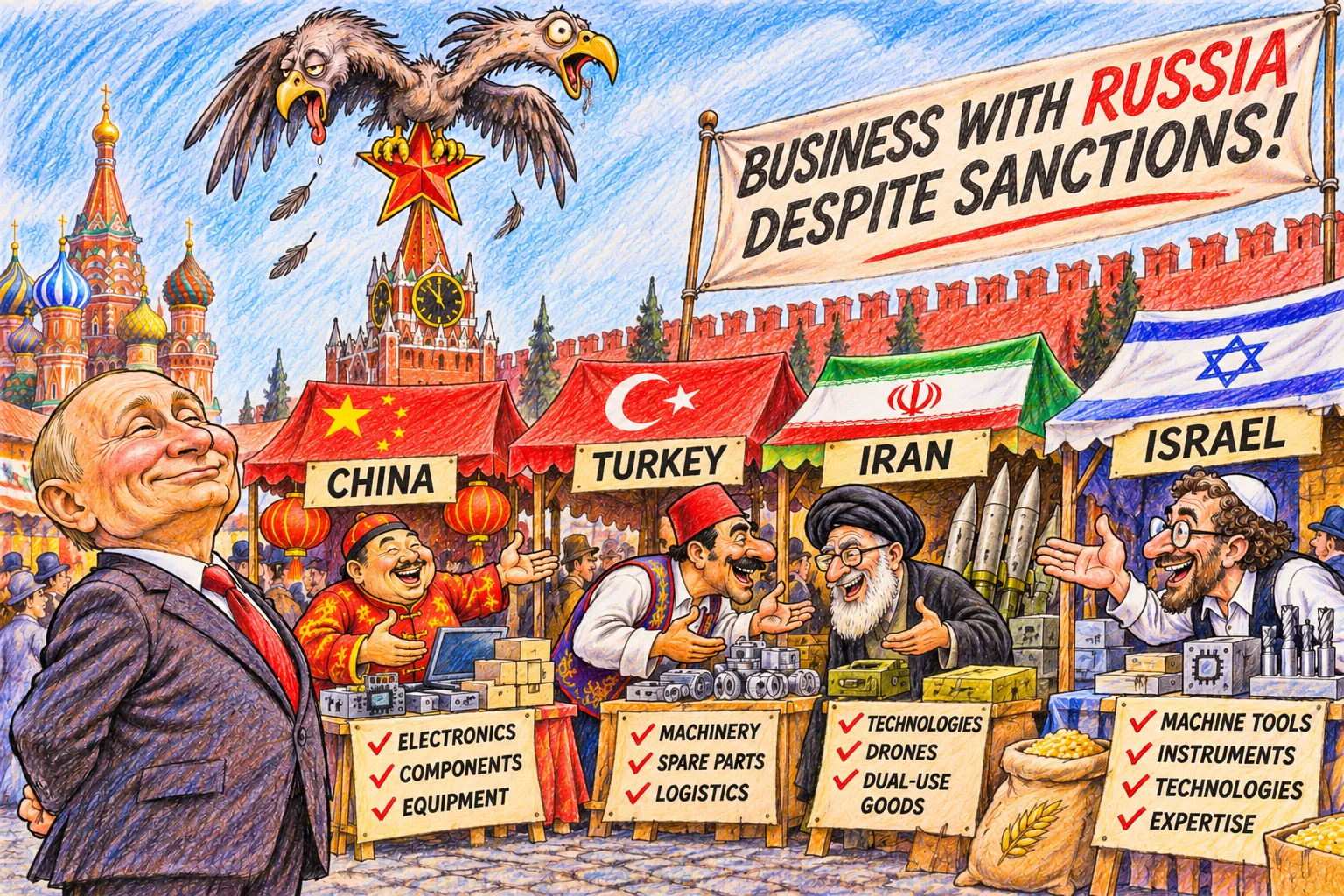
One way to check the political meaning of statistics is to stop considering Israel separately.
According to Rusprofile data published by Russian media in different months of 2026, the picture looks as follows:
| Country of founders | End of 2021 | 2026 |
|---|---|---|
| China | 1 434 | 17 099 |
| Turkey | 568 | 1 608 |
| Iran | 99 | 449 |
| Israel | 203 | 520 |
The Chinese figure is taken from the August RTVI study, the Turkish one from the April material of “Vedomosti”, the Iranian one from the March publication. The Israeli slice refers to September. Due to differences in dates, the data should not be perceived as an absolutely synchronous census, although they all allow assessing the order of magnitude.
The number of companies with Chinese participation increased almost 12 times. With Iranian — 4.5 times, with Turkish — approximately 2.8 times, with Israeli — 2.6 times.
In absolute terms, there are about 33 times more Chinese companies than Israeli ones.
And yet, Chinese presence and Israeli presence are often perceived through completely different political expectations. From China, strategically cooperating with Moscow, no one expects joining Western sanctions. Israel, however, remains a close partner of the US and at the same time a state whose security directly depends on international support.
Such a difference indeed explains the increased interest in Israeli statistics. But it does not negate the need to compare countries.
There is also another figure.
According to UN Comtrade data presented in Israel’s merchandise export statistics to Russia, in 2021 it amounted to about $794 million, and in 2025 — $489 million. For reference, this is approximately 2.53 billion and 1.56 billion shekels respectively at the exchange rate at the beginning of November 2026, without recalculation at historical rates.
Thus, official merchandise exports during this period decreased by about 38.4%, although the number of Russian companies with Israeli founders increased.
There is no contradiction here. A Russian company of an Israeli entrepreneur can trade Chinese goods, rent real estate, or provide services within Russia. Such operations do not necessarily fall into Israel’s export statistics.
But that is precisely why it is unacceptable to turn the increase in the number of companies into a statement about a comparable growth in supplies from Israel.
About the differences in trade statistics methodologies and possible involvement of third countries, NANews previously reported in the material “Hellish sanctions against Russia: what changes for Israel and trade with Moscow”.
Israel’s ambassador in Moscow: what signals does the Russian audience receive
The most inconvenient episode for the Israeli leadership in this story occurred even before the November publication.
On October 23, 2026, Israel’s ambassador to Russia, Oded Yosef, gave a large interview to RTVI.
In the interview, the diplomat characterized Russian-Israeli relations as “friendly,” confirmed the “absence of mutual sanctions,” and spoke positively about “bilateral trade.”
He also expressed confidence that Israel “will continue to attach great importance to relations with Russia” regardless of “changes in domestic politics.”
The ambassador reported on the ongoing import of Russian grain and expressed hope for “organizing a visit of the Israeli Prime Minister to Russia.”
From a diplomatic point of view, maintaining communication channels can be explained by the need to address regional security issues, protect citizens, and avoid direct clashes of interests between the two states.
But public statements by the ambassador do not exist in a vacuum.
When an Israeli diplomat emphasizes friendship, trade, and the absence of sanctions in an interview with a Russian publication, these words can become convenient confirmation of the Russian thesis: the country is not isolated even among US allies.
In such a situation, Russian propaganda does not need to invent statements by an Israeli official. It is enough to quote his own words.
And here the question arises not so much for RTVI journalists as for the Israeli Ministry of Foreign Affairs.
Does the department calculate how its representatives’ statements are used within Russia? Does it assess their consequences for relations with Europe, Ukraine, and other partners? And is there a public strategy to counter Russian information operations aimed at Israeli society?
Without an official response, it cannot be asserted that the ambassador consciously contributes to propaganda. But his statements and their potential informational effect can be verified.
Russia helps Iran. Why does Israeli diplomacy talk about friendship?
In the same interview, Oded Yosef spoke about the threat from Iran and emphasized the importance of economic sanctions as a tool of pressure on Tehran.
It is here that a political contradiction is revealed, which the Israeli government needs to explain.
On the one hand, Israel considers sanctions against Iran an important component of its own security. On the other hand, it maintains a policy of not joining Western sanctions against Russia, which is developing military-technical cooperation with Tehran.
On April 7, 2026, Reuters published a material about a Ukrainian intelligence assessment, according to which Russia provided Iran with satellite images and cyber assistance. Agency sources confirmed intense Russian satellite activity and intelligence sharing. This does not mean that all details of the Ukrainian assessment received independent confirmation, but it indicates the seriousness of the issue.
In February, the Financial Times also reported on an agreement between Moscow and Tehran on the supply of portable anti-aircraft missile systems, citing obtained documents.
Therefore, for Israel, relations with Russia are not just a matter of maintaining trade ties or diplomatic courtesy.
It is about a state that is simultaneously waging war against Ukraine and cooperating with a regime considered by Israel itself as one of the main threats to national security.
The government has the right to explain the need to maintain relations with Moscow by specific security interests. But then society has the right to demand a clear answer: how are the benefits of such a policy assessed and what are its risks?
And why do statements about “friendly relations” continue to sound so confidently against the backdrop of reports on Russian-Iranian military cooperation?
The real problem: Israeli tools at Russian military enterprises
When checking possible manipulation of statistics, one cannot ignore facts that indeed require investigation.
On April 14, 2025, The Insider published the results of a study of customs data on the supply of metalworking tools from Israeli manufacturers to Russia.
According to the publication, in 2024, the volume of such supplies exceeded $10 million — about 32 million shekels at the exchange rate at the beginning of November 2026.
It was about products from ISCAR, Vargus, Carmex, and EROJET — cutting tools used in mechanical engineering, including the production of complex metal parts.
Some supplies passed through China and Uzbekistan. Investigators found connections between Russian buyers and distributors with enterprises of the military-industrial complex.
Representatives of the mentioned manufacturers, responding to journalists, pointed to the absence of direct cooperation with Russian military enterprises or the impossibility of fully controlling subsequent resales through independent dealers.
Such responses cannot be excluded from consideration. International trade chains can indeed include several intermediaries, and the presence of a certain brand’s product with the end user does not always prove conscious supply by the manufacturer.
However, this is why it is critically important to verify the end recipient and comply with applicable export restrictions.
This story shows that questions about Israeli products and the Russian military-industrial complex have a real factual basis.
But investigating specific supplies does not automatically allow accusing the other 520 companies on Rusprofile. A connection between these samples still needs to be established.
For the Israeli government, this is an independent problem: how effectively do state bodies control the export of sensitive products and are they able to prevent them from reaching enterprises associated with the production of Russian weapons?
Russian information operations in Israel are not an assumption.
On October 22, 2026, The Insider published an investigation into the activities of the Russian Agency for Social Design, based on the study of internal documents of the structure engaged in information influence.
The materials describe work with Israeli media, Telegram channels, social networks, and imitations of expert organizations.
The documents reveal specific tasks: spreading anti-Ukrainian messages, undermining trust in the USA, creating conflicts between Israeli and Ukrainian audiences.
Particularly indicative are the discovered instructions for preparing comments on behalf of fictional Israelis with a predetermined political position.
Investigators also describe cases where publications in real Israeli editions were edited in such a way as to reinforce Moscow’s advantageous theses, including by excluding inconvenient statements from interlocutors.
These are already documented examples of information influence, not abstract talks about propaganda.
The studied materials also contain a broader international narrative, presenting sanctions against Russia as a problem for other countries of the world.
This is why the story with 520 companies deserves separate verification.
On the Russian side, there are structures described by investigators, practices of adapting messages to foreign audiences, and experience in using local information platforms.
However, in the available documents, no direct instruction has yet been found to spread Rusprofile statistics about Israeli companies for two specific purposes. The established fact of the existence of information infrastructure does not replace evidence of its involvement in this story.
Why is it not enough for the Israeli leadership to simply maintain a friendly tone?
In Russian policy towards Israel, a combination of two circumstances arises.
Moscow is interested in maintaining diplomatic and trade channels with a state associated with the United States. Simultaneously, investigations document Russian attempts to influence public opinion in Israel and intensify conflicts around Ukraine.
If the Israeli government truly considers such duality, the public needs to be explained what measures are being taken.
Why does Israel not join the Western sanctions policy? Where is the line between permissible trade and the risk of aiding Russian military productions? What checks are applied to sensitive goods? How does the Ministry of Foreign Affairs react to the use of statements by its representatives by Russian media?
And finally, is the possibility being assessed that economic cooperation, which Moscow presents as evidence of international normalization, is used abroad to inflict reputational damage on Israel itself?
These questions cannot be answered with mere assurances of the need to maintain dialogue.
Dialogue between states is sometimes inevitable. But it does not relieve the government of the obligation to consider the informational consequences of its own decisions.
Especially when it comes to Russia, whose military ties with Iran cause concern for Israel itself.
520 companies — who really benefits?
Israeli entrepreneurs can engage in legitimate business in Russia. Some may have occupied niches after the departure of Western companies. Others may have found themselves participants in opaque trade chains requiring additional verification.
The figure 520 itself does not allow determining the motives of these people and does not establish their guilt.
However, the informational story around it touches on a much wider range of interests.
Within Russia, the increase in the number of foreign companies can be used as an illustration of economic resilience. Abroad, information about Israeli participation can turn into accusations of violating sanction solidarity. And diplomatic statements about friendship with Moscow can reinforce both interpretations.
At the same time, it is the Israeli leadership that has the opportunity to explain its own policy, show real trade figures, strengthen control over sensitive products, and publicly respond to information operations.
The main question of the investigation remains: is the coincidence of two effects beneficial to Moscow the result of a deliberate strategy regarding the story of 520 companies?
There is still insufficient evidence of a pre-planned campaign specifically around these figures. But the existence of Russian influence operations, the nature of public diplomatic statements, and the difference between initial statistics and subsequent political interpretations provide grounds to seek an answer.
And perhaps the most unpleasant question is addressed not to Russian journalists, but to the Israeli government: does it understand how Moscow uses the remaining relations with Israel, and where is the line between necessary diplomacy and providing the Russian side with convenient political arguments?
Until this boundary is publicly explained, the story of 520 companies will remain not only an economic news item but also a reason for new informational conflicts around Israel, Russia, and the war against Ukraine.
The material is based on publications by Rusprofile through Russian media, international trade statistics data, an interview with the Israeli ambassador, and investigations by The Insider. The version of coordinated use of specific statistics within a single information operation is considered an investigative hypothesis, not an established fact.