
On October 9, 2026, the Federation of Jewish Communities of Ukraine reported on assistance to the residents of Kharkiv after another Russian strike. Representatives of the local Jewish community JewishKharkov went to the affected areas of the city, bringing bread and drinking water.
Author: Lev Varshavsky
There are no impressive numbers in the report. It does not specify how many families received food, how many volunteers participated in the trip, or how much money was spent on it. The main thing is known: people went to where help was needed after the shelling.
What seems special here? Bread and water. But try telling a person whose house was damaged by a Russian missile that it’s a trifle. Especially if they are elderly, live alone, or are simply afraid to go outside unnecessarily.
In Kharkiv, they have long learned to help each other.
Kharkiv is located about 30 kilometers from the Russian border. For an Israeli reader, this distance is quite understandable: it is approximately the same distance that separates some settlements in northern Israel from the border with Lebanon. Only the Russian war against Ukraine has been going on for the fifth calendar year, and Kharkiv has remained one of the constant targets of attacks all this time.
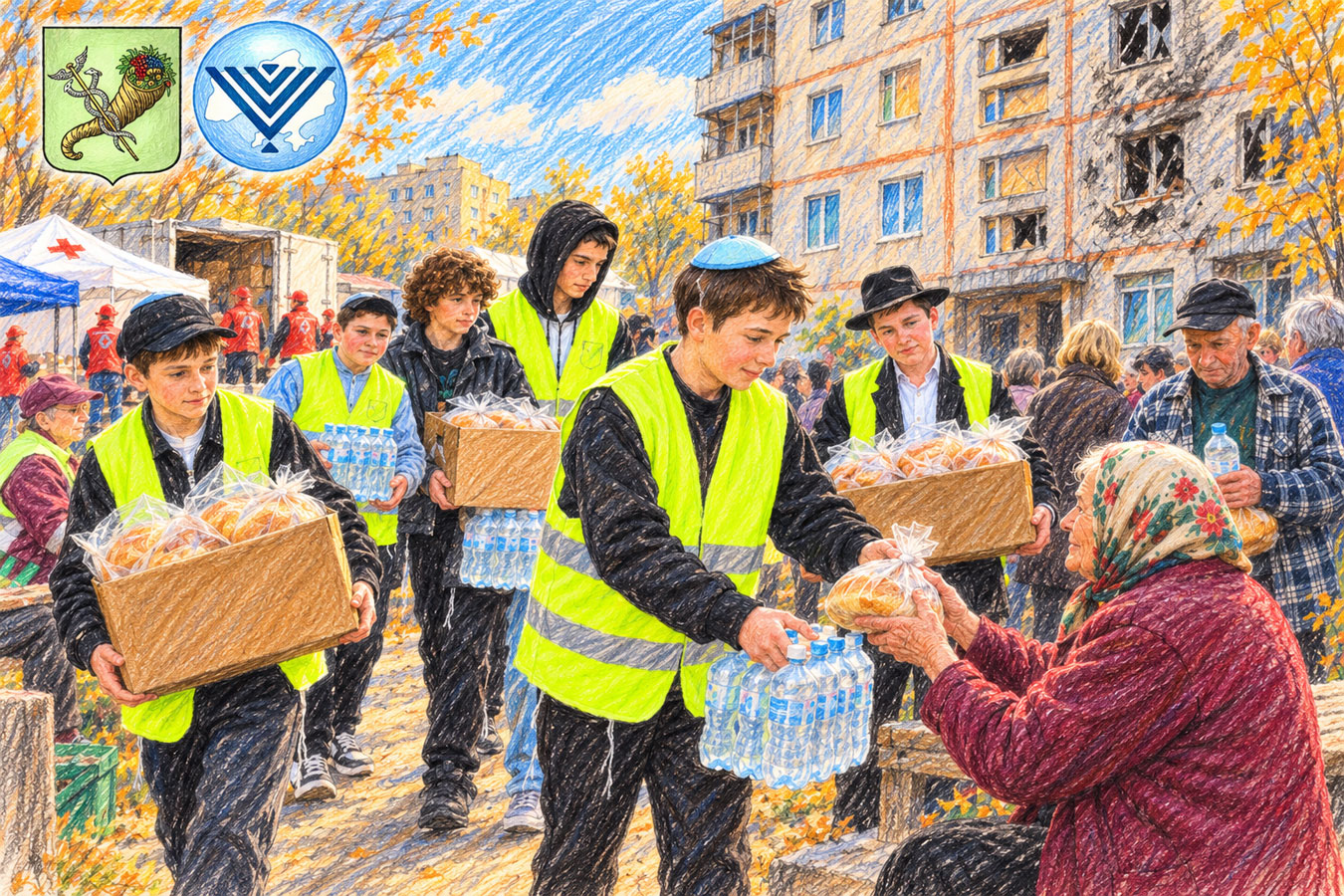
On October 5, the city was again subjected to a Russian airstrike. Rescuers dismantled damaged buildings, employees of the Ukrainian Red Cross went around the affected houses, found out who needed help, and delivered necessary items.
A few days later, a publication appeared about the work of Jewish volunteers. The Federation did not specify which strike their departure was related to. But the very necessity of such trips for Kharkiv, unfortunately, has long become customary.
Various charitable, volunteer, and religious organizations operate in the city. Each helps to the best of its ability. Sometimes it’s a complex evacuation, sometimes medicine for a person who cannot leave the apartment, sometimes a few bags of groceries.
The Jews of Kharkiv are not helping a foreign people. They are helping their own.
I think this is where the main content of this small news lies.
Ukrainian Jews are part of Ukrainian society. Their families lived in Kharkiv long before the current war. They built the city, worked as doctors, engineers, teachers, entrepreneurs. Their children went to the same schools as the children of other Kharkiv residents.
Ukrainian Jews have their own religious life, traditions, and a strong connection with Israel. But all this does not make them any less Ukrainian.
When the Russian army shells Kharkiv, the rockets do not choose apartments based on the nationality of the residents. When electricity or water disappears after a strike, everyone suffers from it. And when the Jewish community distributes food, it helps the people of its city, its Ukrainian people.
No one has to give up their own identity for this.
On the contrary, preserving Jewish life and participating in the fate of Ukraine here perfectly combine.
A community that has itself suffered from the war
Behind this help stands an organization with a long history. The Jewish community of Kharkiv is headed by Rabbi Moshe Moskovitz, a representative of the Chabad movement — an international Jewish religious and charitable network well known in Israel.
Since the beginning of the full-scale invasion, the community has been engaged in delivering food, helping the elderly, supporting families and children. At the same time, prayers, classes, and holidays continue.
Moreover, the Russian strikes did not spare the Jewish infrastructure itself.
As previously reported by NAnovosti in a material about damaged Jewish objects in Ukraine, in March 2022, a Jewish school, synagogue, and yeshiva — a religious educational institution — were damaged in Kharkiv. The memorial in Drobitsky Yar, a site of mass killings of Jews by the Nazis during World War II, was also damaged.
There is a bitter historical detail here. People whose community preserves the memory of the Holocaust victims are today again forced to protect their children, save neighbors, and restore damaged buildings. Now — because of Russian shelling.
And yet they find the strength to help others.
What Israelis should see in this story
In Israel, there is the concept of “arvut adadit” — mutual responsibility. When, after rocket attacks, residents of one area help neighbors from another, no one is particularly surprised. That’s how it should be.
But this mutual responsibility has no state borders.
The Jews of Kharkiv remain part of the global Jewish people, maintain relations with Israel, and receive help from Jewish organizations abroad. At the same time, they fulfill their civic duty to Ukraine.
In NAnovosti — News of Israel | Nikk.Agency we have already reported on Jewish children’s camps in Ukraine in the summer of 2026. Children are given holidays and activities, but adults must know in advance where the nearest shelter is. Even leisure here cannot be separated from the war.
Now another story from the same life. While some community members take care of children and the elderly, others bring bread and water to people affected by Russian strikes.
And this should not be perceived as something exceptional. Ukrainian Jews help their country not because someone demands a demonstration of patriotism from them. They live here. Here are their homes, relatives, neighbors, and future.
A few loaves of bread are also resistance.
Russia is trying not only to destroy Ukrainian cities. Constant strikes on residential areas make ordinary life increasingly difficult. People are forced to spend energy on things they wouldn’t even think about in peacetime.
And helping a neighbor allows at least a little to ease this life.
Of course, bread and water cannot stop missiles or rebuild a destroyed house. For this, completely different solutions, money, and efforts are needed.
But a person left without the most necessary after a shelling needs not only large state programs. They need help today.
That’s why I wanted to talk about this short publication of the Federation of Jewish Communities of Ukraine.
There is nothing heroic in the usual sense. No one makes loud speeches, demands gratitude, or portrays a savior.
The Jews of Kharkiv simply brought bread and water to their fellow citizens.
And as long as the Russian army continues to shell Ukrainian cities, such actions remind us that it is much easier to destroy houses than to destroy human connections.
This is their city. This is their people. And they help not in words.
