
The scheduled bus Italy — Ukraine on January 6, 2025, unexpectedly turned into a public story with a resolution at the border. One of the passengers — an Italian citizen, traveling to Ukraine with his Ukrainian partner, according to eyewitnesses, began openly praising Putin and belittling Ukraine. It ended with the man being denied entry and banned from staying in the country for several years.
Entry Denied
The tone of this story is not “scandal for the sake of scandal.” It’s about how the war has long gone beyond the front lines. Sometimes it’s just a conversation on the road, sometimes a demonstration of symbols, sometimes an attempt to “visit” a country while simultaneously disparaging it.
The story became public after a post by Ukrainian blogger Daria Melnichenko on Threads. She recounted the conflict during the trip, not postponing it “for later,” and emphasized that she would not let it pass — especially in a situation where Ukraine pays with lives daily for its right to exist.
How It All Started
According to Melnichenko, the incident occurred during a stop. A couple — a Ukrainian woman and an Italian named Rocco — got off the bus. He was wearing a vyshyvanka — a gift from his partner. And this initially confused people: outwardly — a gesture of respect, a symbol of support, “one of us.”
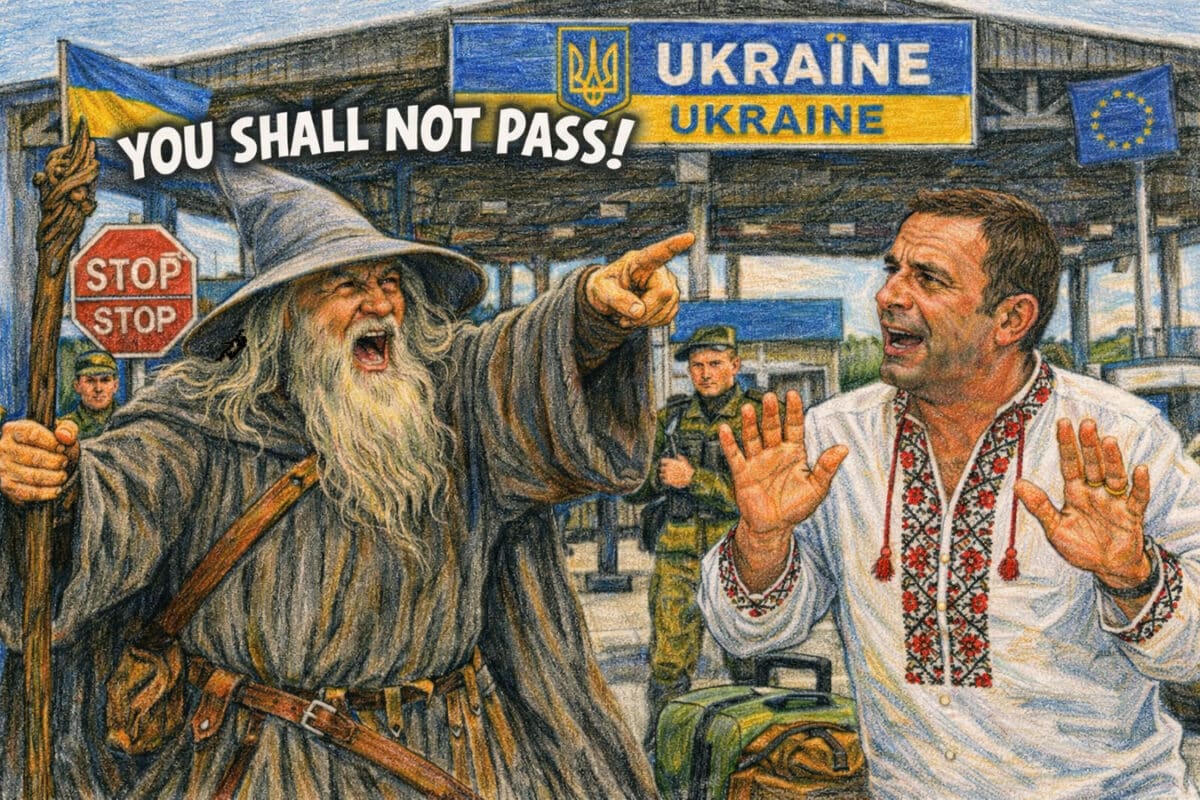
He himself approached to introduce himself, and the conversation started easily. Then — a sharp turn. Upon learning that the interlocutor was from Ukraine, the man, according to the publication’s author, switched to insults: he began repeating that Ukraine is “bad,” that the president is “bad,” and further — the key point — that Putin is “great” and “deserves respect.”
Such scenes always resonate not only with words. Here, the dissonance worked: a person is traveling to Ukraine, wearing a Ukrainian national symbol, saying he is heading to live in a Ukrainian city — and simultaneously justifying the aggression of a state that kills Ukrainians.
Eyewitnesses noted another difficult moment: according to them, the Italian’s companion did not look like someone trying to stop the conflict but like someone who shared it. This added anger to those who read the story: “this is not a random tourist, this is not ‘misunderstood,’ this is deliberate.”
The Decision “Not to Stay Silent”
In Melnichenko’s post, what later spread through reposts was that she wrote she would raise a fuss and “lie down at the border,” but such a passenger would not be allowed into Ukraine. There was a lot of emotion in this — and at the same time, it was an absolutely practical signal: there would be appeals to services, a statement, and identification.
This determination became the trigger. People recognized a familiar feeling in the situation: fatigue from how the war is devalued in a “roadside” conversation, how propaganda hides behind a smile and a foreign passport, how the aggressor is praised “in a safe environment,” sitting on a bus.
Then came an effect well-known in Ukraine: the collective reaction of the network. Subscribers began following the flight like a series — not out of curiosity, but because they wanted to see the finale: “will he pass or not.”
Simultaneously, users started searching for the Italian’s public pages. In open profiles, according to journalists and eyewitnesses, they found symbols, publications, and details that looked like a pro-Russian position. The story ceased to be just a “verbal skirmish” and became a matter of security.
The Border and Legal Framework
The climax occurred at the “Chop — Zahony” checkpoint. According to Melnichenko, she spoke with the shift supervisor, the border guards were already aware of the situation due to the social media resonance, made the necessary recordings, the couple was taken for additional checks, and the author herself wrote a statement.
Later, journalist Vitaliy Glagola reported that he sought a comment from the representative of the State Border Guard Service of Ukraine Andriy Demchenko. They confirmed: the border guards were informed and acted according to procedures, the decision is made strictly within the law.
It was separately reported that the Security Service of Ukraine is also aware of the situation. This is logical: during the war, even “words” on the road can be part of a broader picture — provocations, reaction tests, attempts to demonstratively humiliate the country at its doorstep.
As a result, according to journalists, the Italian was issued a refusal of entry card and a ban on staying in Ukraine for several years. In public retellings, the term three years is most often mentioned.
Why This Affected Many
This is not a story about “canceling an opinion.” It’s a story about the fact that war is not a discussion in comments and not a “point of view” that can be worn like a badge while remaining comfortable.
Several things immediately affected Ukrainians:
Someone wears a vyshyvanka as armor against responsibility, but inside — contempt.
Someone travels to live in Ukraine but chooses to humiliate people living under attacks on the road.
Someone thinks that a foreign passport gives the right to say anything and still “get through.”
And here, the very “small force” worked — not a state machine in a vacuum, but a specific person who did not back down, and thousands who did not let the story disappear.
One could “not get involved,” close their eyes, turn the page. But it is precisely such moments — when society does not swallow humiliation — that form the rules. In this sense, the finale at the border became an emotional relief for many: “he did not pass.”
On What Laws the Entry Denial Is Based: Specific Norms, Not “By Feelings”
The decision to turn the foreigner away at the border was not based on emotions or social media pressure, but on direct norms of Ukrainian legislation, which are applied especially strictly in wartime conditions.
Here are the key legal grounds used in such cases.
1. Law of Ukraine “On the Legal Status of Foreigners and Stateless Persons”
This is the basic document.
Article 13 directly provides for the refusal of entry to a foreigner if:
— their entry contradicts the interests of Ukraine’s national security;
— there are grounds to believe they may threaten public order;
— their actions or statements harm the interests of the state.
Important:
the law does not require the person to have committed a crime.
A risk assessment is sufficient.
Support for the aggressor state during the war is automatically considered such a risk.
2. Law of Ukraine “On the State Border of Ukraine”
This law gives the State Border Guard Service the right to:
— conduct additional checks;
— deny entry if there is information about a possible threat;
— act based on data from other bodies, including the SBU.
The decision is made at the border, without a court, within an administrative procedure — this is normal international practice.
3. Martial Law
Martial law is introduced by presidential decrees and approved by the Verkhovna Rada.
During this period:
— the priority is state security;
— the behavior of foreigners is assessed more strictly;
— public support for the enemy is not considered an “opinion” but a threat factor.
This is a critically important point:
in peacetime, such statements might end in scandal,
during war — they become grounds for entry denial.
4. Powers of the SBU
The Security Service of Ukraine has the right to:
— provide border guards with information and recommendations;
— initiate an entry ban for foreigners whose actions or views
contribute to aggression against Ukraine.
In such cases, the SBU is not required to initiate a criminal case — it is about preventive measures.
5. Administrative Form of Decision
Legally, it looks like this:
— a refusal of entry card is issued;
— a ban period is set (often 3 years — standard practice);
— the decision is not a conviction and does not require a court sentence.
This is not a punishment, but a restriction of access to the state’s territory.
Why This Is Legal and in International Logic
No state is obliged to admit a foreigner who:
— publicly supports its enemy;
— travels to a country at war;
— demonstrates a hostile position even before crossing the border.
Israel, the USA, and EU countries act in the same way — the question is only how directly the person themselves indicates their position.
In this story, three factors coincided:
public statements, a statement by a Ukrainian citizen, and confirmation of the position through open sources.
This is enough for the decision to be legal, formalized, and stable — without a court, but strictly within the legal framework.
This is exactly how the border and legal logic of a warring country works today, as recorded by NAnews — News of Israel | Nikk.Agency.
