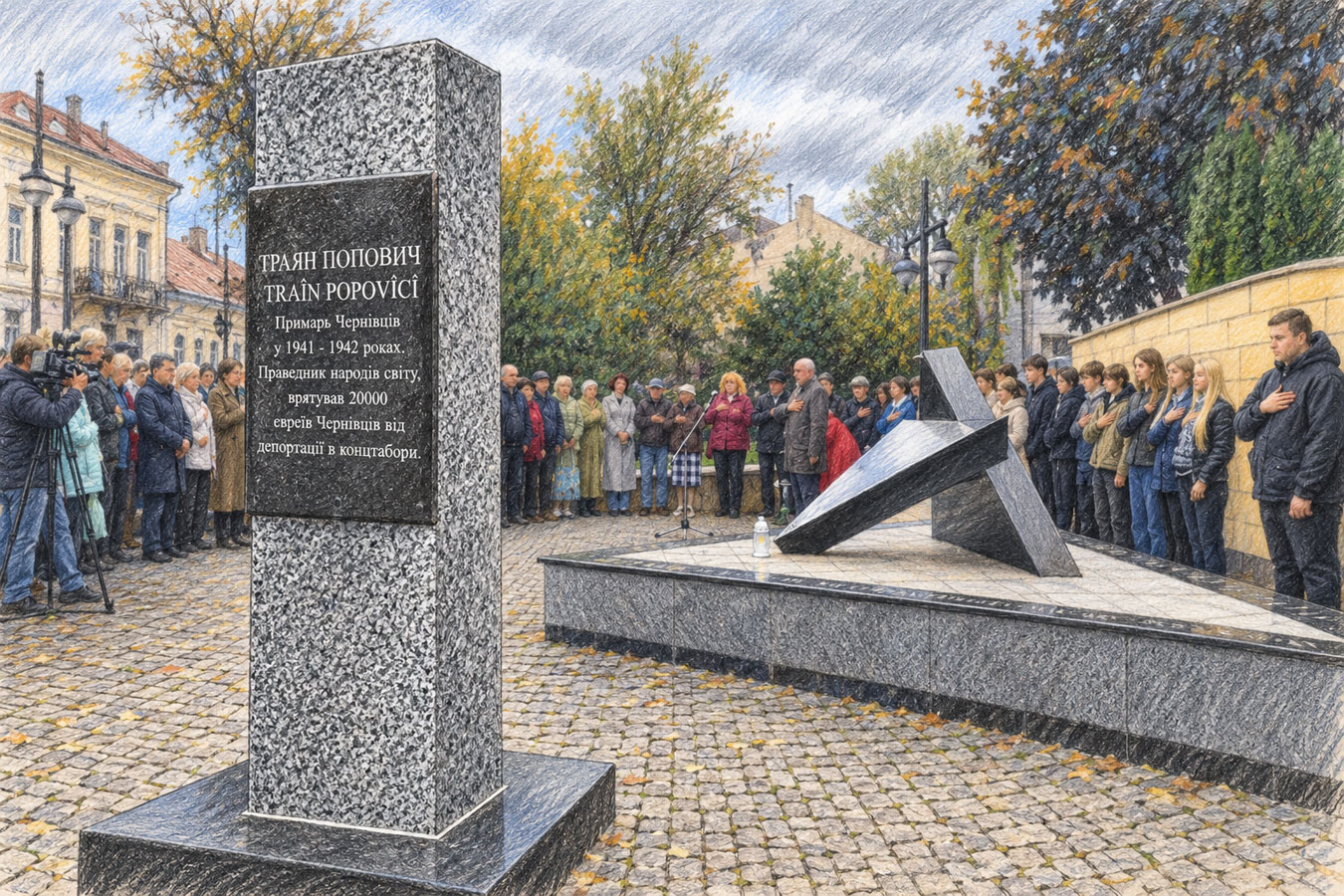
In Ukrainian Chernivtsi in October 2026, the memory of Traian Popovici was honored — the Romanian mayor of the city, who in the fall of 1941 managed to save almost 20,000 Jews from deportation. On the 85th anniversary of the creation of the Chernivtsi ghetto, a bust was installed near the Holocaust victims’ memorial.
While Putin’s Russia continues to bombard Ukraine with missiles and drones, while air raid sirens interrupt city life, and Russian strikes kill civilians, including children, Ukrainians even in the midst of this war find time, strength, and resources to commemorate people who once saved others from death.
Author: Pavel Shveyko
This story has an unexpected modern detail. The ceremony was scheduled for October 15, 2026, but those gathered saw an empty pedestal. The Ukrainian sculptor was mobilized into the army on the eve of the event, and it was not possible to install the finished work on time. The bust appeared two days later — on October 17, on the 134th anniversary of Popovici’s birth.
This is not just a local story about a new monument. It is about a person who held a position in the administration of the Nazi Germany-allied regime but refused to participate in the extermination of the city’s Jewish population.
How the ceremony in Chernivtsi took place
On October 15, 2026, representatives of the Ukrainian authorities, Jewish and Romanian communities, diplomats, and city residents gathered at the memorial complex for the memory of the prisoners of the Chernivtsi ghetto on Petra Sahaidachnoho Street.
This was also reported by the Ukrainian State Service of Ukraine for Ethnopolitics.
Participants honored the dead with a minute of silence and laid flowers. The event was dedicated to the 85th anniversary of the creation of the ghetto and the beginning of mass deportations of Jews in the fall of 1941.

The initiator of the monument’s installation was Ilya Hoch, a representative of the Chernivtsi Jewish community, head of the “Miriam” organization, and honorary consul of Latvia in the Chernivtsi region. He paid for the bust’s creation with his own funds.
During the event, Hoch reminded that Popovici saved about 20,000 people and compared the scale of his actions to the story of Oskar Schindler, known from the film “Schindler’s List.”
Among the participants was the Consul General of Romania Irina-Loredana Stanculescu. She emphasized that the memory of those who saved people during the Holocaust should be preserved as a testament to responsibility and solidarity.
The Ukrainian State Service for Ethnopolitics and Freedom of Conscience was represented by the head of the relevant department Viktor Kovrey. Among the diplomatic representatives was also the honorary consul of South Korea Vladimir Kavulya.
The ceremony’s history was covered by local Ukrainian and Romanian journalists.
The author of the bust is Ukrainian sculptor Vitaliy Shelegin. Due to his mobilization, only the pedestal was opened on October 15. Already on October 17, the sculpture was installed in the prepared place. On this day, the Romanian consul and representatives of the Romanian community visited the memorial again, laid flowers, and lit candles.
The official ceremonial unveiling of the bust was planned to be held later.
Who is Traian Popovici and why did he save Jews
Traian Popovici was born on October 17, 1892, in Bukovina, a territory that at different historical periods was part of Austria-Hungary, Romania, the USSR, and Ukraine.
He received a legal education and worked as a lawyer. In 1941, when Chernivtsi was under the control of Romanian occupation authorities, Popovici became the city’s mayor.
Here it is necessary to explain the historical context. During World War II, Romania was led by dictator Ion Antonescu, an ally of Nazi Germany. His regime participated in the persecution, deportation, and mass murder of Jews.
According to materials from the Israeli memorial complex “Yad Vashem”, Popovici was initially not an opponent of Antonescu. After the war, he admitted that he himself once believed in the image of a strong leader capable of restoring the state.
However, the mayor’s attitude towards specific people proved incompatible with the state’s policy of persecuting Jews.
After Chernivtsi was occupied by German and Romanian troops in July 1941, anti-Jewish pogroms took place in the city, and the Great Synagogue was set on fire.
Popovici continued to receive Jewish residents, helped those in need, and ordered full pensions to be paid to Jewish pensioners.
The hostile press even called Jews “Traian’s people.”
October 1941: A decision that saved thousands of families
On September 29, 1941, the governor of Bukovina, Romanian General Corneliu Calotescu, announced the intention to create a Jewish ghetto. Popovici opposed it.
On October 10, it became known about the order to deport the Jews of Chernivtsi to Transnistria. The mayor again demanded to abandon this decision.
On October 12, realizing that it would not be possible to completely stop the deportation, Popovici began to seek exceptions. He pointed out the role of Jewish doctors, engineers, lawyers, entrepreneurs, and other specialists in the city’s life. He demanded to also leave pensioners, disabled people, and former military personnel.
Initially, he was allowed to compile a list of only 100–200 people.
He did not agree.
Popovici continued to seek to expand the list. On October 15, 1941, Antonescu allowed about 20,000 Jews to remain in Chernivtsi.
Thus, special documents known as “Popovici’s authorizations” appeared. They allowed Jewish families to stay in the city and not fall into deportation trains.
According to “Yad Vashem,” thanks to his actions, about 19,000 people were saved. On the memorial plaque installed in Chernivtsi back in 2009 on the house where Popovici lived, a more precise number is indicated — 19,600.
The mayor also sheltered Jews in his own home who were threatened with deportation and those who managed to escape from camps.
For a person working within the occupation administration, such actions meant a conscious conflict with its leadership.
What happened to those who could not be saved
Here it is important to remember the other side of the story.
According to the Ukrainian State Service for Ethnopolitics, in the fall of 1941, more than 30,000 Chernivtsi Jews were deported to Transnistria.
Transnistria in the history of the Holocaust is not the modern unrecognized Transnistria. It was the occupation territory between the Dniester and Southern Bug rivers, which was governed by Romania from 1941 to 1944.
There were ghettos and camps. People died from hunger, disease, abuse, and mass killings.
In 1942, Calotescu achieved the resumption of deportations. Popovici was removed from office, and on June 4, the removal of Jews began again. Among the deported were people who had previously managed to stay in the city.
Popovici could not stop this criminal system. But he managed to save thousands of human lives from it.
NANews — News of Israel | Nikk.Agency
Israel recognized his feat back in 1969
Traian Popovici died on June 4, 1946, at the age of 53. Shortly before his death, he left memories of the events in Chernivtsi and his own attempts to stop the deportations.
On January 2, 1969, the Israeli memorial complex “Yad Vashem” recognized him as a Righteous Among the Nations.
For readers unfamiliar with this concept: Israel recognizes non-Jews who saved Jews during the Holocaust, risking themselves and not expecting a reward, as Righteous Among the Nations.
The decision is made after studying testimonies and documents. It is not an honorary title for general humanitarian views but recognition of specific actions to save people.
In Jerusalem, Popovici’s name is preserved in the official archive of “Yad Vashem.” A tree was also planted in his honor.
For Israelis whose families come from Chernivtsi and Bukovina, this story is especially close. Among the people who survived the war thanks to his decisions were members of the Jewish community whose descendants later ended up in Israel and other countries.
There is also another important circumstance: in Israel, Popovici was recognized long before his story received wide public recognition in his native region.
Why this story unites Ukraine, Romania, and Israel
For Romania, Popovici is an example of a person who found the courage to oppose the crimes of his own state. In 2000, a street in Bucharest was named after him.
For Ukraine, he is connected with the history of Chernivtsi — a city where Jewish, Ukrainian, Romanian, German, Polish, and other cultures coexisted for decades.
For Israel, Popovici is one of the Righteous Among the Nations, thanks to whom thousands of Jews had a chance to survive the Holocaust.
But these three perspectives do not negate the responsibility of the Romanian regime for the deportations and deaths of Jews. On the contrary, Popovici’s act is especially significant precisely because he acted within a system that knew where and why people were being sent.
The memorial ceremony in Chernivtsi united representatives of these historical communities.
Chernivtsi has already immortalized his name along with other Righteous
The October event was a continuation of the great work of preserving Jewish memory in the city.
In 2009, a memorial plaque with gratitude from the Jews of Chernivtsi appeared on Popovici’s house.
On October 7, 2016, a memorial complex for the memory of the prisoners of the Chernivtsi ghetto was opened.
And on May 14, 2026, a plaque with the names of 12 Bukovinian Righteous Among the Nations, including Traian Popovici, was installed on the “Israel” synagogue building on Ukrainian Street, 2.
NANews detailed this in the article “A memorial plaque to the Bukovinian Righteous Among the Nations was opened in Chernivtsi”.
Initiatives to preserve this memory are also being worked on by the head of the Chernivtsi Jewish community Shapsa Averbukh, who participated in the May events.
Similar events are taking place in other cities of Ukraine. For example, in the Odessa region, a Righteous Among the Nations square appeared in Balta.
And in Israel, we talked about Yaroslava Levitskaya from Haifa, whose family saved Jews during World War II.
Ukraine under fire remembers those who saved people
Think about the circumstances in which all this is happening.
Russia continues its war against Ukraine. Missiles and drones hit residential buildings, energy infrastructure, streets, and public places. People live between air raid alerts, funerals of the dead, and the anticipation of the next strike.
According to data from the UN Monitoring Mission, in September 2026 alone, at least 328 civilians were killed in Ukraine, and another 2,105 were injured. Among the victims of Russian attacks are children.
And in this reality, Chernivtsi installs a monument to a person who 85 years ago saved Jews from deportation. People come to the ceremony, attract diplomats, collect historical documents, and find funds for the sculpture. Even the mobilization of its author does not stop the initiated work.
Moreover, they remember Romanian Traian Popovici — a representative of the people to whom the leaders of the regime that carried out the deportations belonged. He is honored not for his nationality but for his deed.
This, in my opinion, is where the true Ukraine manifests itself. A country that today fights for its own existence does not forget those who in the past saved other people’s lives. And it can separate the crimes of the state from the human courage of people who resisted these crimes.
The monument to Popovici in Chernivtsi speaks of this without loud slogans. It stands where his story actually happened and reminds us that even in the darkest times, a person has a choice.
A monument during a new war
There is a detail in the story of the bust’s installation that would be hard to invent.
85 years ago, Popovici risked his position and safety to save Jews from deportation. In October 2026, Ukrainian sculptor Vitaliy Shelegin, who created the monument to this man, could not attend the opening: he was mobilized to defend Ukraine from the Russian invasion.
Ilya Hoch and the ceremony participants did not abandon the event. On October 15, they honored the memory of the dead and the savior, and on the 17th, they installed the finished bust.
The history of the Holocaust in Ukraine today is preserved by people who themselves live in conditions of war.
In September 2026, Israel and Ukraine together commemorated the 85th anniversary of the Babi Yar tragedy. NANews also reported on the uprising of Sobibor camp prisoners led by Alexander Pechersky.
The memory of the dead, of resistance, and of saving people are different but connected pages of one history.
And here I would highlight the main thing. Popovici did not have an army, could not change Romania’s foreign policy, and did not stop the Holocaust in Chernivtsi. His tools were his position, documents, negotiations, and a willingness to argue with his superiors.
For about 19,000 people, this was enough to stay alive.
A bust of him now stands in Chernivtsi. And in Israel, for more than half a century, there has been a document explaining why this person deserves memory and gratitude.
Pavel Shveyko, author of NANews. Writes about Ukrainian-Israeli relations, Jewish history, and events connecting the two countries.
Sources: Yad Vashem — Traian Popovici archive; State Service of Ukraine for Ethnopolitics, October 15, 2026; BucPress — bust installation on October 17; Chernivtsi Promin — report from the ceremony.