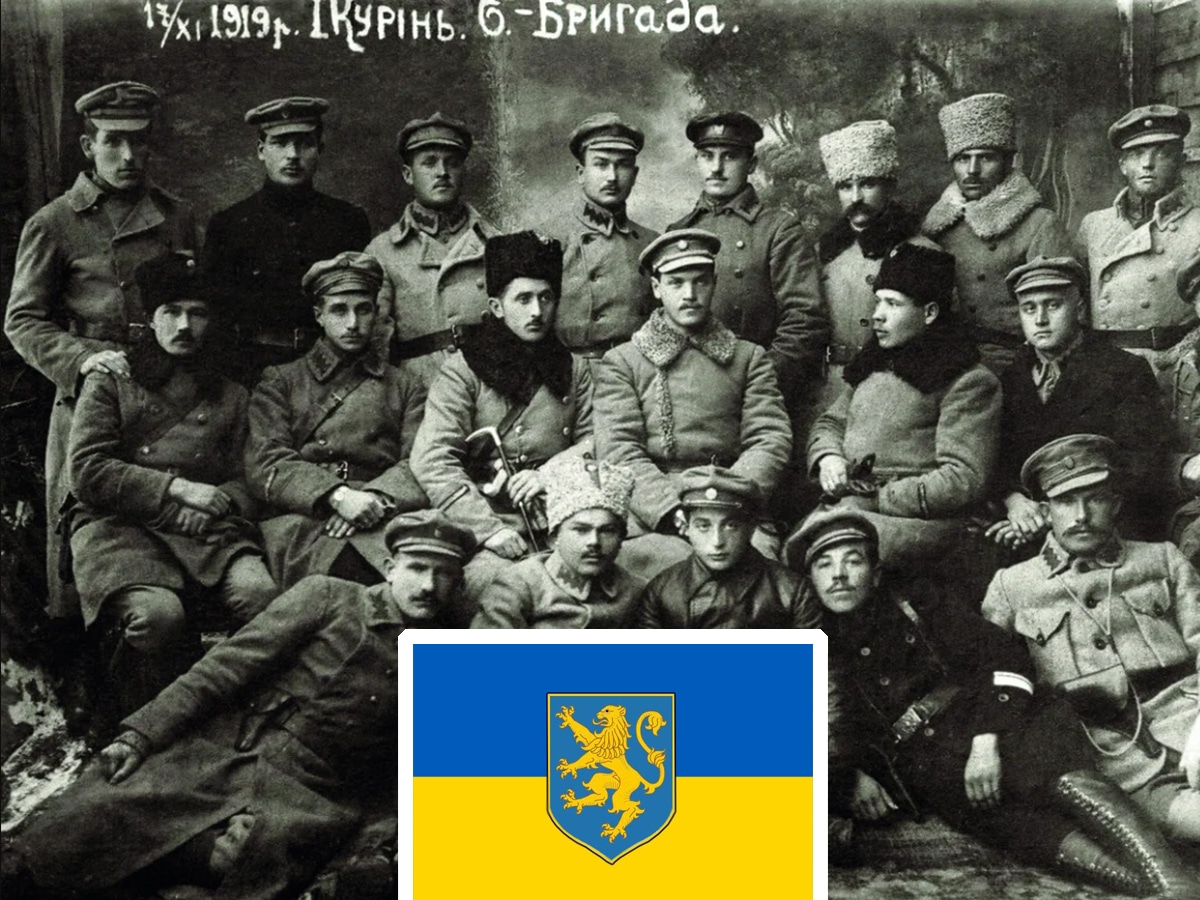
The Jewish Detachment left a significant mark in history as a symbol of bravery and solidarity between two peoples.
In honor of the commander Solomon Laynberg, a street in Lviv was named after him.
In 2013, it was proposed to establish a monument to the “Jewish Detachment” in Ternopil, but the project was suspended due to the war in Donbas.
The Jewish Detachment (official name – “Shock Detachment of the 1st Corps of the Galician Army”) within the Ukrainian Galician Army (UGA) became an important element in the struggle for Ukraine’s independence in 1919. This unit became a bright example of cooperation between two peoples — the Ukrainian and the Jewish, striving for freedom and independence during the war, and we are telling its story in our regular section Jews from Ukraine.
Political Situation and Jewish Involvement
At the beginning of the 20th century, Jews made up about a quarter of the population of Lviv, and most of them were actively involved in social and political life. Lviv had many Jewish lawyers, doctors, and students. Despite relative safety in Galicia, Jews still suffered from Polish discrimination, which forced them to cooperate with Ukrainians in the struggle for independence.
With the formation of UNR and ZUNR, Jews faced the necessity of deciding whether to support Ukraine’s fight for independence. Despite the cultural autonomy offered by these states, many Jews chose neutrality.
UNR (Ukrainian People’s Republic), formed in 1917, sought Ukraine’s independence but faced numerous challenges — Bolsheviks, Whites, and Polish forces.
Meanwhile, ZUNR (Western Ukrainian People’s Republic), formed in 1918 in Galicia, sought to preserve Ukrainian identity and independence but was quickly absorbed by Polish forces. Both of these states not only recognized cultural autonomy for Jewish communities but also gave them the opportunity to participate in state affairs.
The Union of UNR and ZUNR
Union, or the unification of UNR and ZUNR, took place on January 22, 1919, and became a symbol of the desire for unity of Ukrainian lands. This act was an important step toward the creation of a unified independent Ukrainian state. However, in practice, the union turned out to be complicated. ZUNR ultimately remained under Polish control, and Ukrainian authorities of UNR faced numerous internal problems, which prevented the Union from leading to a long-term consolidation. In 1920, Polish forces finally established control over Galicia, and ZUNR was integrated into the Polish state. Nevertheless, Union remained an important symbol of unity for the Ukrainian people and continued to influence Ukraine’s national ideology in the years to come.
Union was not instantaneous. After November 9, 1918, UNRada formed the Temporary State Secretariat headed by K. Levitsky, and the “Temporary Basic Constitution” on the state independence of Ukrainian lands from the former Austro-Hungarian Empire, declaring ZUNR on the territory of Eastern Galicia, Northern Bukovina, and Transcarpathia. On November 13, the new coat of arms — a golden lion on a blue background — and the flag — blue and yellow — were approved.
At the same time, against the backdrop of military actions and Polish aggression, on November 11, the ZUNR forces were forced to leave Przemysl, which became a base for Polish forces’ attack on Lviv. A few days later, in mid-November, Romanian troops captured Northern Bukovina, and on November 22, Polish forces took Lviv.
By December 1, the ZUNR delegation signed a preliminary agreement on union with UNR. On January 22, 1919, at Sofiyskaya Square in Kyiv, the act of reunion of UNR and ZUNR took place. However, in reality, the union was postponed until the convening of the Constituent Assembly (which never occurred).
The Fate of UNR After the Union
After Union in 1919, UNR continued the struggle for independence but faced serious internal and external challenges. The Ukrainian army actively fought the Bolsheviks and tried to hold its territories against Polish aggression. Poland, strengthening its control in Galicia, captured the territory of ZUNR, and in 1920, it completed its victory on this front.
In April 1918, after the German occupation, Pavlo Skoropadsky became the Hetman of the Ukrainian People’s Republic and declared the creation of Ukrainian State — an authoritarian monarchist state. His rule was supported by Germany but faced resistance from Ukrainian socialists and nationalists who opposed dependence on foreign powers. After the German capitulation in November 1918, Skoropadsky was overthrown, and power passed to the Directory.
Directory was formed in November 1918 in response to the overthrow of Skoropadsky. It was a collective executive body composed of five leaders, including Volodymyr Vynnychenko, Symon Petliura, and other political figures.
Directory represented a more democratic and radical form of government, aimed at mass support among peasants and workers.
The main goal of the Directory was to create an independent Ukrainian state, without dependence on foreign powers such as Germany.
Directory faced several problems: internal disagreements among its leaders, an unstable political situation, and threats from Poland, Bolsheviks, and other external enemies.
However, it resisted both internal and external threats, despite military defeats.
Directory actively fought against Bolsheviks and Whites, trying to restore Ukraine’s independence.
However, in 1920, the Bolsheviks won, and Ukraine (UNR) became part of Soviet Russia.
Creation of the “Jewish Detachment”
“The Jewish Detachment”, officially known as “Shock Detachment of the 1st Corps of the Galician Army”, was formed in June 1919 during the Chortkiv Offensive (operation). It became an independent operational military unit of the 1st Corps of the Ukrainian Galician Army and played an important role in defending Ukrainian territories from Polish and Bolshevik troops.
The creation of the detachment was supported by the Jewish National Council of Ternopil, which authorized Solomon Laynberg to approach Colonel Osip Mykytka, commander of the 1st Corps of the UGA, with a proposal to form a Jewish military unit. Laynberg suggested gathering several hundred Jews from Ternopil to create a fighting unit that would become part of the Galician army.
Colonel Mykytka agreed to this proposal, and an order to form the detachment was signed. Among the commanders of the unit, in addition to Jews, were also senior Ukrainian officers. Thus, the Jewish Detachment became a symbol of the union between two peoples — Ukrainians and Jews, who fought for Ukraine’s independence.
Formation and Training
The detachment was formed in the village of Ostapye, located in the Pidvolochysk district of Ternopil region. Intensive training of soldiers began here. The unit consisted of about 1200 fighters, including riflemen, officers, as well as sappers, telephone operators, and cavalry. A feature of the detachment was the large number of intellectuals and experienced soldiers among the fighters, which allowed for the formation of a combat-ready and disciplined unit.
It is also worth noting the engineering skills of the commander — Solomon Laynberg, who, using his knowledge, created a radio station for effective communication between army units, which significantly improved coordination in combat conditions.
Furthermore, the detachment was provided with all the necessary equipment — uniforms, weapons, ammunition, forage, and food — from the 1st Corps of the UGA, which indicates its importance in the context of military operations.
Combat Path of the Detachment
On July 14, 1919, the detachment participated in battles with Polish troops at places such as Maxymivka, Romanove Selo, and Zherebky, covering the retreat of Ukrainian troops across the Zbruch River. In the following days, the detachment actively participated in battles against the Bolsheviks. It captured Mikhaylpole, defended Proskuriv (now Khmelnytsky), Vinnytsia, Fastiv, and Berdiansk.
Despite heavy losses, the detachment continued its participation in military operations, taking part in the Kiev offensive in August 1919.
Reasons for Disbandment
“The Jewish Detachment” was disbanded at the end of 1919 for the following reasons:
- Epidemic and Losses: The epidemic of typhus and shigellosis killed about 60% of the detachment’s personnel, weakening the unit.
- Lack of Resources: After several military operations, there was a shortage of weapons, ammunition, and food, which made it impossible to continue fighting.
- Military Reorganization: Due to changes in the strategy of the UGA, the detachment was integrated into other parts of the army.
Why Jews Joined the Ukrainian Army
Jews who joined the “Jewish Detachment” saw their role in defending Ukrainian independence for several reasons:
- The Idea of National Liberation: Despite striving to create a Jewish state in Palestine, many Jews saw supporting Ukraine as a chance to ensure the security of Jewish communities.
- Solidarity with Ukrainians: In Galicia, there was a close connection between the Jewish and Ukrainian people, which strengthened their alliance in the fight for independence.
- Response to Pogroms: In response to the pogroms in Lviv in 1918, when Polish forces carried out mass reprisals against Jews, many Jews decided to join the ranks of the Ukrainian army to defend their land.
Legacy and Memory
“The Jewish Detachment” left a significant mark in history as a symbol of bravery and solidarity between two peoples. In honor of its commander Solomon Laynberg, a street was named in Lviv. In 2013, a proposal was made to install a monument to the “Jewish Detachment” in Ternopil, but the project was suspended due to the war in Donbas.
Officially, the Jewish unit ceased to exist. On November 17, the UGA and the Armed Forces of the South of Russia signed a separate peace treaty. The Ukrainian army came under the command of Anton Denikin. The “Whites” were notorious for their extreme anti-Semitism. Some Jewish fighters refused to fight. Nearly a hundred soldiers broke through to Odessa, where, together with members of the local Jewish fighting group, they seized a ship and sailed to Palestine, where they continued to fight for a Jewish state.
Some stayed in Soviet Ukraine, while others returned to Galicia, which by then was under Polish control.
What happened to Solomon Laynberg afterwards is unknown. According to one version, he returned to Ternopil and was killed by the Poles the following year. According to another, he stayed in Soviet Ukraine, became a member of the Communist Party, served in the Red Army, and soon moved to Moscow. He was arrested twice. In 1938, he was executed in Leningrad.
The phenomenon of “The Jewish Detachment” can be compared to the Jewish Legion, which fought in the British army against the Turks in Palestine, with the difference that the Jewish fighters of the detachment fought not for their own country but for the independence of Ukraine.
NAnews and the “Jews from Ukraine” series
The article about “The Jewish Detachment” in the Ukrainian Galician Army highlights the important role of Jews in the fight for Ukraine’s independence. It is an example of solidarity and joint struggle between Ukrainians and Jews against external threats, where Jews actively participated in the creation of the Ukrainian state.
In the series “Jews from Ukraine“, we uncover the contribution of the Jewish community to Ukraine’s history, emphasizing their important role in the national struggle. NAnews – Israel News continues to cover these events, preserving the memory of solidarity and mutual understanding between the two peoples.