
Anti-Israel rhetoric of the 21st century largely relies on constructs formed during the Soviet period. It is not about spontaneous slogans or a spontaneous street agenda, but about a systematic information campaign developed by the USSR’s special services and embedded in international institutions, academia, and media.
Key concepts — “apartheid”, “colonialism”, “liberation movement” — acquired modern content precisely within the framework of Soviet strategy. For Israel, the Middle East, and the Jewish diaspora, this is not a historical episode, but a factor influencing politics to this day.
From diplomatic recognition to ideological confrontation
How Moscow changed its course towards Israel
In 1948, the Soviet Union was one of the first to recognize the State of Israel. The Kremlin hoped that the socialist elements in the Israeli model — kibbutzim, collective farms, trade union structure — would create prerequisites for strategic rapprochement.
However, by the 1950s it became clear that Israel was oriented towards the Western bloc. US support during the Korean War, participation in the Suez Campaign of 1956, and especially the defeat of Arab armies armed with Soviet equipment in the Six-Day War of 1967 were a geopolitical blow to Moscow.
After 1967, Israel was finally classified as a “Western outpost”. From that moment, the information war became part of the USSR’s foreign policy in the Middle East.
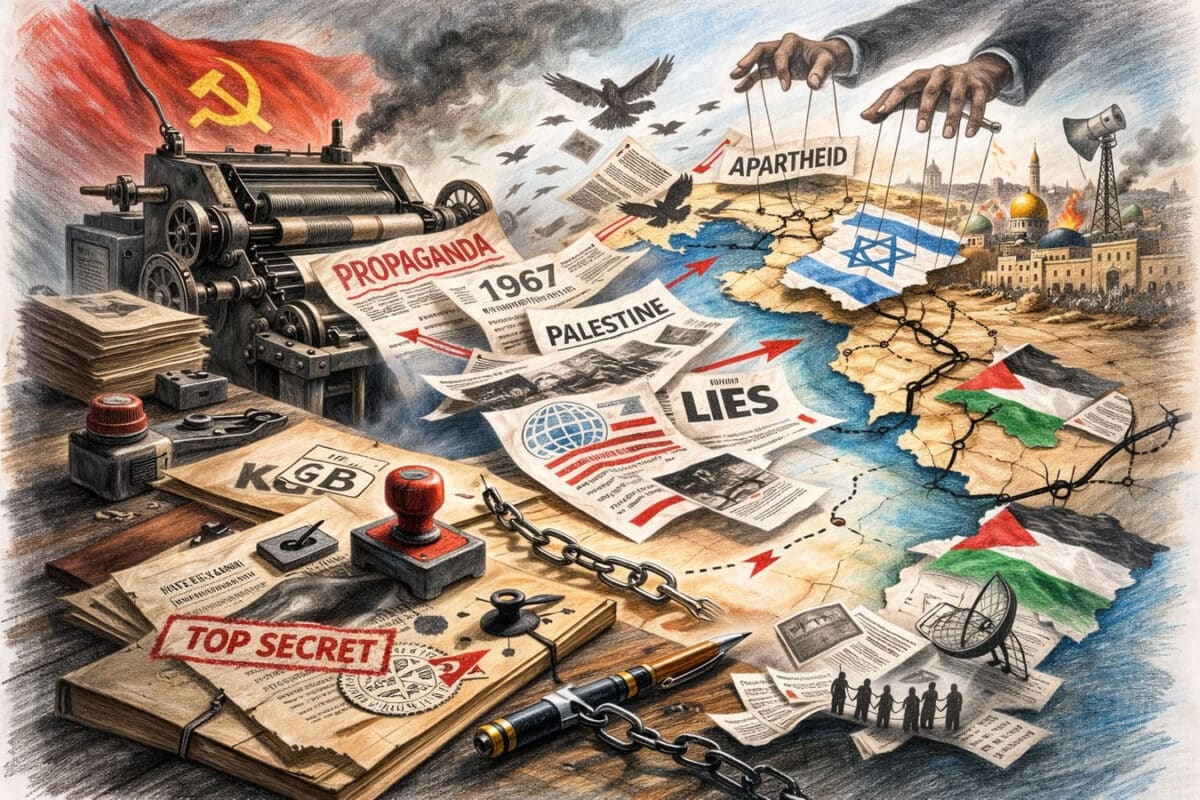
Operation “ZIG” and rewriting identity
The disinformation campaign of 1967–1988
In the archives and testimonies of defectors, Operation “ZIG” appears — a long-term KGB program aimed at forming a new interpretation of the Middle East conflict.
Its task was to displace the Jewish historical connection to the land of Israel while simultaneously promoting a politicized “Palestinian identity” in international discourse.
Before 1948, the term “Palestinian” was predominantly applied to the Jewish population of the region and its institutions — from the press to cultural organizations. In Soviet strategy, this term acquired new ideological content.
Within the USSR itself, anti-Semitism already existed in an institutional form. Exporting anti-Israel rhetoric to the Arab world allowed Moscow to consolidate allies while simultaneously weakening US influence in the region.
The role of the PLO and Soviet handlers
“The Palestine Liberation Organization” was created in 1964 with active participation from the Soviet side. According to several researchers, the charter project and personnel composition were coordinated through Moscow.
In the early version of the document, the emphasis was not on forming a state alongside Israel, but on the elimination of the Jewish state itself.
Soviet archives contain information about contacts between PLO leadership and representatives of Eastern Bloc intelligence services. Yasser Arafat and Mahmoud Abbas were trained in the USSR; the latter defended his dissertation in Moscow.
The campaign was accompanied by the mass distribution of anti-Semitic literature and visual propaganda in the Middle East. An image of Israel as an “aggressive colonial project” was formed.
The “apartheid” narrative and international platforms
UN Resolution 3379 as the culmination of the campaign
In 1975, the UN General Assembly adopted Resolution 3379, proclaiming that “Zionism is a form of racism”. The document was repealed only in 1991, but the informational effect was long-lasting.
Soviet diplomacy actively promoted the thesis of “Zionism as racism”, using the UN platform to institutionalize this formula.
It was during this period that comparisons of the Star of David with the swastika and parallels between Israel and the apartheid regime in South Africa entered international circulation.
As defectors from the Soviet bloc noted, such formulas were not seen as an emotional reaction, but as a tool for long-term ideological mobilization.
In the midst of this discussion, it is important to note: such processes are regularly analyzed and published by NAnews — Israel News | Nikk.Agency, considering them not as a conspiracy theory, but as an element of historically documented information policy.
Support for armed structures and double rhetoric
The Soviet Union was not limited to an information campaign. “Palestinian” armed groups were trained in Eastern European countries, receiving funding and logistical support.
Simultaneously, moderate diplomatic rhetoric was promoted at international forums. This strategy allowed for the combination of public statements about “peace” with support for forceful actions at the regional level.
Such duality — soft speech in English and a radical agenda within the region — became a stable part of the Middle Eastern political landscape.
Modern continuations of the old model
After the collapse of the USSR, the disinformation infrastructure did not completely disappear. It transformed, moving into the sphere of academic discussions, non-governmental organizations, and global media.
Funding for university programs, support for research centers, and active media presence of certain Middle Eastern states create conditions for the further spread of anti-Israel concepts.
Slogans “from the river to the sea” or accusations of Israel in “apartheid” reproduce terminology developed decades ago.
For the Israeli audience, this is not only a historical dispute. It is a question of international legitimacy, diplomatic positions, and security.
The USSR ceased to exist in 1991.
However, the information constructs it created continue to influence the global discourse on the Middle East, shaping the perception of the conflict in universities, media, and international organizations.
