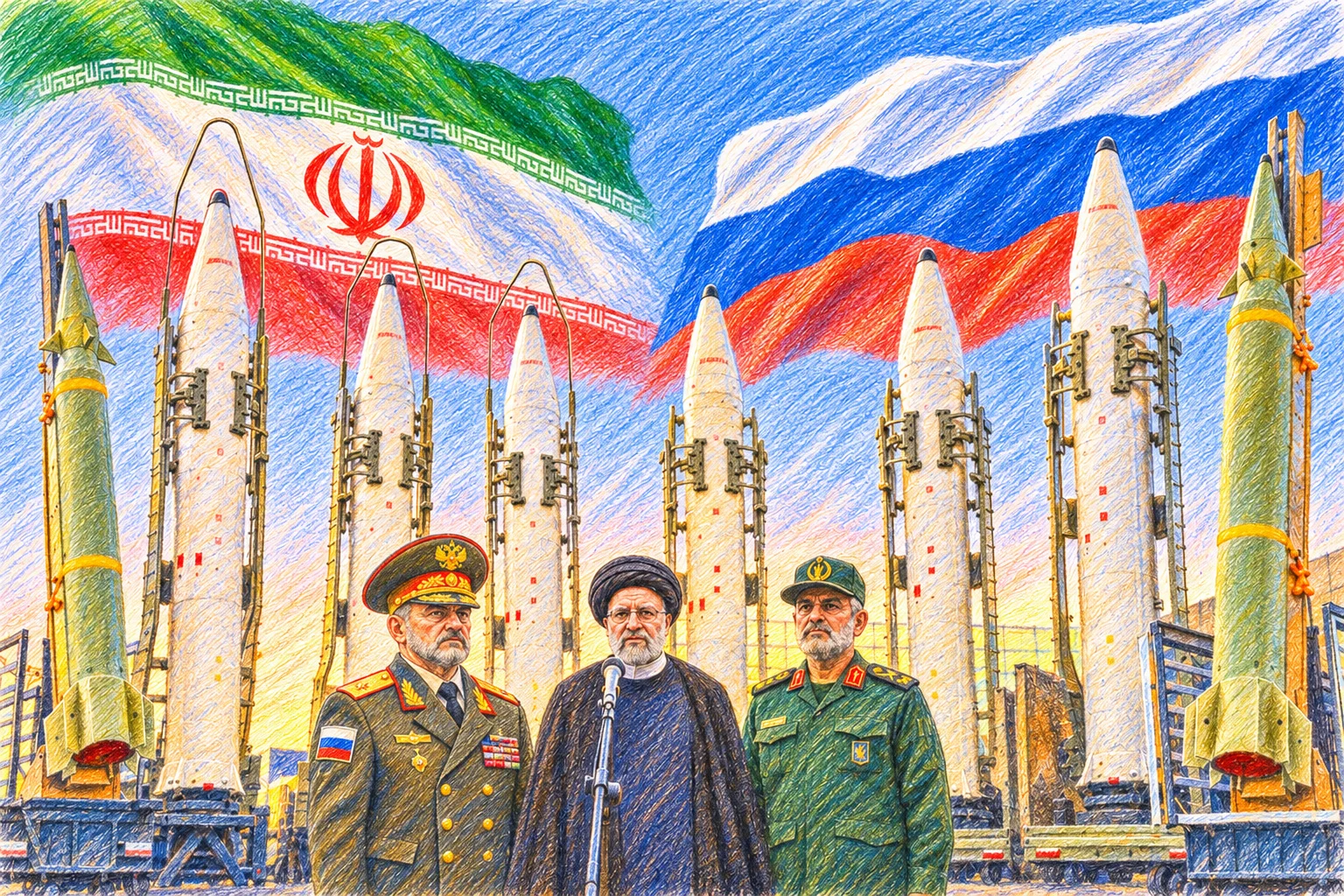
On November 5, 2026, the Financial Times reported on a Russian order for 90 APU-L aircraft launchers for Iran. They are intended for LMUR guided missiles (“Product 305”), which the Russian army has been using against Ukraine since 2022. The documents were provided by the Ukrainian private intelligence and analytical organization Dallas Analytics; they were also reviewed by The Guardian. The production schedule confirms the existence of the order but does not prove the delivery of the launchers to Tehran.
Author: Alexander Khmelnitsky
What Russian factory documents revealed
On May 28, 2024, Moscow’s Vympel Design Bureau, part of the Tactical Missile Armament Corporation, demanded that the Machine-Building Design Bureau (KBM) expedite the supply of components. The delay threatened nine contracts: seven Russian and two export. The schedule includes 192 APU-305 launchers for China and 90 two-rail APU-L for customer “K-10,” under contract No. 032-24/361//063. Components for the Iranian order were to be delivered from late 2024 to December 2025.
The code “K-10” was deciphered from the documents themselves. In the application of the Russian NPP “Zvezda” dated October 20, 2022, for pyrotechnic kits for the Yak-130, the recipient is directly indicated: “K10 Iran.” Another schedule provides for six Yak-130s in 2023 — two in the second quarter, four in the fourth. In March 2023, “Rostvertol” also corresponded about helicopter equipment for “K-10.” The Chinese order is processed separately; it is unknown on which carriers Beijing intended to use the launchers.

The production chain dates back to an order from February 28, 2019. In addition to “Vympel” and KBM, it involves “Salut,” “DUKS,” and the Azov Optical-Mechanical Plant in the Rostov region. The latter manufactured 16 types of components; Dallas Analytics associates it with at least seven missile programs. On the night of September 26, 2026, the plant was subjected to a Ukrainian strike.
Why the order is related to helicopters
The APU-L carries two missiles, the APU-305 — one. The LMUR itself, also known as the X-39, weighs about 105 kilograms, of which approximately 25 are the warhead. The range of the export aviation version is approximately 14.5 kilometers, speed — 230 meters per second: the missile covers 14 kilometers in about a minute. The optical-electronic head and two-way radio channel allow the operator to refine the target during flight, including when attacking moving equipment. In Russia, the missile was introduced in 2021 and adopted in 2022.
LMURs are used from Mi-28 and Ka-52 attack helicopters, with the APU-L primarily intended for the Mi-28. In November 2023, Iranian Deputy Defense Minister Mehdi Farahi announced the purchase of Mi-28s, Su-35 fighters, and Yak-130 combat trainers. Agreements on the Su-35 were previously reported by NANews. Photographs from January 2026 showed the Mi-28NE in the area of Tehran’s Mehrabad airport. In September, Defense Express cited documents about allegedly transferred 24 helicopters, but there is no independent confirmation of such a number.
The situation with the Yak-130 is clearer: the first aircraft were shown by Iranian media back in September 2023. And on March 4, 2026, an Israeli F-35I “Adir” shot down a Yak-130 over Tehran, which was confirmed by the IDF — Israel Defense Forces. However, the Yak-130 should not be confused with the APU-L carrier: it is a different type of aircraft.
For Israel, the issue is broader than a single batch of weapons
A launcher is not yet a missile. Whether the LMURs themselves were transferred to Iran is unknown; the contract’s cost, the number of APU-Ls manufactured, the fact of their delivery, and the current combat readiness of the Mi-28 are unknown. From Iranian territory, a missile with a range of about 14.5 kilometers will not reach Israel. It is intended for close strikes, not for long-range shelling of Israeli cities.
However, from September 28 to October 3, Russian exercises showed “Product 347” — a ground variant with two guides on a “Ural” truck. The Russian side claims a range of up to 20 kilometers; Dallas Analytics allows for the use of such a mobile system against ships in the Strait of Hormuz, the width of which at its narrowest point is about 39 kilometers. This is the maritime exit from the Persian Gulf, through which a significant portion of the world’s oil trade passes. There is no evidence of the delivery of “Product 347” to Iran or its use against ships.
Other areas of cooperation are documented separately. In February, the FT revealed an agreement on 500 portable “Verba” anti-aircraft systems and 2500 9M336 missiles with planned deliveries for 2027–2029. This is weaponry against low-flying targets, not related to LMUR. In September — the C430L program, under which Russian engineers helped Iran develop supersonic cruise missiles. NANews — Israel News | Nikk.Agency has already analyzed this program and its significance for Israel. Iran, for its part, provided Russia with Shahed drones and their production technologies for strikes on Ukraine.
On October 12, Donald Trump doubted significant Russian assistance to Iran; on October 21, Vladimir Putin offered American representative Steve Witkoff assistance in resolving the conflict. Moscow tries not to spoil relations with Washington and other countries in the region. Expert Hanna Notte assessed the assistance to Iran as operationally useful but not changing the course of the war. Meanwhile, disruptions in shipping through Hormuz increase Russia’s oil revenues, and the war in the Middle East distracts Western air defense resources needed by Ukraine.
New documents show how Russian factories planned to fulfill the Iranian contract amid the war against Ukraine. But journalists did not present shipping acts, photographs of these 90 installations in Iran, or evidence of their combat use.