
The morning of October 9, 2025, in Kherson did not begin with prayer, but with noise and dust.
Around 7:15 AM, a cluster munition hit the building of the Chabad Kherson Synagogue on Teatralnaya Street, 27 — the only functioning synagogue in the city.
At that time, there were already people inside.
The community team was preparing free meals for the elderly and needy residents of the city.
And then everything froze.
At the moment, there is no official evidence that the synagogue in Kherson was deliberately targeted as a religious object, but the context of the events suggests that this is not a coincidence in the usual sense.
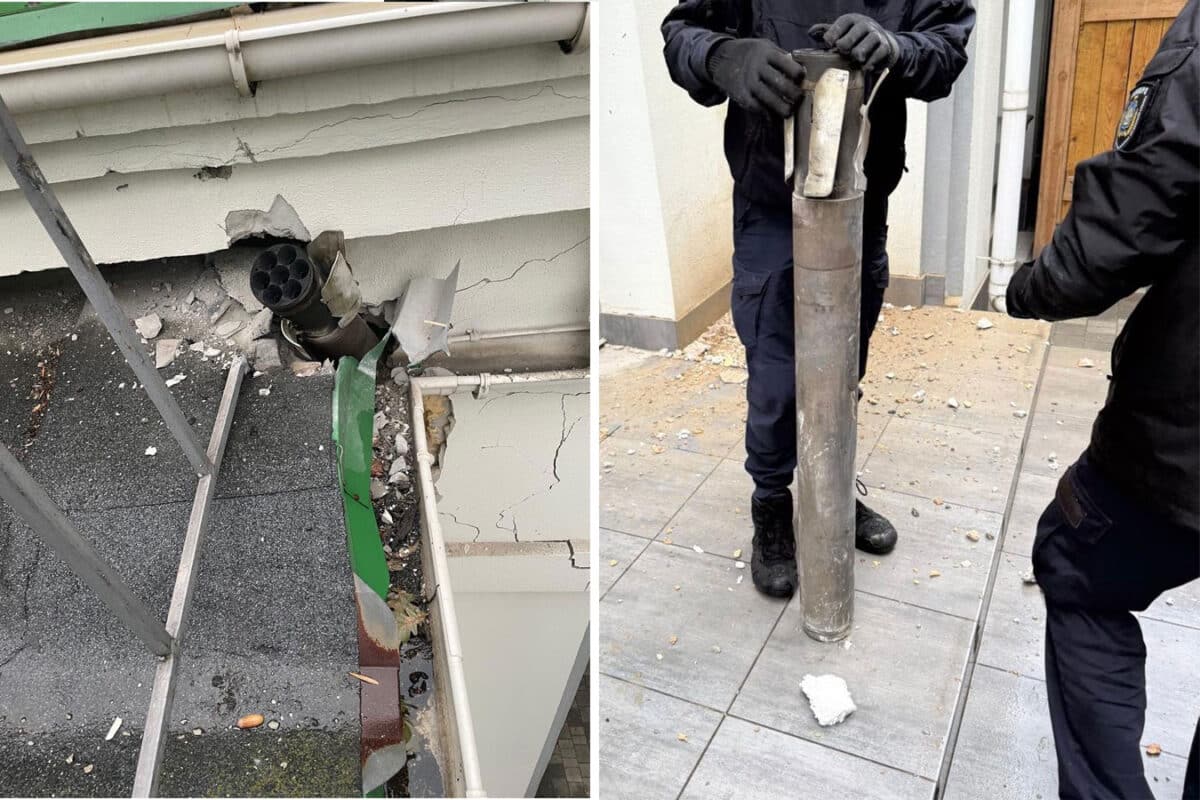
On the morning of October 9, 2025, Russia launched a cluster shelling on residential areas of Kherson, where the synagogue building on Teatralnaya Street, 27 is located. The shell exploded nearby, and one of the combat elements hit the temple wall and did not detonate.
This is a typical pattern of Russian attacks on the central part of the city, where there are no military targets, but many civilians and infrastructure objects — schools, hospitals, temples.
Why it cannot be considered “just a coincidence”
The synagogue is located in a civilian quarter, in an area that has been hit multiple times.
According to the OVA (regional military administration), on the same day, residential buildings, a hospital, and a volunteer center were also shelled.
That is, Russian troops were hitting civilian objects, indiscriminately.
Moreover, the use of cluster munitions in residential areas contradicts international humanitarian law and can be classified as a war crime.
“The cluster bomb exploded and got stuck in the wall”
According to representatives of the Jewish community of Kherson, the cluster bomb exploded nearby, scattering dozens of small explosive elements.
One of them hit directly into the synagogue wall but did not detonate.
“The cluster bomb exploded, scattering dozens of small elements, and then got stuck in the synagogue wall,” the community reported.
The kitchen workers, upon hearing the explosion, did not run — they continued to cook food.
The very meals that are delivered daily to the homes of the elderly and displaced persons.
Prayers do not stop
Even under shelling, life in the synagogue did not stop.
As reported by the community Chabad Kherson, after the explosion, the process of preparing food did not stop, and distribution continued to homes.
“The food, thank God, was prepared — now it is being distributed to people directly to their apartments.
Prayers also do not stop… and a minyan gathers every day — no matter what,” wrote representatives of Chabad.
In the photos published by the community, you can see pots with hot dishes standing in the synagogue courtyard.
Nearby are pieces of metal torn from the wall by shrapnel.
But the synagogue doors remain open.
“Thank God it did not explode”
Kherson residents call it a true miracle.
The shell that could have destroyed the sanctuary did not work.
“Thank God it did not explode. May the Lord keep and bless you, my dear Kherson residents, my dear Jews. Chag Sukkot Sameach — joy, peace, and closeness to the Father,” wrote one of the commentators under the community’s post.
Others added briefly:
“Hold on,” “God bless you,” “It’s a miracle.”
Chabad Synagogue: A history that survived wars and empires
The Chabad Synagogue is the only functioning synagogue in Kherson.
It is located at Teatralnaya Street, 27 (formerly Gorky, before that Vitovskaya, 21).
This is a building of the Hasidic community, built in 1895–1899 on the site of an old synagogue, marked on the 1855 plan.
By the beginning of the 20th century, the temple gathered up to 1500 parishioners and was one of the main centers of Jewish life in southern Ukraine.
Until 1941, it operated as a prayer house for the Jewish community.
During the Nazi occupation, the building was burned, but in 1947 it was restored.
In 1952, the premises were transferred to a dormitory of the Petrovsky plant,
and later to a sobering-up station.
Only in the late 1980s did the synagogue return to the Jewish community.
In the fall of 1990, it once again became an active temple.
In 1999, a major renovation was carried out,
and in 2003–2005 — a complete internal reconstruction and the addition of a new wing to the south.
Funds for restoration came from Israel and the USA.
Today, the synagogue houses the Kherson Jewish Religious Community Chabad and the regional center for the revival of Jewish culture and religion.
The building has the status of an architectural monument and remains a center of life for the Jewish community of Kherson.
When a wall becomes a symbol
A piece of metal is still stuck in the wall of the Kherson synagogue.
It did not explode — and has now become a symbol that faith cannot be destroyed.
This fragment of the wall reminds us: as long as the candle burns, the prayer sounds, and there are people ready to help, — the city lives.
Kherson lives.
And its synagogue once again gathers the morning minyan.
