
The White House is discussing the idea of expanding the mandate of the so-called “Peace Council” — a structure tied to post-war governance of the Gaza Strip in American plans — to other crisis points, including Ukraine and Venezuela. This was reported by the Financial Times on January 17, 2026, citing sources familiar with the discussions.
According to one of the publication’s interlocutors, in Donald Trump’s entourage, this body is seen as a potential alternative to existing international formats — a less formalized mechanism for resolution that could work where, in Washington’s view, the UN is too slow or politically blocked.
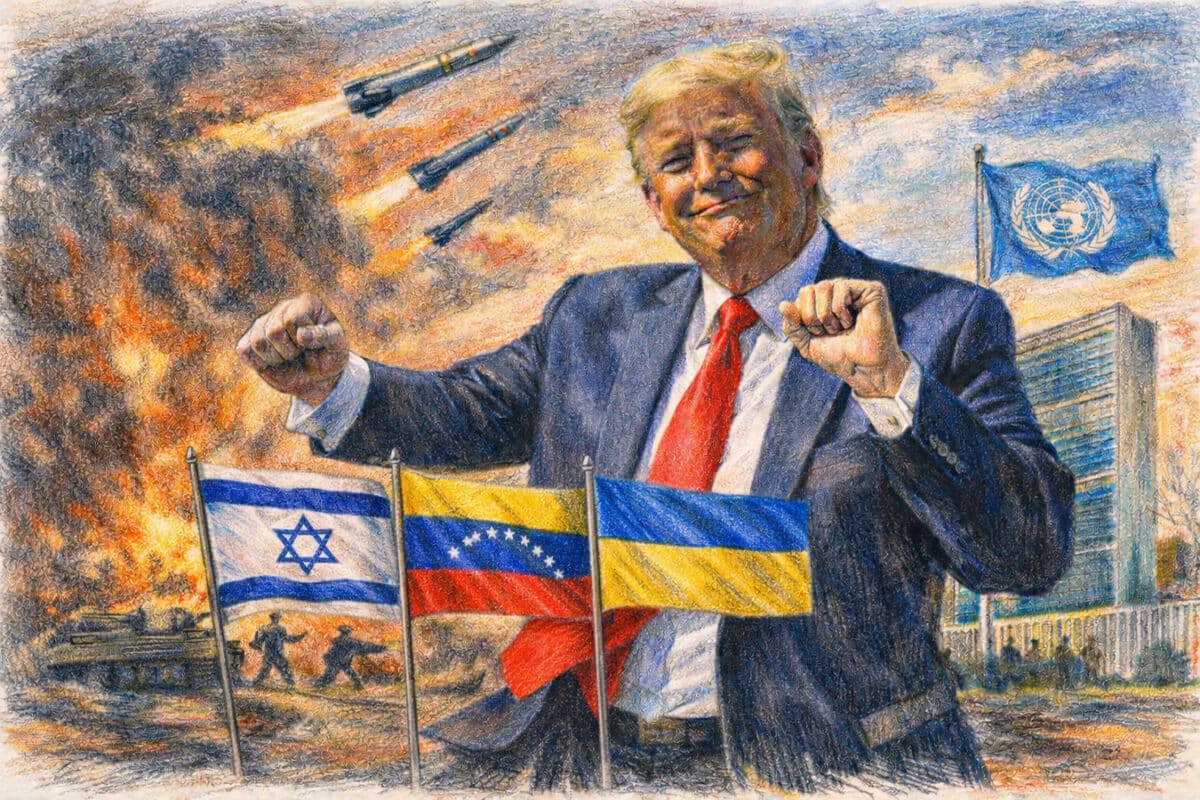
It is this “parallelism” that causes tension among diplomats. FT writes that talks about expanding the Council’s role have alarmed both Western and Arab representatives: they are concerned about the prospect of granting too broad powers to a structure essentially tied to the White House and the political will of one president.
One Arab diplomat, quoted by FT, confirms: the idea is being discussed in the region, but the attitude towards it is restrained — this is “not a usual procedure.” In other words: it is unclear who sets the rules, what is considered a violation, how guarantees are ensured, who bears responsibility, and where “reconstruction management” ends and “external governance” begins.
The Ukrainian part of the discussions appears even more sensitive. A high-ranking representative of Kyiv, participating in consultations with the US, told FT that proposals for ending the war with Russia include the creation of a separate “Peace Council” specifically for the Ukrainian-Russian case.
According to this version, it may involve a mechanism that will not just be a platform for meetings but a body for control and guarantees of implementing a 20-point peace plan. The potential composition, as claimed by an FT source, may include representatives from Ukraine, Europe, NATO, and Russia — a format broader than bilateral and simultaneously narrower than the UN.
The White House is trying to dampen the excitement. An American official, cited by FT, stated at the end of the week that the planning of the “Peace Council” is focused exclusively on the Gaza Strip, and talks about other directions are premature. This resembles a familiar tactic: keeping the door ajar without fixing commitments while observing the reaction of allies and opponents.
A separate intrigue is Turkey. The Turkish president’s press service hastened to report that Trump allegedly invited Recep Tayyip Erdoğan to become a founding member of the “Peace Council.” Meanwhile, Israel previously opposed Turkey’s participation in such constructions around Gaza — due to political disagreements and Ankara’s role in the regional agenda.
American officials confirmed this week that invitations to potential participants were indeed sent out on Wednesday, but did not specify the recipients. The White House publicly presented the initiative as broadly as possible: “The whole world wants to be part of President Trump’s historic efforts to achieve peace in the Middle East.”
Looking at the original “Gaza” plan, the scheme looks like this: the day-to-day management of the enclave is to be transferred to a Palestinian technocratic committee, and the “Peace Council” is to oversee the process as a political and financial “umbrella.” According to FT, Bulgarian diplomat Nikolay Mladenov — a former Bulgarian defense minister and a figure with experience in international missions — is planned to be appointed as an observer/curator of the technocrats’ work.
The composition of the Council’s executive committee, described by FT, is also indicative: US Secretary of State Marco Rubio, President’s Special Envoy Steve Witkoff, Jared Kushner, former UK Prime Minister Tony Blair, American businessman Marc Rowan, World Bank President Ajay Banga, and US Deputy National Security Advisor Robert Gabriel. This is a mix of politics, special diplomacy, finance, and “large project managers” — a structure inherently geared towards quick decisions, control of flows, and PR effect.
Reflections and Analysis: What’s Really “New” Here
1) This is not a “peace body,” but a conflict management tool
The key question is not in the name, but in the function. If the structure is created under the White House and under Trump’s personal brand, it inevitably becomes a political lever of the US. And levers work not only for “peace” but also for the conditions of peace.
In this sense, the “Peace Council” looks like an attempt to replace international law with managed management: quick decisions, short approval chains, clear hierarchy. For business, this is a plus. For diplomacy — a minefield.
2) Acceleration is a plus, but the price may be high
The strong side of such a construction: speed. When it is necessary to launch humanitarian logistics, stabilize communal infrastructure, establish recovery financing, classical multilateral formats often stall.
The weak side: speed is achieved by reducing “brakes” — procedures, legal frameworks, publicity, parliamentary control. Therefore, diplomats fear “too broad powers”: fast management without clear responsibility.
3) Ukraine and Gaza are different tasks, and this may break the model
Gaza in American logic is simultaneously Israel’s security, humanitarian agenda, regional deals, and recovery. Ukraine is a war of attrition with Russia and a question of European security. Venezuela is a completely different geography and set of stakes.
If one “council” is attempted to be stretched over three different conflicts, it will either become decorative or turn into a political headquarters where decisions are made not based on universal principles, but on the basis of a favorable moment.
4) The main risk for Ukraine: the “council” as a platform for pressure, not guarantees
The formula “Russia and NATO can join it” sounds nice, but in reality, the key question is what constitutes a violation and what sanctions follow a violation.
If the “council” has no levers of coercion (economic, military, legal), then it records not guarantees, but a framework for bargaining. And then Ukraine risks finding itself in a situation where it is pushed to make concessions for the sake of a “quick result” that the White House can sell as a victory.
5) The main risk for Israel: the composition of participants and regional trade
For Israel, the question is not academic. Any structure that claims to manage post-war Gaza automatically affects:
- who gains legitimacy as a “founder” and “guarantor”
- how money and security control are distributed
- which countries gain a role in humanitarian and civil infrastructure
- how negotiation channels with Arab capitals change
If Turkey indeed gets a “founder” seat, it will become a factor of constant tension: Ankara will use the platform for pressure and public policy, and Israel — for blocking and counteraction. The result may be paradoxical: the “peace council” will become another arena of conflict.
6) Why the US is moving in this direction at all
We see this as an attempt to solve three tasks simultaneously:
- reduce dependence on the UN and the Security Council, where blockages constantly arise
- obtain a manageable mechanism of “deal + control + reconstruction”
- establish a new foreign policy philosophy: fewer institutions, more personal agreements
This is the logic of a “project,” not the logic of a “convention.” And in 2026, it seems to be strengthening.
7) What will be a marker that all this is not PR
There is a simple test. If the “council” has:
- transparent membership and exit rules
- a public map of powers
- a mechanism of responsibility for violations
- a clear source of funding and audit
— then it can become a new tool of international practice.
If everything remains at the level of “invitations,” lists of VIP participants, and vague formulations about “historic efforts” — then it is primarily a political facade created for managing expectations and bargaining with allies.
Why this is important right now
Washington is testing a new architecture of influence: faster, tougher, more personalized than traditional international institutions. What this will turn into in practice will determine not only the “day after tomorrow of Gaza,” but also attempts to “package” wars and crises further — in Europe and the Middle East.
And this directly concerns Israel: because any sustainable mechanism that allows the White House to negotiate “peace packages” will inevitably include regional parameters — security, Syria, Iran, proxy groups, sanctions, logistics, and diplomatic roles in Gaza. NAnews — Israel News | Nikk.Agency
