
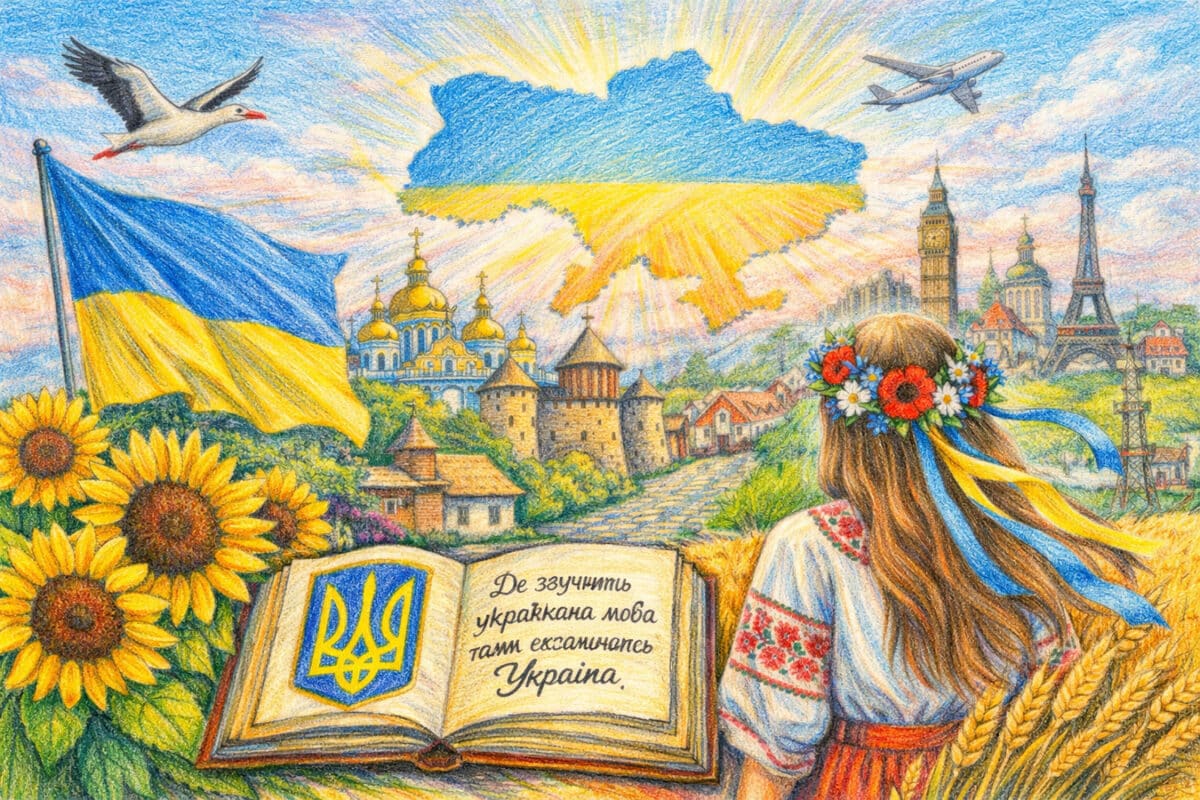
The Ukrainian language is not only a means of communication but also a sign of the country’s presence in the world. Where it lives and is used, Ukraine is preserved as a cultural and political space. That is why the conversation about language always goes beyond linguistics and becomes a matter of identity and security.
Today, about 45 million people worldwide speak Ukrainian, with more than 37 million calling it their native language. For its melodiousness, lexical, and phraseological richness, the Ukrainian language has repeatedly been recognized as one of the most harmonious in Europe. At international linguistic forums, it consistently ranked among the leaders, second only to a few languages of the Romance group.
The modern vocabulary of the Ukrainian language consists of about 256,000 words, placing it among the most developed language systems.
Researchers also emphasize the antiquity of the Ukrainian language. Scientist V. Kobyliukh argued for its formation as early as the X–IV millennia BC, linking the origin of several words to Sanskrit. By the number of speakers, the Ukrainian language ranks 14th in the world — a figure that speaks for its resilience and viability.
The attitude towards the native language has always been a marker of national consciousness. Metropolitan Ilarion (Ohienko) warned: the loss of respect for the language is equivalent to undermining the foundations of the nation. Educator Konstantin Ushinsky wrote even more harshly — a people can regain what was lost, but a language, once destroyed, cannot be restored. This idea was later developed by modern Ukrainian thinkers, emphasizing that language is a personal and collective asset that cannot be confiscated or stolen.
The history of the Ukrainian language is a history of resistance. After the capture of Ukrainian lands by Moscow, a long process of systematic suppression began. During the imperial and then Soviet rule, about 170 decrees were issued against the Ukrainian language, tens of thousands of words disappeared from dictionaries, and language policy was reduced to forced “convergence” with Russian. This process is increasingly called linguocide — the deliberate destruction of language as the basis of cultural-historical community.
It is important to emphasize: Ukrainian and Russian languages do not have a common root and are among the most distant from each other among the Slavic languages. Ukrainians are an ancient Slavic people, while the formation of the Russian ethnos occurred in a different, mixed historical environment. Despite this, during the Soviet period, the Ukrainian language was pushed into the ritual sphere, even after formally receiving state status in 1989.
After the restoration of independence, the position of the Ukrainian language began to change, but slowly. The Constitution enshrined its state status, but pro-Russian forces continued to promote the idea of “oppression” of the Russian language. Meanwhile, nowhere in the world do national minorities have the volume of rights that Russian speakers in Ukraine had for a long time. The struggle against the law on the functioning of the Ukrainian language as a state language in 2019 became another confirmation of this resistance.
It is indicative that the regions with minimal presence of the Ukrainian language turned out to be the most vulnerable to occupation. In the Luhansk and Donetsk regions, as well as in Crimea, the share of Ukrainian schools was critically low, despite the numerical predominance of Ukrainians. The 2001 census recorded an increase in the use of the Russian language to 81% in these regions, which directly affected their informational and cultural vulnerability.
Today, one of the channels for maintaining Russian influence remains the so-called UOC-MP, which continues to broadcast Moscow’s ideology under the guise of religion. Added to this is the phenomenon of the “Russian-speaking population” — not as an ethnic, but as a political category. Many people became Russian-speaking not through their own fault, but as a result of colonial policy. But the responsibility for refusing to reclaim their native language for themselves and their children during the years of independence remains.
Global experience shows: language protection is the norm. The Czech Republic, Finland, and Israel have gone through a conscious language policy. Under President Tomáš Masaryk, the Czech language returned to the public space of Prague. Finland almost completely switched to Finnish in one generation. In Israel, Hebrew became the state language, despite the fact that at the time of the country’s founding, only a few spoke it — the choice was made for the sake of nation-building.
In France, Germany, Poland, and Slovakia, strict laws protect national languages, including fines and criminal liability. Paradoxically, today the Ukrainian language is being studied more actively in Europe — in Poland and Germany, it is introduced as a second foreign language, with the support of states and the diaspora.
A new threat is not Russification, but Anglicization. Knowledge of foreign languages is necessary, but the substitution of native vocabulary with borrowings without necessity is a path to blurring the linguistic core. Linguist Yuriy Shevelyov warned: excessive borrowings indicate an underestimated self-esteem of one’s own language. This idea was formulated even earlier by Jan Amos Comenius, insisting on the primacy of the native language in education.
The Ukrainian language has withstood the pressure of empires. It survived Russification, Polonization, Germanization, and Magyarization. Today, its future no longer depends on decrees from outside, but on the everyday choice of Ukrainians themselves — to speak at home, at work, at school, on the street, and to pass the language on to children.
As Ivan Franko wrote, language grows with the soul of the people. And as long as this growth continues, Ukraine remains alive — here and now. This is the meaning and reality captured by NAnews — News of Israel | Nikk.Agency, viewing language as a line of defense for culture and the state.
