On July 29, 2026, a lecture titled “From Soviet Propaganda to Modern Russia” will take place in Tel Aviv (orig. English – From Soviet Propaganda to Modern Russia: Ukrainians, Jews and the Language of Political Myths). Artist, visual culture researcher, and Jewish education specialist Moshe Shamah will show how the same propaganda constructs have been used for decades against Ukrainians, Jews, and Israel.
The meeting will take place on Wednesday, July 29, at 19:00, at the ANU — Museum of the Jewish People. The lecture will be delivered in English with translation into Russian, so Russian-speaking residents of Israel can also participate.
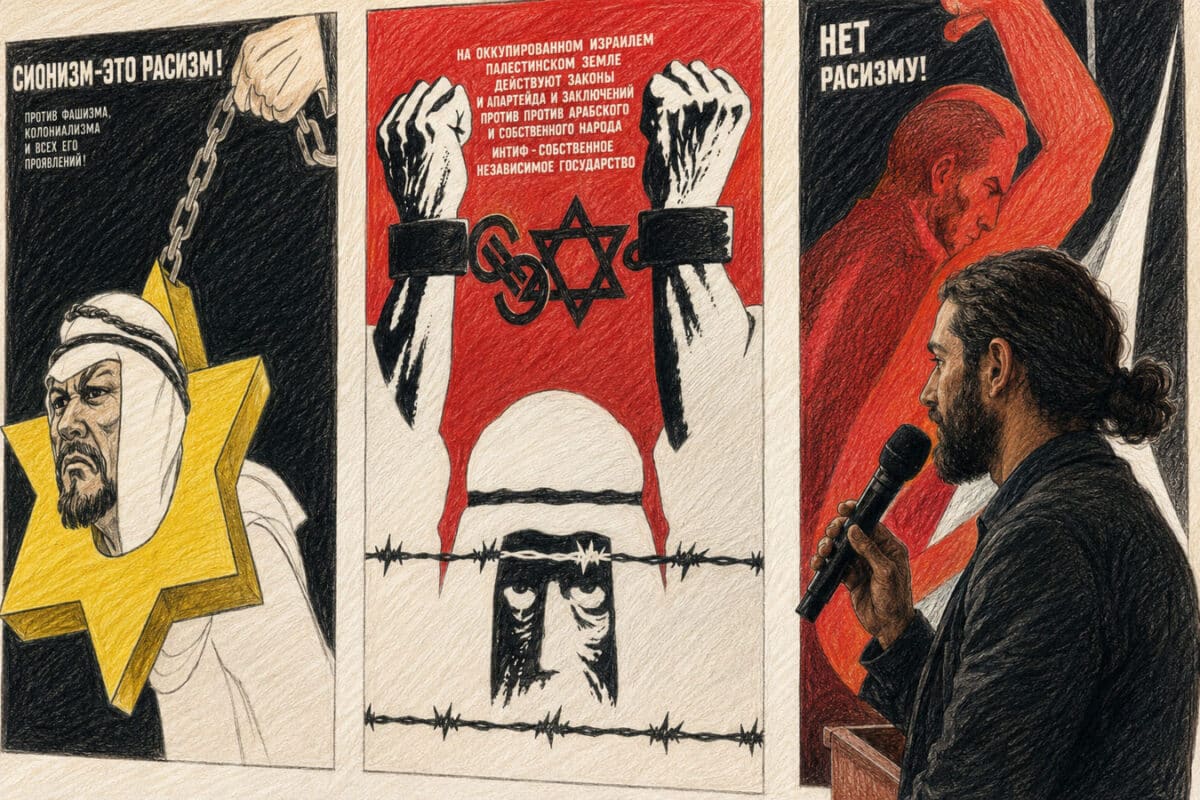
This is not just a historical account of Soviet posters. The organizers propose to trace how old anti-Semitic, anti-Ukrainian, and anti-Zionist images have been transferred into the modern Russian information space — into television broadcasts, news, Telegram channels, social networks, and short videos.
How propaganda creates an “enemy” and then justifies an attack
One of the central themes of the lecture will be the Russian claim of an allegedly existing “neo-Nazi regime” in Kyiv. The Kremlin uses this formula as a justification for the war against sovereign Ukraine, but the mechanism itself appeared long before the full-scale invasion and grew out of the Soviet propaganda tradition.
First, a certain country, people, or social group is depicted as an absolute threat. Then the thesis emerges that any actions against this threat are permissible — war, repression, destruction of cultural identity, or political violence.
In Soviet and Russian propaganda, images of Ukrainians, Jews, and Israelis were often linked together. Accusations of Nazism, blood libels, conspiracy stories about secret centers of influence, and depictions of “puppet masters” reminiscent of the visual language of the “Protocols of the Elders of Zion” were used. The lecture materials mention, in particular, posters depicting IDF soldiers and Ukrainians as participants in an allegedly impending Nazi coup.
Why this topic is important specifically for Israel
For the Israeli audience, it’s not just about Ukraine. The same propaganda templates are used to demonize Israel: the state is first portrayed as the source of global evil, and then violence against Israelis and Jews is attempted to be explained as a “natural reaction.”
Particularly dangerous is the historical inversion, where the victim of aggression is declared the aggressor, and the attacking side — the defender.
In such a narrative, Ukraine becomes “Nazi,” Israel — “colonial” or “fascist,” and the Russian state gains the ability to simultaneously appeal to Soviet memory, anti-Semitic conspiracy theories, and the modern language of social networks.
At the lecture, Moshe Shamah plans to analyze recurring symbols, stigmas, and visual constructs, as well as talk about media literacy — how to recognize manipulation in news, publications, and the surrounding information flow.
For NAnews — News of Israel | Nikk.Agency, this meeting is of particular interest also because it connects two topics that are too often considered separately: the Russian war against Ukraine and the spread of anti-Semitic and anti-Israeli narratives.
Who is Moshe Shamah
The full name of the lecturer in English sources is Peter Moshe Shamah. He grew up in New Milford, New Jersey, and after graduating from university, made aliyah and moved to Israel. He currently lives and works in Jerusalem.
Shamah calls the house he grew up in essentially Israeli: Israel was present in family music, culture, spiritual life, and self-perception. In 2013, while still a high school student, he participated in an educational trip to Holocaust sites in Poland, the Czech Republic, and Germany. Later, the artist said that this trip was one of the events that prompted him to work with Jewish memory, historical trauma, and identity.
Studies at Rutgers University and archival work
At Rutgers University, Shamah studied art history and Judaic studies. In 2018, he graduated from the School of Arts and Sciences with a double major — Art History and Jewish Studies. His curriculum included biblical poetry in Hebrew, the Dead Sea Scrolls, and museology.
He worked as a research assistant to Professor Gary Rendsburg and participated in the deciphering and digital processing of medieval documents related to Ovadia the Proselyte — a Christian monk who converted to Judaism in the 12th century. Shamah’s participation in the creation of the digital project is confirmed by Rutgers University materials.
In addition, he was involved in transcribing and annotating interviews with the renowned ancient Near East researcher Cyrus Gordon. On his own website, Shamah also lists a certificate in cultural heritage preservation and experience working with historical archives and archaeological projects.
After aliyah, he worked for about a year in a Jerusalem project sifting soil from the Temple Mount. According to the artist, contact with archaeological fragments, ash, and material traces of the past became a turning point for him and returned him to active artistic work. In 2019, he opened his own studio Studio Shamah in Jerusalem.
Art between antiquity and modernity
Shamah works with collage, calligraphy, watercolor, ink, oil painting, and mixed media. In his works, he combines Jewish texts, Sephardic culture, biblical images, and modern political plots.
His works are dedicated to collective memory, Zionism, Israel, anti-Semitism, the consequences of October 7, and Russia’s war against Ukraine. The artist himself explains collage as a way to take the surrounding chaos, destroy its previous structure, and reassemble it into a meaningful human statement.
In 2024, Shamah, together with poet Yonah ben Avraham, released the book Ohelibah: Quiet on the Mountain & Memory, combining poetry, painting, and collage. The presentation and exhibition took place in Tel Aviv. In June 2025, his works were shown in Belgrade at the exhibition Places That Aren’t, dedicated to the role of utopias in human culture.
The artist’s personal projects have been held in Israel, Serbia, and the USA. The ANU Museum also reports planned exhibitions in Warsaw, Kyiv, Jerusalem, and Tel Aviv.
Moshe Shamah and Ukraine
The Ukrainian theme appeared in Shamah’s works not after 2022.
He said he has been following Russian aggression since 2014, after the occupation of Crimea and the start of the war in Donbas, and considers the struggle of Ukraine and Israel as connected parts of a broader confrontation against dictatorship, terror, and the destruction of national identity.
In the spring of 2022, his solo exhibition Slava Ukraini was held at the Karmazin Gallery at Rutgers Hillel. Simultaneously, Studio Shamah launched a charitable art series of the same name.
According to the studio, 50 to 90 percent of the proceeds from individual works were directed to humanitarian aid for Ukrainians and the purchase of protective equipment. In this series, Ukrainian wheat, sunflowers, elements of embroidery, city silhouettes, and the combination of Ukrainian and Jewish motifs appeared.
In 2025, in the USA, Shamah presented the series To Those Who Fight for Life, dedicated to Ukraine’s struggle, and his lectures and art projects simultaneously addressed the war against Israel, anti-Semitism, and Russian propaganda.
Not a political scientist, but a researcher of visual language
It is important to accurately understand the professional perspective of the lecturer. Moshe Shamah is not positioned as a military analyst, a specialist in Russian special services, or a professor of political science.
His approach is based on art history, archival work, Jewish studies, cultural memory, and the analysis of visual symbols. That is why he considers propaganda primarily as a system of images: which faces are turned into “enemies,” what historical associations they evoke in the viewer, and why old anti-Semitic drawings can reappear in modern digital design.
This is the uniqueness of the upcoming meeting. Participants will be offered to see Russian propaganda not as a set of separate false statements, but as a visual language that changes form over decades while maintaining its previous goals.
Date, place, and practical information
Title: “From Soviet Propaganda to Modern Russia”
Lecturer: Moshe Shamah — artist, researcher, and specialist in Jewish education
Date: Wednesday, July 29, 2026
Start: 19:00
Language: English with translation into Russian
Place: ANU — Museum of the Jewish People
Address: Klausner Street, 15, Ramat Aviv, Tel Aviv
Entrance: through gate No. 2 of Tel Aviv University
Tickets are available through the official page of the ANU Museum
– https://anumuseum.org.il/events/propaganda/
Moshe Shamah’s lecture is an opportunity to see the connection between Soviet posters, Kremlin television, and modern social networks. For the Israeli audience, it is also a conversation about why propaganda directed against Ukraine so often uses the same vocabulary of hatred that has been used against Jews and the State of Israel for decades.
NAnews — News of Israel | Nikk.Agency recommends paying attention to this meeting for everyone who wants not only to read the information flow but also to understand who, why, and with what images tries to manipulate the perception of war, history, and the very concept of victim.
