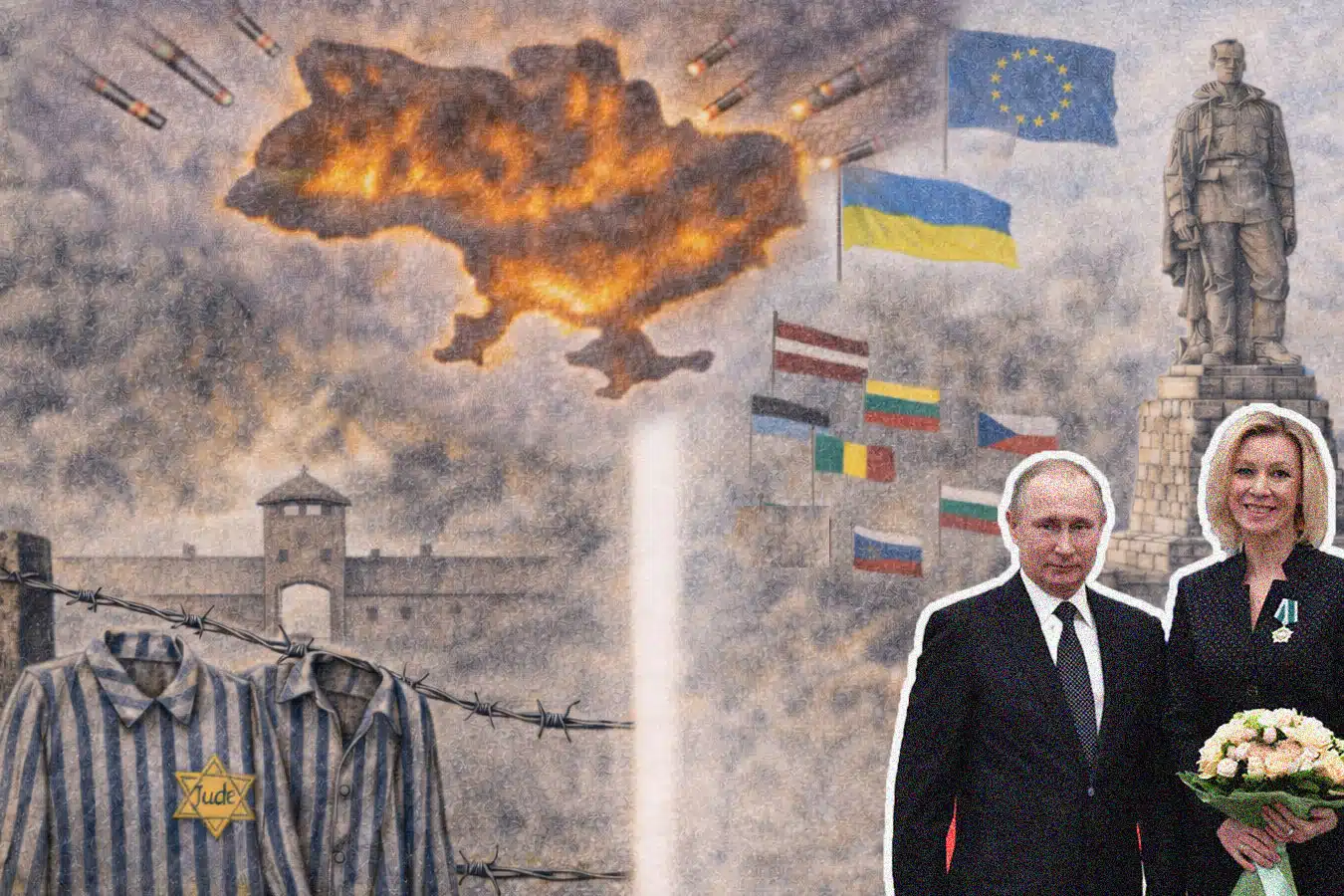
On February 8, 2026, Russian state resources spread a statement by the official representative of the Russian Foreign Ministry Maria Zakharova that Moscow is “trying to convince” Israel: the dismantling of memorials to Soviet soldiers in Europe is allegedly linked to the rise of anti-Semitism.
The quote sounded like this:
“We are trying, among other things, to convince our Israeli colleagues that the destruction of memorials to Soviet soldiers (including Jews) who stopped the Nazi Holocaust is one of the factors in the rise of anti-Semitism in Europe,” she said.
At the time of publication, the Israeli Foreign Ministry had not publicly responded.
Why this does not look like “fighting anti-Semitism”
Because here you can hear not fear for the Jews of Europe, but a scheme familiar to Moscow: take a topic that cannot be calmly objected to and attach it to its current policy.
The Holocaust is not a “trump card” in a diplomatic skirmish. In Israel, it is family memory, names, archives, graves, empty places at the table. When official Moscow inserts this into a press construction, the effect is the opposite: people get the feeling that their pain is being used as a tool of pressure.
“Soviet” does not equal Russian, and this is a key deception
The second problem is the privatization of victory.
The Soviet army was the army of a multinational USSR. Russians, Ukrainians, Belarusians, Jews, peoples of the Caucasus and Central Asia fought and died there. Therefore, the “Soviet victory” cannot automatically turn into a “Russian monopoly on morality.”
When Moscow talks to Israel as if it alone is the main heir and everyone else should “remember correctly,” it sounds like a political substitution of history.
This is where what readers of NANews — Israel News | Nikk.Agency instantly recognize: it’s not about memory, but about trying to get a moral “shield” for today’s policy.
The price of victory: what Moscow prefers to speak quietly about
In the USSR, victory was real — and at the same time terribly expensive.
And yes, in conversations about the war, an uncomfortable layer increasingly surfaces: how many people Soviet commanders sacrificed, how often they advanced “at any cost,” how little a soldier’s life meant in the logic of a totalitarian system.
And here arises what many find particularly vile: a country that is waging war today tries to speak from the position of a moral arbiter — while its critics see the same logic of “the task is more important than life” in current practice.
Kremlin critics formulate this harshly: both then and now, tens of thousands of soldiers are sacrificed without regard for losses — only now it’s about the death of Russian soldiers in the war against Ukraine. This is not a “historical reference,” it’s a political accusation, and it directly undermines the attempt to lecture others.
Sovereign countries decide for themselves what stands on their land
The third thing Moscow stubbornly ignores: monuments are located on the territory of independent states.
Riga, Warsaw, Kyiv or Vilnius are not “branches of foreign memory.” These are sovereign societies that have the right to decide which symbols remain in public space, which are moved, and which are dismantled.
You can argue with these decisions. You can condemn them. You can engage in dialogue.
But when Russia presents this as a reason to “educate” countries and demand the correct reaction from Israel, it is perceived not as concern for the victims, but as a continuation of the imperial habit of dictating rules.
Why comparisons with Nazi Germany keep resurfacing
It’s important to say carefully: no one claims that history repeats itself literally. But in public debate, parallels in methods emerge — and they emerge largely because Moscow itself imposes the language of “fighting Nazism” on everyone.
What critics of current Russian policy usually compare:
aggression against a neighbor under ideological justification;
propaganda that explains the war as a “historical mission”;
language that divides people into “correct” and “hostile,” replacing the conversation about facts with moral labels.
And when these elements accumulate, any attempt to speak on behalf of the memory of the Holocaust looks not like the protection of Jews, but like an attempt to cover one’s own aggression with a high theme.
Separately — about “rashism.” In this text, this word is used as a journalistic label: about the practice of propaganda and pressure, where someone else’s pain and common history are used as justification for war and as a reason to lecture others.
What Russia is doing now with Ukraine
Russia’s war in Ukraine has long become not only a front but also constant pressure on the country’s everyday life. The logic is simple: not to give Ukraine a “normal day” — if it’s quiet in one place, it hits in another, if the network is restored, a new wave of strikes begins.
Strikes on cities and infrastructure
Regular missile and drone attacks hit residential areas and critical infrastructure — energy, transport, communications. The result for people is down-to-earth: destroyed homes, interruptions in water and electricity, problems with heating and medicine. This is not a “background,” but a way of exhausting the population and the state.
Occupation and pressure
In the occupied territories, the key is control and coercion. Pressure on local residents, the displacement of Ukrainian identity from public space, persecution of dissenters. Around this, accusations of filtration and forced relocations constantly sound — something that rarely gets into short reports but creates long-term trauma.
Refugees, families, economy
Millions of people are forced to leave or relocate within the country. Families are torn apart, children grow up in foreign languages, the elderly are left alone — this is a demographic blow for years. Simultaneously, attacks on logistics and economic hubs undermine Ukraine’s ability to earn and recover: less export, less money for social payments and defense, more dependence on external aid.
Price and cynicism
Even for Russia, the war means large human losses, including the death of Russian soldiers, and the depletion of resources. And this is what makes any attempts to speak to Israel in the language of the Holocaust especially cynical: it is impossible to appeal to the memory of the catastrophe while simultaneously causing new large-scale destruction and human suffering in Ukraine.
What this means for Israel
For Israel, it is most advantageous to maintain a cold distance here.
Because any word can be taken out of context and used as “evidence” — either of support or hostility. And the topic of the Holocaust is too important to allow it to be turned into a bargaining chip in someone else’s information war.
Conclusion
Russia is not just “convincing Israel” of the danger of anti-Semitism.
It is trying to impose a framework on Israel: monuments as an indicator of morality, and Moscow as the main guardian of history.
The problem is that this framework looks not like the protection of memory, but like the exploitation of memory — primarily the memory of Jews and veterans — for the sake of whitewashing its own aggression, justifying the current war, and the right to dictate to others.