
Iran, with the help of Russia and China, continues to receive military components, explosives, and equipment for the production of missiles and drones, despite international sanctions and the American naval blockade. The purchases are backed by a network of more than 5,000 structures linked to the Ministry of Defense of the Islamic Republic. Through one of them, military products worth $2.3 billion passed in a year and a half.
Author: Stas Shifer
On October 29, 2026, Reuters published an investigation, prepared jointly with the Israeli-American analytical company 240 Analytics. Journalists studied Iranian banking documents, corporate registers, transport invoices, and about 19,000 import records. Among the identified operations were five deliveries of Russian detonators with a total value of $7.6 million. The last one, worth $1.9 million, took place in June 2026, after the start of the US and Israel war against Iran.
The investigation has a direct connection to Israel. The first signs of the hidden network were discovered by 35-year-old economist Noam Binstock, working at 240 Analytics in Petah Tikva. His analysis of bank accounts helped establish how Iranian military continues to purchase equipment abroad without conducting regular international payments.
This story continues the theme that NANews — News of Israel Nikk.Agency already thoroughly investigated in August: Russia uses the Caspian Sea to send ammunition, explosives, and drone components to Iran. New documents reveal not only the delivery route but also the financial infrastructure that supports such operations.
Five thousand structures, one address in Tehran, and billions of dollars
The identified organizations bear the designation MOD — an abbreviation for Ministry of Defense, or VODJA in Persian transliteration. It is followed by a five- or six-digit number. For example, MOD 346428 and MOD 424000. Each structure has its own 11-digit state identifier, allowing for the matching of accounts, procurement documents, and customs records.
All organizations are registered at the address of the Iranian Ministry of Defense and Logistics of the Armed Forces. The formal date of their creation is February 11, 1979 — the day of the victory of the Islamic Revolution. However, most actually appeared in 2013, when sanction pressure sharply complicated the export of Iranian oil and international settlements.
Network participants operate through foreign intermediaries and shell companies. Revenue from oil sales remains outside Iran and is directed to pay for weapons, industrial equipment, and dual-use goods. In 97% of the studied deliveries, settlements were made without cross-border currency transfers.
For Israeli readers, this explains why sanctions against the Iranian Ministry of Defense are not equivalent to a complete halt in its purchases. Money can be held in foreign accounts, the goods are acquired by an intermediary, and the final recipient is determined only after matching several documents.
Reuters did not find evidence of the inclusion of the numbered structures themselves in Western sanctions lists. However, some recipients and military organizations they assist are already under restrictions.
In the documents of the state Bank Sepah, there were matches of phone numbers of 91 structures with bank records of employees of the Islamic Revolutionary Guard Corps (IRGC). This corps is not an ordinary part of the Iranian army but a separate military-political organization controlling significant economic resources and participating in weapons development.
Russian detonators and Chinese missile components: what Iran purchased
The Russian part of the investigation contains specific amounts and dates. Since January 2025, at least five batches of Russian-origin detonators worth $7.6 million have been delivered to Iran. In June 2026, a batch worth $1.9 million was delivered. Such devices can be used to initiate explosives in missile warheads and strike drones.
Russian cargoes were transported by ships across the Caspian Sea. Other routes passed overland through Central Asia and by air from China. The US naval blockade, which operated intermittently, did not block all these directions.
Chinese deliveries included materials for missile production. From January to April 2025, 886 tons of chemicals registered as Chinese products and classified under a customs category including solid rocket fuel components were imported through Bandar Abbas.
On February 9, 2026, 93 tons of unprocessed Chinese titanium, suitable for making missile bodies, arrived at the port. In February, 268 tons of nitrocellulose and 276 tons of other chemicals from a category including perchlorates were also delivered.
On April 26, 2025, an explosion in Bandar Abbas claimed at least 70 lives, and more than 1,200 people were injured. Sources linked the disaster to the ignition of sodium perchlorate. Reuters did not establish whether the specific last 75-ton batch of chemicals was the cause. The cargoes were stored by a company owned by the Bonyad Mostazafan foundation, which is under American sanctions.
Iran also purchased CNC machines, electron beam furnaces, and particle accelerators. The equipment has civilian applications but can also be used for manufacturing missile bodies and drone parts. The documents show an effort not only to receive ready-made components but also to maintain its own production capabilities.
European trucks and drones for the war against Ukraine
Through MOD 346428, from January 2025 to June 2026, 435 Iveco trucks were imported. Among other purchases were thousands of Toyota Hilux and Land Cruiser, as well as four Toyota Tundra, which arrived in January 2025. The Iranian military uses such vehicles to transport weapons, mount machine guns, and deploy mobile launch systems.
In March, the American command published a video of the destruction of a disguised missile installation. Janes specialists identified the vehicle as an Iveco model, but its belonging to a specific MOD 346428 batch could not be established. Reuters also matched satellite images of a parking lot on the outskirts of Tehran with identification numbers of several trucks.
Import documents also featured European goods: trucks, aircraft engines, electronics worth hundreds of millions of dollars, including Iveco worth $34 million. Their origin was indicated as Germany and other EU countries.
Iveco stated that it restricts sales to prohibited recipients but does not control independent resales. Toyota denies involvement in the described purchases. The documented origin of the goods does not in itself imply a conscious violation of sanctions by the manufacturer.
A separate operation links the network to Russia’s war against Ukraine. In the fall of 2022, an Iranian car dealer in Italy purchased six Iveco Eurocargo for €426,000. Through Deilami Trading in Dubai, the trucks were delivered to Bandar Abbas. The final recipient was Sahara Thunder — a company sanctioned by the US in 2024 for producing and supplying drones to Russia.
Previously, NANews investigated how Russian-Iranian cooperation in the field of drones links the wars in Ukraine and the Middle East. New documents add financial and transport components to this story. They do not prove that Russian detonators were used in specific strikes but establish the intersection of military procurement chains.
Analyst from Petah Tikva, Bank Sepah, and hidden accounts
Noam Binstock discovered unusual records in June 2025 while studying Bank Sepah documents published on Telegram and WikiIran. The bank services, in particular, salary and pension accounts of IRGC employees. The responsibility for hacking its systems was previously claimed by the Codebreakers group.
The bank documents repeated the names of organizations, a common address, and the same registration date. At the end of 2024, the foreign currency accounts of 36 structures held $1.2 billion. The rest of the network had the equivalent of about $1.8 billion in Iranian currency.
In August 2026, Binstock returned to the study and matched bank records with oil revenues and import documents. After this, 240 Analytics involved Reuters. MOD 346428 stood out: its annual imports grew from $442 million for the period up to March 2023 to $988 million for the next year, and from January 2025 to June 2026 reached $2.3 billion.
For Israel, the significance of this work lies in discovering financial links between seemingly disparate purchases. Instead of one supplier or ship, researchers established a network of identifiers, bank accounts, and recipients through which military imports can be traced.
Purchases continued during the war, and the network also served repression
After the start of the war on February 28, 2026, imports through the investigated structure decreased by 47% in March, to $54 million, but recovered to $77 million by May. Additionally, goods worth $27 million were registered as originating from the UAE. The last identified sea delivery of electronics was dated June 27. The American blockade was temporarily suspended on June 18 and resumed in mid-July.
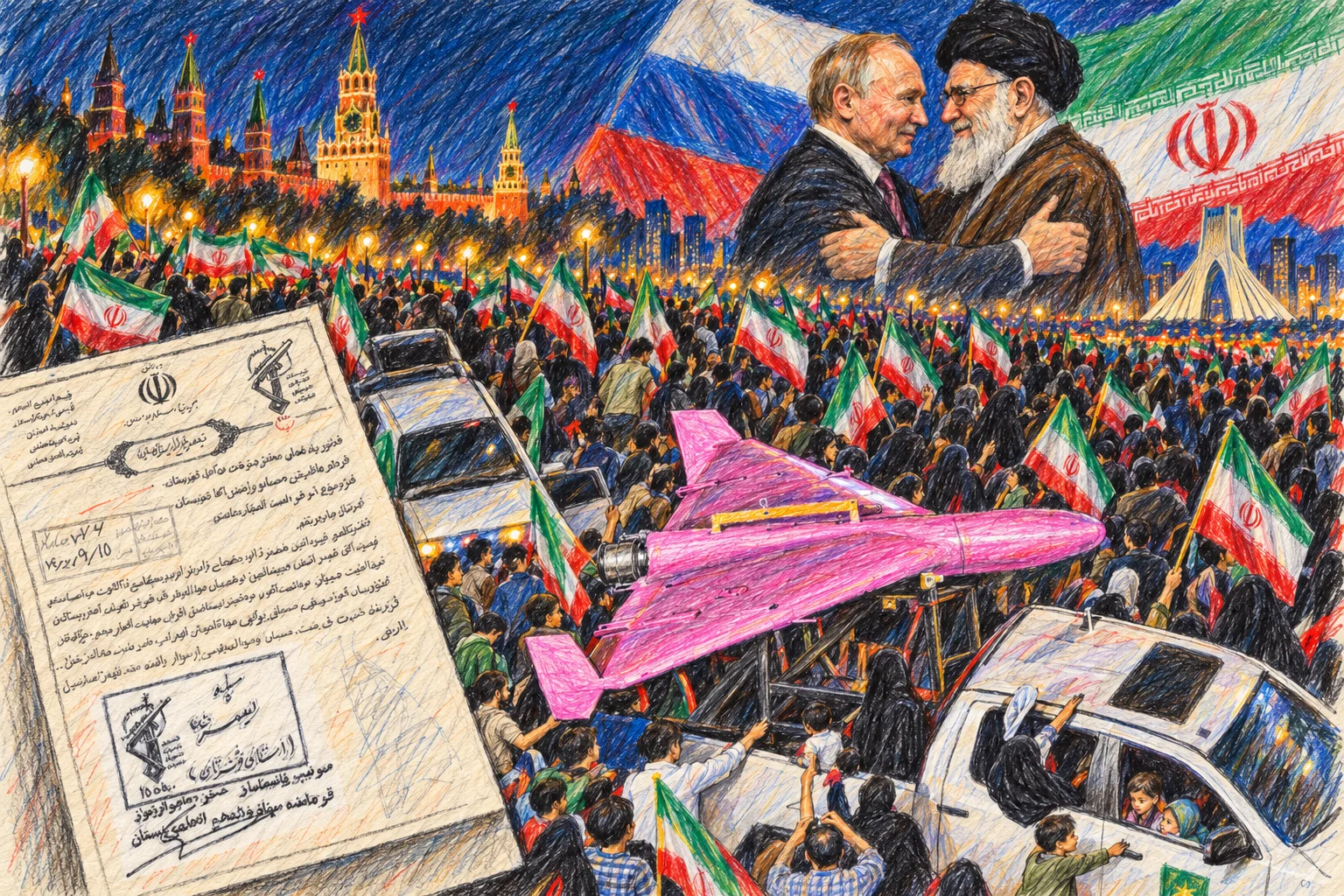
The network was used not only for external military purchases. Documents link MOD 424000 to funding IRGC facilities in Khuzestan province. In 2021, General Hassan Shahvarpour requested 50 billion rials for the construction of a corps building. The US previously accused his subordinate units of killing protesters in 2019. Human rights activists also reported 46 deaths in Khuzestan during the January 2026 protests. In Iranian television materials, Shahvarpour’s units used Toyota Tundra, including for transporting a bright pink Shahed drone.
On October 12, US President Donald Trump publicly questioned the significant assistance of Russia and China to Iran. However, documents published on October 29 record deliveries of goods of Russian and Chinese origin. Moscow did not respond to Reuters’ request, and Beijing stated that it was unaware of the described circumstances and rejected accusations of involvement in the regional war.
The published materials do not confirm that specific Russian detonators were used against Israel. Their cost, origin, dates, and connection to the Iranian military procurement network are established. The last documented Russian batch arrived in June 2026 — four months after the start of the war, when Israel and the US were already striking Iranian missile productions.
