
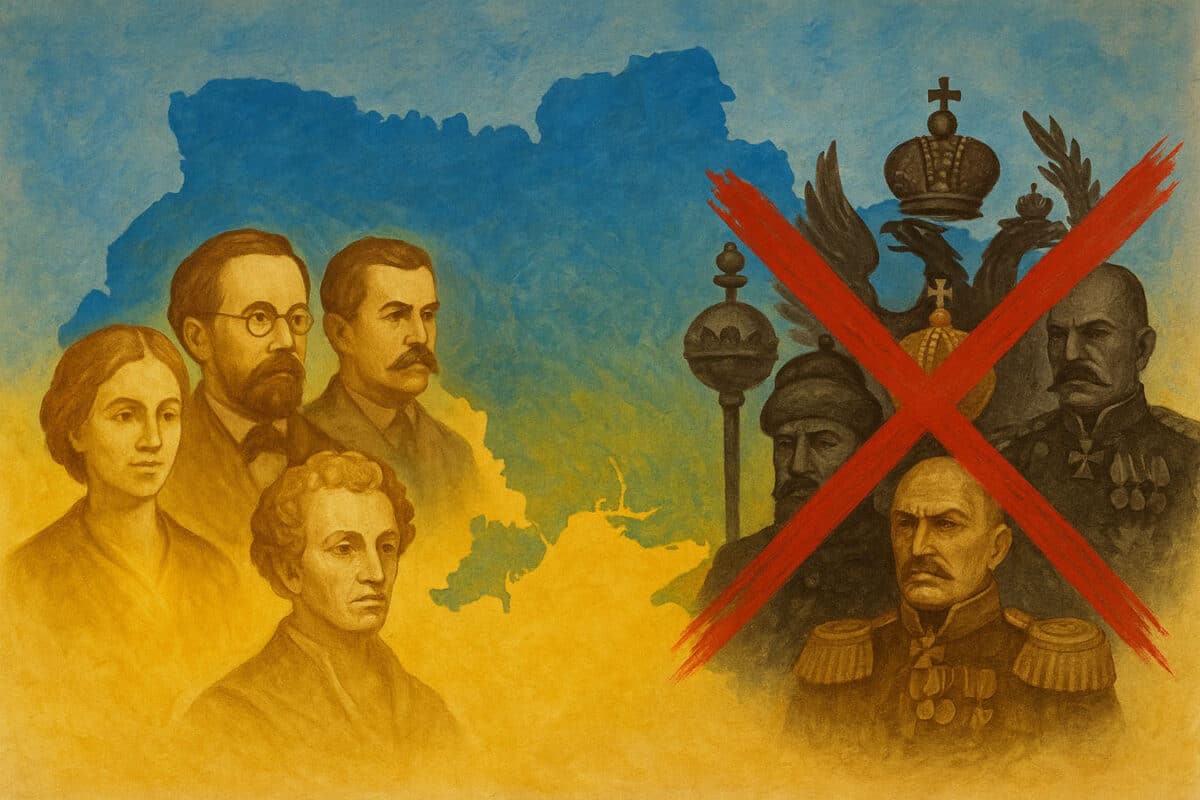
October 7, 2025 The Ukrainian Institute of National Memory (UINP) published an official list of persons and events NOT containing “symbols of Russian imperial policy”.
This step became part of the state decolonization program — rethinking historical heritage, where the main goal is not to destroy, but to discern.
What is this list and why is it needed
In recent years, Ukraine has been actively cleansing public spaces of traces of its colonial past.
Streets are being renamed, monuments to imperial rulers and ideologists are being dismantled. But to avoid “throwing the baby out with the bathwater,” a “white list” was created — names and events that can be preserved.
“The list is not exhaustive and will be supplemented in accordance with the special conclusions of the expert commission,” explained the UINP.
“Its goal is to help local governments implement the law on condemning imperial policy without losing genuine cultural heritage.”
What is UINP and where did the decolonization law come from
The Ukrainian Institute of National Memory (UINP) https://uinp.gov.ua/ is a state institution responsible for shaping the country’s historical policy. It is engaged in researching, preserving, and popularizing historical heritage, especially those periods where Soviet or Russian propaganda distorted facts.
After 2014, and especially after the start of the full-scale war, UINP became a key center for decommunization and decolonization.
These processes are based on the Ukrainian law “On the Condemnation and Prohibition of Propaganda of Russian Imperial Policy in Ukraine and Decolonization of Toponymy”, which prohibits the use of imperial symbols, names, and monuments associated with the ideology of subjugating Ukraine.
The law does not ban Russian culture as such — it clearly distinguishes between culture and propaganda.
If a person lived in the Russian Empire but acted in the name of humanity, science, or art, their name is preserved.
Who was included in the list
“List No. 2
of persons and events of the Moscow Tsardom and the Russian Empire period, objects dedicated to which, according to paragraph 4 of part 1 of article 2 of the Law of Ukraine “On the Condemnation and Prohibition of Propaganda of Russian Imperial Policy in Ukraine and Decolonization of Toponymy”, fall under exceptions and do not contain symbols of Russian imperial policy“
They are united by one thing — the absence of service to imperial ideology.
Many of them had Ukrainian roots, lived or created in Odesa, Poltava, Kharkiv, Kyiv, creating works that have long become part of Ukrainian identity.
Personalities and events, objects dedicated to which do not contain symbols of Russian imperial policy
- Ivan Aivazovsky (1817–1900) — Russian painter of Armenian origin.
- Mykola Arkas (1853–1909) — Ukrainian composer, poet, historian, public figure.
- Mykola Benardos (1842–1909) — Ukrainian inventor, creator of arc welding.
- Volodymyr Borovykovsky (1757–1825) — Ukrainian and Russian painter, academician of the St. Petersburg Academy of Arts.
- Karl Bryullov (1799–1852) — classicist and romantic painter, teacher of Taras Shevchenko.
- Hryhoriy Vakulenchuk (1877–1905) — native of Zhytomyr region, petty officer of the Black Sea Fleet, one of the leaders of the uprising on the battleship “Potemkin”.
- Mykhailo Vrubel (1856–1910) — symbolist painter of Polish origin.
- Oleksandr Verkhovtsev (1837–1900) — Russian railway engineer, head of the Kateryninska Railway.
- Alexander Herzen (1812–1870) — Russian writer, philosopher, publicist, supporter of Ukraine’s independence.
- Nikolai Gogol (1809–1852) — writer of Ukrainian origin, representative of the “Ukrainian school” of Russian literature.
- Vladimir Dal (1801–1872) — writer, lexicographer, scientist.
- Hryhoriy Danylevsky (1829–1890) — Ukrainian and Russian writer, ethnographer, historian.
- Osip (Jose) Deribas (1751–1800) — Russian admiral of Spanish origin, founder and organizer of Odesa.
- Vasyl Dokuchaev (1846–1903) — Russian scientist, founder of soil science, worked in Poltava.
- Oleksandr Zasyadko (1779–1837) — Ukrainian specialist in rocket weaponry creation.
- Vasyl Karazin (1773–1842) — Ukrainian scientist, inventor, founder of Kharkiv University.
- Mykola Kybalchych (1853–1881) — Ukrainian engineer, creator of a rocket apparatus project, revolutionary.
- Petro Kishka (1828–1882) — sailor of the Black Sea Fleet, hero of the Crimean War.
- Thomas Cobley (1761–1833) — major general, governor of Odesa, fought the plague epidemic.
- Volodymyr Korolenko (1853–1921) — writer and public figure.
- Ivan Kramskoi (1837–1887) — portrait painter of Ukrainian origin.
- Alexander Kuprin (1870–1938) — writer, journalist, advocated for people’s rights.
- Louis de Langeron (1763–1831) — governor of Odesa, founder of the Richelieu Lyceum and Botanical Garden.
- Andriy Levanidov (d. 1802) — governor of Sloboda Ukraine, philanthropist and collector of antiquities.
- Nikolai Leskov (1831–1895) — writer and publicist, lived in Kyiv for a long time, actively used Ukrainian motifs.
- Yuriy Lisianskyi (1773–1837) — Ukrainian navigator, one of the first circumnavigators.
- Hryhoriy Marazli (1831–1907) — mayor of Odesa, philanthropist and reformer.
- Levko Matsievich (1877–1910) — shipbuilding engineer, one of the first aviators.
- Illya Mechnikov (1845–1916) — Ukrainian and French scientist, founder of immunology, Nobel laureate.
- Apolon Mokrytskyi (1810–1870) — Ukrainian painter and teacher.
- Hryhoriy Myasoyedov (1834–1911) — Russian and Ukrainian painter.
- Ivan Myasoyedov (1881–1953) — Ukrainian artist and graphic artist.
- Nikolai Nekrasov (1821–1878) — writer and publicist, criticized autocracy.
- Klavdiy Nemeshaev (1849–1927) — railway engineer, education reformer.
- Petro Nesterov (1887–1914) — Ukrainian aviator, inventor of the “loop-the-loop”.
- Nikolai Novoselsky (1818–1892) — doctor, public figure, mayor of Odesa, founder of spa treatment.
- Nikolai Pirogov (1810–1881) — scientist, surgeon, founder of field surgery.
- Ivan Pavlov (1849–1936) — physiologist, Nobel laureate.
- Alexander Popov (1859–1906) — inventor and physicist, pioneer of radio communication.
- Adrian Prakhov (1846–1916) — art historian, archaeologist, led the painting of the St. Vladimir’s Cathedral in Kyiv.
- Emmanuel de Richelieu (1766–1822) — French and Russian statesman, first governor of Odesa.
- Kondraty Ryleyev (1795–1826) — poet, Decembrist, supporter of Ukraine’s liberation.
- Illya Repin (1844–1930) — artist of Ukrainian origin, author of “The Zaporozhians”.
- Mykhailo Sazhin (1818–1887) — artist and graphic artist, author of Kyiv landscapes.
- Nikolai Solovtsov (1857–1902) — actor and director, founder of the theater in Kyiv.
- Konstantin Ushinsky (1823–1871) — educator of Ukrainian origin, founder of the public school.
- Andriy Fabr (1789–1863) — governor of the Katerynoslav province, industrial reformer.
- Mykhailo Falleev (1730–1792) — military figure, participated in the construction of Mykolaiv.
- Anton Chekhov (1860–1904) — writer and playwright of Ukrainian origin, theater reformer.
- Konstantin Tsiolkovsky (1857–1935) — scientist, founder of astronautics.
- Mykhailo Shchepkin (1788–1863) — actor, founder of stage realism, friend of Taras Shevchenko.
The list is not final and will be supplemented with personalities and events from the RSFSR, USSR, and modern Russian Federation periods.
The main goal is to separate imperial and human heritage, preserving the memory of those who glorified Ukraine and the world with their work, not the ideology of subjugation.
Source:
Why this is important for Ukraine — and for Israel
For Ukraine, this document is a sign of maturity.
The country does not erase the past but has learned to distinguish the good from the oppressive.
This is a step towards its own cultural independence: respecting what is universal and rejecting what symbolizes enslavement.
For Israel, this is especially understandable.
Israeli society has also gone through the path of memory restoration: from rejecting colonial narratives to creating its own symbols, language, and historical identity.
Ukraine is now taking a similar step — measured, legal, cultural.
How the law works and why it is flexible
The main difference in the Ukrainian approach is that decisions are made by experts, not politicians.
Each name is reviewed by a commission: biographies, views, context, and place in history are checked.
If a person does not embody “imperial policy” — they remain in the cultural space.
Thus, the state shows that decolonization is not a fight against names, but a restoration of historical justice.
Reaction and significance for the diaspora
For Israelis of Ukrainian origin, this news is especially symbolic.
It reminds that memory is not a weapon, but a compass.
Just as Israel once reclaimed names forgotten for millennia, Ukraine today reclaims the right to determine who is ours and who is a symbol of foreign power.
Conclusions
The UINP list has become a document that teaches to see the difference between culture and ideology.
It helps build a future where artists, doctors, scientists are respected — but not those who justified the subjugation of peoples.
Ukraine tells the world: “We do not erase history — we cleanse it.”
There is also “List No. 1”: who is considered a bearer of imperial symbols
In addition to the “white list” (List No. 2), UINP also published List No. 1 — these are persons and events of the Moscow Tsardom and Russian Empire period, whose names/monuments are considered symbols of Russian imperial policy. The list is formed based on UINP expert conclusions and is not exhaustive: it will be supplemented, including with persons and events from the RSFSR, USSR, and modern RF periods.
What this means in practice:
objects dedicated to the persons and events listed below are subject to removal from the public space of Ukraine (renaming, dismantling, relocation, contextualization, etc.) according to the Law of Ukraine “On the Condemnation and Prohibition of Propaganda of Russian Imperial Policy in Ukraine and Decolonization of Toponymy”.
List No. 1 (according to UINP data)
- Konstantin Aksakov (1817–1860) — publicist, ideologist of Slavophilism (“special Russian path”, “chosen by God”).
- Ivan Babushkin (1873–1906) — RSDLP(b) figure, Lenin’s associate.
- Pyotr Bagration (1765–1812) — general, participant in the 1812 war.
- Mikhail Bakunin (1814–1876) — political figure, ideologist of anarchism (anti-Semitic views).
- Nikolai Bauman (1873–1905) — RSDLP(b) figure, Lenin’s associate.
- Fabian (Faddey) Bellingshausen (1778–1852) — admiral, participant in the implementation of imperial policy.
- Vissarion Belinsky (1811–1848) — critic, glorified imperial policy.
- Alexander Bestuzhev (1797–1837) — Decembrist; participation in the conquest of the Caucasus.
- Battle of Borodino (1812) — event associated with the implementation of imperial policy.
- Ivan Bunin (1870–1953) — writer, glorification of imperial policy.
- Aleksey Butovsky (1838–1917) — general; participation in the suppression of the January Uprising of 1863.
- Vasily Buturlin (†1655) — military and diplomat; head of the delegation at the Pereyaslav Rada 1654.
- Aleksey Bestuzhev-Ryumin (1693–1768) — chancellor, field marshal.
- Mikhail Vorontsov (1782–1856) — field marshal, governor.
- Ilarion Vorontsov-Dashkov (1837–1916) — minister of the court, governor in the Caucasus.
- Mikhail Glinka (1804–1857) — composer, glorification of imperial policy.
- Aleksey Greig (1775–1845) — admiral, implementation of imperial policy.
- Alexander Griboyedov (1795–1829) — diplomat, implementation of imperial policy.
- Boris Godunov (1552–1605) — Moscow tsar.
- Semyon Dezhnev (1605–1673) — navigator, exploration in the interests of the empire.
- Decembrists (1825) — movement with centralizing goals; denial of the right of peoples to self-determination (majority).
- Gavriil Derzhavin (1743–1816) — poet, dignitary, panegyrics to the empire.
- Elizaveta Petrovna (1709–1762) — empress.
- Yermak Timofeyevich (1534–1585) — “conqueror of Siberia”, beginning of the conquest of Siberian Turkic lands.
- Vasily Zhukovsky (1783–1852) — poet, privy councilor, glorification of the empire.
- Pyotr Zaporozhets (1876–1905) — RSDLP(b) figure, Lenin’s associate.
- Vladimir Istomin (1809–1855) — rear admiral.
- Antioch Kantemir (1708–1744) — diplomat, poet; the name gave the name to the 4th Guards Tank Division of the Russian Federation.
- Nikolai Karamzin (1766–1824) — writer, historian; glorification of the empire.
- Paisiy Kaisarov (1783–1844) — general of infantry, senator.
- Catherine II (1729–1796) — empress.
- Vladimir Kornilov (1806–1854) — vice admiral.
- Caesar Cui (1835–1918) — composer, engineer-general.
- Mikhail Kutuzov (1745–1813) — field marshal.
- Viktor Kurnatovsky (1868–1912) — RSDLP(b) figure, Lenin’s associate.
- Lado Ketskhoveli (1876–1903) — RSDLP(b) figure, associate of Lenin and Stalin.
- Mikhail Lazarev (1788–1851) — vice admiral.
- Mikhail Lermontov (1814–1841) — poet; glorification of the empire.
- Mikhail Lomonosov (1711–1765) — scientist; glorification of the empire.
- Mikhail Miloradovich (1771–1825) — military and state figure.
- Kuzma Minin (1570–1616) — state and military figure of the Moscow Tsardom.
- Nicholas I (1796–1855) — emperor.
- Nicholas II (1868–1918) — emperor.
- Nikita Muravyov (1795–1843) — Decembrist, leader of the Northern Society.
- Modest Mussorgsky (1839–1881) — composer (“Boris Godunov”).
- Pavel Nakhimov (1802–1855) — admiral.
- Alexander I (1777–1825) — emperor.
- Alexander II (1818–1881) — emperor.
- Alexander III (1845–1894) — emperor.
- Pavel I (1754–1801) — emperor.
- Vasily Panyutin (1788–1855) — major general.
- Ivan Paskevich (1782–1856) — field marshal; suppression of the Polish uprising, repressions.
- Pavel Pestel (1793–1826) — colonel, ideologist of the Decembrists.
- Peter I (1672–1725) — tsar/emperor.
- Dmitry Pozharsky (1578–1642) — state and military figure.
- Battle of Poltava (1709) — key event in the interests of the empire against Mazepa and Charles XII.
- Grigory Potemkin (1739–1793) — state and military figure, diplomat.
- Georgy Plekhanov (1856–1918) — political figure.
- Alexander Pushkin (1799–1837) — poet; glorification of the empire.
- Emelyan Pugachev (1742–1775) — leader of the peasant war, impostor.
- Stepan Razin (1630–1671) — ataman of the Don Cossacks, leader of campaigns.
- Nikolai Raevsky (1771–1829) — general.
- Romanovs — ruling house of the Moscow Tsardom and the Russian Empire.
- Grigory Romodanovsky (†1682) — state and military figure; participant in the Pereyaslav Rada.
- Dmitry Senyavin (1763–1831) — admiral, commander of the Baltic Fleet.
- Ivan Sinelnikov (1738–1788) — military and political figure of the empire.
- Mikhail Skobelev (1843–1882) — general, participant in Central Asian campaigns and Russo-Turkish wars.
- Alexander Suvorov (1729–1800) — generalissimo.
- Ivan Susanin — mythologized character of imperial propaganda.
- Vasily Surikov (1848–1916) — painter of historical canvases, glorification of the empire.
- Nikolai Sukhina — provincial secretary of the Poltava province (1812).
- Aleksey Teplov (1763–1826) — state figure.
- Ivan Turgenev (1818–1883) — writer; glorification of the empire.
- Vasily Tyapkin — ambassador of the Moscow Tsardom in the Hetmanate (1677–1680).
- Alexander Tsulukidze (1876–1905) — RSDLP(b) figure, Lenin’s associate.
- Fyodor Ushakov (1745–1817) — admiral.
- Pyotr Schmidt (1867–1906) — fleet officer; cult of Soviet propaganda.
- Ivan Gudovich (1741–1820) — field marshal.
- Ivan Sabaneev (1831–1909) — military figure.
- Alexander Stroganov (1795–1879) — governor-general of Novorossiya and Bessarabia.
List No. 1 is a decolonization tool: it helps local governments legally correctly remove imperial symbols from the urban environment while preserving cultural heritage that did not serve ideology (List No. 2).
